From idea to market-ready product, our NPI solutions make every stage easier, faster. Discover How We Help

Views: 256 Author: Feifan Hardware Publish Time: 2026-07-04 Origin: Site


Content Menu
● What Is Selective Laser Sintering (SLS)?
● Core Keywords and Who Should Read This
● How the SLS Process Works (Engineer's View)
● Key Advantages of SLS 3D Printing
>> 1. No Support Structures – Freedom for Complex Geometry
>> 2. High Productivity and Batch Efficiency
>> 3. Strong, Near‑Isotropic Mechanical Properties
>> 4. Surface Porosity Enables Efficient Dyeing and Coloring
>> 5. Reduced Product Development Time
● Disadvantages and Practical Limitations of SLS
>> 1. Limited Material Portfolio Compared with Other Processes
>> 2. Rough Surface Finish and Porosity
>> 3. Shrinkage, Warping, and Dimensional Accuracy
>> 4. Higher Powder Waste Than Other Additive Methods
● SLS vs CNC Machining vs Injection Molding
>> Process Selection at a Glance
● When SLS Is a Smart Choice (Real‑World Scenarios)
>> Applications Where SLS Excels
● Design Best Practices for Reliable SLS Parts
>> Engineer‑Level Design Guidelines
● OEM/ODM Perspective: Integrating SLS into Your Supply Chain
>> How Overseas Buyers Typically Use SLS With a Chinese CNC Partner
● How to Decide if SLS Is Right for Your Next Project
>> Practical Decision Checklist
● Clear Call to Action: Discuss Your SLS and CNC Strategy
● FAQs About Selective Laser Sintering (SLS)
As a CNC precision parts manufacturer working daily with global OEMs and industrial buyers, I've seen selective laser sintering (SLS) evolve from a niche prototyping tool into a serious option for functional production parts. In this guide, I'll walk through the real advantages and disadvantages of SLS from an engineering and sourcing perspective, and explain when you should choose SLS versus CNC machining or injection molding. [gushwork]
Selective laser sintering is an additive manufacturing process that uses a high‑energy laser to fuse thin layers of polymer powder—typically nylon—inside a heated powder bed. After each layer is sintered, a recoater spreads a fresh layer of powder and the cycle repeats until the full 3D part is built. [sciencedirect]
Because the surrounding unsintered powder supports the part, SLS can produce complex geometries that are difficult or impossible to machine conventionally, especially enclosed cavities or internal channels. From a buyer's point of view, SLS sits between fast prototyping and low‑volume production: no tooling, fast turnaround, and decent mechanical performance. [ranktracker]
If you are searching for "selective laser sintering advantages and disadvantages", "SLS 3D printing for production parts", or comparing SLS vs CNC machining for functional prototypes, this article is written for you. [plantautomation-technology]
Typical readers include:
- Design engineers validating new plastic components
- Procurement teams sourcing rapid prototypes or low‑volume production
- Founders and product managers in hardware, IoT, and industrial equipment
- OEMs and wholesalers looking for OEM/ODM partners for complex parts
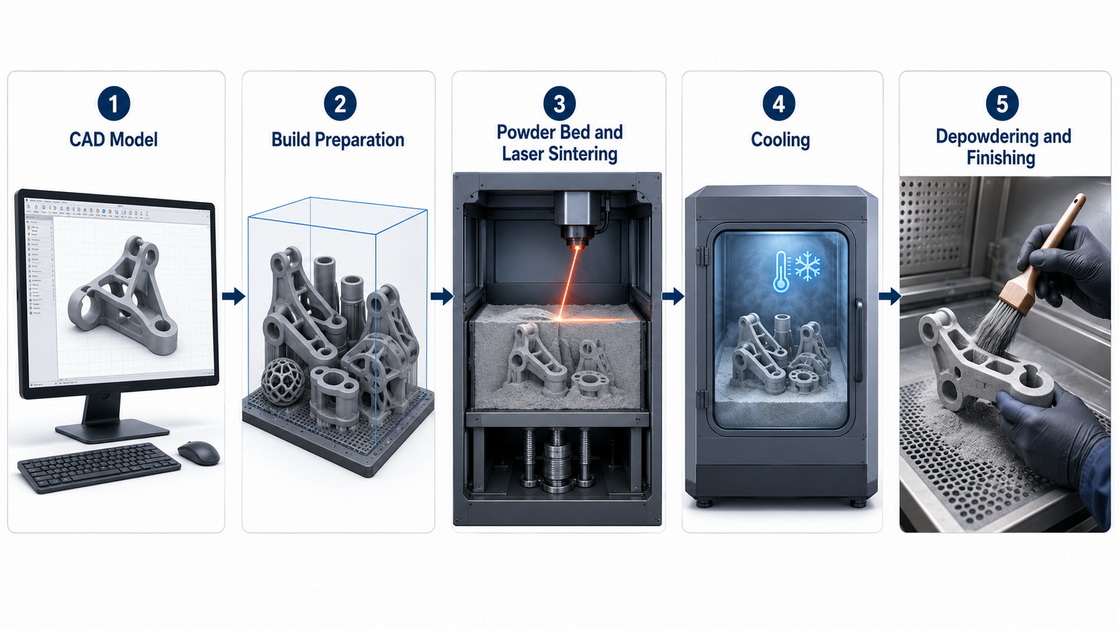
From the perspective of a manufacturing engineer, an SLS build follows a clear sequence: [gushwork]
1. 3D model preparation
The CAD file is checked, oriented, and nested with other parts to maximize the build volume.
2. Powder bed heating
The machine heats the nylon‑based powder to just below its melting point to minimize thermal gradients.
3. Laser sintering
A laser scans the cross‑section of the part, fusing particles into a solid layer.
4. Layer recoating
A recoater spreads a new layer of powder across the bed, typically 0.08–0.15 mm thick.
5. Build completion and cool‑down
When the final layer is sintered, the entire powder cake must cool down slowly to reduce warping and internal stresses.
6. Depowdering and post‑processing
Parts are extracted from the powder bed, cleaned, and optionally dyed, bead‑blasted, or vapor smoothed to improve surface quality and mechanical performance. [gushwork]
As a manufacturer, the process feels closer to batch production than to one‑off printing: build density, nesting strategy, and cooling management heavily influence cost and lead time. [plantautomation-technology]
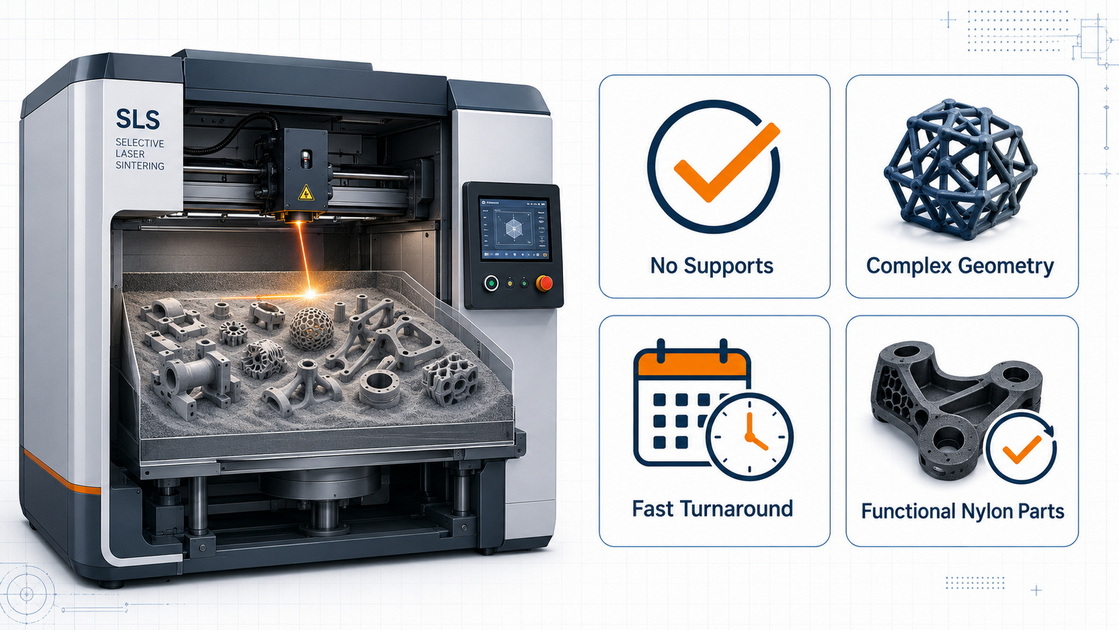
One of the biggest engineering advantages of SLS is that it does not require support structures. The unsintered powder naturally supports overhangs, thin walls, and internal cavities. [gushwork]
This brings several practical benefits:
- Design of complex internal channels for cooling, pneumatics, or lightweight lattice structures
- Consolidation of multi‑part assemblies into a single printed component
- Reduced post‑processing because no support removal is needed
From a CNC manufacturer's perspective, we often receive designs that are impossible to mill or turn economically, but can be produced in SLS in a single build.
SLS is among the fastest additive technologies for low‑volume batches because parts can be tightly nested in 3D throughout the build chamber. Multiple parts are produced simultaneously with minimal spacing, which: [gushwork]
- Increases parts per build, reducing cost per unit
- Shortens time‑to‑market compared with tooling‑dependent processes
- Supports iterative design cycles with multiple design variants in a single build
For OEM and ODM projects, we regularly use SLS at the early validation stage to test multiple design options, then transition the final geometry to CNC machining or injection molding for mass production.
Unlike some other 3D printing processes, SLS parts show strong interlayer bonding and near‑isotropic mechanical properties in the x, y, and z directions. [sciencedirect]
Typical nylon SLS parts offer:
- Good tensile strength and stiffness for functional components
- Reliable dimensional stability under normal operating temperatures
- Chemical resistance against many oils, greases, and industrial fluids
For many of our customers, these properties make SLS a viable alternative to injection‑molded samples during pilot runs, especially for housings, brackets, and snap‑fit features.
SLS parts have a naturally porous surface, which is a challenge for sealing but a benefit for coloring. Dyes penetrate the material and create robust coloration that is more durable than surface paint in many use cases. [gushwork]
This is particularly useful for:
- Brand‑specific color coding of enclosures or consumer‑facing components
- Internal visual management (e.g., safety colors, assembly markers)
- Differentiating versions of the same part in testing or logistics
Industrial buyers should note that SLS dyeing can be integrated as a standard post‑processing step, not a separate painting process.
Like other 3D printing technologies, SLS eliminates hard tooling such as injection molds, significantly shortening the development cycle. [plantautomation-technology]
In our experience with overseas customers, SLS is most valuable when:
- You need functional prototypes in days, not weeks
- You want to validate ergonomics and assembly with near‑final materials
- You need bridge production before molds or CNC fixtures are ready
Because the same machine can deliver both prototypes and end‑use parts, engineers can quickly iterate designs and move towards production with minimal disruption.
While material options have grown over the past years, SLS still offers a more limited material selection than CNC machining or injection molding. Most service providers focus on: [sciencedirect]
- PA 12 (nylon) – general‑purpose engineering plastic
- PA 12 with glass or carbon fiber – higher stiffness and heat resistance
- TPU – flexible, rubber‑like applications
From an engineering standpoint, this is enough for many applications, but if you require specialized polymers (e.g., PEEK, high‑temperature fluoropolymers), CNC machining or other processes may still be necessary.
As‑printed SLS parts typically have a matte, slightly grainy surface and are not naturally watertight. Porosity also leads to lower impact strength compared to fully dense molded parts. [gushwork]
However, as manufacturers we can mitigate this with post‑processing such as:
- Bead blasting for a uniform matte finish
- Vapor smoothing to seal the surface, reduce roughness, and improve impact strength and elongation at break
- Coating or sealing for applications requiring pressure or fluid tightness
When our customers specify SLS, we always clarify surface roughness and sealing requirements early, especially for fluid‑handling parts or visible external components.
Because SLS heats the powder close to its melting point, parts undergo thermal contraction as they cool, leading to shrinkage on the order of 3–4% depending on geometry and material. [gushwork]
Key implications for design and sourcing:
- CAD models must be scaled or compensated to achieve the desired final dimension
- Thick sections and sharp corners are more prone to warping and distortion
- Tight tolerances are harder to guarantee than with CNC machining
For critical interfaces—such as bearing housings or precision mounting surfaces—we often recommend a hybrid approach: print the basic geometry with SLS and finish‑machine key surfaces using CNC to meet tight tolerances.
One of the promises of additive manufacturing is low material waste, but in practice SLS generates more powder waste than some other technologies. Because the powder bed is pre‑heated, some unsintered powder partially fuses and loses its full reuse quality. [sciencedirect]
Most service providers will:
- Recycle a portion of the unused powder by mixing with fresh powder
- Discard a fraction as unusable material, which affects environmental footprint and cost
When comparing quotes between SLS suppliers, you may see price differences based on powder refresh ratios and internal recycling policies.
From the perspective of a CNC precision parts factory that also supports OEM/ODM development, SLS is not a competitor to CNC or molding—it is a complementary tool.
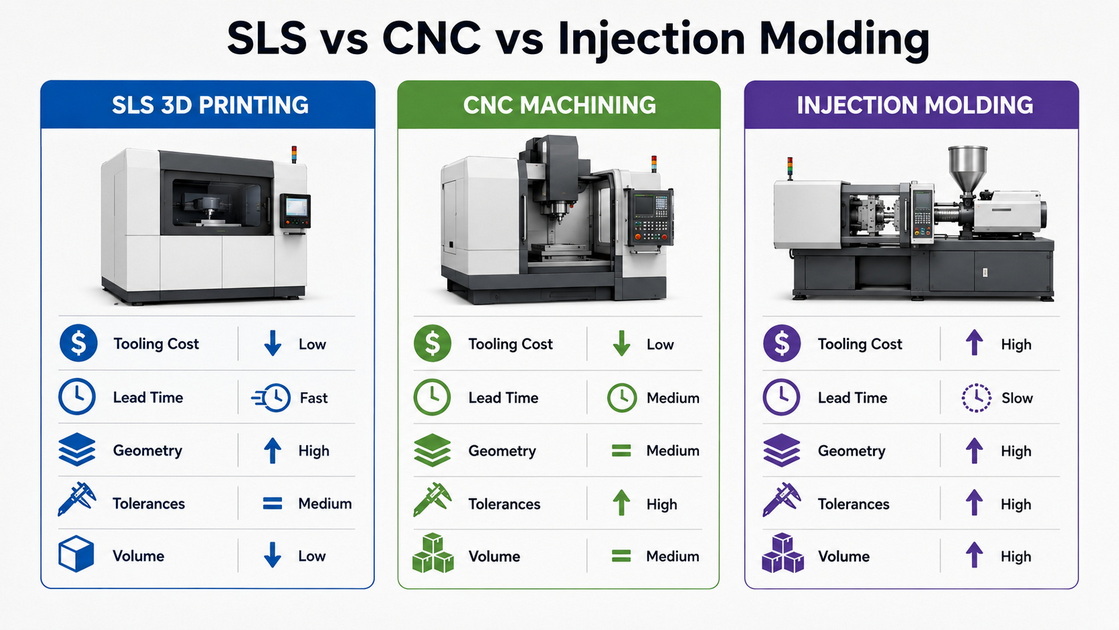
Below is a practical comparison based on what we see in daily projects for global customers. [plantautomation-technology]
| Use case / Factor | SLS 3D printing | CNC machining | Injection molding |
|---|---|---|---|
| Typical volumes | Low to medium batches, prototypes | Prototypes to medium volumes | Medium to very high volumes |
| Upfront tooling cost | None | Very low (fixtures only) | High (mold tooling) |
| Lead time | Fast (days) | Fast–medium | Medium–long |
| Geometry complexity | Excellent for complex internal features | Limited by tool access | Excellent once tooling exists |
| Tolerances | Moderate | Excellent | Very good |
| Surface finish | Rough–medium (improvable via post‑processing) | Smooth to very fine | Very fine (mold‑dependent) |
| Material range | Limited polymers | Very wide (metals & plastics) | Wide range of plastics |
| Design iteration speed | Very high | Medium | Low once mold is cut |
For many overseas OEMs and wholesalers we support, the optimal workflow is:
1. Use SLS for rapid functional prototypes and small pilot batches.
2. Move to CNC machining for higher‑precision validation and small‑to‑medium production.
3. Transition mature, stable parts to injection molding when annual volumes justify tooling cost.
Common industrial uses where SLS typically delivers strong value include: [sciencedirect]
- Jigs and fixtures for assembly lines and quality inspection
- Housings and enclosures for electronics and IoT devices
- Snap fits and living hinges where nylon flexibility is required
- Custom ducts and manifolds with complex internal flow paths
- Low‑volume spare parts for legacy equipment
In these scenarios, SLS often cuts lead time from weeks to days, enabling faster testing and deployment.
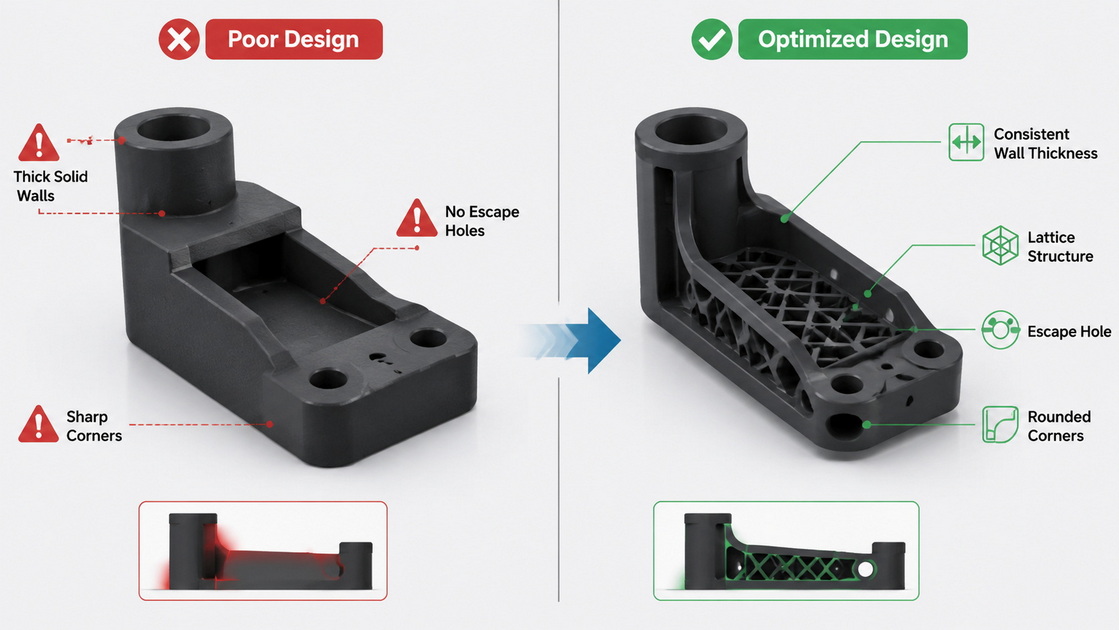
Based on our work with international customers, here are practical rules that significantly improve SLS outcomes: [sciencedirect]
- Maintain consistent wall thickness to reduce warping and uneven cooling.
- Avoid massive solid blocks; use internal lattices or light‑weighting where possible.
- Respect minimum feature sizes recommended by the manufacturer (holes, ribs, text).
- Design for powder removal by adding drain/clean‑out holes for internal cavities.
- If critical tolerances are required, plan for secondary machining or inserts.
These practices not only improve part quality but also reduce cost by minimizing failed builds and post‑processing effort.
As a Chinese CNC precision parts supplier working with global brand owners, wholesalers and manufacturers, we see SLS used strategically alongside traditional machining.
A typical collaboration looks like this:
- The customer sends a 3D model and functional requirements.
- We recommend SLS for early prototypes or complex plastic parts, and CNC for metal or high‑precision surfaces.
- After SLS trials, we refine the design and transition to CNC machining or molding for scalable production.
This integrated approach allows you to de‑risk design, validate performance early, and then scale with the most cost‑effective process for your target volume.
Use the checklist below during your next design review:
- Do you need functional prototypes or low‑volume parts in less than two weeks?
- Is your geometry complex or internally channeled, making CNC costly or impossible?
- Are your tolerances moderate rather than ultra‑tight?
- Is nylon‑based material acceptable for your application?
- Can you accept matte, slightly rough surfaces, or are you open to post‑processing?
If you answered "yes" to most of these questions, SLS is likely a cost‑effective, low‑risk option—especially when combined with a supplier who can also support CNC and molding when you are ready to scale.
If you are evaluating selective laser sintering for your next project and want an experienced manufacturing partner to help balance speed, cost, and precision, consider sending us your 3D files and basic requirements.
As a Shenzhen‑based CNC precision parts manufacturer (Shenzhen Feifan Hardware & Electronics Co., Ltd.), we provide OEM/ODM services for global brands, wholesalers and manufacturers, and can recommend the best mix of SLS, CNC machining, and injection molding for your specific application.
Q1. Is SLS strong enough for end‑use production parts?
In many applications, yes. Nylon SLS parts offer good tensile strength, stiffness and chemical resistance, and are widely used for housings, fixtures and mechanical components, especially at low to medium volumes. [sciencedirect]
Q2. How accurate is SLS compared with CNC machining?
SLS typically delivers moderate dimensional accuracy with some shrinkage and warping risk, while CNC machining consistently achieves tighter tolerances and better repeatability for critical dimensions. [plantautomation-technology]
Q3. Can SLS produce metal parts?
Industrial metal 3D printing exists but uses different processes, such as selective laser melting (SLM) or direct metal laser sintering (DMLS); standard SLS machines focus on polymer powders like nylon and TPU. [sciencedirect]
Q4. What is the typical lead time for SLS parts?
Lead time depends on part size and quantity, but many projects can move from CAD to physical parts within a few days when the supplier has available machine capacity and standard materials in stock. [plantautomation-technology]
Q5. When should I switch from SLS to injection molding?
Once your design is stable and annual volumes are high enough to justify mold tooling, injection molding usually offers lower per‑part cost and finer surface finish, while SLS remains ideal for development and bridge production. [plantautomation-technology]
1. Protolabs. "Selective Laser Sintering – Its Advantages and Disadvantages." 3D Printing Blog, 2025. Available at: [https://www.protolabs.com/en-gb/resources/blog/selective-laser-sintering-its-advantages-and-disadvantages/] [gushwork]
2. An overview of selective laser sintering technology: principles, formulations, applications and promising potentials in pharmaceutics. ScienceDirect, 2025. [sciencedirect]
3. Plant Automation Technology. "How SEO Can Drive Business Growth for CNC Manufacturers?" [plantautomation-technology]
4. Ranktracker. "CNC Router & Laser Cutting SEO: Build Visibility and Convert High‑Value Leads." [ranktracker]
5. QuickCreator. "E‑E‑A‑T for Technical Content: 2025 Best Practice Guide." [quickcreator]


