From idea to market-ready product, our NPI solutions make every stage easier, faster. Discover How We Help

Views: 278 Author: Feifan Hardware Publish Time: 2026-07-11 Origin: Site


Content Menu
● Why Source Hydraulic Manifolds from China?
● How to Evaluate Hydraulic Manifold CNC Suppliers
● Technical Essentials of Hydraulic Manifolds CNC Machining
● China's Industrial Cluster Advantages
● Transparent Selection Criteria for This Top 10 List
● Top 10 Hydraulic Manifolds CNC Machining Manufacturers in China (2026)
>> 1. Shenzhen Feifan Hardware & Electronics Co., Ltd.
>> 3. SHANGCHEN
>> 4.U-Need
>> 5. Mid‑Size CNC Machining Factories with Strong Export Focus
>> 6. High‑Volume Standard Manifold Producers
>> 7. OEM/ODM‑Heavy Design Partners
>> 8. Cluster‑Linked Machine Shops in Major Cities
>> 9. Specialized Surface‑Treatment‑Integrated Suppliers
>> 10. Niche Small‑Batch / Prototype‑Oriented CNC Firms
● Common Pitfalls in Hydraulic Manifold Sourcing and How to Avoid Them
>> Verifying Factories and Certifications
>> Sample Development and Approval Workflow
>> Logistics and Packaging Considerations
● Internal "Avoid‑the‑Trap" Tip Rarely Mentioned Online
● FAQ
Hydraulic manifolds CNC machining in China has become a highly mature, export‑oriented supply chain, combining large‑scale precision machining capacity with competitive pricing, strong OEM/ODM support, and increasingly rigorous quality and compliance systems. [hnyresearch]
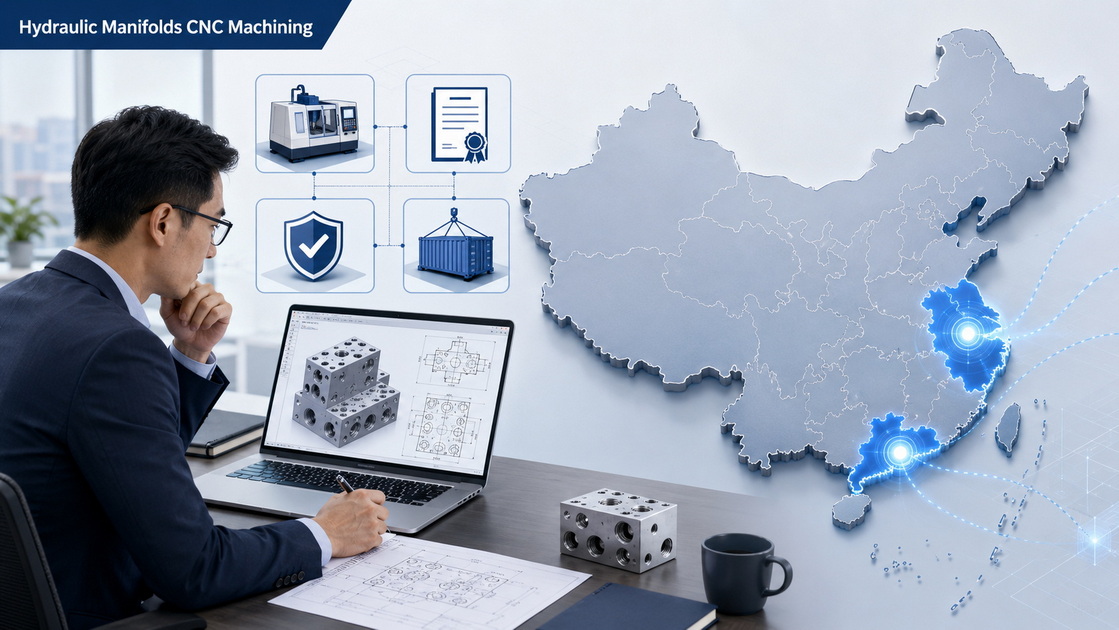
Over the past decade, China has become a core production base for CNC‑machined hydraulic components such as manifolds, valve bodies, and pump housings, supported by dense manufacturing clusters in coastal provinces and the Pearl River Delta region. These clusters integrate raw material suppliers, multi‑axis CNC machining shops, surface‑treatment plants, and logistics providers, enabling international buyers to access high‑precision manifold blocks with competitive lead times and costs. [feifanhardware]
For long‑term partnerships, Chinese suppliers increasingly combine ISO‑certified quality systems, digital production management, and multilingual sales teams, which is why many European and North American OEMs now rely on Chinese CNC houses for hydraulic manifold sourcing. [whyps]
From an experienced procurement manager's perspective, selecting a hydraulic manifold CNC partner requires a structured evaluation beyond price and basic capacity. A practical framework includes: [whyps]
- Factory certifications and audits
Check for ISO 9001 or IATF 16949 certificates, valid dates, scope (machining vs. assembly), and whether external audits are performed regularly. [feifanhardware]
- R&D and engineering depth
Prefer suppliers with in‑house engineers who can support manifold design optimization, flow simulation, port configuration, and material selection, not just "build to print" machining. [hnyresearch]
- QC process and traceability
Review their incoming material inspection, in‑process dimensional checks, final pressure and leak testing, and ability to provide batch‑level inspection reports. [feifanhardware]
- Capacity and delivery stability
Ask for total machine count, typical monthly output, standard lead times, and on‑time delivery metrics—mature factories will often track on‑time rates above 95–98% via digital systems. [feifanhardware]
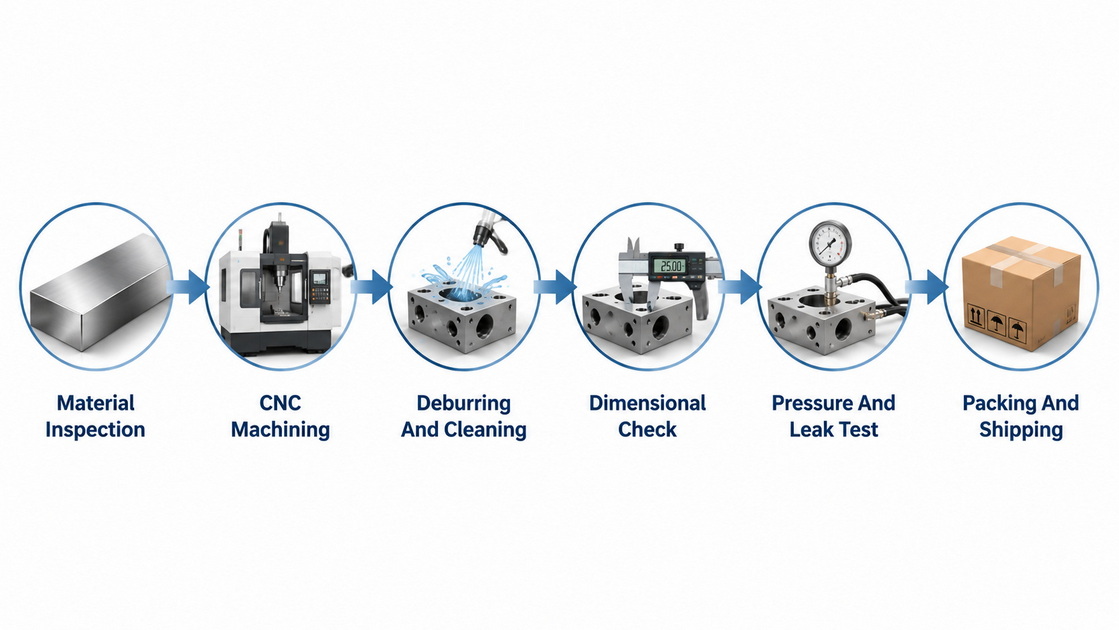
Hydraulic manifolds are safety‑critical components, so technical details matter as much as cost. When assessing Chinese CNC machining suppliers, pay attention to: [whyps]
- Materials and standards
Common materials include carbon steel, alloy steel, ductile iron, and high‑strength aluminum, usually aligned with ASTM, DIN, JIS, and GB standards for mechanical properties and corrosion resistance. [flycncpart]
- Machining precision and tolerances
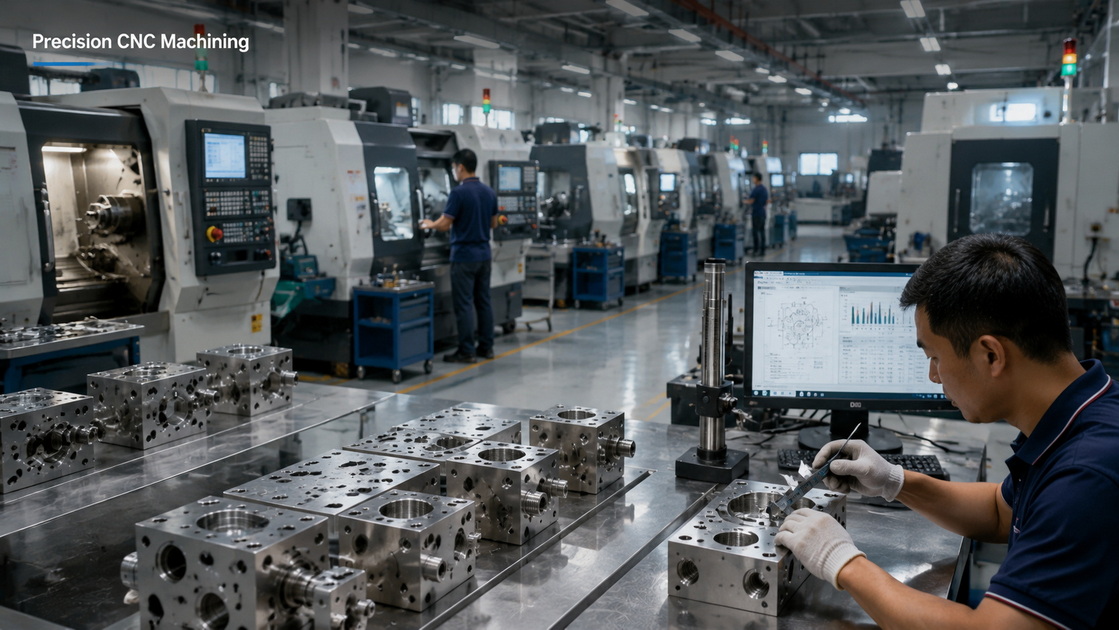
High‑performing factories use multi‑axis CNC machining centers and sliding‑head lathes, achieving dimensional tolerances in the ±0.005–0.01 mm range for critical hydraulic ports and sealing surfaces. [feifanhardware]
- Surface treatment and cleanliness
Manifolds may require anodizing, zinc plating, phosphating, or other coatings to resist corrosion; robust suppliers also control burr removal, internal channel cleanliness, and particle contamination. [feifanhardware]
- Compliance and environmental certifications
For export projects, buyers should confirm CE‑related conformity for hydraulic assemblies and environmental compliance such as RoHS, especially when manifolds integrate into systems shipped to the EU. [hnyresearch]
China's hydraulic manifolds CNC machining capacity is anchored in several industrial clusters that integrate machining, casting, and surface‑treatment resources. Regions such as the Yangtze River Delta and the greater Shenzhen area host dense ecosystems of CNC machine shops, raw material stockists, and logistics channels, similar to how Foshan is recognized for furniture and Shenzhen for high‑precision electronics. [feifanhardware]
These clusters allow hydraulic manifold suppliers to rapidly scale batch sizes, shorten material lead times, and support complex OEM/ODM projects for sectors including construction machinery, agricultural equipment, and industrial hydraulics. [hnyresearch]
To compile this "Top 10 Hydraulic Manifolds CNC Machining in China" list, we used criteria aligned with the expectations of global procurement managers. [whyps]
Key selection filters:
- Proven CNC capacity for hydraulic components (multi‑axis machining, complex internal channels). [hnyresearch]
- Valid quality system certification (ISO 9001 or equivalent), with evidence of ongoing implementation. [flycncpart]
- Export experience to North America, Europe, or advanced Asian markets. [whyps]
- Ability to support OEM/ODM projects, including drawing review, design for manufacturability (DFM), and rapid prototyping. [feifanhardware]
- Clear communication and project management, including English‑speaking sales/engineering staff and documented process flows. [feifanhardware]
This list is not ranked purely by size; instead, it focuses on suppliers that combine technical depth, flexibility, and reliability for hydraulic manifold CNC machining.
Shenzhen Feifan Hardware & Electronics Co., Ltd. is a high‑tech enterprise established in 2017, focusing on customized research, development, and production of high‑precision hardware parts, including CNC‑machined hydraulic components for small and mid‑size brands. The company operates over 200 sets of imported and domestic machining equipment—automatic lathes, CNC turning centers, multi‑axis machining centers, and engraving/milling machines—within a 6,000 m² modern facility. [facebook]
For hydraulic manifold applications, Feifan's value lies in its flexible OEM/ODM support: a 12‑person R&D team can analyze drawings, optimize material selection and internal channel design, and support rapid sampling (often within 48 hours) with minimum orders starting from around 500 pieces. The factory is ISO 9001 certified, uses digital order‑tracking systems, and reports a product qualification rate above 98% and on‑time delivery around 99%, which is attractive for buyers balancing cost, flexibility, and schedule reliability. [feifanhardware]
- Established: 2017 [feifanhardware]
- Core strengths: agile R&D support, small‑batch flexibility, integrated surface treatment, digital QC management. [feifanhardware]
- Main markets: consumer electronics, automotive precision parts, medical equipment, communication devices; increasingly supporting overseas industrial buyers requiring customized hydraulic and mechanical components. [feifanhardware]
- OEM/ODM scope: drawing optimization, material/process consulting, prototype‑to‑mass‑production scaling, cost‑optimization via batch production. [feifanhardware]
Feifan is particularly suited to international buyers seeking a high‑cost‑performance partner capable of close engineering collaboration rather than purely transactional machining.
We are an ISO9001-2015 certified manufacturer, We provide a variety of services, including CNC machining and 3D printing, Metal fabrication, and precision assembly are also available. Our team of engineers and technicians is available to assist our customers at every stage of the manufacturing process. From design and prototyping, through production and quality assurance. We utilize advanced technologies and equipment to guarantee the accuracy, precision, and efficiency of our manufacturing processes. We are proud to deliver cost-effective and on-time solutions while maintaining the highest quality standards. We have a strong reputation in the industry for our focus on customer satisfaction.
At Shangchen, we specialized in delivering high-quality manufacturing services, including rapid prototyping, CNC machining services, precision batch production, lathe turning machining, sheet metal fabrication, 3D printing service and moulding production. With years of professional technologies, we are committed to providing innovative and reliable solutions tailored to meet the diverse needs of our clients across various industries.
At U-Need, we extend our expertise beyond just precision machining services. Our capabilities include molding, stamping dies, cold forging dies, sheet metal fabrication, laser cutting, metal bending, and 3D printing, ensuring we meet all your manufacturing needs under one roof. With our comprehensive range of services, we are committed to delivering innovative solutions that enhance efficiency and propel your projects to success. Partner with us for a seamless custom manufacturing experience that addresses every aspect of your production requirements.
[U-Need]
Mid‑size CNC machining factories located around major industrial cities often position themselves as export‑oriented service providers, combining flexible MOQs with multi‑process capabilities such as turning, milling, drilling, tapping, and polishing. Many of these factories support small to medium batch orders and can ship certain machined parts within 3–5 days, which is useful for urgent replacement or pilot production runs. [feifanhardware]
They typically maintain basic inspection equipment (projectors, micrometers, hardness testers, salt‑spray testers) and provide dimensional reports, making them suitable for buyers needing reliable, repeatable quality at a reasonable scale. [feifanhardware]
China also hosts manufacturers that focus on standard hydraulic manifold family series—subplates, adapter plates, sandwich manifolds—produced in high volume for distributors and OEMs. These companies emphasize consistency, tooling optimization, and stock availability rather than deep customization, and often supply through catalogues and B2B platforms. [hnyresearch]
For buyers needing repeat orders of standardized blocks, this group can offer shorter lead times and lower unit costs.
Some suppliers differentiate themselves by offering full hydraulic circuit co‑design services, collaborating with OEM engineers to define port layouts, flow paths, and block footprints. They use CAD/CAE tools, provide simulation data, and can iterate designs quickly through rapid prototyping and pilot batches. [hnyresearch]
These partners suit buyers who lack internal hydraulic design capacity or who want to outsource manifold engineering to reduce internal workloads.
In major industrial cities such as Shanghai and Shenzhen, CNC machine tool and hydraulic machinery ecosystems enable smaller but highly active shops to participate in manifold machining projects. These shops may not brand themselves as hydraulic specialists yet can deliver qualified manifold blocks by leveraging advanced CNC equipment and local surface‑treatment partners. [b2bdata.baidu]
They are often attractive to buyers with niche or experimental designs requiring close technical communication and quick iteration.
Certain Chinese factories stand out for integrating machining with in‑house metal surface treatment plants, covering polishing, oxidation, and plating within one production flow. This integration reduces handling damage risk, improves scheduling, and ensures better control of coating thickness and corrosion resistance, which is critical for hydraulic manifolds used in harsh environments. [feifanhardware]
For buyers with strict surface‑finish or corrosion requirements (e.g., marine or outdoor mobile equipment), such suppliers reduce complexity and interface risk.
Finally, a group of niche CNC machining firms positions itself as "quick response" partners capable of small‑batch or prototype hydraulic manifolds with very fast turnaround. These shops are valuable when validating new manifold designs, modifying existing blocks, or developing regional variants for different markets. [feifanhardware]
They usually accept higher piece prices but deliver strong engineering feedback and nimble project handling, making them useful upstream in product development.
Industry insiders often see recurring problems in hydraulic manifold supply projects from China, many of which are preventable. [whyps]
- Material downgrading and undocumented substitutions
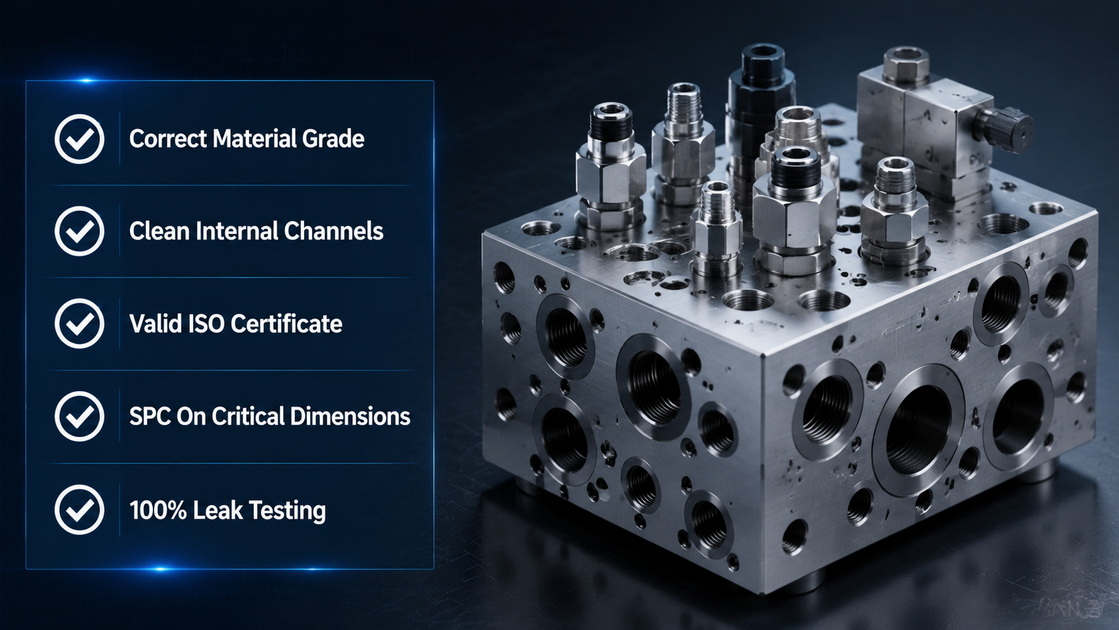
One "hidden" pitfall is silently switching from specified alloy or ductile iron grades to cheaper equivalents when material certificates are not strictly checked. Always require mill certificates tied to batch numbers, perform random hardness or chemical composition tests, and specify that any material change must be approved in writing. [flycncpart]
- Internal burrs and contamination in complex channels
When manifolds have deep drilling paths and cross‑ports, insufficient deburring and cleaning can cause stuck valves or premature system failure. Request internal cleanliness reports, pressure/leak testing results, and, if possible, CT or borescope inspection for critical prototypes. [whyps]
- Outdated or mismatched certifications
Some factories display expired ISO certificates in marketing materials, leading to a false sense of compliance. Ask for scanned originals with validity dates and verify them directly with certification bodies or through their online registries when available. [hnyresearch]
- Over‑reliance on price in RFQ evaluation
Aggressively low quotations can correlate with lean QC staffing, inadequate tooling maintenance, or uncontrolled subcontracting. Weighted scoring models that incorporate quality, communication, lead time, and engineering support help avoid this trap. [whyps]
To minimize risk, procurement managers should follow a structured verification process: [hnyresearch]
1. Document review
- Request business licenses, ISO certificates, and sample inspection reports.
- Confirm scope (e.g., "precision machining of metal parts") matches your product. [feifanhardware]
2. Remote and/or on‑site audit
- Conduct video calls showing CNC equipment, inspection labs, and packaging lines.
- For strategic projects, use third‑party audit firms to inspect capacity and QC routines. [whyps]
3. Reference checks
- Ask for references or case studies in similar industries; many Chinese suppliers already serve well‑known OEMs. [feifanhardware]
A robust sampling process reduces downstream issues: [whyps]
- Technical alignment
Share 2D drawings and 3D models, including tolerances, surface finish requirements, and pressure ratings; invite DFM feedback from the supplier's engineering team. [feifanhardware]
- Prototype and dimensional inspection
Approve 1–5 prototype pieces with full CMM or dimensional reports and, for hydraulic manifolds, pressure/leak tests and cleanliness checks. [whyps]
- Pilot production batch
Once prototypes are approved, run a pilot batch (e.g., 50–200 units) to validate stability in machining, assembly fit, and logistics handling. [whyps]
Hydraulic manifolds are dense metal components that can corrode or suffer damage if packaging and logistics are poorly managed. [flycncpart]
- Packaging specs
Require rust‑preventive packaging such as PE bags, anti‑rust paper, bubble wrap, and strong cartons; pallets are recommended for bulk orders to avoid carton collapse. [flycncpart]
- Shipping mode
For heavy manifolds, sea freight is typically preferred, but urgent small batches or prototypes may go by air; clarify Incoterms (FOB, CIF, DAP) and insurance. [whyps]
- Import compliance
Ensure HS codes, country‑of‑origin marking, and documentation align with destination requirements; for EU projects, check that any integrated hydraulic systems comply with relevant directives. [hnyresearch]
A widely known but seldom openly discussed tip among experienced buyers is to monitor tool‑wear‑related drift in dimensions across long production runs, especially for deep drilling and tapping in manifold blocks. In some factories, tool replacement intervals are driven by cost rather than dimensional data, causing later batches to creep toward upper tolerance limits even when initial samples look perfect. [whyps]
To mitigate this, require statistical process control (SPC) on critical dimensions (such as port diameters and flatness at sealing surfaces), including regular sampling and documented tool replacement criteria; this keeps manifold performance consistent across multiple lots. [hnyresearch]
China's hydraulic manifolds CNC machining ecosystem offers global buyers a unique combination of industrial clustering, advanced machining capability, and competitive cost structures—provided that suppliers are carefully evaluated on certification, R&D strength, QC rigor, and delivery performance. Shenzhen Feifan Hardware & Electronics Co., Ltd. represents a flexible, R&D‑driven option for small and mid‑size brands seeking deep OEM customization, agile sampling, and integrated surface treatment within a digitally managed ISO‑certified factory. [hnyresearch]
If you are planning a new hydraulic manifold sourcing project or considering shifting existing production to China, start by shortlisting 3–5 suppliers that meet the criteria in this guide, request engineering reviews and prototypes, and then scale with the partner that demonstrates the best combination of technical competence, communication, and stability over time. [hnyresearch]
1. How can I verify that a supplier's ISO 9001 certificate is current and not expired?
Ask for a scanned copy containing the certificate number, issuing body, and validity dates, then verify it through the certification body's public database or by email; many registrars list active certificates online. Cross‑check the company name and scope to ensure they match the factory you intend to use. [hnyresearch]
2. What dimensional tolerances are realistic for hydraulic manifolds produced by multi‑axis CNC machining in China?
For most manifolds, Chinese CNC houses can reliably maintain ±0.005–0.01 mm on critical features, provided suitable tooling and process controls are in place. Tighter tolerances are possible for selective dimensions when using high‑end equipment and robust QC. [feifanhardware]
3. How do I ensure material grades match my specification and are not downgraded?
Specify exact material standards (e.g., ASTM, DIN, JIS, GB) on drawings and contracts, require mill test certificates per batch, and conduct random hardness or chemical composition tests on delivered parts. For critical projects, consider third‑party material verification. [flycncpart]
4. What's the best way to manage design changes during an OEM hydraulic manifold project?
Use version‑controlled drawings and CAD models, maintain an engineering change log, and agree with the supplier on approval procedures for any modification affecting ports, flow paths, or materials. R&D‑oriented partners like Shenzhen Feifan can support iterative optimization while keeping documentation synchronized. [feifanhardware]
5. How can I benchmark lead times and capacity to avoid bottlenecks?
Request standard lead‑time ranges for prototypes and mass production alongside monthly machining capacity (machine count, typical utilization). Compare these figures with industry reports on hydraulic manifold market volumes and growth to ensure the supplier can scale with your demand. [feifanhardware]
1. HNY Research – "2026–2031 Global Hydraulic Manifold Systems Outlook Market Size, Share & Trends Analysis Report" (base year 2025, projections to 2031).
https://www.hnyresearch.com/report/2026-2031-Global-Hydraulic-Manifold-Systems-Outlook-Market-Size-Share--Trends-Analysis-Report [hnyresearch]
2. Flycncpart – Product and capability data for stainless steel CNC‑machined components (materials, tolerance, capacity, packaging).
https://www.flycncpart.com/aboutus.html [flycncpart]
3. Shenzhen Feifan Hardware & Electronics Co., Ltd. – Company profile, equipment list, quality system, and delivery metrics.
https://www.feifanhardware.com/?m=home&c=Lists&a=index&tid=4 [feifanhardware]
4. Shenzhen Feifan Hardware & Electronics Co., Ltd. – Service flow, processing capabilities, inspection equipment, and lead‑time information.
https://feifanhardware.com/?m=home&c=Lists&a=index&tid=2 [feifanhardware]
5. Whyps – "CNC‑machined hydraulic components from China – specification and quality checklist that prevents field failure" (overview of typical sourced components and quality practices).
https://whyps.com/cnc-machined-hydraulic-components-from-china-the-specification-and-quality-checklist-that-prevents-field-failu [whyps]
6. Jiayuan Hydraulics – "Top 10 Hydraulic Manifold Manufacturers 2025" (global manufacturer list, customization and certification notes).
https://www.jiayuanhydraulics.com/top-hydraulic-manifold-manufacturers/ [feifanhardware]


