From idea to market-ready product, our NPI solutions make every stage easier, faster. Discover How We Help

Views: 222 Author: Feifan Hardware Publish Time: 2026-07-01 Origin: Site


Content Menu
● What CNC Coolant Really Does in Precision Machining
● Primary Types of CNC Machine Coolant (With Real-World Use Cases)
>> CNC Coolant Types at a Glance
● How CNC Coolant Is Delivered: Flood, Mist, Through‑Spindle and MQL
● Selecting the Right Coolant for Precision Parts (Buyer and Engineer View)
>> 1. Match coolant type to material and operation
>> 2. Control concentration, not just "top up the tank"
● Coolant Management: Daily Habits That Protect Uptime
>> Early warning signs to watch
● Safety, Compliance and Environmental Considerations
● How Coolant Strategy Influences Tolerance, Tool Life and Cost
>> Impact on tolerances and stability
>> Impact on tool life and cycle time
● Practical Coolant Optimization Checklist for CNC Projects
● What Global Buyers Should Ask CNC Suppliers About Coolant
● Clear Call to Action for OEM/ODM Buyers
● FAQ: CNC Coolant for Precision Machining
CNC machining coolant is one of those topics you only truly respect after you've scrapped a batch of precision parts or burned through an expensive carbide tool in a single shift. Speaking as someone who has worked with global OEM/ODM buyers on tight-tolerance CNC programs, getting coolant right is often the difference between "good enough" and "world‑class" machining performance. [fictiv]
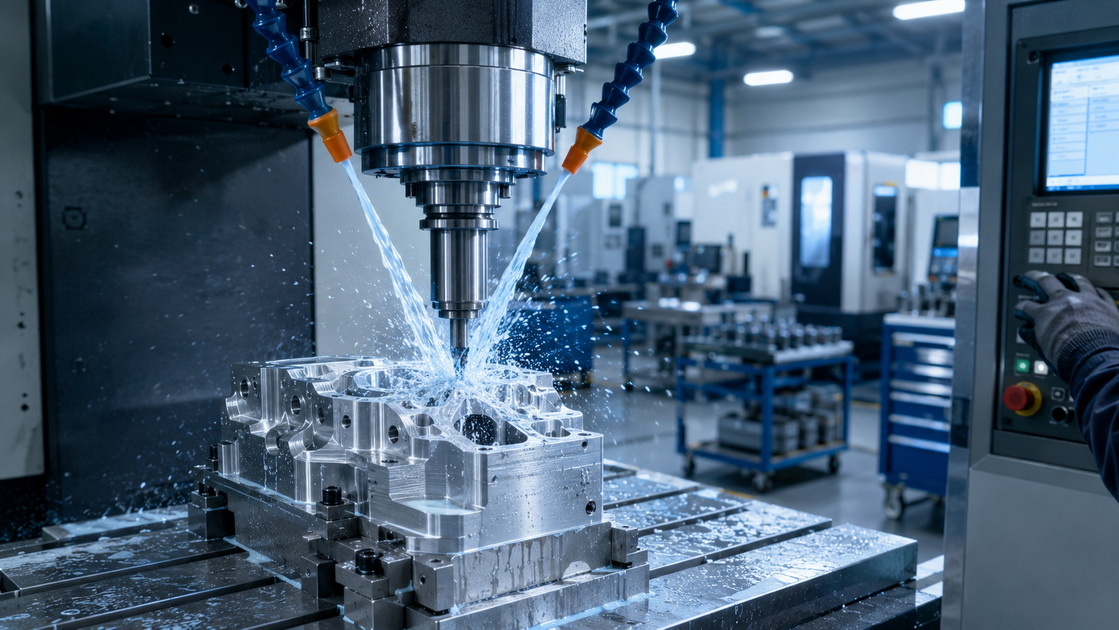
When a cutting tool meets metal at high speed, the contact zone can exceed 1,000°C, even if the rest of the machine feels cool to the touch. Without proper coolant, heat builds up in the tool and workpiece, causing thermal expansion, dimensional drift, work hardening, and premature tool failure. [fsfab]
In real production environments—especially for aerospace, medical, and tight‑tolerance industrial parts—coolant is not just about "keeping things wet." It must: [deli-cnc]
- Cool the cutting zone and stabilize dimensions
- Lubricate tool–chip and tool–work interfaces to reduce friction
- Flush chips and fines out of deep pockets and holes
- Protect machines, fixtures, and parts from corrosion
From a sourcing perspective, procurement teams increasingly evaluate coolant strategy as a proxy for process capability and risk control, not just as a consumable line item. [quickcreator]
Choosing coolant is always a trade‑off between cooling capacity, lubrication, cleanliness, safety, and cost. The table below summarizes the main types and where they excel. [jlccnc]
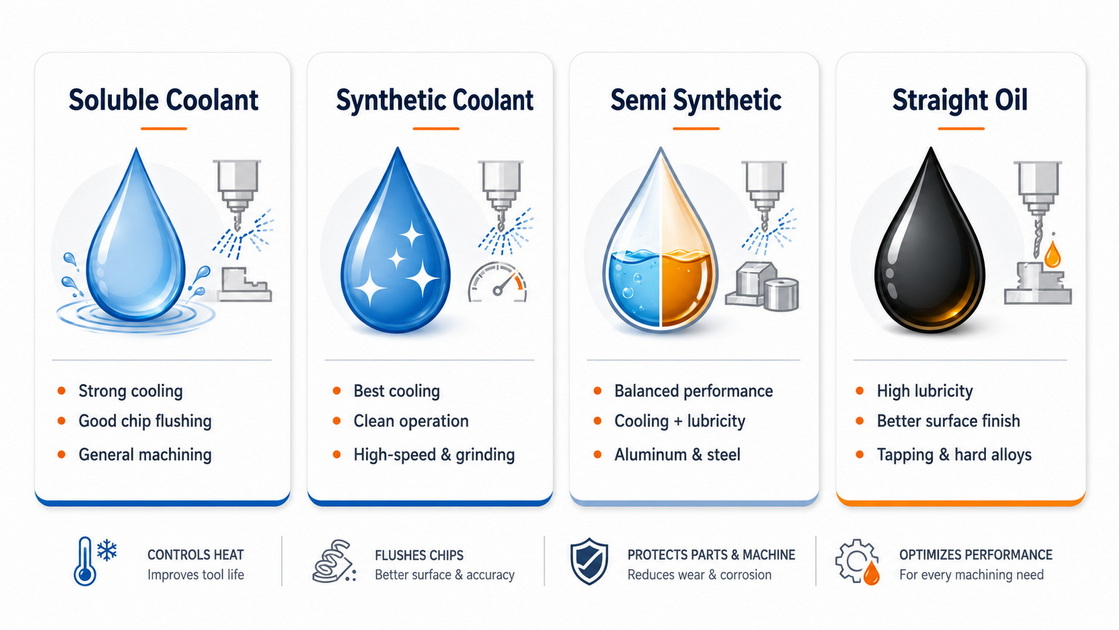
| Coolant type | Key strengths | Main weaknesses | Typical materials | Best use cases |
|---|---|---|---|---|
| Soluble / water‑miscible (emulsion) | Good cooling and lubrication, versatile, cost‑effective fictiv | Bacterial growth, residue and foam, rust risk if over‑diluted fsfab | Steel, aluminum, cast iron fsfab | General machining, mixed‑material job shops |
| Synthetic (water‑based, no oil) | Excellent cooling, clean machines, strong bacteria resistance fictiv | Lower lubricity, may stain sensitive metals, costlier rapiddirect | Aluminum, stainless, titanium, aerospace alloys fsfab | High‑speed machining, grinding, tight tolerances |
| Semi‑synthetic | Balanced cooling and lubrication, broad process window fictiv | Compromise on both extremes; still needs tight concentration control jlccnc | Steel, aluminum, medical and automotive parts fictiv | CNC milling, turning, drilling across mixed portfolios |
| Straight oils / neat oils | Maximum lubricity and tool life, excellent surface finish fictiv | Poor cooling, smoke at high speeds, messy and harder to manage jlccnc | Tough steels, nickel alloys, gears jlccnc | Heavy‑duty cutting, threading, gear cutting, low‑speed lathes |
From an engineering perspective, the wrong coolant type will show up quickly as tool chipping, blue chips, dimensional instability, or a sudden spike in scrap and rework. That's why experienced CNC suppliers document not only the coolant family but also typical concentration ranges by material. [jlccnc]
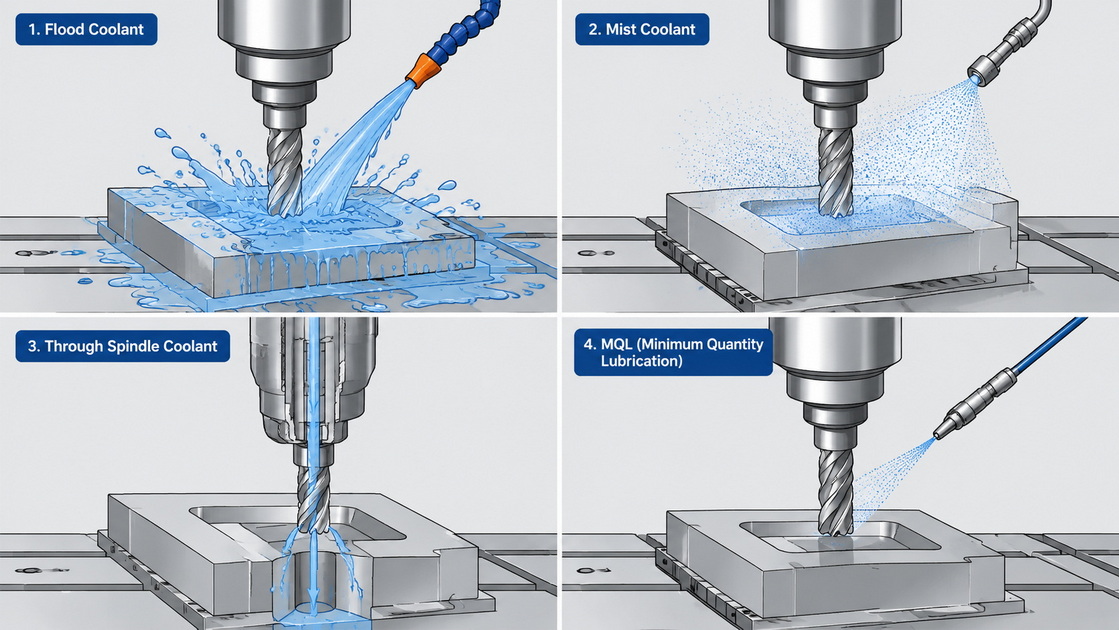
Coolant selection is only half the story; how you deliver it to the cutting zone is just as critical. Modern CNC shops typically use a mix of these systems: [customproc]
- Flood coolant – A steady stream that covers the entire cutting area; ideal for general milling and turning where chip evacuation is important. [moldiecasting]
- Mist coolant – Atomized droplets for light cuts, harder‑to‑reach setups, or when you need to minimize fluid volume. [customproc]
- Through‑spindle / through‑tool coolant – High‑pressure coolant delivered through the spindle or tool, essential for deep holes, complex pockets, and small‑diameter drills. [customproc]
- Minimum Quantity Lubrication (MQL) – Microdroplets of lubricant with almost no flooding; useful for specific high‑speed or environmentally focused applications. [moldiecasting]
As tolerances tighten and cycle times drop, many OEMs now treat through‑spindle coolant capability as a baseline requirement for critical parts. [fsfab]
When I review machining process plans for international buyers, I always ask three questions about coolant: what, how strong, and how controlled. [quickcreator]
- For aluminum housings and large volume general parts, water‑miscible soluble or synthetic coolants usually deliver the best mix of cooling and chip flushing. [fictiv]
- For stainless steel, tool steels, and nickel alloys, semi‑synthetics or straight oils often protect tool edges better, especially in threading or deep‑hole drilling. [jlccnc]
- For high‑speed finishing and grinding, synthetic coolants help achieve stable surface finish and keep the work area clean. [rapiddirect]
Most water‑soluble coolants run best around 5–12% concentration, adjusted by application: [fsfab]
- General machining: roughly 5–8% for a balance of cooling and lubrication. [fsfab]
- Medium to heavy‑duty machining: around 7–10% for harder materials and higher cutting loads. [fsfab]
- Corrosion‑sensitive materials and high‑precision surfaces: often 8–10% to strengthen rust prevention and surface quality. [fsfab]
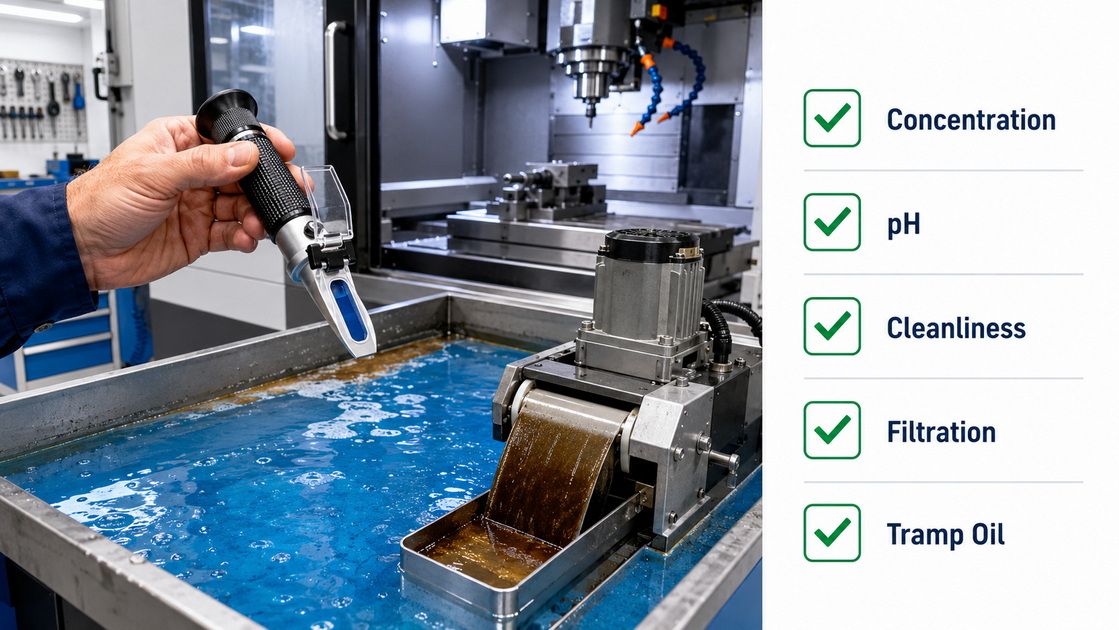
Seasoned process engineers use refractometers to monitor concentration and adjust based on tool life, chips, and surface finish feedback. [mscdirect]
Coolant performance depends heavily on water quality. Using deionized (DI) or reverse‑osmosis (RO) water helps avoid mineral scaling, bacterial growth, and premature coolant breakdown. In contrast, hard tap water can cause deposits, foam, and inconsistent performance over time. [jlccnc]
One of the most common gaps I see in supplier documentation is a lack of detail on how they manage coolant day‑to‑day. Yet this is where many hidden costs and risks live. [deli-cnc]
- Daily checks – Verify levels, concentration, and visible contamination; skim tramp oil when needed. [mscdirect]
- Regular filtration – Use filters or magnetic separators to remove fines and chips that accelerate wear and reduce coolant life. [jlccnc]
- Bacteria and pH control – Maintain pH around the manufacturer's spec (often above 8.6 for many fluids) to inhibit bacterial growth and corrosion. [mscdirect]
- Scheduled sump cleaning – Periodically drain, clean, and recharge tanks to prevent sludge and odor issues. [moldiecasting]
- Foaming and overflowing sumps
- Strong odors or skin irritation for operators
- Rust spots on machine ways or fixtures
- Sudden, unexplained drop in tool life or surface finish
Professional shops log these parameters and tie them to SPC and preventive maintenance programs, which is exactly the kind of operational detail engineering and procurement teams look for in long‑term suppliers. [quickcreator]
Modern CNC coolants are engineered not only for performance, but also for operator safety and regulatory compliance. For international customers, this is a critical part of supplier evaluation. [deli-cnc]
Key aspects include:
- Mist control and ventilation to reduce airborne exposure and maintain a clean work environment. [customproc]
- Skin protection and appropriate PPE, especially with straight oils or fluids containing specific additives. [jlccnc]
- Waste handling and disposal in line with local regulations, including proper treatment of spent coolant. [moldiecasting]
- Documentation such as SDS (Safety Data Sheets), REACH/RoHS declarations, and any industry‑specific certifications. [quickcreator]
Global OEMs increasingly include coolant handling and waste‑disposal practices in their on‑site audits, so demonstrating robust controls here has become a competitive advantage. [deli-cnc]
From a CNC supplier's perspective, coolant is a lever that directly affects dimensional capability, tool consumption, and total cost per part. When we optimize coolant, we are not just "changing a fluid," but recalibrating the economics of the machining cell. [deli-cnc]
- Better cooling and consistent concentration reduce thermal drift, making it easier to hold tight tolerances over long runs. [deli-cnc]
- Improved chip evacuation prevents re‑cutting and surface damage, which is critical for high‑precision bores and sealing surfaces. [fictiv]
- Adequate lubrication in difficult materials protects cutting edges and can extend tool life significantly. [customproc]
- Stable coolant conditions allow more aggressive feeds and speeds, reducing cycle time without sacrificing quality. [fsfab]
For overseas buyers, asking about coolant strategy—type, concentration control, and maintenance—often reveals whether a shop is truly ready for high‑mix, tight‑tolerance, export‑grade production. [quickcreator]
When you qualify or co‑develop a CNC machining process with an OEM/ODM partner, a clear checklist dramatically improves outcomes. [quickcreator]
Step‑by‑step coolant optimization checklist:
1. Define part requirements – Tolerance bands, surface roughness, material, expected annual volume. [quickcreator]
2. Select coolant type – Choose based on material and operation (roughing, finishing, deep drilling, grinding). [fictiv]
3. Set initial concentration – Use supplier recommendations as a baseline, then fine‑tune during trial runs. [fsfab]
4. Choose delivery method – Flood, mist, through‑spindle, or MQL depending on geometry and chip load. [customproc]
5. Define monitoring routine – Refractometer checks, pH tracking, visual inspection, and log frequency. [mscdirect]
6. Run controlled trials – Document tool life, chip shape, and dimensional stability across multiple batches. [deli-cnc]
7. Review with supplier – Align on adjustments and lock in a standard operating procedure (SOP). [quickcreator]
Embedding this checklist in your RFQ and process approval stages signals to suppliers that you value process discipline and expect data‑backed coolant management. [deli-cnc]
If you are sourcing CNC precision parts from overseas—especially from high‑volume Chinese manufacturers—it is worth going beyond a simple "yes, we use coolant" confirmation. Targeted questions reveal expertise. [quickcreator]
Consider asking:
- Which coolant types and brands do you use for my part's material and tolerance requirements? [fictiv]
- How do you monitor and record concentration and pH during production runs? [mscdirect]
- What coolant delivery systems (through‑spindle, high‑pressure, MQL) are available on the machines that will run my parts? [customproc]
- How often do you clean and recharge coolant sumps, and how is waste disposed of? [moldiecasting]
- Can you share examples where coolant optimization improved tool life or reduced scrap on similar parts? [deli-cnc]
Shops that answer these questions clearly—and support them with logs, photos, or case data—tend to be far more reliable long‑term partners for critical CNC programs. [fsfab]
If you are evaluating CNC suppliers or looking to optimize an existing precision machining program, coolant should be part of your technical discussion—not an afterthought. [fsfab]
At Shenzhen Feifan Hardware & Electronics Co., Ltd., a typical CNC quotation and DFM review includes:
- Recommended coolant type and concentration range by material and operation
- Available coolant delivery options for your parts (e.g., through‑spindle for deep holes)
- A brief outline of our coolant monitoring and maintenance procedures
Share your drawings, annual volume, and key tolerance requirements, and we can propose a coolant‑optimized machining solution that balances surface finish, tool life, and total cost per part for your application. [fsfab]
1. How often should CNC coolant be changed?
This depends on material mix, contamination, and maintenance habits, but well‑managed systems can run for months with partial top‑ups before a full change, provided concentration, pH, and cleanliness remain in spec. [moldiecasting]
2. What happens if coolant concentration is too low?
Under‑concentrated coolant loses lubricity and corrosion protection, causing tool wear, poor surface finish, and rust on machines and parts. In extreme cases, it can also encourage bacterial growth and odor issues. [mscdirect]
3. Is synthetic coolant always better than soluble oil?
Not always. Synthetic coolants offer excellent cooling and cleanliness, especially for high‑speed machining and grinding, but soluble oils can provide better lubrication and are often more forgiving in general machining. The "best" choice depends on your materials and operations. [rapiddirect]
4. Do I really need through‑spindle coolant for my parts?
If your parts involve deep holes, complex pockets, or small‑diameter drills, through‑spindle coolant significantly improves chip evacuation, tool life, and reliability. For simpler geometries, flood coolant may be sufficient. [fictiv]
5. How can I quickly assess whether a supplier manages coolant well?
Ask how they check concentration, what tools they use (e.g., refractometer), how often they clean sumps, and whether they track coolant data alongside tool life and quality metrics. Clear, specific answers backed by records are a strong positive sign. [deli-cnc]
1. Fictiv – "CNC Machine Coolant: Purpose, Types and Management" (2023). [fictiv]
https://www.fictiv.com/articles/cnc-machine-coolant-purpose-types-and-management
2. QuickCreator – "SEO for OEM/ODM Suppliers: 2025 Best Practices for B2B" (2025). [quickcreator]
https://quickcreator.io/blog/seo-best-practices-oem-odm-suppliers-2025/
3. JLCCNC – "CNC Coolant Explained: Types, Maintenance & Safety" (2025). [jlccnc]
https://jlccnc.com/blog/cnc-coolant-types-and-maintenance
4. RapidDirect – "CNC Machine Coolant Guide: Types, Delivery and Maintenance" (2026). [rapiddirect]
https://www.rapiddirect.com/blog/cnc-machine-coolant-guide/
5. CustomProc – "CNC Machine Coolant: Types, Benefits & Expert Selection Guide" (2025). [customproc]
https://www.customproc.com/cnc-machine-coolant-guide/
6. FS FAB – "Ultimate Guide To CNC Coolant: Types, Uses & Machining Tips" (2025). [fsfab]
https://www.fsfab.com/cnc-coolant/
7. Deli CNC – "CNC Machine Coolant: Guide to Maintenance & Savings" (2025). [deli-cnc]
https://www.deli-cnc.com/cnc-machine-coolant-guide-to-maintenance-savings/
8. Moldie Casting – "CNC Coolant: Types and Management" (2025). [moldiecasting]
https://moldiecasting.com/blog/cnc-coolant/
9. MSC Direct – "A Guide to Machine Lubrication: Find the Right Water-Coolant Type". [mscdirect]
https://www.mscdirect.com/knowledge-center/articles/guide-machine-lubrication-find-right-water-coolant-type


