From idea to market-ready product, our NPI solutions make every stage easier, faster. Discover How We Help

Views: 255 Author: Feifan Hardware Publish Time: 2026-07-07 Origin: Site


Content Menu
● Understanding Small Metal Brackets
● What Is CNC Milling for Brackets?
● What Is Stamping for Brackets?
● CNC Milling vs. Stamping: Core Differences
● When CNC Milling Is the Better Choice
● When Stamping Is the Better Choice
● Expert Decision Framework for OEM/ODM Bracket Projects
● Case Insight: Transitioning from CNC Prototypes to Stamped Brackets
● Practical Design Tips from a Manufacturing Partner
● CTA
● FAQs
Choosing between CNC milling and stamping for small metal brackets comes down to volume, geometry complexity, tolerance requirements, and total lifecycle cost; in practice, most OEMs combine both processes at different project stages to balance flexibility and unit cost. As a Shenzhen‑based precision parts manufacturer, Shenzhen Feifan Hardware & Electronics Co.,Ltd. is well‑positioned to help global brands make this decision with data‑driven engineering support and integrated CNC + forming capabilities. [shengching]
Small metal brackets are typically thin‑wall, load‑bearing connectors used to fix, support, or align assemblies in consumer electronics, automotive systems, industrial equipment, and medical devices. They often require consistent dimensions, controlled flatness, and reliable surface finishes to ensure proper fit with mating parts and long‑term structural stability. [lsrpf]
From a manufacturing perspective, brackets sit exactly at the intersection where both sheet‑metal forming (stamping) and subtractive machining (CNC milling) can be viable, which is why the process choice is strategically important for cost and performance. [sunon-mould]
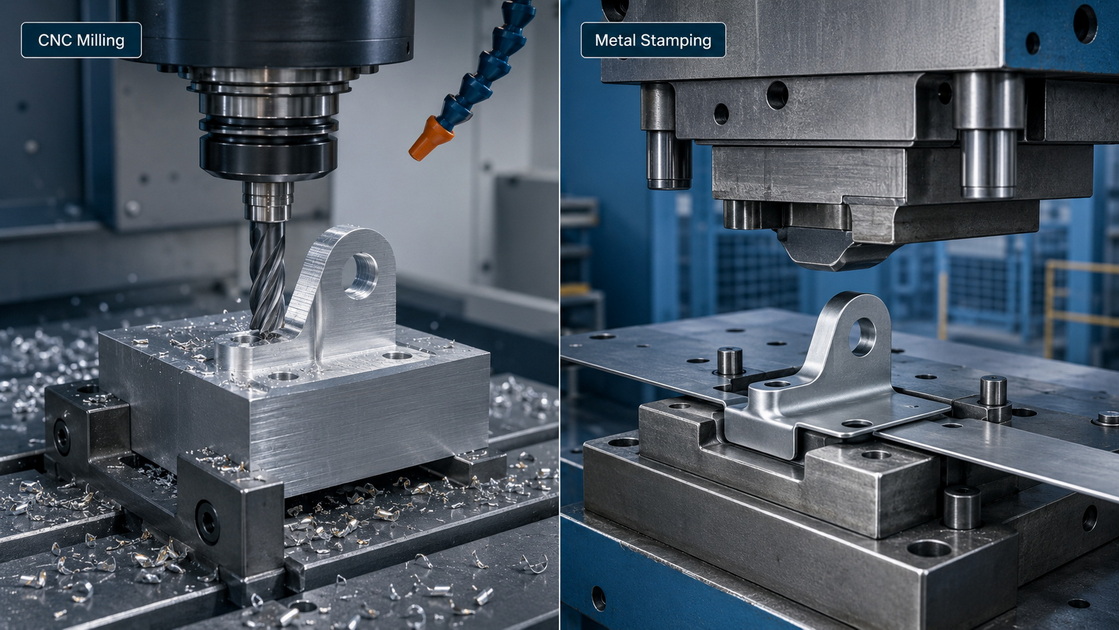
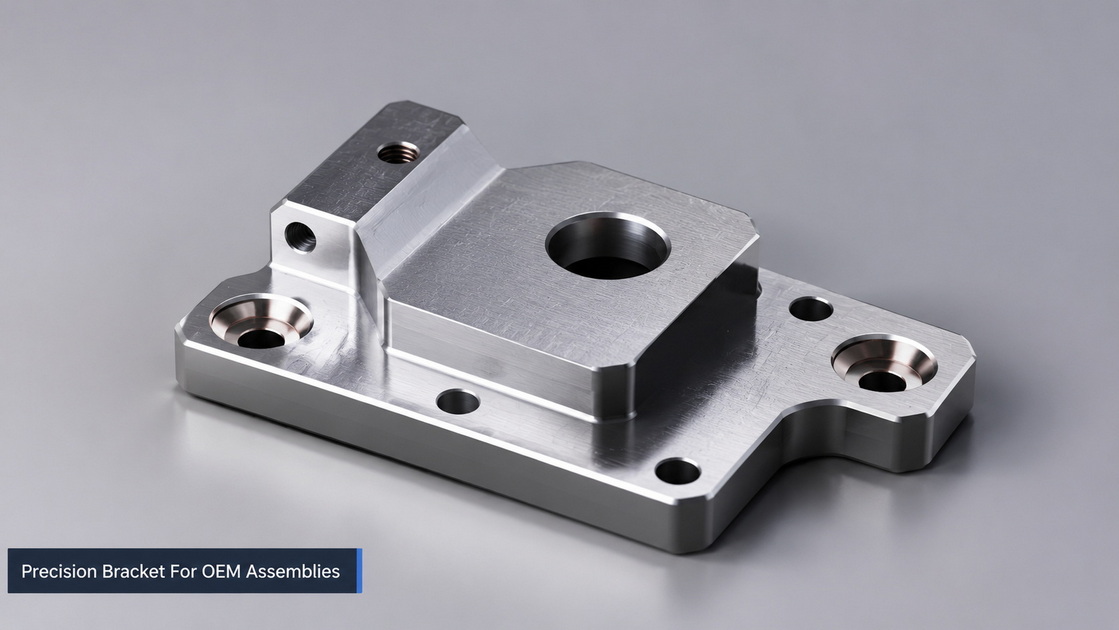
CNC milling is a subtractive process that uses computer‑controlled cutting tools to remove material from a solid block, bar, or thick plate, creating precise 3D geometries. It excels at producing complex shapes, variable thickness sections, deep pockets, and tight tolerances, which are common in high‑end brackets for robotics, medical devices, and 5G equipment. [feifanhardware]
At Shenzhen Feifan, CNC milling is integrated with turning, drilling, tapping, and polishing, achieving processing accuracy controlled within ±0.005 mm using multi‑axis machining centers and imported equipment. This level of precision allows global OEMs to design brackets with critical alignment features, countersunk holes, and functional surfaces that must meet strict tolerances. [feifanhardware]
Metal stamping uses a die and press to form sheet metal into the desired shape through cutting, bending, and drawing operations. For thin‑sheet brackets, stamping offers high output and excellent repeatability, especially once the tool set is designed and validated. [lutco]
Stamped brackets are typically flat or lightly formed components with consistent thickness, such as mounting plates, angle brackets, clips, and housings used in consumer electronics and automotive subassemblies. Once the stamping dies are in place, unit cost per bracket drops sharply as volume grows, making stamping the default choice for long‑running, high‑volume programs. [cnkaierwo]
Below is a practical comparison table specifically focused on small metal brackets used in OEM and ODM projects. [jennisoncorp]
| Aspect | CNC Milling for Brackets | Stamping for Brackets |
|---|---|---|
| Geometry complexity | Excellent for complex 3D shapes, pockets, variable thickness. shengching | Best for simple, flat or slightly formed shapes with uniform thickness. shengching |
| Tolerances | Tight tolerances down to ±0.005 mm feasible on Feifan equipment. feifanhardware | Good repeatability from a fixed die; ultra‑tight tolerances may require secondary operations. shengching |
| Volume economics | Competitive for prototypes, small and medium batches, frequent design changes. shengching | Most economical for stable designs and high volumes after tool investment. shengching |
| Tooling investment | No stamping dies; only fixture and program setup, enabling agile changes. shengching | High upfront die cost and lead time; pays off over long production runs. shengching |
| Material utilization | Lower; scrap is unavoidable due to subtractive cutting. shengching | Higher; sheet layout and nesting optimize material usage. shengching |
| Lead time to first parts | Fast for prototypes (often 48‑hour sampling at Feifan). feifanhardware | Slower initially due to die design, manufacturing, and try‑out. shengching |
| Design iteration | Very flexible; update program and fixtures instead of replacing dies. shengching | Changes to geometry often require die modification or new tooling. shengching |
From a practitioner's perspective, CNC milling is usually the right choice when:
- You need rapid prototypes or validation builds for new bracket designs, especially in early product development. [blog.boenrapid]
- The bracket includes features like countersunk holes, stepped surfaces, deep pockets, or multi‑level bosses that are difficult or impossible to stamp. [shengching]
- Your project has low to medium volumes or frequent design updates, which would make stamping dies economically risky. [sunon-mould]
At Shenzhen Feifan, foreign‑trade specialists and engineering teams can turn customer drawings into small batch CNC production and functional samples within 3–5 days, enabling overseas brands to compress their design‑validation timelines. This agile response is particularly valuable in industries like consumer electronics and robotics, where bracket designs often evolve with each hardware revision. [feifanhardware]
Stamping tends to win when your bracket meets three conditions: simple geometry, stable design, and high volume. In these cases, the high initial die cost is quickly offset by the lower per‑part cost and the speed of press production. [lsrpf]
For example, standard L‑shaped mounting brackets, battery compartment clips, or cable management clips with a single bend profile and hole pattern are ideal stamped parts once the design is frozen. The resulting parts show excellent repeatability and consistent dimensional stability, which is critical for automated assembly lines and multi‑cavity fixtures. [lutco]
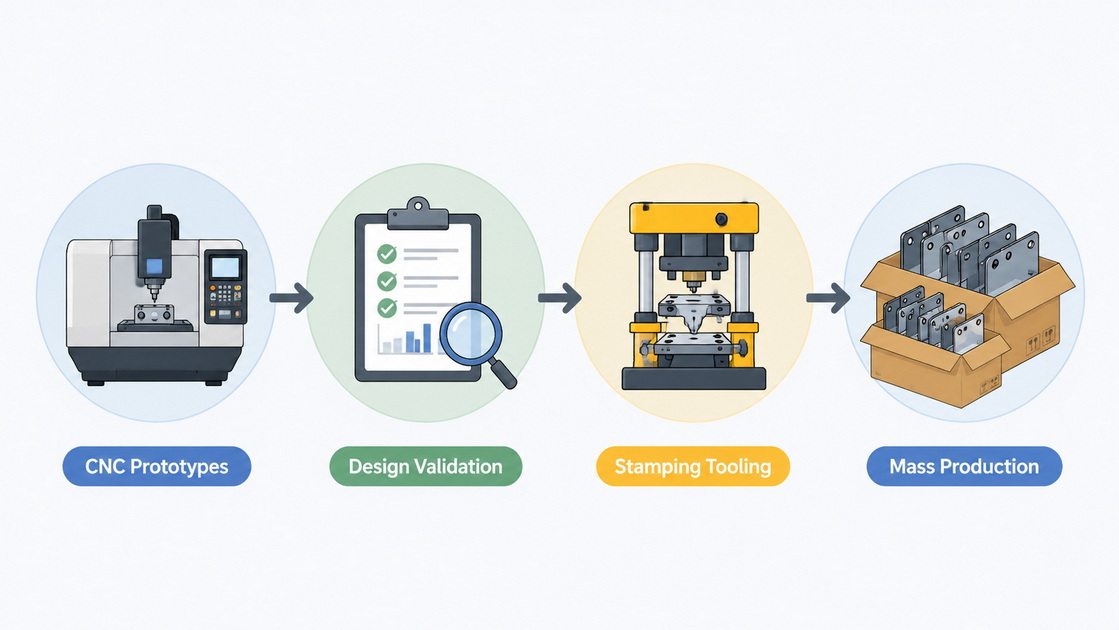
Many manufacturers adopt a hybrid approach: using CNC machining for early prototypes and engineering builds, then migrating mature, volume‑stable bracket designs to stamping to reduce unit cost and increase throughput. [jennisoncorp]
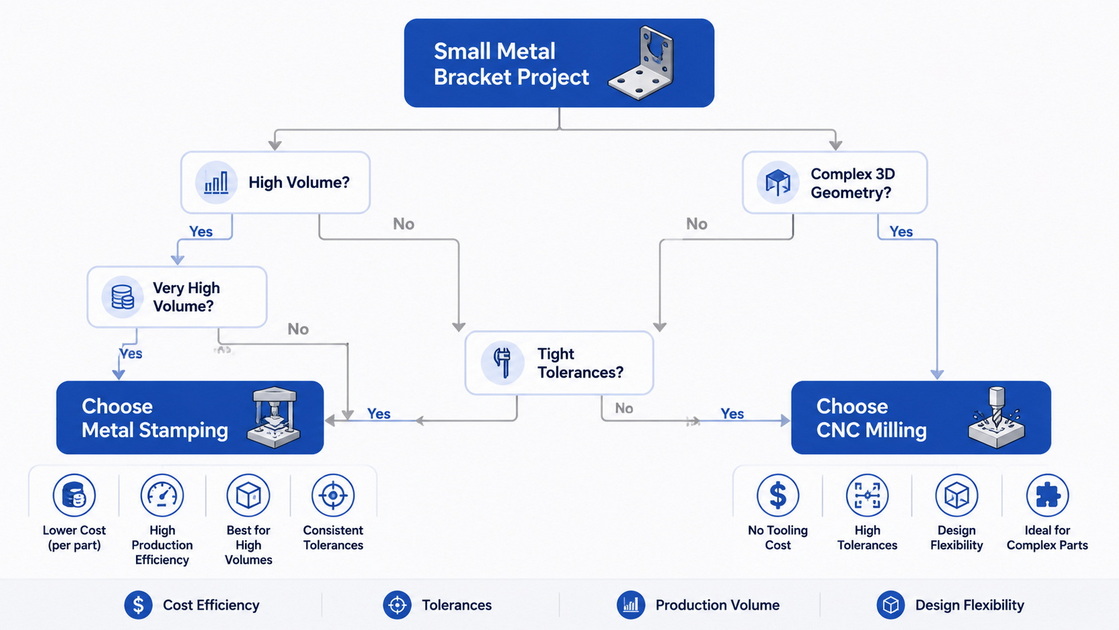
From an industry‑expert viewpoint, a practical decision framework for small metal brackets integrates volume, complexity, tolerance, and lifetime cost. [cnkaierwo]
1. Define annual volume and design stability
- Under roughly 5,000–10,000 pieces/year with frequent design iterations: CNC milling usually offers better flexibility and total cost of ownership. [blog.boenrapid]
- Above 10,000–50,000+ pieces/year with a stable design and long program lifetime: stamping becomes economically attractive despite tooling investment. [sunon-mould]
2. Map geometry and features
- Complex 3D surfaces, multi‑level functional areas, or thick sections: favor CNC milling. [shengching]
- Flat profiles, simple bends, uniform thickness: favor stamping, potentially combined with minor secondary operations. [lutco]
3. Assess tolerance and surface requirements
- Critical alignment features with ±0.005 mm tolerances or functional surfaces requiring fine machining: CNC milling on high‑precision equipment such as Feifan's imported machines. [feifanhardware]
- Standard commercial tolerances with cosmetic finishing needs: stamping plus surface treatment (e.g., plating, oxidation) is often more cost‑effective. [feifanhardware]
Shenzhen Feifan's integrated material selection, process validation, and surface treatment consulting helps overseas clients apply this framework to real bracket projects rather than relying on generic rules of thumb. [feifanhardware]
A typical project path for international OEMs working with Feifan looks like this:
- Phase 1 – CNC prototypes and EVT/DVT builds
The customer submits 3D models and tolerance schemes; Feifan's team performs drawing analysis and feasibility assessment, then delivers CNC‑milled brackets in small batches, often within 48 hours for urgent programs. [feifanhardware]
- Phase 2 – Design stabilization and cost analysis
After field testing and assembly trials, the bracket design stabilizes. At this point, Feifan and the customer evaluate stamping feasibility and potential cost reduction of 10–20% through scale production and supply‑chain synergy. [jennisoncorp]
- Phase 3 – Tooling, stamping, and secondary machining (if needed)
Stamping dies are designed; some critical features may still be machined in secondary CNC operations, balancing die simplicity with precision requirements. [lsrpf]
This hybrid path allows brands to keep time‑to‑market short in early phases while still achieving long‑term cost optimization once volumes ramp up. [sunon-mould]
From day‑to‑day engineering practice, three expert tips can significantly improve bracket manufacturability and cost:
- Design for a future stamping transition even if you start with CNC milling. Keep thicknesses relatively uniform, avoid unnecessary undercuts, and standardize hole patterns to facilitate future die design. [cnkaierwo]
- Separate "functional critical" features from "non‑critical" ones. Critical surfaces can be machined after stamping, allowing dies to stay simpler while still meeting tight assembly requirements. [shengching]
- Engage the manufacturing partner early. Feifan's R&D team supports customers from drawing review through process selection and surface treatment, helping OEMs avoid late‑stage redesigns and tooling rework. [feifanhardware]
These practices align with modern DFM (Design for Manufacturability) principles that leading OEMs follow to minimize lifecycle cost and technical risk. [lsrpf]
If you're evaluating CNC milling vs stamping for your next small metal bracket project, share your drawings and annual volume targets with Shenzhen Feifan Hardware & Electronics Co.,Ltd. Our engineering team can simulate both process routes, estimate unit costs, and propose a scalable OEM/ODM plan—from rapid CNC sampling to cost‑optimized stamping and surface treatment. [feifanhardware]
1. Is CNC milling always more expensive than stamping for brackets?
Not always; CNC milling can be more cost‑effective for low‑volume or frequently changing designs because it avoids high die investment and supports rapid iteration. For very high volumes and stable geometries, stamping usually offers a lower per‑part cost. [blog.boenrapid]
2. What bracket features typically require CNC machining instead of pure stamping?
Features such as deep pockets, multi‑level bosses, complex 3D surfaces, or extremely tight tolerances (around ±0.005 mm) usually require CNC machining. These may be machined on top of a stamped blank in hybrid process flows. [jennisoncorp]
3. How fast can I get CNC‑milled bracket samples from Feifan?
Shenzhen Feifan supports fast sampling, with some CNC bracket orders shipped within 3–5 days, depending on complexity and material availability. Foreign‑trade specialists track orders and communicate updates in English for overseas customers. [feifanhardware]
4. Can I switch an existing CNC bracket project to stamping later?
Yes, many OEMs start with CNC machining and transition to stamping as volumes grow and designs stabilize. Early collaboration with Feifan's R&D team helps determine when a stamping migration is feasible and economically justified. [shengching]
5. Which materials are suitable for CNC‑milled and stamped brackets?
CNC milling can handle thick metals, specialty alloys, and even plastics, giving designers broad freedom. Stamping works best with ductile sheet metals; very thick or brittle materials may be unsuitable for high‑volume stamping without special process design. [cnkaierwo]
1. Sheng Ching – Stamping vs. CNC Machining (Lathe / Milling).
https://www.shengching.com/news/comparison-stamping-and-cnc [shengching]
2. Shenzhen Feifan Hardware & Electronics Co.,Ltd – About Us.
https://www.feifanhardware.com/?m=home&c=Lists&a=index&tid=4 [feifanhardware]
3. Shenzhen Feifan Hardware & Electronics Co.,Ltd – Service.
https://feifanhardware.com/?m=home&c=Lists&a=index&tid=2 [feifanhardware]
4. Sunon – Metal Stamping vs. CNC Machining: 2026 Comparison Guide.
https://www.sunon-mould.com/metal-stamping-vs-cnc-machining/ [sunon-mould]
5. Boen Rapid – Metal Stamping vs CNC Machining for Low‑Volume Component Production.
https://blog.boenrapid.com/metal-stamping-vs-cnc-machining-for-low-volume-component-production [blog.boenrapid]
6. LSR Precision – Precision Metal Stamping VS. CNC Machining Service.
https://www.lsrpf.com/blog/precision-metal-stamping-vs-cnc-machining-service-choosing-the-best-custom-manufacturing [lsrpf]
7. Lutco – Metal Stamping vs CNC Machining: How To Choose.
https://www.lutco.com/metal-stamping-vs-cnc-machining-how-to-choose/ [lutco]
8. Kaierwo – Sheet Metal Process Selection: Laser, Punching & Stamping.
https://www.cnkaierwo.com/blogs/sheet-metal-process-selection-made-practical.html [cnkaierwo]
9. Jennison Corporation – Metal Stamping vs. CNC Machining: Which Is Right for Your Component.
https://www.jennisoncorp.com/post/metal-stamping-vs-cnc-machining-which-is-right-for-your-component [jennisoncorp]
10. Fly CNC Part – Top 10 Stainless Steel CNC Machining Manufacturers in China (includes Feifan).
https://www.flycncpart.com/top-10-stainless-steel-cnc-machining-manufacturers-in-china.html [flycncpart]


