From idea to market-ready product, our NPI solutions make every stage easier, faster. Discover How We Help

Views: 256 Author: Feifan Hardware Publish Time: 2026-06-24 Origin: Site


Content Menu
● Real-world Application Scenarios
>> Best use cases for CNC milling
● New Insight: Selection Workflow
● FAQ
>> 1. Is CNC milling stronger than forging?
>> 2. Is forging cheaper than CNC milling?
>> 3. Which process gives better tolerances?
>> 4. Can forged parts be CNC machined?
>> 5. Which industries use forging most often?
>> 6. When should I choose CNC milling over forging?
CNC milling and forging solve different manufacturing problems: forging is usually the better choice when strength, fatigue life, and impact resistance matter most, while CNC milling wins when dimensional accuracy, complex geometry, and tight tolerances are the priority. For OEM and ODM buyers, the smartest decision is rarely "which process is better" but "which process best fits the part's function, volume, and tolerance target". [7-swords]
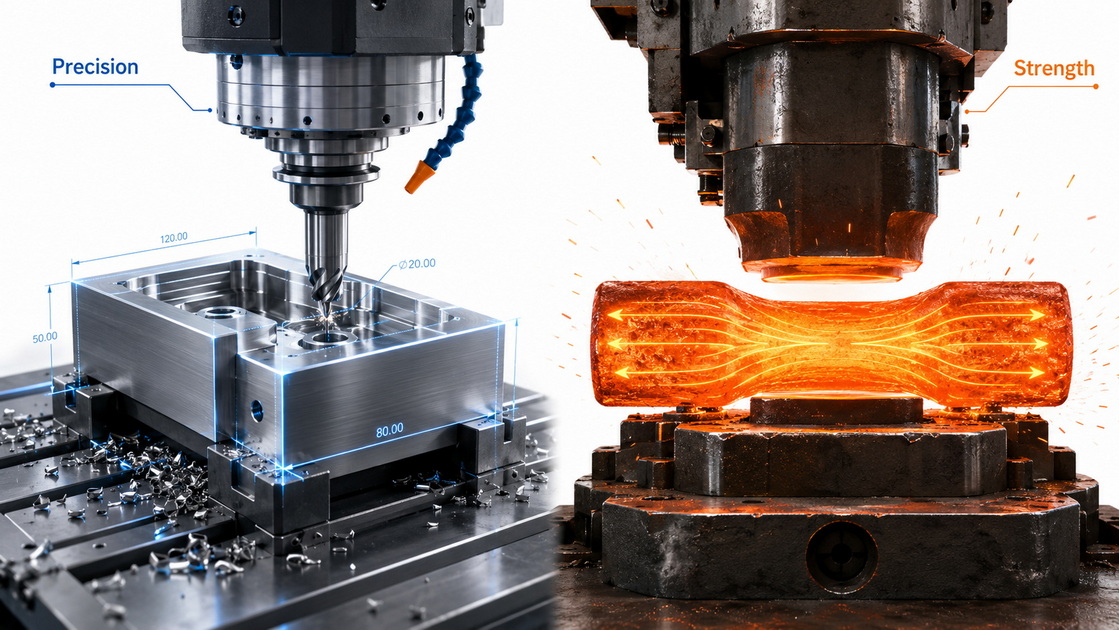
From a manufacturing buyer's perspective, the CNC milling vs. forging decision affects more than part quality. It influences tooling cost, lead time, unit economics, design freedom, and even the long-term reliability of the final product. In our work with precision metal components, we often see foreign brand owners and industrial buyers choose one process for structural performance and another for finishing and accuracy. [feifanhardware]
CNC milling is a subtractive process that removes material from a solid block using computer-controlled cutting tools. Because the toolpath is digitally controlled, the process is well suited for complex shapes, prototypes, low-to-medium volumes, and features that require tight tolerances. [seller.alibaba]
A key advantage of CNC milling is precision. Industry references commonly describe standard tolerances around ±0.005 in (about 0.13 mm), with precision setups achieving tighter results on selected features. That is why CNC milling is often preferred for housings, brackets, connectors, fixtures, and parts that must assemble consistently. [rapid-model]
Forging is a forming process that shapes metal under compressive force, often at elevated temperature. Unlike milling, forging does not start by cutting away material; it reshapes the metal and refines its internal grain structure. [fierf]
That grain refinement is the core strength advantage. Forged parts often deliver better fatigue resistance, impact resistance, and directional strength because the grain flow can follow the part's load path. In practical terms, forging is frequently chosen for highly stressed components such as shafts, gear blanks, automotive parts, and heavy-duty industrial hardware. [xmgoldcattle]
The simplest way to compare the two processes is this: forging builds material performance into the part, while CNC milling builds dimensional control into the part. Forging is generally stronger in cyclic or shock-loading applications because the internal structure is aligned and compacted during deformation. CNC milling, by contrast, is better at producing accurate features, fine details, and repeatable interfaces. [seller.alibaba]
| Factor | CNC Milling | Forging |
|---|---|---|
| Strength | Depends mainly on base material and design | Usually higher, especially in fatigue-critical parts nrc |
| Precision | Excellent, often very tight tolerances seller.alibaba | Lower as-forged accuracy, usually needs secondary machining seller.alibaba |
| Geometry | Very flexible and detailed | More limited by die design and flow behavior |
| Tooling cost | Lower for prototypes and short runs | Higher upfront die cost |
| Lead time | Faster for design changes | Better for stable, long-run parts |
| Best use | Precision components, prototypes, complex parts | Load-bearing, durable, high-volume parts |
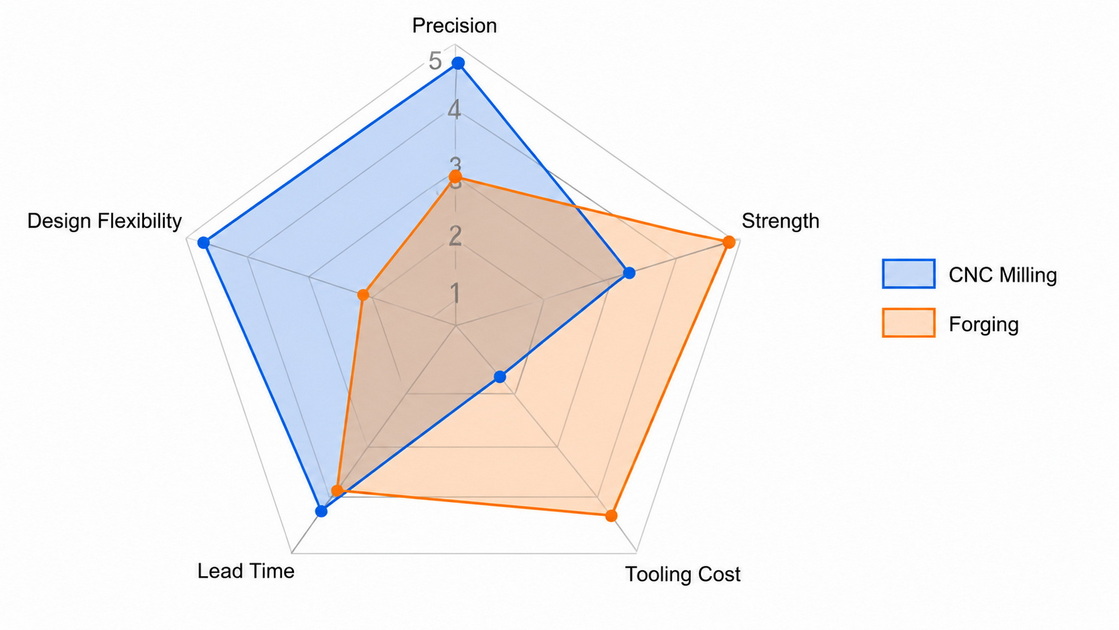
This table is especially useful for procurement teams because it shows the real trade-off: strength and precision rarely peak in the same first-process step. [seller.alibaba]
For engineering teams, choosing the wrong process can create hidden costs later. A part that is beautifully precise but too weak may fail early in service, while a part that is exceptionally strong but poorly controlled dimensionally may create assembly issues and scrap. That is why many high-performance parts are made by forging first and then CNC machined for critical surfaces. [aquacnc]
- Prototypes and product validation.
- Parts with complex geometry, pockets, threads, and fine detailing.
- Low-to-medium volume production.
- Tight fit components and assemblies with strict GD&T requirements. [americanmicroinc]
- Components exposed to repeated stress, vibration, or impact.
- High-volume production where unit cost must fall after tooling investment.
- Parts that benefit from improved grain flow and fatigue resistance.
- Semi-finished blanks that will later receive CNC finishing. [nrc]
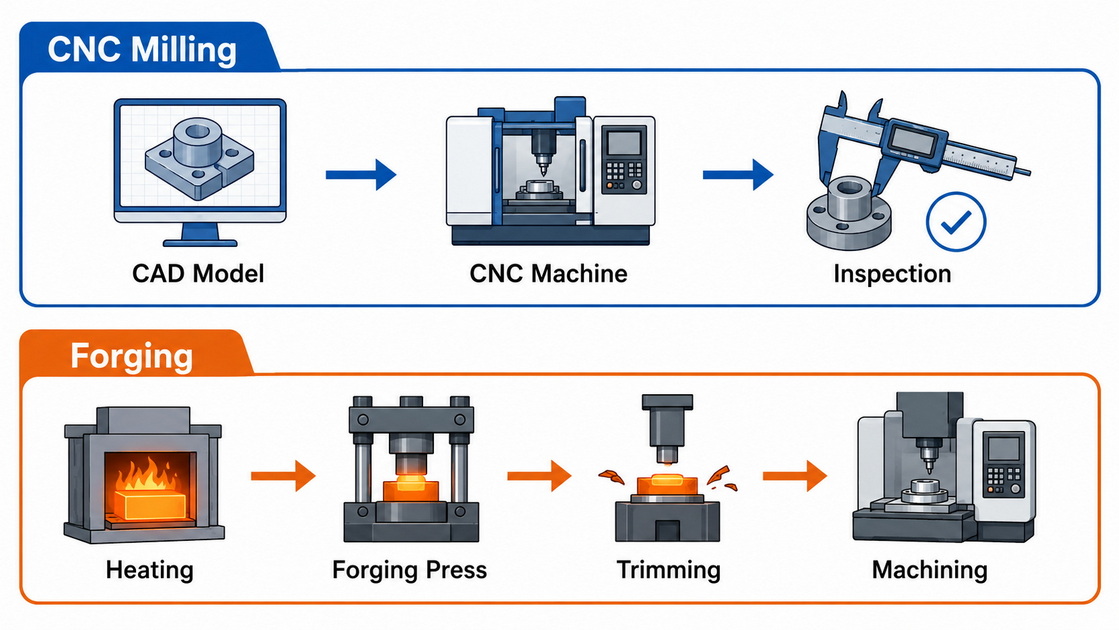
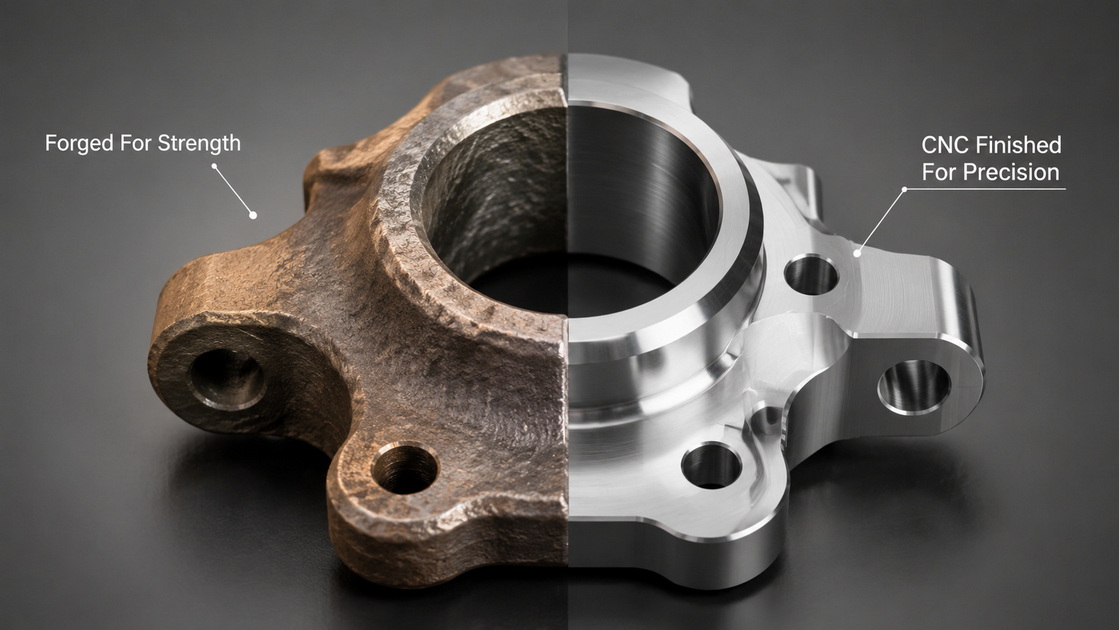
One of the most effective industrial strategies is to combine both processes. Forging creates a strong near-net-shape blank, and CNC milling finishes the exact functional surfaces, holes, and datums. This approach is common in demanding applications because it balances structural performance with usable precision. [newayaerotech]
In practice, this hybrid method is often the best answer for buyers who need both reliability and repeatability. It is also a strong OEM/ODM solution because it supports design optimization, cost control, and performance tuning without forcing the customer to choose only one process. [feifanhardware]
When we advise overseas buyers, we recommend a simple decision sequence before locking in the process. First, define the part's failure mode: is it likely to crack, deform, wear, or misalign? Second, confirm the dimensional tolerance and surface finish needed for assembly. Third, evaluate production volume and whether tooling amortization makes forging more economical over time. [seller.alibaba]
A practical rule is useful here: if the part must survive load first, forge it; if the part must fit first, mill it. If it must do both, the forged-plus-machined route is often the most balanced manufacturing choice. [alibaba]
Published manufacturing references consistently show that CNC machining can hold tighter tolerances than forging, while forging generally improves mechanical performance through grain flow and reduced internal discontinuity. Some industry examples report standard CNC machining precision around ±0.005 in and precision options tighter than that on selected features, while as-forged tolerances are typically wider and often require machining afterward. In fatigue-sensitive parts, literature and industry case material repeatedly note that forged grain flow can improve crack resistance and service life. [scribd]
If you are sourcing for OEM or ODM production, start with the end-use requirement rather than the process name. Share drawings, target tolerances, expected annual volume, material preference, and load conditions with your supplier before requesting a quote. For precision hardware buyers, this upstream clarity reduces redesign cycles and helps the factory recommend either CNC milling, forging, or a combined process. [aquacnc]
For Shenzhen Feifan Hardware & Electronics Co.,Ltd., the most compelling value proposition is not just machining capacity. It is the ability to help overseas brands and manufacturers choose a process route that aligns performance, cost, and manufacturability. That is exactly where expert OEM/ODM support creates measurable business value. [feifanhardware]
CNC milling and forging are not competitors in every case; they are often complementary. CNC milling delivers precision and geometry freedom, while forging delivers strength, fatigue resistance, and long-term durability. The best manufacturing decision is the one that matches the part's real operating conditions, not the one that sounds more advanced. [7-swords]
CTA: If your next project requires both structural reliability and precision finishing, request a DFM review and compare a forged-plus-CNC solution against a CNC-only option before finalizing tooling. [alibaba]
No. CNC milling is usually more precise, but forging generally produces stronger parts because it improves grain flow and fatigue resistance. [nrc]
It depends on volume. Forging often has higher upfront tooling cost, but it can become more economical in high-volume production. [seller.alibaba]
CNC milling usually gives better tolerances than forging, especially for critical dimensions and fit features. [seller.alibaba]
Yes. This is a common hybrid approach: forge the blank for strength, then CNC machine the critical surfaces for precision. [aquacnc]
Automotive, aerospace, heavy machinery, energy, and industrial hardware commonly use forging for load-bearing components. [newayaerotech]
Choose CNC milling when the part requires complex geometry, fast design changes, low-to-medium volume, or very tight tolerances. [americanmicroinc]
1. Shenzhen Feifan Hardware & Electronics Co., Ltd. Service page: [https://feifanhardware.com/?m=home&c=Lists&a=index&tid=2] [feifanhardware]
2. ASM/FIERF material on forging and heat treatment: [https://www.fierf.org/uploaded/tinymce/media/What_is_Forging.pdf] [fierf]
3. CNC machining versus forging discussion and tolerance comparisons: [https://seller.alibaba.com/blogs/2026/southeast-asia/machinery/cnc-machining-vs-forging-guide-alibaba-b2b] [seller.alibaba]
4. Forging, grain flow, and fatigue behavior literature: [https://www.nrc.gov/docs/ML1516/ML15161A221.pdf] [nrc]
5. CNC machining tolerance guidance: [https://seller.alibaba.com/blogs/2026/southeast-asia/manufacturing/cnc-tolerance-precision-manufacturing-alibaba-guide] [seller.alibaba]
6. CNC machining tolerances reference: [https://www.protolabs.com/en-gb/resources/design-tips/fine-tuning-tolerances-for-cnc-machined-parts/] [protolabs]
7. Forging plus CNC machining case material: [https://www.aquacnc.com/cnc-machined-forgings-for-strength-and-precision/] [aquacnc]
8. High-temperature precision forging case study: [https://www.newayaerotech.com/study-cases/high-temperature-precision-forging-and-cnc-machined-parts] [newayaerotech]
9. Forging grain flow and fatigue-life discussion: [https://www.scribd.com/document/871744950/Grain-Flow-in-Forgings-VI] [scribd]


