From idea to market-ready product, our NPI solutions make every stage easier, faster. Discover How We Help

Views: 222 Author: Feifan Hardware Publish Time: 2026-06-27 Origin: Site


Content Menu
● Core Keywords and Audience Focus
● Understanding Bronze, Brass, and Copper Alloys
>> What These Alloys Have in Common
● Bronze Alloys: Toughness and Corrosion Resistance
>> Common Bronze Grades Used in Industry
>> Bronze in Precision Components
● Brass Alloys: Workability, Appearance, and Cost
>> Why Brass Is a Designer's Favorite
>> Brass for CNC Machining and Decorative Parts
● Copper Grades: Conductivity and Formability
>> Industrial Copper Grades for Precision Parts
>> Where Copper Is the Right Choice
● Key Property Comparison: Bronze vs Brass vs Copper
>> Mechanical and Physical Properties
>> Conductivity and Thermal Behavior
● Pairwise Comparisons: Making Practical Design Choices
>> Brass vs Bronze: Marine and Decorative Applications
>> Brass vs Copper: Cost vs Performance
>> Copper vs Bronze: Strength vs Conductivity
● Real‑World Applications: Where Each Material Excels
>> Typical Bronze Applications
>> Typical Copper Applications
● Expert Material Selection Checklist for CNC Precision Parts
● How an OEM/ODM CNC Partner Can Help
● Call to Action: Move from Theory to Prototype
● FAQs: Bronze, Brass, and Copper for CNC Precision Parts
As a CNC machining specialist working with international OEM and ODM clients, I've seen countless projects succeed—or quietly fail—because of one simple decision: material selection. Bronze, brass, and copper are three of the most widely specified alloys in precision parts, yet they're often confused or chosen based only on color and price. [nopio]
In this article, we'll explore bronze vs brass vs copper from a practical, engineering‑driven perspective—linking real‑world applications, machinability, and long‑term performance to each material's properties. Whether you are designing connectors, marine hardware, or high‑volume turned fittings, this guide will help you justify your choice to internal stakeholders and suppliers. [athenaswc]
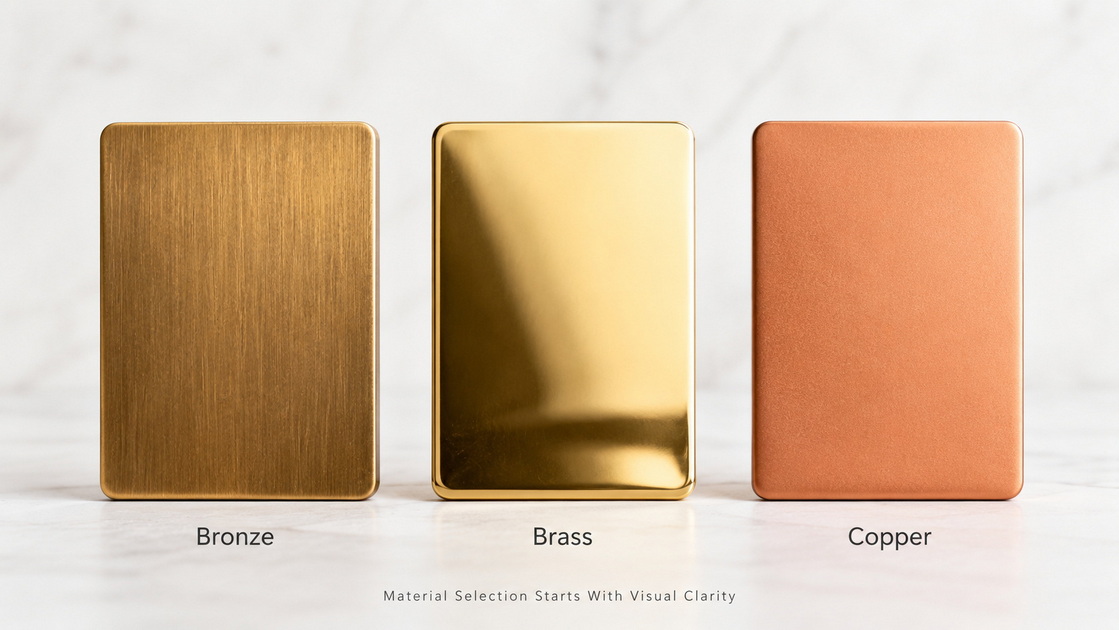
This article is written for:
- Mechanical engineers and product designers working on new assemblies and retrofits. [fonzy]
- Procurement and sourcing teams selecting materials for CNC precision parts and metal fabrication. [plantautomation-technology]
- Brand owners and wholesalers who rely on OEM/ODM partners for customized components. [marketveep]
Primary target keywords: bronze vs brass vs copper, bronze vs brass, brass vs copper, copper vs bronze, plus intent‑driven long‑tails such as best material for marine components, conductive copper alloys for CNC machining, and brass alloy selection for fittings. [gushwork]
All three materials are copper‑based, which explains why they can be visually similar and often grouped together in design discussions. In practice, however, their alloying elements, mechanical properties, and life‑cycle behavior are quite different. [gushwork]
- Copper is a pure element used as the performance baseline for both electrical and thermal conductivity across the metals industry. [gushwork]
- Brass is primarily a copper–zinc alloy, with optional additions such as tin, lead, aluminum, or manganese to tweak machinability and strength. [gushwork]
- Bronze was historically copper–tin, but modern industrial bronzes include elements such as silicon, aluminum, manganese, nickel, and phosphorus for strength and corrosion resistance. [gushwork]
From an OEM/ODM perspective, this means you're rarely choosing "pure copper" versus "pure brass" or "pure bronze"; you're choosing between specific alloys within each family based on performance targets and manufacturing constraints. [gushwork]
Modern bronze is a family of alloys rather than a single material, each tailored for different environments and loads. [gushwork]
Key bronze types include: [gushwork]
- Phosphor bronze (PB): Typically 0.5–1% tin and a small amount of phosphorus, valued for fine grain structure, fatigue resistance, and low friction in springs, connectors, and wear parts. [gushwork]
- Silicon bronze: Contains around 6% silicon plus copper and trace elements, offering high strength, excellent corrosion resistance, and good casting behavior—ideal for pump and valve components. [gushwork]
- Aluminum bronze: Generally 6–12% aluminum with added iron and nickel, known for outstanding corrosion resistance and strength in marine hardware and toxic fluid handling systems. [gushwork]
- Copper‑nickel (Cupronickel): 2–30% nickel, with exceptional resistance to corrosion, oxidation, and stress‑cracking, widely used in ship hulls and marine equipment. [gushwork]
- Manganese bronze: A complex alloy including manganese, copper, zinc, aluminum, and iron, combining shock resistance and saltwater corrosion resistance, commonly used in boat propellers, gears, nuts, bolts, and pump components. [gushwork]
From a CNC machining standpoint, bronze tends to be harder and more rigid than brass and copper, which can increase tool wear but delivers excellent performance in high‑load environments. OEMs frequently specify bronze for: [gushwork]
- Bearings and bushings in heavy equipment and industrial machinery. [gushwork]
- Propellers and marine fittings exposed to saltwater and mechanical stress. [gushwork]
- Springs and electrical connectors where fatigue and wear resistance are critical. [gushwork]
For high‑stress marine applications, correctly specified bronze often becomes the "no‑regrets" choice when long‑term durability outweighs marginal increases in machining cost. [gushwork]
Brass's popularity comes from its combination of machinability, aesthetics, and affordability. With zinc as the primary alloying element, brass can be tuned for either formability or strength, which makes it extremely versatile in OEM and consumer applications. [gushwork]
Common brass alloys include: [gushwork]
- Alloy 260 (cartridge brass): Excellent cold‑working properties, widely used in automotive parts, fasteners, ammunition, and hardware. [gushwork]
- Alloy 272 (yellow brass): About 33% zinc, giving higher strength for industrial applications that require robust mechanical performance. [gushwork]
- Alloy 330: High machinability and low lead content, optimized for piping and cold‑worked tubing. [gushwork]
- Alloy 353 (clock brass): Very machinable, ideal for high‑precision components such as clock and instrument parts. [gushwork]
- Alloy 360: The most widely available brass, known for exceptional formability and machinability, used in hardware components, fittings, fasteners, and valves. [gushwork]
- Alloy 464 (naval brass): Superior corrosion resistance and thermal stability, preferred for marine and high‑temperature bending, soldering, and welding applications. [gushwork]
Brass is usually easier to work with than bronze and significantly cheaper than copper, making it a staple for high‑volume CNC turned and milled parts. In practice, engineers and buyers select brass when they need: [gushwork]
- Good strength at lower cost, especially for fittings, connectors, and general hardware. [gushwork]
- Attractive golden appearance for exposed components, decorative hardware, and brand‑visible parts. [gushwork]
- High machinability for tight tolerances, complex geometries, and high‑volume production. [gushwork]
For many general applications, brass is the most cost‑effective all‑rounder among the three materials. [gushwork]
Copper remains the reference material for electrical and thermal performance, and its industrial grades are carefully differentiated by purity and processability. [gushwork]
Typical copper grades include: [gushwork]
- Alloy 101 (oxygen‑free copper): Extremely high conductivity and ductility, chosen where purity and electrical performance are non‑negotiable. [gushwork]
- Alloy 110 (ETP copper): Electrolytic tough pitch copper with excellent electrical and thermal conductivity, plus good ductility and malleability. [gushwork]
- Alloy 122: Similar to Alloy 110 but optimized for formability, brazing, and welding, preferred for complex fabricated assemblies. [gushwork]
- Alloy 145 (tellurium copper): Contains 0.4–0.7% tellurium, improving machinability while preserving good conductivity, commonly supplied as rod and bar. [gushwork]
Copper's defining characteristics are high conductivity and excellent ductility, which make it suitable for parts that must flex under load and efficiently carry current or heat. [gushwork]
Typical applications include: [gushwork]
- Heat sinks and exchangers, where thermal performance drives design decisions.
- Architectural and roofing components that leverage copper's patina and durability.
- Plumbing and industrial machinery requiring corrosion resistance and formability.
- Telecommunication and electrical components, from wiring to high‑performance connectors. [gushwork]
Copper's cost is generally higher than brass and many bronze alloys, so it is best reserved for applications where conductivity or specific forming behavior is essential. [gushwork]
When designing CNC precision parts, engineers typically compare these materials across composition, weight, machinability, weldability, durability, and corrosion resistance. [gushwork]
Summary of core properties: [gushwork]
| Property | Bronze | Brass | Copper |
|---|---|---|---|
| Composition | Copper + tin + elements (Si, Mn, Al, etc.) gushwork | Copper + zinc + traces (Fe, Pb, Al, Mn) gushwork | Pure copper (with minor impurities) gushwork |
| Density / Weight | 7400–8900 kg/m³ (medium) gushwork | ~8720 kg/m³ (relatively light) gushwork | 8930 kg/m³ (heaviest) gushwork |
| Machinability | Moderate (hard and rigid) gushwork | Low to moderate (alloy‑dependent) gushwork | Excellent (high ductility) gushwork |
| Weldability | High (depends on lead/zinc content) gushwork | Excellent, but leaded alloys are harder to weld gushwork | High, especially oxygen‑free grades gushwork |
| Durability | Great in high‑stress environments gushwork | Good general durability gushwork | High but softer, can deform gushwork |
| Corrosion resistance | Excellent, especially in saltwater gushwork | Good, but lower than bronze gushwork | High with protective patina gushwork |
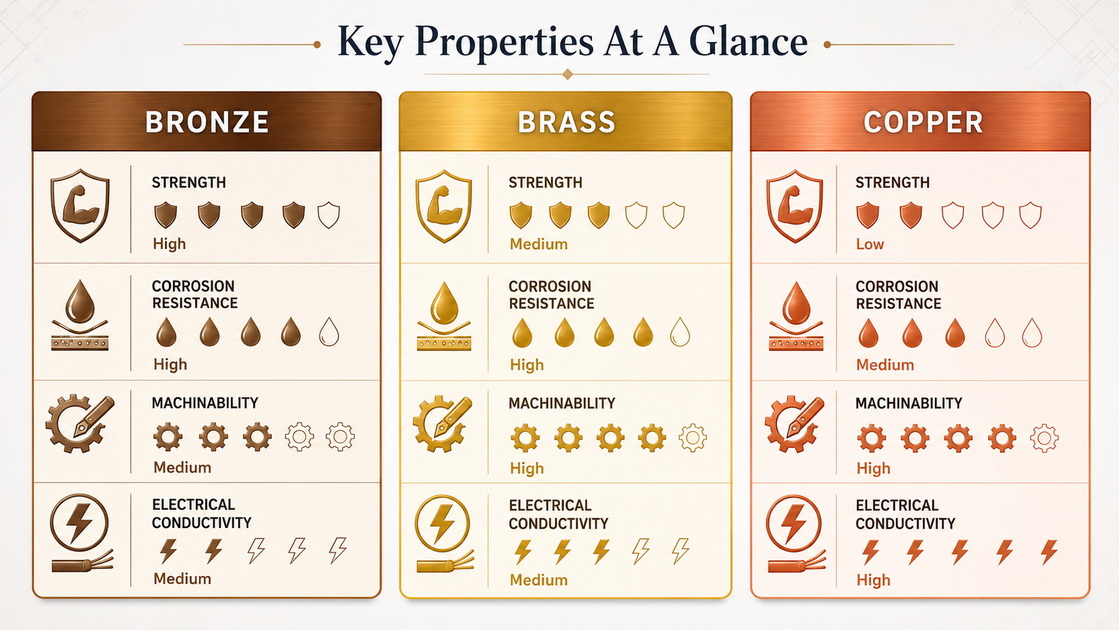
In terms of strength, bronze generally shows the highest yield and tensile values, followed by brass, while copper is significantly softer and more ductile. Bronze yield strengths can range from roughly 125 to 800 MPa, with tensile strength up to about 635 MPa, whereas brass typically sits lower and copper lowest. [gushwork]
For electrical conductivity, copper is the benchmark; brass conducts at around 28% of copper's level, and bronze at roughly 15% due to its alloying content. [gushwork]
For thermal conductivity, the original article reports some ranges that vary by alloy, but in practice engineers assume:
- Copper offers excellent thermal conductivity, widely used wherever fast heat transfer is required. [gushwork]
- Brass provides moderate thermal conductivity, often sufficient for general mechanical parts. [gushwork]
- Bronze can deliver good thermal behavior, but specific values depend strongly on alloy composition and microstructure. [gushwork]
For safety‑critical or high‑temperature applications, it is always best to consult datasheets from material suppliers for the exact alloy you are specifying. [marketveep]
When you are deciding between brass and bronze, start by clarifying the environmental conditions and visual expectations. [gushwork]
Choose bronze when: [gushwork]
- Components are exposed to saltwater, such as propellers, ship fittings, and marine valves.
- The part must withstand high mechanical stress and shock.
- High‑temperature service or severe corrosion environments are expected.
Choose brass when: [gushwork]
- You need brighter color and decorative appearance for visible hardware.
- Workability and machinability matter more than ultimate strength.
- Cost is a constraint for mid‑to‑high volume production. [gushwork]
In practice, a marine OEM might specify bronze for propeller hubs and shafts, while using naval brass for associated fittings that require both corrosion resistance and more accessible machining. [gushwork]
Because brass is a copper alloy, the two share baseline properties—but diverge significantly in cost and conductivity. [gushwork]
Copper is preferred when: [gushwork]
- Electrical or thermal performance is the primary design driver.
- Parts must carry high currents or act as thermal interfaces.
- Formability is critical, such as drawing micron‑sized wires or complex shapes. [gushwork]
Brass is preferred when: [gushwork]
- You need greater mechanical strength at lower cost.
- The part must withstand mechanical loads but does not require extreme conductivity.
- Appearance and machinability for general hardware or fittings are key selection criteria. [gushwork]
This is why high‑end connectors often combine copper and brass: copper alloys for conductive pathways and brass for robust mechanical housings and threaded interfaces. [gushwork]
Copper and bronze sit at opposite ends of the strength–conductivity spectrum. [gushwork]
Use copper when: [gushwork]
- Heat or current must flow efficiently through the part.
- You need high ductility and the ability to withstand flexing without cracking.
Use bronze when: [gushwork]
- Hardness and wear resistance are crucial, as in bushings and bearings.
- Parts are exposed to harsh mechanical and corrosive environments (e.g., offshore infrastructure). [gushwork]
In many industrial designs, core structural elements might be bronze, while copper is used for conductive or thermal subcomponents within the same assembly. [gushwork]
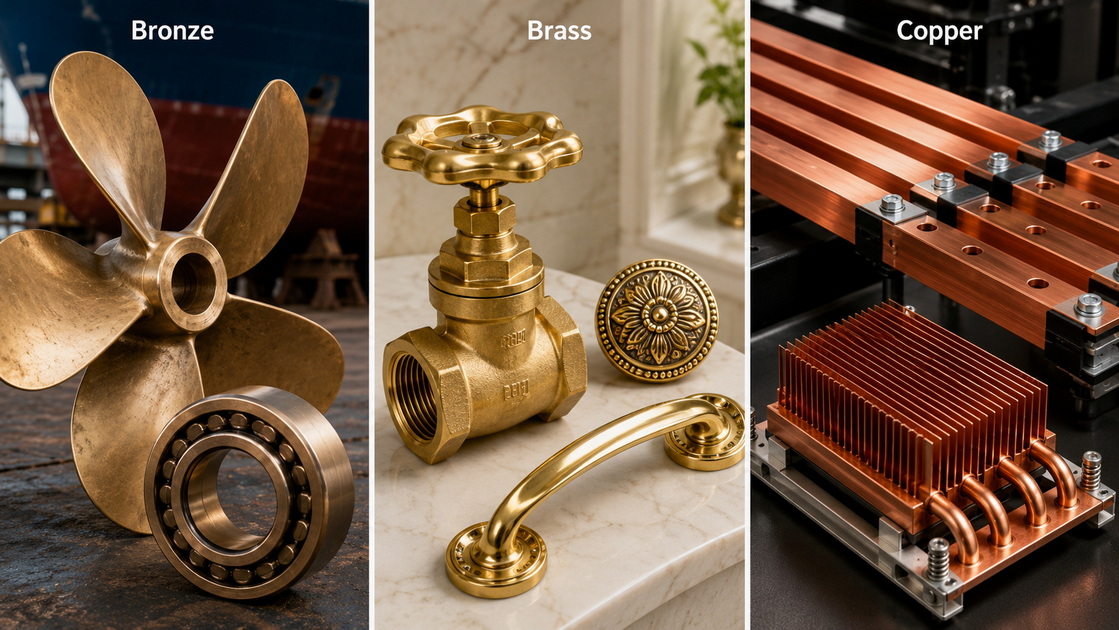
Bronze sheet and bar are widely used across heavy industry due to their wear resistance and corrosion behavior. [gushwork]
Representative use cases include: [gushwork]
- Bushings and bearings in industrial machinery and automotive systems.
- Marine propellers and fittings where saltwater resistance is critical.
- Springs, electrical connectors, and electric motors needing both mechanical and electrical performance.
- Oil rig and petrochemical tools and components in aggressive environments. [gushwork]
Brass's gold‑like color and robust machinability make it common in both industrial and consumer applications. [gushwork]
Typical uses include: [gushwork]
- Plumbing and piping materials, hose couplings, and valves.
- Electrical plugs, sockets, terminals, and electronic hardware.
- Musical instruments, clock and watch components, locks, hinges, and fittings.
- Ammunition casings and precision mechanical hardware. [gushwork]
Pure copper is favored where conductivity and corrosion resistance outweigh weight and cost considerations. [gushwork]
Typical uses include: [gushwork]
- Heat sinks, heat exchangers, and industrial cooling systems.
- Architectural elements, roofing, and decorative facades.
- Plumbing, electrical wiring, vacuum tubes, and electric motors.
- Telecommunication and anti‑biofouling components in submarines. [gushwork]
From an OEM/ODM perspective, choosing between bronze, brass, and copper is rarely about one single property. It's about balancing performance, manufacturability, cost, and end‑user expectations. [athenaswc]
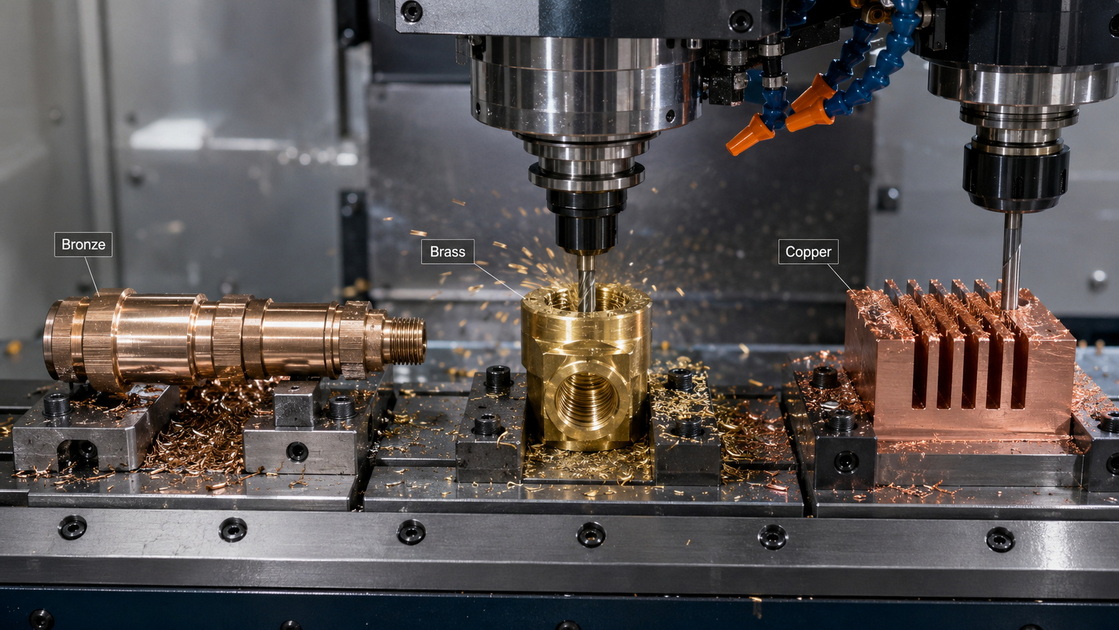
Use this 5‑step checklist when selecting materials for CNC precision parts:
1. Define the operating environment
- Exposure to saltwater, chemicals, or outdoor conditions.
- Required temperature range and thermal cycling. [marketveep]
2. Prioritize functional requirements
- Electrical or thermal conductivity.
- Mechanical load, wear, and fatigue life. [marketveep]
3. Assess manufacturability
- Machinability (tool wear, cycle time, achievable tolerances).
- Forming, welding, brazing, and assembly methods. [athenaswc]
4. Align with cost and supply chain
- Material cost relative to part value and production volume.
- Availability of specific alloys and bar/rod/plate sizes. [marketveep]
5. Confirm compliance and certifications
- Lead content and RoHS requirements.
- Industry standards and regional regulations for marine, electrical, or structural components. [fonzy]
This structured approach helps engineers and buyers defend material decisions with data and context rather than tradition or personal preference. [journaleus]
For international OEMs, brand owners, and wholesalers, working with an experienced CNC precision parts manufacturer simplifies material decisions and reduces project risk. A capable supplier should be able to: [plantautomation-technology]
- Translate functional requirements into alloy recommendations (e.g., phosphor bronze vs naval brass vs tellurium copper). [fonzy]
- Advise on machining strategies, tooling, and tolerances matched to each material family. [gushwork]
- Provide rapid prototyping plus small‑batch and mass‑production capabilities for bronze, brass, and copper parts. [hmm]
- Support OEM and ODM services, including design for manufacturability (DFM), surface finishing, and packaging tailored to your brand. [gushwork]
For complex assemblies, collaborating early with your CNC partner helps align material choice, cost expectations, and timeline before drawings are frozen. [plantautomation-technology]
If you're currently comparing bronze vs brass vs copper for a new project, the most reliable way to validate your choice is to move beyond datasheets and machine real prototypes. [fonzy]
Send your 3D models and material requirements to a trusted CNC precision parts manufacturer and request:
- Alternative quotes for at least two material options (e.g., naval brass vs aluminum bronze).
- Surface finish samples and tolerance reports.
- Feedback on manufacturability and potential cost savings. [hmm]
Turning your design into physical parts gives engineers, buyers, and end customers the confidence they need to approve materials for long‑term production.
Q1: Which material is best for marine components?
Bronze—especially aluminum bronze or manganese bronze—is generally the best choice for marine components because of its superior saltwater corrosion resistance and high mechanical strength compared with brass and copper. [gushwork]
Q2: When should I choose brass instead of copper?
Choose brass when you need a combination of reasonable strength, good machinability, attractive appearance, and lower cost; copper should be reserved for parts where electrical or thermal conductivity is a primary functional requirement. [gushwork]
Q3: Are all brass alloys easy to weld?
Most brass alloys can be welded using MIG, TIG, or silver soldering, but alloys with higher lead or zinc content are more challenging to weld and require careful process control and filler selection. [gushwork]
Q4: Can bronze be used for electrical components?
Yes, specific bronze alloys—such as phosphor bronze—are widely used for electrical connectors and springs, offering a balance of mechanical strength, wear resistance, and acceptable conductivity for many applications. [gushwork]
Q5: How do I decide between phosphor bronze and naval brass for a spring or clip?
If the part operates in a high‑stress or corrosive environment and fatigue resistance is critical, phosphor bronze is usually preferred; if the environment is more moderate and appearance plus cost are important, naval brass may be sufficient. [gushwork]
1. Runsom Precision. "Bronze vs. Brass vs. Copper: Their Difference."
https://www.runsom.com/blog/bronze-vs-brass-vs-copper/ [gushwork]
2. Nopio. "Manufacturing SEO: Guide to Getting Found by B2B Buyers."
https://www.nopio.com/blog/manufacturing-seo/ [nopio]
3. Gushwork. "SEO for Manufacturers: A Comprehensive Guide."
https://www.gushwork.ai/blog/boost-strategy-seo-manufacturers [gushwork]
4. Athenaswc. "Accelerate Growth with These CNC Machining SEO Strategies."
https://www.athenaswc.com/resources/blog/the-heat-is-on-accelerate-growth-with-these-cnc-machining-seo-strategies/ [athenaswc]
5. Plant Automation Technology. "Impact of SEO on CNC industry growth."
https://www.plantautomation-technology.com/articles/how-seo-can-drive-business-growth-for-cnc-manufacturers [plantautomation-technology]
6. Fonzy AI. "SEO Playbook for CNC Machining Services."
https://www.fonzy.ai/playbooks/seo/specialized-b2b/cnc-machining-services [fonzy]


