From idea to market-ready product, our NPI solutions make every stage easier, faster. Discover How We Help

Views: 246 Author: Feifan Hardware Publish Time: 2026-07-09 Origin: Site


Content Menu
● What Makes Aerospace CNC Machining Different?
● Typical Aerospace Components Made by CNC Machining
● Key Materials for Aerospace CNC Components
>> Alloy steels
● Seven Core Machining Challenges in Aerospace (And How Experts Solve Them)
>> 1. Large thin‑walled housings and residual stress
>> 2. Unnecessary geometric complexity
>> 3. Part size versus machine envelope
>> 4. Heat treatment and dimensional control
>> 5. Sourcing exotic alloys and aerospace plastics
>> 6. Finding AS9100‑capable manufacturing partners
>> 7. High‑mix, low‑quantity production
● Advanced Machining Strategies: 3‑Axis vs 5‑Axis and Beyond
● How Shenzhen Feifan Supports Overseas Aerospace OEM/ODM Needs
● Practical Steps for Engineers Sourcing Aerospace CNC Parts
● Call to Action: Partner With an OEM/ODM Precision Machining Expert
● FAQs About Aerospace CNC Machining and OEM/ODM Services
CNC machining is the quiet backbone of modern aerospace, and for engineers and procurement teams, the difference between a good supplier and a truly strategic partner often shows up in thin‐walled housings, exotic alloys, and unforgiving tolerances. As a China‑based OEM/ODM precision machining manufacturer working daily with overseas brands, I've seen how the right digital workflows and shop‑floor discipline turn those challenges into repeatable, certifiable production value. [feeds.marseng]
The aerospace industry is unforgiving: a single out‑of‑tolerance bracket or warped housing can compromise an entire assembly, so precision and process control matter more than headline cycle times. Aircraft and spacecraft also run in extreme environments, which means parts must combine high strength‑to‑weight ratios with tight dimensional stability over temperature, vibration, and load cycles. [customproc]
From a machining standpoint, three drivers define aerospace work:
- Safety‑critical tolerances and documentation requirements (AS9100, traceability, first‑article inspection). [yijinsolution]
- Complex geometries aimed at weight reduction and optimized airflow. [cncmachiningshops]
- Low‑volume, high‑mix production that demands flexible setups and robust programming practices. [clarwe]
As Shenzhen Feifan Hardware & Electronics Co., Ltd., we position our OEM/ODM services directly around these realities: multi‑axis CNC capacity, rigorous metrology, and production systems designed to handle high‑mix programs for global aerospace customers.
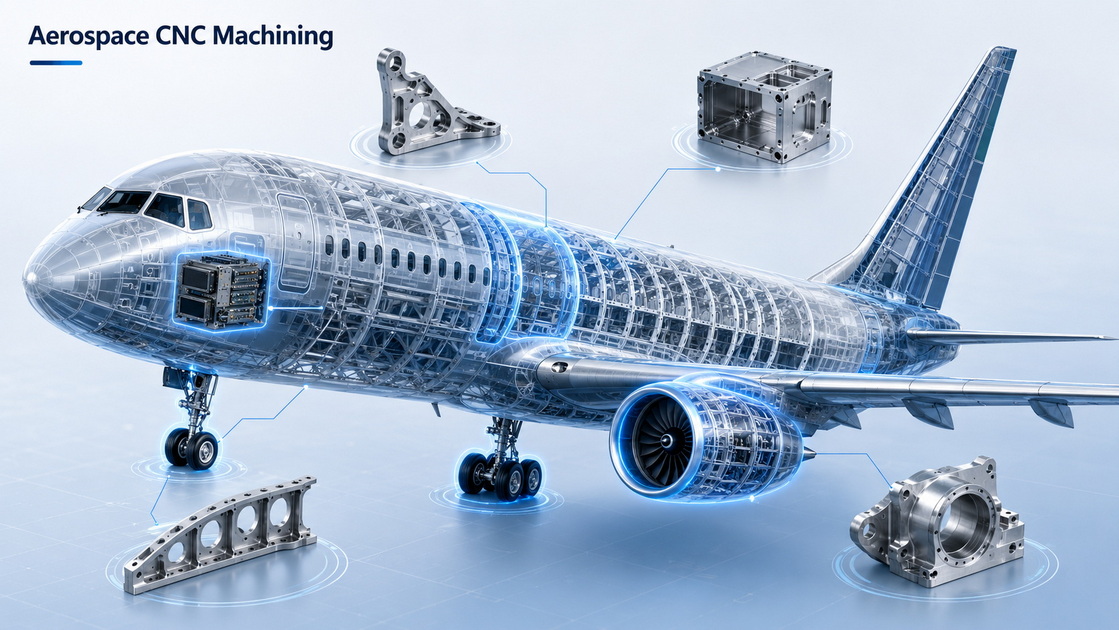
CNC machining touches nearly every zone of an aircraft, from landing gear to avionics housings. [feeds.marseng]
Common CNC‑machined aerospace parts include: [customproc]
- Landing gear elements: braces, torque links, trunnions.
- Engine components: compressor and turbine housings, pump bodies, manifolds.
- Structural parts: fuselage frames, bulkheads, wing ribs, seat tracks.
- Motion and drive components: shafts, gears, housings, couplings.
- Helicopter and UAV parts: transmission housings, rotor hubs, precision fasteners.
Below is a concise view of where CNC machining fits in the aircraft:
| Component zone | Typical CNC parts |
|---|---|
| Landing gear | Braces, torque links, actuator housings feeds.marseng |
| Engines & turbines | Compressor housings, pump bodies feeds.marseng |
| Airframe structures | Ribs, frames, bulkheads, seat tracks feeds.marseng |
| Flight control | Hinge fittings, brackets, levers jiga |
| Avionics & interiors | Enclosures, mounting plates, heat sinks customproc |
| Helicopter drive | Transmission housings, shafts feeds.marseng |
For overseas brands, the most effective way to leverage this breadth is to align your part portfolio with a supplier that already runs similar geometries, alloys, and tolerance bands—exactly the type of work our Shenzhen Feifan team executes for OEM and ODM partners across North America and Europe. [quickcreator]
Aerospace machinists work with a carefully selected palette of metals and plastics, each chosen for a specific balance of weight, strength, and durability. [china-maching]
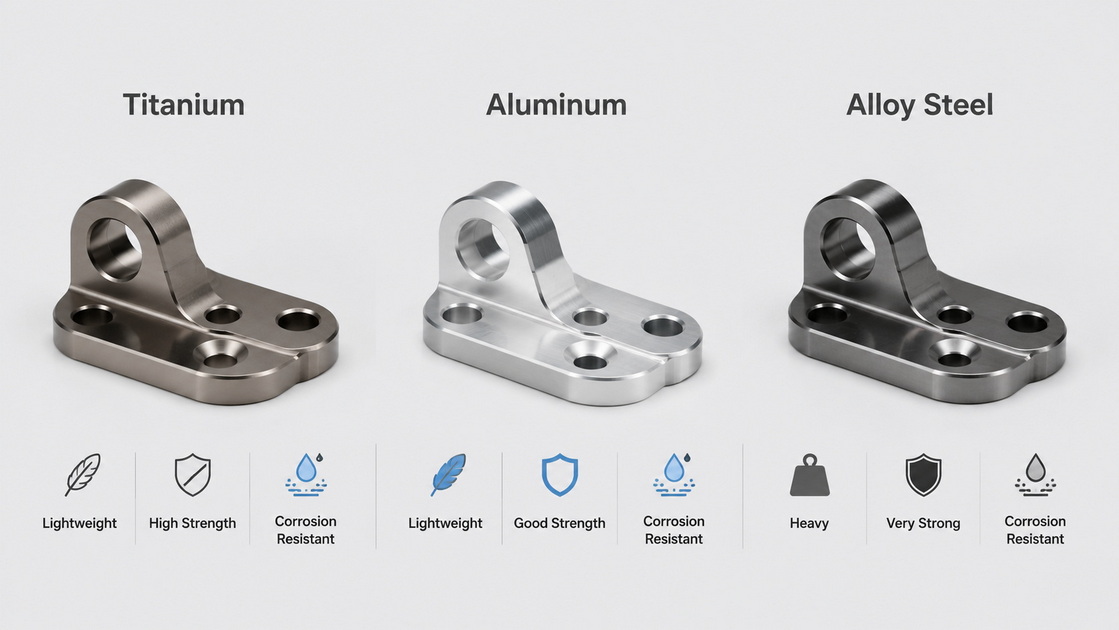
Titanium Grades 2 and 5 are widely used in hot‑section engine components, structural fittings, and high‑strength fasteners thanks to their heat resistance and excellent strength‑to‑weight ratio. They are expensive and more challenging to machine, demanding optimized toolpaths, robust coolant delivery, and specialized cutting tools. [china-maching]
Alloy steels such as 4340 and 4130 show up in landing gear beams, fasteners, gears, and exterior components that handle high loads. Their advantages include: [feeds.marseng]
- High toughness and fatigue strength for repeated impact cycles (e.g., landings). [feeds.marseng]
- Lower material cost than titanium, but higher density and a greater tendency to corrode without coatings. [cncmachiningshops]
Aluminum alloys 2024, 6061, and 7075 remain workhorses for airframes and wing structures. [customproc]
- 2024: strong fatigue resistance, ideal for long‑life structural parts.
- 6061: good corrosion resistance, widely used in wings and fuselages.
- 7075: combines fatigue and corrosion resistance with high strength, often used in critical structural components. [feeds.marseng]
Aluminum can be machined two to three times faster than steel, which makes it cost‑effective for many airframe parts when paired with high‑speed machining strategies. [clarwe]
As an OEM/ODM supplier, we maintain qualified material sources for these alloys and can support mill certs, batch traceability, and customer‑specific material approval workflows, which are vital for aerospace purchasing teams. [yijinsolution]
The original Fictiv article highlights seven recurring obstacles in aerospace CNC machining; below, I'll walk through them from a practitioner's perspective, adding practical lessons we apply in our China‑based precision shop. [feeds.marseng]
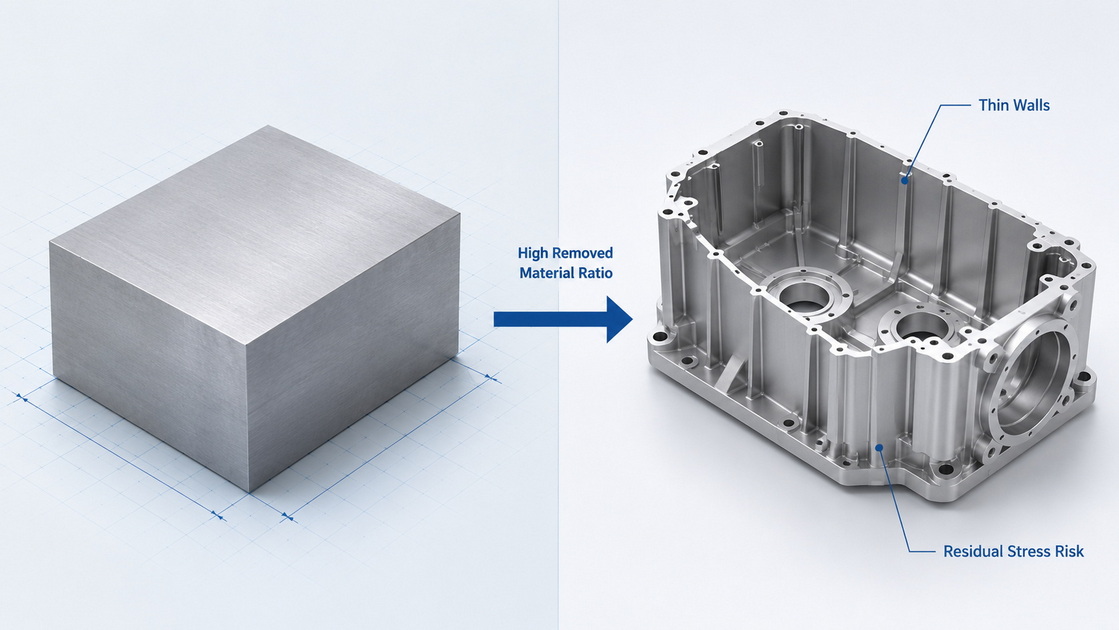
Large housings—such as compressor or transmission bodies—start as heavy billets with large internal cavities. Coring out that material creates: [cncmachiningshops]
- Long cycle times and significant scrap.
- Residual stress that leads to warping and out‑of‑tolerance surfaces. [clarwe]
Experienced machinists use two simple ratios to assess manufacturability before committing to a process: [feeds.marseng]
- IRMR (Internal Removed Material Ratio) – compares remaining internal volume to the original.
- ERMR (External Removed Material Ratio) – compares finished part bounding box volume to stock volume.
If IRMR is below about 85% or ERMR falls under 30%, we treat the design as high‑risk for warping and explore alternative methods. Options include: [cncmachiningshops]
- Switching early roughing to casting plus finish machining.
- Using high‑performance 5‑axis machines with lower forces and symmetric ADOC/RDOC strategies. [china-maching]
In our own practice, we often blend stress‑relief cycles and semi‑finish passes before final finishing, which stabilizes the part and keeps thin walls in tolerance.
Complex geometries are often essential for weight reduction and airflow, but internal components are sometimes designed with organic surfaces that add machining time without functional gain. The remedy is disciplined Design for Manufacturability (DFM): [cncmachiningshops]
- Simplify non‑critical internal surfaces to prismatic features.
- Standardize fillet radii and wall thicknesses for tool and fixture efficiency.
- Reserve complex 5‑axis surfaces for airflow or structural critical regions only. [elimold]
Our engineering team routinely runs DFM reviews for OEM/ODM customers, offering alternative geometries that deliver identical performance at lower machining cost and risk.
Aircraft structures are large, while many CNC machine beds are only a few feet long. For oversized spars, frames, or skins, you either: [feeds.marseng]
- Find a supplier with large‑envelope 5‑axis or gantry machines.
- Redesign the part into multiple sections with additional fasteners. [feeds.marseng]
Casting and friction‑stir welding offer alternative approaches for some structural elements, but they introduce their own tooling and lead‑time implications. For high‑mix, low‑volume work, we typically recommend: [cncmachiningshops]
- Segmenting non‑critical structural members.
- Using robust dowel and fastener schemes to maintain alignment without over‑weighting the assembly.
Aerospace components often demand precise hardness and strength, requiring heat treatment either before or after machining. [customproc]
Heat treating before machining:
- Improves stability and allows tighter tolerances.
- Increases tool wear and cycle time, raising cost. [china-maching]
Heat treating after machining:
- Can distort dimensions and push critical surfaces out of spec. [clarwe]
Experts mitigate these trade‑offs by:
- Choosing tempering or aging processes with lower temperature profiles.
- Using press quenching instead of oil quenching to minimize shrinkage and distortion.
- Reserving a small final machining allowance after hardening for critical fits. [elimold]
In our shop, we collaborate closely with heat‑treat vendors and customers to lock in parameter windows, then document proven recipes in our process sheets for future repeats.
Titanium, nickel superalloys, and plastics such as Ultem deliver ideal performance but are harder to source, longer to ship, and costlier to purchase. Digital manufacturing ecosystems and global supply chains help by: [china-maching]
- Aggregating demand across multiple customers, improving access to specialized stock.
- Centralizing material qualification and certification handling. [yijinsolution]
As a China‑based producer, we combine local mill relationships with export‑oriented quality systems to provide certified materials at competitive lead times, while aligning with customer documentation requirements (material certs, RoHS/REACH, etc.).
AS9100 certification based on ISO 9001 is a baseline requirement for many aerospace OEMs, covering quality management, safety, and traceability. Not all shops are certified, and smaller aerospace programs sometimes struggle to justify certification costs. [yijinsolution]
Digital manufacturing platforms and vetted supplier networks help companies connect with partners who either hold AS9100 or operate in compliance with its principles. At Shenzhen Feifan, we mirror these expectations by: [feeds.marseng]
- Running documented quality procedures aligned with international standards.
- Providing full traceability from raw material to finished component, including first‑article inspection reports and process records.
Most aerospace components are produced in relatively small batches—a few dozen to a few hundred pieces—across many part numbers. This is the opposite of traditional mass‑production economics. [clarwe]
To make high‑mix, low‑volume machining viable, experts:
- Standardize fixtures and tooling libraries to minimize setup times.
- Use modular programming templates and CAM strategies across part families.
- Leverage digital scheduling to fill machine capacity with mixed jobs efficiently. [quickcreator]
Our OEM/ODM business model is tailored for this environment, where overseas brands can send diverse part portfolios and rely on us to absorb the programming and setup complexity while keeping unit costs predictable.
Modern aerospace shops rarely rely on a single type of CNC machine; they orchestrate multiple technologies to achieve both precision and cost control. [elimold]
Key processes include: [customproc]
- 3‑axis milling for planar surfaces, slots, and simpler geometries.
- 4‑axis milling for multi‑face machining without re‑clamping.
- 5‑axis simultaneous machining for complex contours, undercuts, aero surfaces.
- CNC turning and mill‑turn centers for shafts, housings, and fasteners.
- EDM (wire and sinker) for deep, intricate features in hard alloys.
- High‑speed machining with adaptive toolpaths for aluminum structures.
For a typical aerospace program, our team might rough a 7075 structural frame on a high‑speed 3‑axis line, finish complex mounting features on a 5‑axis machine, and then add critical bores on a dedicated precision turning center—all under a single OEM/ODM project.
From an overseas brand's perspective, partnering with a China‑based precision shop should simplify rather than complicate aerospace sourcing. At Shenzhen Feifan Hardware & Electronics Co., Ltd., we focus on three pillars: [quickcreator]
1. Engineering collaboration
Our engineers review customer CAD/CAM data for DFM, recommend manufacturability improvements, and share risk assessments for thin‑wall ratios, material removal, and fixture design. [elimold]
2. Process discipline and metrology
We combine multi‑axis CNC lines with CMM inspection, optical measurement, and documented control plans, ensuring each batch meets the specified tolerances and surface finish requirements. [clarwe]
3. Digital communication and traceability
Overseas customers receive clear process documentation, inspection reports, and shipment details, supporting internal audits and end‑customer compliance demands. [quickcreator]
For OEM and ODM engagements, this means you can outsource not only machining, but also design refinement, prototype iteration, and ongoing production support under a single partner relationship.
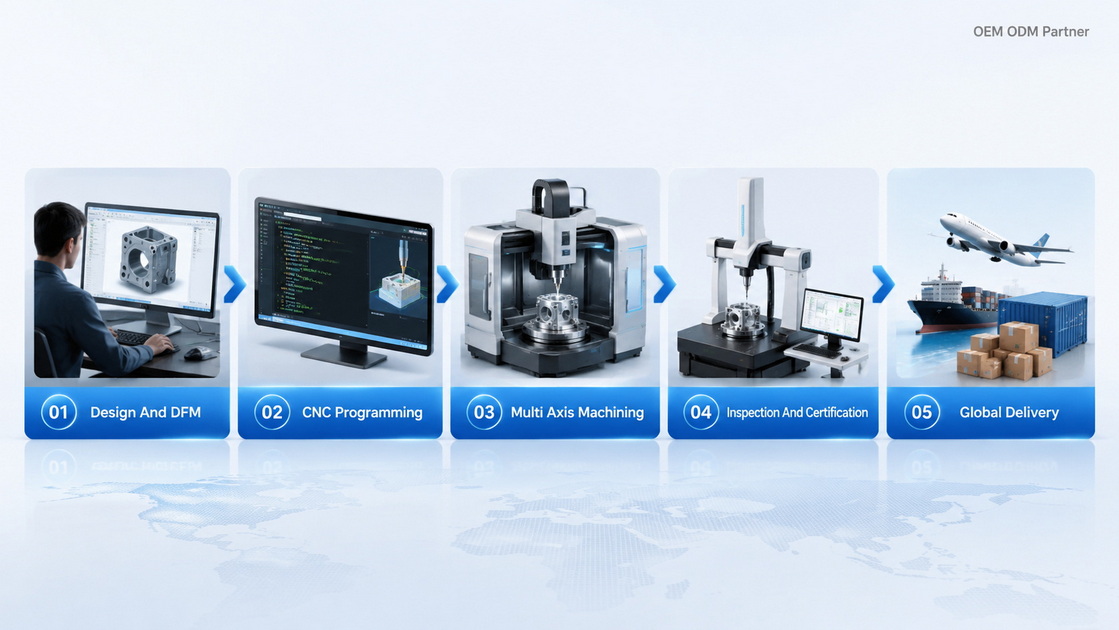
If you're an aerospace engineer, buyer, or startup founder looking to source machined parts, a structured approach will save both time and budget. [jiga]
1. Define functional priorities
Clarify which dimensions, surfaces, and material properties are truly critical; mark them explicitly in your drawings and models. [customproc]
2. Run DFM early
Engage your machining partner (or an OEM/ODM provider like us) to review wall thickness, accessible radii, and fixture strategy before design freeze. [elimold]
3. Align material and heat‑treat plans
Select alloys and heat‑treat processes compatible with your supplier's capabilities and documentation standards. [china-maching]
4. Plan for high‑mix realities
Where possible, group related part families, standardize features, and anticipate future variants so your supplier can build reusable process assets. [clarwe]
5. Use digital workflows
Share 3D models, tolerances, and inspection specs via secure platforms, then track revisions and approvals systematically. [yijinsolution]
By following these steps, you increase your chances of getting reliable aerospace‑grade components on time, while giving your supplier the information they need to succeed.
Aerospace CNC machining will always be demanding, but with the right engineering collaboration and manufacturing partner, those demands can become a competitive advantage. If your team is developing new aircraft, UAV, or aerospace subsystem designs and needs reliable precision machining across titanium, alloy steels, and aerospace aluminum grades, we invite you to explore OEM/ODM cooperation with Shenzhen Feifan Hardware & Electronics Co., Ltd. [jiga]
Share your 3D models, tolerance requirements, and target volumes, and our engineering team can provide DFM feedback, process proposals, and transparent cost structures—so you can move from concept to certified components with confidence. [quickcreator]
Q1: What certifications should I look for in an aerospace CNC supplier?
A: AS9100 (based on ISO 9001) is the most common aerospace quality standard, ensuring robust quality management, traceability, and safety control across manufacturing processes. [yijinsolution]
Q2: How do I reduce the risk of warping in thin‑walled housings?
A: Assess IRMR and ERMR ratios early, consider casting for extreme material removal, and use symmetric, low‑force 5‑axis machining with stress‑relief passes to stabilize the part. [cncmachiningshops]
Q3: Which materials are best for structural aerospace components?
A: High‑strength aluminum grades such as 2024 and 7075, titanium alloys for critical high‑stress regions, and alloy steels where extreme load and toughness are required. [customproc]
Q4: How can overseas brands effectively work with a China‑based OEM/ODM machine shop?
A: Use clear digital documentation, align on quality and inspection standards, involve the supplier early for DFM, and leverage their multi‑axis capacity and sourcing network for specialized alloys. [quickcreator]
Q5: Is high‑mix, low‑volume machining economically viable for aerospace programs?
A: Yes, when suppliers standardize fixtures and programming, use modular process templates, and fill machine capacity with diverse part families, enabling competitive unit pricing without compromising quality. [clarwe]
1. Fictiv – "CNC Machining for Aerospace Components: Addressing 7 Common Challenges." [Link] [feeds.marseng]
2. CustomProc – "Aerospace CNC Machine Guide: Precision in Aviation Parts." [Link] [customproc]
3. Jiga – "Aerospace CNC Machining: The Importance of Precision." [Link] [jiga]
4. CNC Machining Shops – "Aerospace CNC Machining Guide | Precision Parts & Processes." [Link] [cncmachiningshops]
5. ETCN – "Ultimate Guide to Aerospace CNC Machining: Precision Machining for Aerospace Parts." [Link] [china-maching]
6. Elimold – "CNC Machining Of Aerospace Parts: A Manufacturing Guide You Need To Learn." [Link] [elimold]
7. Clarwe – "Essential Guide to CNC Machining for Aerospace Applications." [Link] [clarwe]
8. MarsEng – "CNC Machining for Aerospace: Complete Guide & Best Practices." [Link] [feeds.marseng]
9. Yijin Solution – "Aerospace CNC Machining Guide 2026: Tolerances & Parts." [Link] [yijinsolution]
10. QuickCreator – "How to Improve SEO for Your CNC Machine Business." [Link] [quickcreator]


