From idea to market-ready product, our NPI solutions make every stage easier, faster. Discover How We Help

Views: 248 Author: Feifan Hardware Publish Time: 2026-06-26 Origin: Site


Content Menu
● China's Strength in Hydraulic Components CNC Machining
● How to Evaluate a Hydraulic CNC Supplier
● Selection Criteria for This Top 10 List
● Technical Essentials for Hydraulic Components CNC Machining
● Top 10 Hydraulic Components CNC Machining Suppliers in China (2026)
>> 1. Shenzhen Feifan Hardware & Electronics Co., Ltd.
>> 2. Cluster-Based CNC Hydraulic Specialist (Eastern China)
>> 3. Precision Turned Hydraulics Parts Manufacturer (Southern China)
>> 4. Integrated Hydraulics Assemblies CNC Shop
>> 5. High-Mix, Low-Volume CNC Machining Partner
>> 6. Automotive-Focused CNC Hydraulics Supplier
>> 7. Export-Oriented Precision CNC Shop for Industrial Hydraulics
>> 8. CNC Machining and Casting Hybrid Supplier
>> 9. Specialist in Stainless and Corrosion-Resistant Hydraulics
>> 10. Precision Micro-Components CNC Manufacturer
● Sample Comparison Table: Key Parameters of Representative Suppliers
● Hidden Pain Points and an "Insider" Pitfall
● Practical Buyer's Guide for Sourcing Hydraulic CNC Components from China
>> 1: Verify Certifications and Compliance
>> 2: Run a Structured Factory Audit
>> 3: Request Samples and FAI Documentation
>> 4: Negotiate Clear RFQ and Contract Terms
>> 5: Manage Logistics and After-Sales
● Conclusion and Call to Action
● FAQ: Advanced Questions from Real Buyers
China has developed a complete industrial chain for hydraulic and pneumatic components, combining steel and non-ferrous metal supply, casting and forging, precision machining, heat treatment, and surface finishing in integrated clusters. [bg.qianzhan]
World Bank trade data shows that China's exports of hydraulic and pneumatic parts (HS 841290) exceeded 1.8 billion USD in value and over 330 million kg in volume, with major destinations including the United States, Germany, Australia, Japan, and Finland. [wits.worldbank]
Recent market research indicates that the China hydraulics market is expected to continue growing toward 2031, driven by construction machinery, industrial automation, and mobile equipment, which in turn increases demand for precision CNC‑machined hydraulic components. [6wresearch]
These clusters, particularly around the Pearl River Delta and Yangtze River Delta, offer buyers shorter supply chains for materials, plating, and testing services, along with a large talent pool of machinists and process engineers familiar with high-pressure hydraulic systems. [bg.qianzhan]
Before looking at any ranking, a professional buyer should define a repeatable evaluation framework covering certifications, engineering depth, QC discipline, and delivery performance. [anxin-cnc]
Key dimensions that global sourcing teams typically apply include:
- Factory certifications and compliance: ISO 9001 as a baseline, with automotive, aerospace, or environmental certifications (IATF 16949, ISO 14001, RoHS/REACH compliance) when relevant. [pkcncmachining]
- R&D and engineering capability: in‑house process engineers, DFM support, material selection guidance, and the ability to co-develop hydraulic components (e.g., valve bodies, pistons, manifolds) rather than doing "build‑to‑print" only. [mfg-solution]
- Quality control system: documented FAI (First Article Inspection), IPQC, final inspection reports, traceable material certificates, and CMM-based dimensional control for tight-tolerance hydraulic parts. [sarbo]
- Capacity and delivery stability: modern CNC equipment, automation level, digital shop-floor tracking, and evidence of stable on‑time delivery performance over multiple years. [feifanhardware]
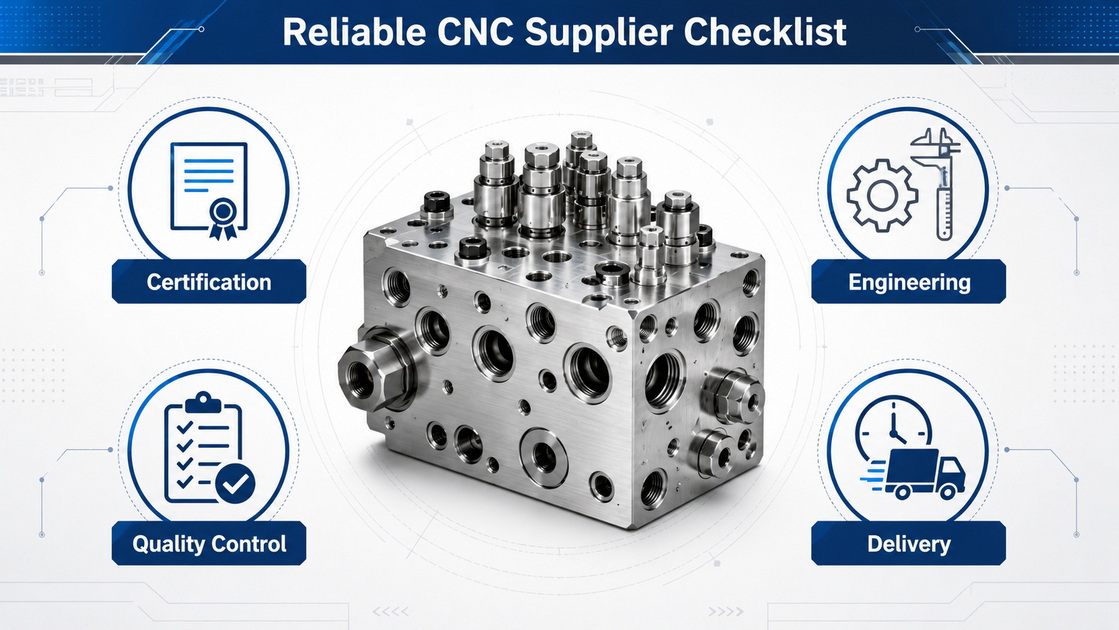
To curate this Top 10 list, we apply a transparent set of selection criteria aligned with how international OEMs and industrial distributors typically audit suppliers. [davantech]
Main criteria:
- Certifications and compliance: Valid ISO 9001 with CNC machining in the scope, plus evidence of material traceability and RoHS/REACH adherence for hydraulic components. [pkcncmachining]
- Technical capability: Experience with high-strength steels, corrosion-resistant stainless grades, aluminum, brass, and engineering plastics used in hydraulic systems; ability to hold tolerances down to approximately ±0.01 mm or better and achieve low roughness sealing surfaces. [eurobalt]
- QC and process control: CMM-based inspection, documented FAI, SPC where appropriate, and robust nonconformance handling (segregation areas, CAPA processes). [sarbo]
- Export and OEM/ODM experience: Demonstrated track record with foreign OEMs or brand owners; capability for engineering collaboration, co‑design, and flexible MOQs. [feifanhardware]
- Delivery and responsiveness: Measurable on‑time delivery rate, digital job tracking, and responsive English communication within roughly 24 hours for RFQs and technical queries. [feifanhardware]
In addition, we prioritize suppliers that openly share equipment lists, material partners, and inspection capabilities, as this transparency is often a proxy for mature management and customer focus. [brightrapid]
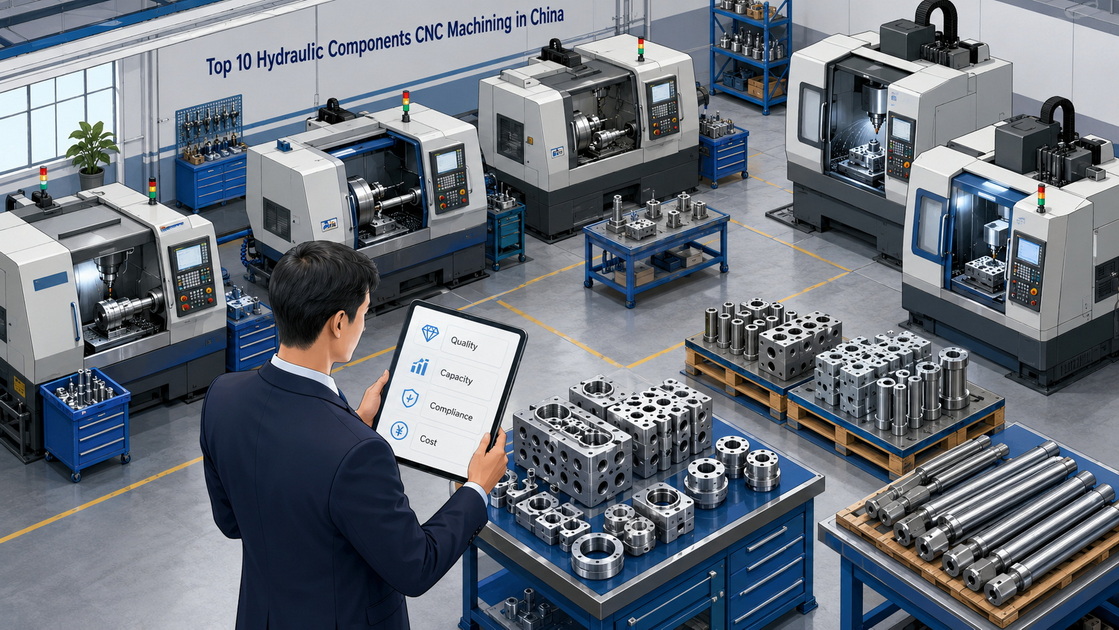
Hydraulic components—such as cylinder rods, barrels, pistons, valve bodies, manifolds, and glands—operate under high pressure and cyclic loads, so machining quality has a direct impact on sealing performance and service life. [mfg-solution]
Key technical points procurement managers should check:
- Materials: Common choices include alloy steels like 42CrMo4 and 34CrNiMo6 for high-pressure parts, 17-4PH and 316 stainless steel for corrosion resistance, 6061/7075 aluminum for lightweight housings, and brass/bronze for low-friction bushings and seats. [eurobalt]
- Tolerances and finishes: Many hydraulic parts require tolerances down to around ±0.005 mm on critical sealing interfaces, with surface roughness often below Ra 0.3 μm to ensure leak-free operation and smooth motion. [mfg-solution]
- Processes and finishing: Beyond CNC turning and milling, typical processes include heat treatment, nitriding, honing, polishing, deburring, anodizing, plating, and functional coatings for wear and corrosion resistance. [sarbo]
A capable supplier for hydraulic components should be able to discuss tolerances, roundness and concentricity control, and how they manage burrs and micro-leaks, rather than only quoting price and lead time. [afiparts]
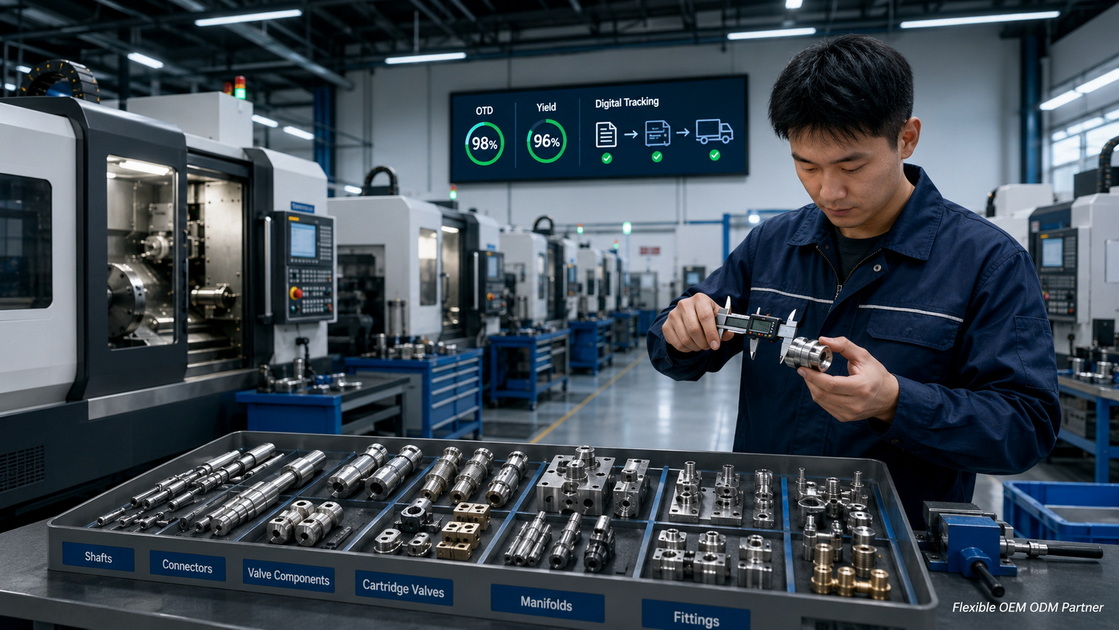
Shenzhen Feifan Hardware & Electronics Co., Ltd. is a national high‑tech enterprise founded in 2017, focusing on customized high-precision hardware parts with over 200 sets of high-end machining equipment and an approximately 6,000 m² modern production base. [feifanhardware]
The company integrates CNC turning, milling, drilling, and surface treatments (including oxidation and plating) in-house, and has passed ISO 9001 quality management certification, achieving a reported product qualification rate above 98% and on‑time delivery around 99%. [feifanhardware]
For hydraulic components, Feifan's strengths lie in multi‑axis machining for small and medium-sized precision parts, long shafts, and micro-porous components, supported by digital manufacturing systems that track order progress, equipment status, and inventory in real time. [feifanhardware]
They handle materials such as aluminum alloys, stainless steel, copper, and engineering plastics, and provide integrated solutions that cover material selection, process validation, and functional surface treatment for high-barrier applications like robotics and medical equipment—capabilities that transfer well to hydraulic manifolds, valve components, and precision connectors. [feifanhardware]
From a buyer's perspective, Feifan positions itself as a flexible, high‑value partner for small to mid-sized brands and OEMs, offering support for sampling, small and medium batch orders, and rapid delivery in as little as 3–5 days for certain jobs, while maintaining strong communication and project management for overseas customers. [feifanhardware]
Several CNC job shops located in Eastern China's hydraulic equipment clusters specialize in valve blocks, cylinder components, and fittings for construction and industrial machinery. [6wresearch]
Typical capabilities include 4/5‑axis machining centers, deep-hole drilling, honing, and in-house heat treatment, with certifications such as ISO 9001 and sometimes IATF 16949 for customers in construction equipment and mobile hydraulics. [eurobalt]
These suppliers often maintain long-term relationships with European hydraulic brands, providing chrome‑plated rods, honed tubes, and assembled kits with full material certificates and pressure test reports, making them attractive for buyers needing both semi-finished and finished hydraulic components. [afiparts]
In Southern China, there are precision turning specialists that focus on hydraulic valve spools, pistons, and sleeves with tight tolerances and intensive inspection. [krdprecision]
They typically control tolerances around ±0.01 mm (and tighter on request), use CMMs and roughness testers for 100% dimensional checks on critical features, and supply components made from certified steels, stainless steels, brass, and bronze with full traceability. [sarbo]
Such suppliers often support OEM/ODM services for hydraulic distributors, including design-for-manufacturing input on groove geometry, sealing profiles, and flow paths, thereby reducing leakage and extending product life. [krdprecision]
Some Chinese CNC shops work as integrators for hydraulic cylinder and valve assembly, combining machined components, seals, and basic assembly to deliver sub-assemblies directly to OEM assembly lines. [afiparts]
They usually provide machining for rods, barrels, pistons, and end caps, along with surface treatments such as nitriding, hard chrome plating, and shot blasting, and test assembled units under pressure to customer-defined standards. [eurobalt]
For buyers who want to reduce internal assembly workloads, these integrators can act as a single point of responsibility, but they require careful auditing of both machining and assembly quality systems. [pkcncmachining]
A subset of CNC suppliers in China focuses on high-mix, low-volume production for custom hydraulic components, serving niche machinery builders and prototype development. [brightrapid]
They support rapid prototyping lead times (commonly 5–10 days) and small MOQs, combined with the ability to machine complex geometries using 5‑axis centers and multi-tasking lathes. [pkcncmachining]
These shops are suitable for engineering teams that frequently iterate designs, require engineering reviews, and need flexible capacity rather than automotive-style high-volume lines. [brightrapid]
Automotive hydraulics, such as brake components and power steering elements, require suppliers with IATF 16949 certification and robust APQP/PPAP practices. [6wresearch]
Some Chinese CNC manufacturers specialize in this segment, offering process FMEAs, control plans, capability studies, and automatic inspection fixtures for high-volume hydraulic parts. [6wresearch]
These suppliers typically maintain fully traceable production records, automated measuring equipment, and strong defect prevention systems, making them suitable for buyers in automotive and heavy vehicle markets who require structured PPAP documentation. [pkcncmachining]
Many mid-sized CNC machining companies in China focus almost exclusively on export markets, especially Europe and North America, for industrial hydraulic components. [haizol]
These shops often offer English-speaking engineers, standardized RFQ templates, and transparent handling of Incoterms such as FOB, EXW, and DDP, along with support for packaging and customs documentation. [chinamachiningsolutions]
Their value proposition typically lies in balancing competitive pricing with high precision, leveraging China's cost structure while maintaining quality through modern equipment and systematic QC processes. [haizol]
Some hydraulic component suppliers combine CNC machining with in-house casting or forging capabilities, which can be advantageous for complex valve bodies and manifolds. [bg.qianzhan]
These companies cast or forge near-net shapes and then apply precision machining, reducing machining time and material waste while controlling dimensional stability and material properties. [afiparts]
They are particularly useful for large-volume projects where consistency and cost efficiency are critical, although they demand more extensive upfront DFM alignment with the customer. [mfg-solution]
For marine, offshore, and chemical applications, some Chinese CNC suppliers specialize in stainless and corrosion-resistant alloys for hydraulic components. [mfg-solution]
They have experience with 316/316L, duplex steels, and nickel-based alloys, and they manage challenges such as work hardening and thermal distortion during machining. [sarbo]
These shops typically offer enhanced surface integrity, corrosion testing, and documentation suitable for demanding environments, making them attractive for buyers in energy, marine, or chemical industries. [eurobalt]
Certain Chinese CNC companies focus on micro-scale precision parts, which can include miniature hydraulic or pneumatic components for medical and robotics applications. [feifanhardware]
They use specialized equipment for small and thin shafts and micro-porous parts, combined with magnified inspection and strict burr control to ensure reliable operation in compact hydraulic systems. [feifanhardware]
These suppliers are relatively rare but valuable for high-tech applications where component size and precision are critical, and where standard hydraulic job shops may not have suitable equipment or inspection methods. [krdprecision]
The following table provides an illustrative comparison of representative Chinese CNC suppliers serving hydraulic components; buyers should verify actual data case by case.
| Supplier Type | Typical Certifications | Approx. MOQ Range | Indicative Capability Highlights |
|---|---|---|---|
| Shenzhen Feifan Hardware & Electronics Co., Ltd. | ISO 9001, internal digital QMS feifanhardware | Flexible; supports samples and small–mid batches feifanhardware | 200+ CNC/lathe units, multi-axis machining, ±0.005 mm tolerance class, integrated surface treatment feifanhardware |
| Eastern China hydraulic cluster specialist | ISO 9001, some IATF 16949 mfg-solution | Medium to high volume | Cylinder components, valve blocks, chrome rods, honing and heat treatment mfg-solution |
| Precision turned parts hydraulics manufacturer | ISO 9001, material traceability sarbo | Mid-volume, repeat orders | Tight tolerances around ±0.01 mm, 100% CMM checks, steels and bronze sarbo |
| High-mix, low-volume CNC partner | ISO 9001; flexible scope brightrapid | Very low; prototype friendly | 5‑axis machining, complex prototypes, rapid lead times for custom hydraulics brightrapid |
This kind of table can be extended with specific suppliers as buyers narrow down their RFQ shortlist and confirm certification details. [davantech]
Beyond obvious issues like visible defects, experienced buyers of hydraulic components note several recurring but less-visible risks. [anxin-cnc]
Common pain points:
- Invisible material downgrades: Substituting cheaper steels or unqualified bars that nominally match the spec but lack proper mechanical properties, leading to premature failure or leakage under pressure. [pkcncmachining]
- Marginal surface finish on sealing surfaces: Parts pass basic dimensional checks but have micro-scratches or insufficiently controlled roughness, causing slow leaks or short seal life in the field. [mfg-solution]
An insider pitfall rarely discussed publicly is "quiet re-sourcing" inside the supply chain: some machining shops outsource part of the production to smaller subcontractors when capacity is tight, without fully disclosing it, resulting in inconsistent quality between batches even though the signed supplier remains the same. [anxin-cnc]
To mitigate this, advanced buyers explicitly require disclosure of sub-suppliers in contracts, mandate that critical hydraulic components stay in-house, and occasionally cross-check batch markings, CMM reports, and factory records during on-site or remote audits. [sanjieprecision]
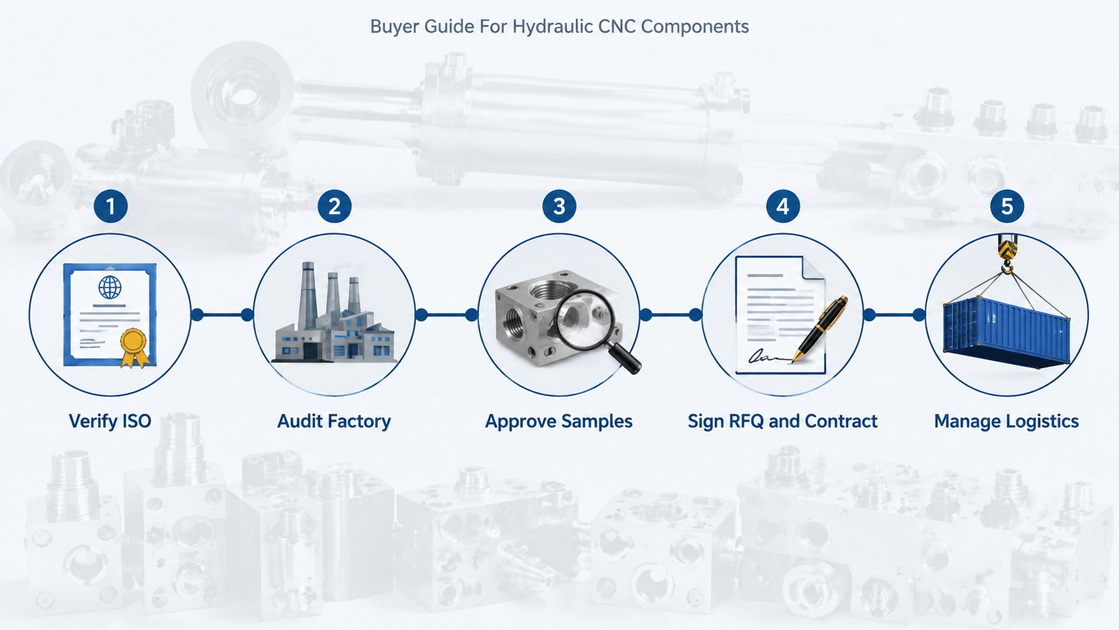
Start with desk-based verification of ISO certificates to ensure that CNC machining is within scope and that the certificate is valid and issued by a recognized body. [davantech]
Use public databases from certification bodies or ask the supplier for scan copies with QR codes or verification links, and check that expiry dates and site addresses match the factory you plan to use. [davantech]
For hydraulic components, also confirm RoHS/REACH compliance where required, and request material test certificates (MTCs) to confirm chemical composition and mechanical properties. [sarbo]
Using an audit checklist aligned with ISO 9001 and CNC machining practices helps buyers evaluate capacity, quality systems, and risk controls in a disciplined way. [davantech]
Key items to inspect include equipment lists (3/4/5‑axis centers, turning, honing), calibration status, 5S practices, segregation of conforming vs. nonconforming materials, and active job travelers on the shop floor. [davantech]
An on-site or video audit should also review nonconformance handling, improvement programs, and EHS/5S performance, as these indicate how robustly the factory handles process variation and long-term quality. [sanjieprecision]
Before placing a mass-production order, ask for prototype parts and a complete FAI report with dimensional, material, and surface finish data. [pkcncmachining]
Consider sending a test drawing with defined CTQs (critical-to-quality dimensions) and comparing multiple suppliers' responses to evaluate both machining capability and documentation quality. [mfg-solution]
Sample evaluation should include pressure tests where relevant, leak checks, and assembly trials to ensure fit with mating parts, not just isolated dimensional checks. [afiparts]
A complete RFQ should include drawings, 3D models, tolerances, surface requirements, heat treatment specs, inspection plans, packaging, and acceptance criteria, along with expected volumes and forecast. [chinamachiningsolutions]
Clarify Incoterms, shipping frequency, buffer stock levels, and responsibilities for defects (e.g., credit notes, rework, replacement time frames) in the contract to avoid disputes later. [chinamachiningsolutions]
Many buyers also define change control requirements—such as advance notice when changing materials, processes, or sub-suppliers—to maintain consistency over the product lifecycle. [sanjieprecision]
Experienced suppliers can support export packaging, anti-rust protection, documentation (commercial invoices, packing lists), and sometimes DDP solutions for key markets. [haizol]
For hydraulic components, packaging must protect surface finish and prevent corrosion (e.g., VCI packaging, oiling, and careful separation to avoid scratching). [eurobalt]
After delivery, track defect rates and response times; long-term partnerships work best when both sides share data and adjust processes to reduce field failures or returns. [brightrapid]
China's hydraulic components CNC machining ecosystem combines mature industrial clusters, a wide range of specialist suppliers, and competitive cost structures, making it an attractive sourcing base for global OEMs and distributors—provided buyers apply robust evaluation and risk-control practices. [wits.worldbank]
For sourcing teams seeking a flexible, high‑value partner capable of supporting OEM/ODM hydraulic components—especially for small and medium brands—Shenzhen Feifan Hardware & Electronics Co., Ltd. offers a strong combination of precision equipment, ISO-certified QC, digital management, and fast sampling and batch delivery. [feifanhardware]
If you are currently shortlisting suppliers, a practical next step is to send a detailed RFQ and sample drawing package to 2–3 candidates, including Feifan, and compare not only quotations but also their technical feedback, inspection plans, and communication responsiveness before committing to long-term cooperation. [feifanhardware]
1. How can I verify whether a supplier's ISO 9001 certificate is still valid and not forged?
Request a digital copy and check the certificate number, scope, and expiry date against the issuing certification body's online database or hotline; many registrars provide searchable lists and QR codes for quick verification. [davantech]
2. What tolerance and surface finish should I specify for critical hydraulic cylinder components?
For pistons, rods, and sealing bores, many hydraulic applications target tolerances in the order of ±0.005–0.01 mm and surface roughness around or below Ra 0.3 μm; however, exact values should follow your system design and OEM standards. [eurobalt]
3. How do I ensure the supplier does not downgrade materials for cost savings?
Include material grade and standards in drawings, request MTCs for each batch, and occasionally send independent lab tests to validate chemical composition and mechanical properties against the certificates provided. [mfg-solution]
4. What is a reasonable lead time for CNC‑machined hydraulic components from China?
Industry guides cite typical lead times of around 5–10 days for prototypes and 2–4 weeks for production batches, depending on complexity, volume, and finishing; custom heat treatments or coatings may extend this. [afiparts]
5. How can I differentiate a high-mix specialist from a high-volume hydraulic supplier during sourcing?
A high-mix specialist will emphasize flexible MOQs, prototyping services, and engineering collaboration, often with many short-run jobs visible on-site, while high-volume suppliers showcase automated lines, APQP/PPAP documentation, and statistical process controls tailored to large, repeat orders. [brightrapid]
1. Qianzhan Industry Research – "China Hydraulic and Pneumatic Power Machinery and Components Manufacturing Industry Analysis Report" (in Chinese). [bg.qianzhan]
2. World Bank – "China Exports of Parts of hydraulic & pneumatic & other power engines (HS 841290)." [wits.worldbank]
3. Davantech – "CNC Supplier Audit Checklist for China" (ISO 9001-aligned audit checklist). [davantech]
4. Anxin CNC – "How to Select a Reliable CNC Machining Supplier in China: Complete 2025/2026 Guide." [anxin-cnc]
5. PuKong CNC – "How to Identify a Qualified CNC Machining Supplier in China." [pkcncmachining]
6. Haizol – "CNC Machining in China vs Local & Overseas Suppliers (2026)." [haizol]
7. MFG Solution – "CNC Precision Machining for High-Precision Hydraulic and Pneumatic Control Components." [mfg-solution]
8. Sarbo – "CNC Machining for Hydraulic Components." [sarbo]
9. Eurobalt – "Manufacturing Hydraulic Cylinder Components: Materials, Technologies, and Quality Standards." [eurobalt]
10. AFI Parts – "OEM Guide to Custom Hydraulic Cylinder Parts CNC Machining." [afiparts]
11. Shenzhen Feifan Hardware & Electronics Co., Ltd. – "About Us." [feifanhardware]
12. Shenzhen Feifan Hardware & Electronics Co., Ltd. – "Service." [feifanhardware]
13. Shenzhen Feifan Hardware & Electronics Co., Ltd. – "Resource" (equipment and process overview). [feifanhardware]
14. 6Wresearch – "China Hydraulics Market (2025–2031)." [6wresearch]
15. BrightRapid and related CNC sourcing guides – "China CNC Machining: Guide to Reliable Precision Manufacturing" and similar buyer guides. [sanjieprecision]


