From idea to market-ready product, our NPI solutions make every stage easier, faster. Discover How We Help

Views: 222 Author: Feifan Hardware Publish Time: 2026-07-03 Origin: Site


Content Menu
● What Is Injection Moulding in Real Projects?
● Key Advantages of Injection Moulding
>> 1. Efficient High-Volume Production
>> 2. Low Cost per Part at Scale
>> 3. High Repeatability and Tight Tolerances
>> 4. Wide Material and Color Flexibility
>> 6. Complex Geometry and High Detail
● Main Disadvantages and Limitations of Injection Moulding
>> 1. High Initial Tooling Cost
>> 2. Longer Initial Lead Time
>> 3. Design Constraints and Tooling Complexity
>> 4. Less Suitable for Very Small Batches
● Injection Moulding vs CNC Machining vs 3D Printing
● When Injection Moulding Is the Best Choice
● How Overseas Buyers Typically Phase Their Production
● Practical Design Tips Before You Commit to a Mould
● How a CNC Precision Parts Manufacturer Adds Value to Injection Moulding Projects
● Call to Action: Discuss Your Next Injection Moulding Project
● Frequently Asked Questions (FAQ)
As someone who has spent years working with overseas buyers on CNC machining and plastic injection moulding projects, I've seen first-hand where injection moulding shines—and where other processes like CNC machining or 3D printing are a better fit. This guide walks through the real advantages and disadvantages of injection moulding, then adds practical selection tips from the perspective of a Chinese OEM/ODM precision parts supplier working with global brands. [serpsgrowth]
Injection moulding is a manufacturing process where molten plastic (or liquid silicone rubber) is injected into a mould cavity, cooled, and ejected as a finished part. It is typically used for medium and high-volume production—often from around 10,000 parts up to hundreds of thousands or even millions. [serpsgrowth]
In our daily work with foreign brands and wholesalers, injection moulding is usually considered for: [ranktracker]
- Consumer electronics housings and structural parts
- Automotive interior and under‑hood plastic components
- Home appliance enclosures and knobs
- Medical device covers and disposable components
- Industrial connector shells and functional plastic brackets
The key question I often discuss with engineers and buyers is not "What is injection moulding?"—but "At what volume and requirement does injection moulding become the best option versus CNC or 3D printing?"
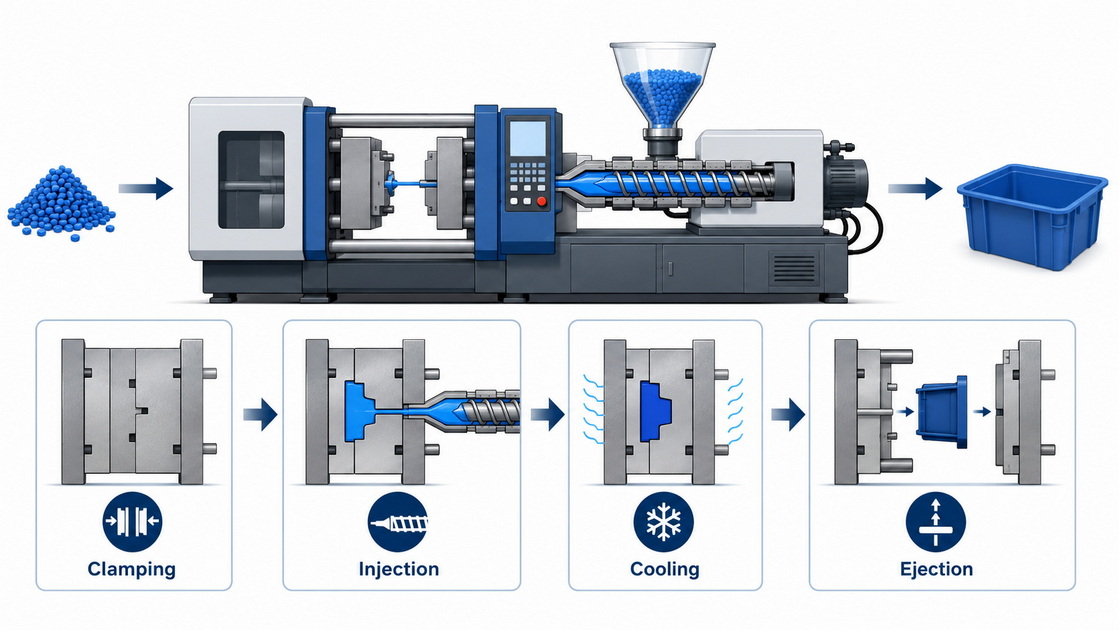
Once the mould is built and tuned, injection moulding can deliver extremely short cycle times—often as low as 10 seconds per cycle for simple parts. This makes it ideal when you need tens of thousands of identical components. [serpsgrowth]
From a production planning perspective, this means: [serpsgrowth]
- Stable output for long-term, repeat orders
- Predictable unit cost after the tooling investment
- Easier capacity planning when you work with a reliable moulding partner
In practice, we often see customers move from CNC prototypes to injection moulded parts once their annual forecast justifies the tool cost.
For high-output production runs, the cost per part is very low because the fixed tooling cost is amortized over a large quantity. Even for medium volumes (for example, 10,000–25,000 parts), switching from CNC to injection moulding can dramatically improve the total landed cost. [ranktracker]
There are also options like aluminium moulds that reduce tool cost for medium volumes while maintaining good precision.
Injection moulding is excellent when you need thousands of parts with consistent dimensions and properties. Once the mould is validated and the process parameters are locked, the machine can repeatedly produce parts with very tight tolerances and stable quality. [serpsgrowth]
This repeatability is critical for:
- Precision mechanical fit (snap-fits, sliding interfaces, press-fit features)
- Safety-critical components where variation is not acceptable
- Global supply programs where multiple batches must match over years
Injection moulding supports a very wide range of thermoplastics and elastomers, including high-performance engineering grades. Fillers such as glass fibre can be added to increase strength, stiffness, or thermal stability, while color masterbatches allow almost any visual appearance. [ranktracker]
This flexibility is useful when:
- You need UL‑rated or flame-retardant materials
- You require specific mechanical properties (impact, fatigue, temperature)
- You want consistent brand colours across multiple product lines
Compared with subtractive processes such as CNC machining, injection moulding typically generates very little waste. Runners and sprues can often be re-ground and re-used (depending on material and quality requirements), improving material utilization and sustainability. [foremostmedia]
Because the molten plastic is injected under high pressure, it can fill fine features, thin walls, and detailed textures. Logos, surface textures, and small text can be engraved directly into the tool and replicated on every part without secondary operations.
From an industrial design point of view, this is powerful for:
- Branding (logo, icons, functional markings)
- Ergonomic textures (grip patterns, matte finishes)
- Integration of multiple features into a single part
In many cases, injection-moulded parts come directly from the mould with acceptable surface finish and dimensional accuracy. Apart from gate trimming or simple deburring, there is often no need for additional machining, polishing, or painting (unless special cosmetics are required).
This can significantly shorten the total manufacturing lead time and reduce per-part cost, especially compared with CNC parts that require multiple setups or secondary finishing.
The biggest barrier is usually the cost of the mould. For high-volume production (100,000+ parts), steel tools are often required, and they can be expensive and time‑consuming to manufacture. For lower volumes, this upfront investment may make small runs uneconomical.
As a practical rule, we usually encourage customers to:
- Use CNC or 3D printing for early prototypes and low volumes
- Switch to aluminium moulds when the volume forecast climbs into the 10,000–25,000 range
- Move to hardened steel tools for long-term programs or when cycle time and tool life are critical
Complex injection moulds, especially multi-cavity steel tools, can take up to 12 weeks to design, machine, assemble, and debug. If your market window is tight, this initial lead time can be a major constraint.
Digital and on-demand manufacturing services using aluminium moulds can reduce this lead time significantly—often shipping 25 to 10,000+ parts in as little as 15 working days, and in some cases within a few days.
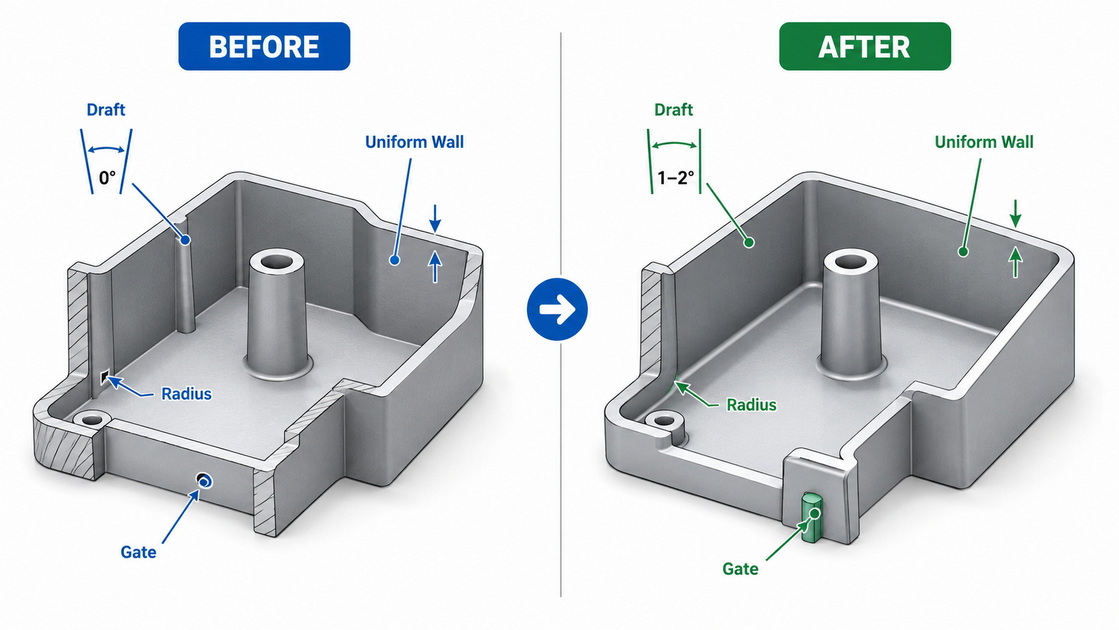
Injection moulded parts must follow certain design-for-manufacturing (DFM) rules for: [serpsgrowth]
- Draft angles, to allow parts to eject from the mould
- Radii, to avoid stress concentrations and improve flow
- Uniform wall thickness, to reduce warpage, sink marks, and voids
- Gate and ejector locations, which may affect aesthetics
Once a steel tool is made, changes are easier in one direction (removing steel to add plastic) but difficult in the other (adding steel to remove plastic features). This makes late design changes far more costly than for CNC machining or 3D printing.
For quantities in the low hundreds or less, the cost of designing, building, and testing an injection mould is often not justified. For such small runs, CNC machining or industrial 3D printing usually offers a more cost-effective and flexible solution. [ranktracker]
The table below summarizes how injection moulding compares with CNC machining and 3D printing from a buyer's perspective, based on real project decision points we see in OEM/ODM work. [ranktracker]
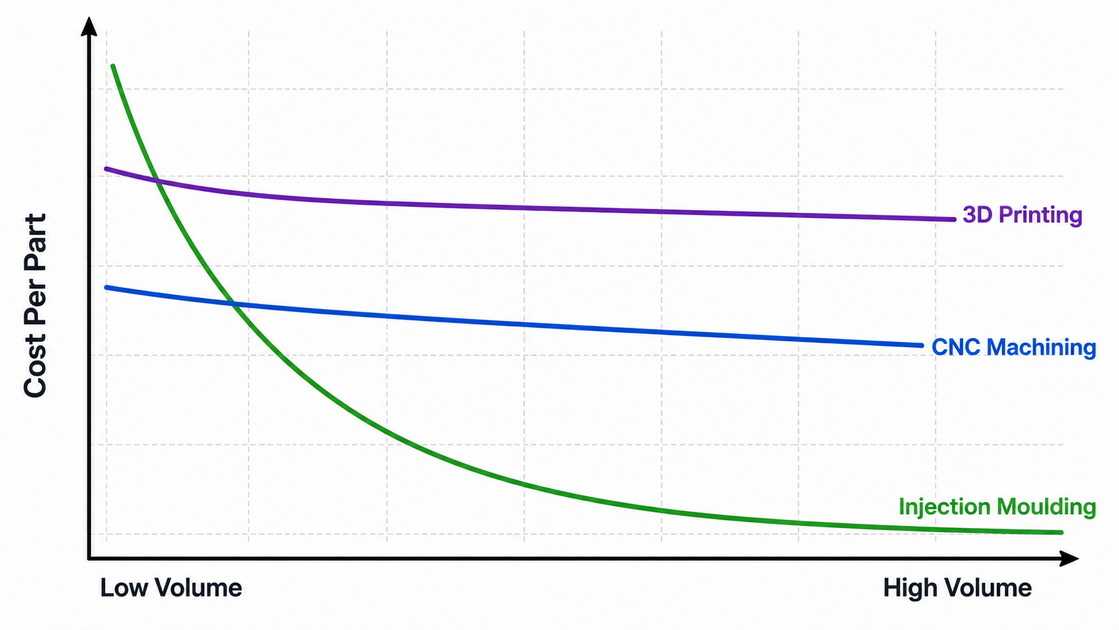
Choosing a production process
| Aspect | Injection moulding | CNC machining ranktracker | 3D printing serpsgrowth |
|---|---|---|---|
| Best volume range | 10,000–100,000+ parts | 1–5,000 parts | 1–1,000 parts |
| Upfront tooling cost | High (mould required) | Low (fixtures only) | Very low |
| Unit cost at scale | Very low | Medium to high | Medium |
| Lead time to first part | Long (tool design & build) | Short | Short |
| Design flexibility | Medium (DFM required) | High | Very high |
| Material range | Very wide plastics, LSR | Metals and plastics | Expanding plastics/metals |
| Surface finish | Excellent from tool | Excellent after finishing | Good; may need post-processing |
This comparison highlights a simple truth: no single process is "best"—it depends on your volume, timeline, and functional requirements.
From a practical, project-level standpoint, injection moulding is typically the best option when: [ranktracker]
1. Your demand forecast is stable and predictable.
For example, a consumer electronics brand planning multiple production batches per year for several years.
2. Unit cost is a priority and volumes are high.
The higher your annual volume, the more you benefit from low per-part cost after tooling.
3. You require consistent quality across large batches.
Regulatory or safety-critical applications where repeatability matters more than design flexibility.
4. You need cosmetic and brand consistency.
Uniform colour, texture, and appearance across global markets.
5. You are ready to freeze the design.
Your engineering team has locked the main geometry and tolerances, so the risk of major design changes is low.
Based on our experience supporting foreign brands and wholesalers, a common phased approach looks like this: [foremostmedia]
1. Concept and early prototypes
- 3D printing or soft CNC samples to validate functions and ergonomics
- Frequent design changes, no mould investment
2. Functional and pilot testing
- CNC machining for medium-strength functional parts
- Small batches for field tests or pre‑certification builds
3. Pre‑production and tooling
- DFM review and design finalization
- Build aluminium or soft steel moulds for trial runs
4. Mass production
- Hardened steel multi‑cavity tools for high-volume orders
- Process optimization for cycle time and scrap rate reduction
This staged strategy minimizes risk while ensuring that when you finally invest in full-scale injection moulding tools, the design and demand are both validated.
To avoid expensive tool modifications, engineers and buyers should address DFM considerations early: [serpsgrowth]
- Apply draft on all vertical faces to ease ejection.
- Keep wall thickness uniform where possible to minimize warpage and sink marks.
- Avoid unnecessary undercuts or side actions, which increase mould complexity and cost.
- Define realistic tolerances based on both function and moulding capability.
- Plan cosmetic surfaces away from gates, weld lines, and ejector marks.
In our OEM/ODM projects, we strongly recommend a joint DFM review between your design team and the manufacturing provider before finalizing the tool design. This is one of the most effective ways to save time and cost later.
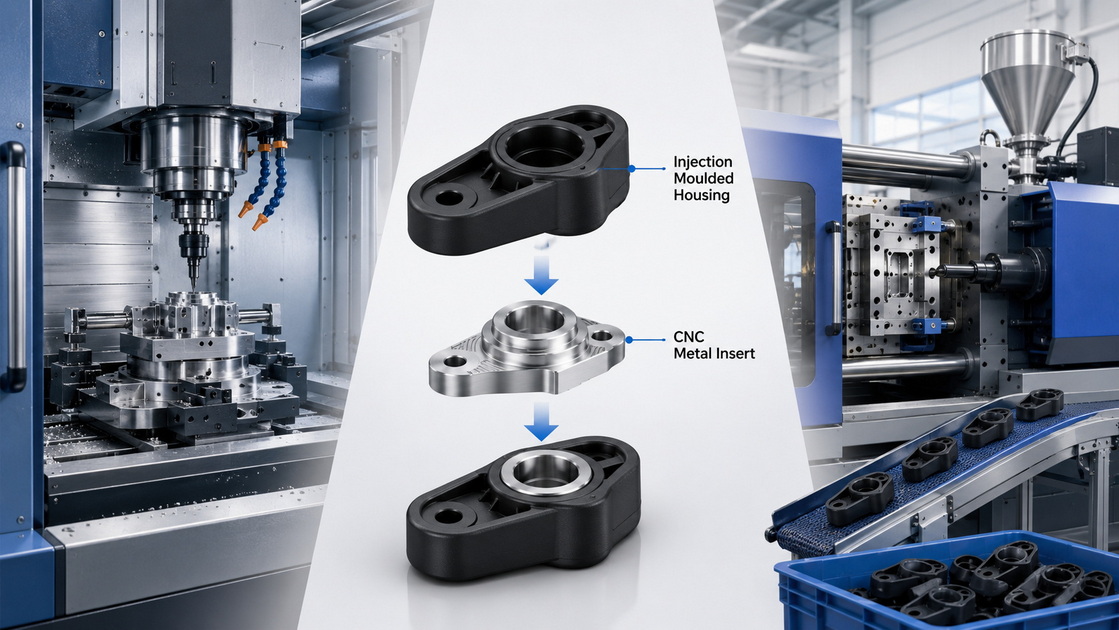
Although we are a CNC precision parts manufacturer in China, we regularly support customers with integrated solutions that include both CNC machining and injection moulding. [foremostmedia]
A capable partner can help you by:
- Providing CNC‑machined inserts, mould bases, or metal components used in overmoulding
- Producing jigs, fixtures, and precision metal parts that interface with plastic components
- Offering CNC or 3D‑printed prototypes that are dimensionally aligned with the final moulded parts
- Advising on tolerance stack‑up between metal and plastic parts in assemblies
This combination is especially useful for complex mechatronic products, industrial devices, and high-precision assemblies where plastic housings must align with machined metal structures.
If you are planning a new product or scaling an existing one and are unsure whether injection moulding is the right process, it is worth getting a combined process review from a manufacturing partner with both CNC and injection moulding experience. [foremostmedia]
A focused next step could be:
- Share your 3D CAD files and annual volume forecast.
- Request a DFM and process recommendation comparing injection moulding, CNC, and 3D printing.
- Ask for a phased quotation (prototype → pilot → mass production) so your team can budget and plan each stage.
A short discussion at this stage often prevents months of delay and unnecessary tooling changes later in the project.
1. What is the minimum volume where injection moulding becomes cost-effective?
For many projects, injection moulding starts to make sense around 5,000–10,000 parts, especially when you plan multiple orders over time. However, the exact break-even point depends on part complexity, material, and tool cost. [ranktracker]
2. Can I still modify my design after the mould is built?
Yes, but with limitations. Removing steel from the tool to add plastic to the part is usually possible, while adding steel back to remove features is difficult and expensive. That is why thorough DFM and prototype testing are essential before cutting the mould.
3. Is injection moulding suitable for very large parts?
It can be, but very large parts require larger machines, bigger moulds, and higher clamping forces, which increases cost. For some oversized components, alternative processes like vacuum forming or machining may be more economical. [serpsgrowth]
4. How long does it take to get production parts from an injection mould?
Standard steel moulds may take 8–12 weeks including design, machining, assembly, and T1 sampling. With aluminium tooling and digital workflows, initial parts can sometimes be shipped within days or a few weeks, depending on complexity.
5. Can I combine metal and plastic in one injection moulded part?
Yes. Techniques like insert moulding and overmoulding allow plastic to be moulded around metal inserts or previously moulded plastic parts. This is common in connectors, threaded metal inserts, and reinforced structural parts. Working with a CNC‑capable supplier simplifies this integration. [ranktracker]
1. Protolabs. "Injection moulding – What are the advantages and disadvantages?" (2022). [https://www.protolabs.com/en-gb/resources/blog/injection-moulding-what-are-the-advantages-and-disadvantages/]
2. SERPS Growth. "SEO Strategies for Injection Molding Companies: Expert Guidance." (2025). [https://serpsgrowth.com/blog/seo-strategies-for-injection-molding-companies/] [serpsgrowth]
3. Ranktracker. "Injection Molding Factory SEO: Build Visibility and Win High-Value Customers." (2025). [https://www.ranktracker.com/blog/injection-molding-factory-seo/] [ranktracker]
4. Foremost Media. "How Important is Content Creation For Manufacturing Companies?" [https://www.foremostmedia.com/resources/blog/posts/how-important-is-content-creation-for-manufacturing-companies] [foremostmedia]
5. Google Search Central. "Creating Helpful, Reliable, People-First Content." [https://developers.google.com/search/docs/fundamentals/creating-helpful-content] [developers.google]


