From idea to market-ready product, our NPI solutions make every stage easier, faster. Discover How We Help

Views: 222 Author: Feifan Hardware Publish Time: 2026-06-23 Origin: Site


Content Menu
● Quick Definitions – What Is Tapping and What Is Thread Milling?
● Key Comparison – Thread Milling vs. Tapping for Large Holes
>> Performance and risk for large diameters
>> Comparison table: large‑hole threading
● Material and Geometry – When Thread Milling Clearly Wins
>> Hard‑to‑machine or high‑value materials
>> Deep, blind and large‑pitch holes
● Speed, Cost and Tooling Economics in Real Projects
>> Cycle time vs. total cost of ownership
>> Inventory and setup flexibility for OEM/ODM work
● Dimensional Accuracy, Surface Quality and Tolerance Control
>> Thread quality and tolerance
>> Adjustability for design changes
● Practical Decision Framework – How to Choose for Large Holes
>> Simple rule‑set you can use on the shop floor
● Design and Process Tips for Large Threaded Holes
>> Getting the pre‑drilled hole right
>> Hole depth, chamfers and edge distances
● Expert Case Insight – Why Many Advanced Shops Thread Mill Large Holes by Default
● Implementation Checklist for Your CNC Shop
● Conclusion – Which Is Better for Large Holes?
● FAQs on Thread Milling vs. Tapping for Large Holes
When you scale up from M8 to M20, M30 or even larger pipe threads, threading strategy starts to dominate both part quality and machining economics. From my experience working with global OEM customers, most "mysterious" assembly problems on large housings, valves or manifolds trace back to poorly engineered tapped holes or under‑engineered thread milling paths. [huayi-group]
For a precision CNC supplier in China serving overseas brands, your choice between thread milling vs. tapping for large holes sends a strong signal about your process capability, risk control, and ability to support design for manufacturability (DFM) in early project stages. This article walks through the technical and business trade‑offs, and then gives you a practical decision framework you can apply directly on your shop floor or in your process sheets. [kennametal]
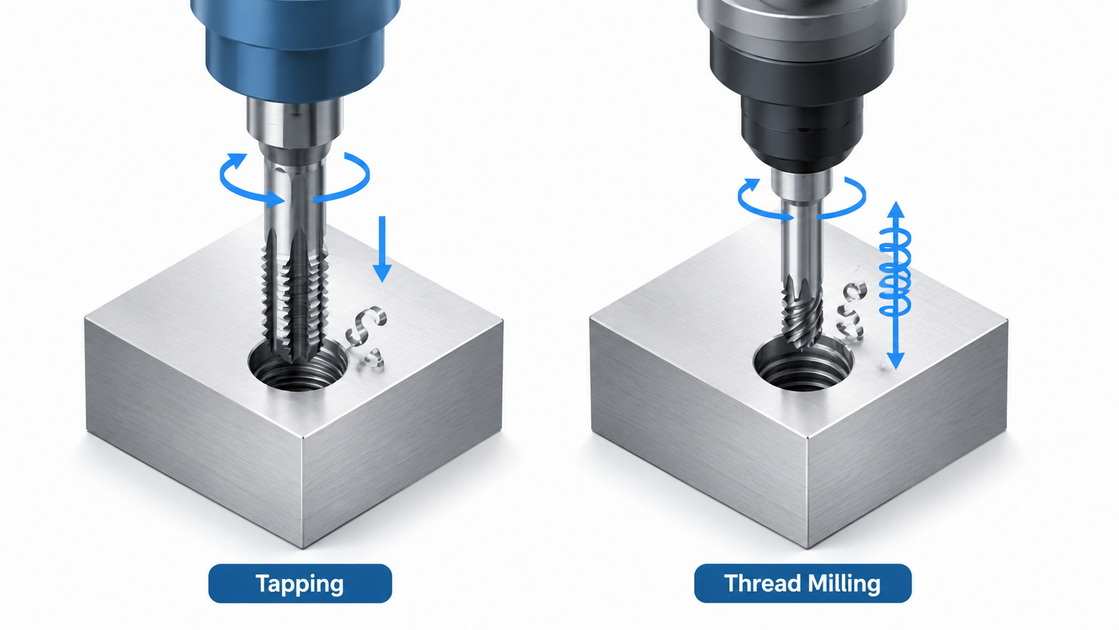
Tapping is the traditional method where a dedicated tap cuts or forms the entire thread profile in one pass through a pre‑drilled hole. In CNC machining, you'll typically use rigid tapping or tension‑compression tapping to synchronize spindle and feed and generate the thread in just a few seconds. [tnnengineering]
- Uses a specific tap size for each thread specification
- Requires relatively high torque, especially on larger diameters
- Very fast per hole, ideal for mass production
- Higher risk of tool breakage in hard or sticky materials
For many standard holes up to around 3/4 inch (≈M20), tapping is often the default choice because it is simple, well‑understood, and easy to quote. [kennametal]
Thread milling uses a rotating milling cutter that moves along a helical path to gradually cut the thread profile inside a pre‑drilled hole. Instead of generating the full thread in one stroke, the cutter "walks" around the hole multiple times and can be programmed for different diameters and pitches. [linkedin]
- One tool can often cover a range of diameters
- Lower cutting forces and torque than a large tap
- Excellent surface finish and dimensional control
- Easier chip evacuation, especially in blind or deep holes
For large holes, deep threads or exotic alloys, thread milling is widely recognized as a high‑precision and lower‑risk option compared with heavy tapping. [linkedin]
Once thread size grows beyond about 3/4 inch (≈M20), the limitations of tapping become obvious: torque rises sharply and any misalignment or chip packing can snap an expensive tap inside a near‑finished part. Thread milling distributes cutting forces over a smaller contact area and multiple passes, so large‑diameter threads can be produced on less powerful machines with lower risk of catastrophic tool failure. [chinamachiningsolutions]
In industries like oil & gas, hydraulics or power transmission, a broken tap in a large, complex casting often means scrapping a high‑value workpiece or extended rework. For OEM customers, that translates into missed delivery, unpredictable cost, and serious quality concerns—exactly what global buyers want to avoid when they work with a Chinese precision supplier. [jcproto]
| Factor | Tapping (large holes) | Thread milling (large holes) |
|---|---|---|
| Speed per hole | Very fast cycles, 1‑pass thread creation jlccnc | Slower, multiple passes around helical path jlccnc |
| Machine power | Needs high torque and rigid spindle for big taps kennametal | Lower torque requirement, more forgiving on machine power kennametal |
| Breakage risk | High in tough or sticky materials; broken taps can scrap parts jlccnc | Much lower; tool failure is rare and easier to recover linkedin |
| Thread quality | Good, but geometry is fixed by tap design jlccnc | Excellent finish, easily tuned depth and pitch diameter linkedin |
| Flexibility | One tap per size and pitch kennametal | One tool can cover range of diameters and threads linkedin |
| Best use case | High‑volume, standard threads, moderate size jlccnc | Large, deep, critical or non‑standard threads linkedin |
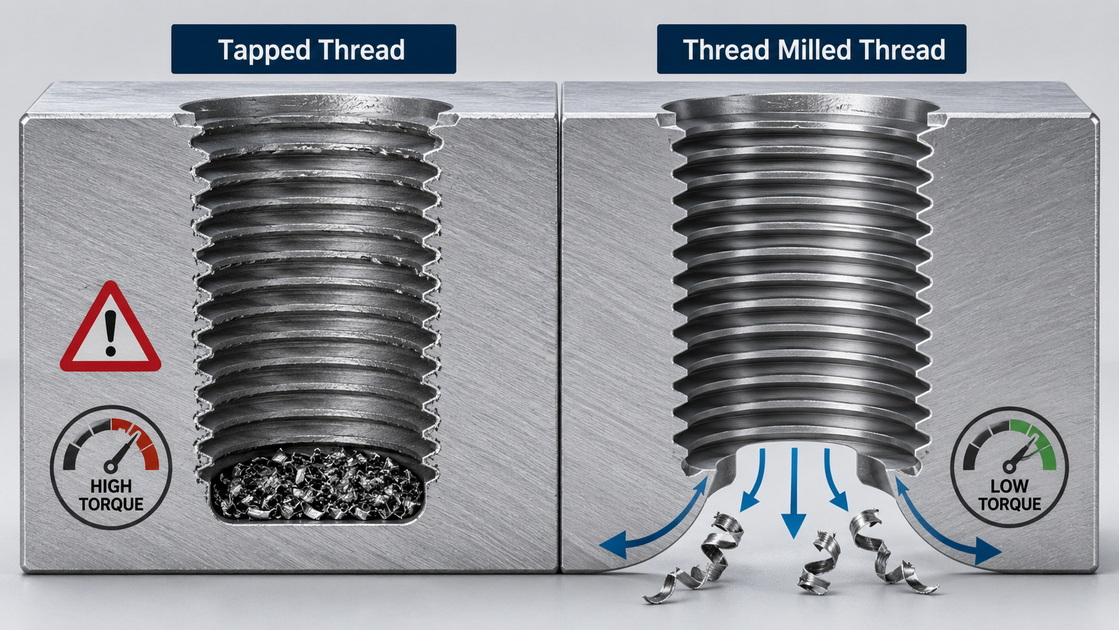
In materials like stainless steels, titanium, Inconel and hardened alloys, taps see high cutting loads and heat concentration, especially on large diameters. That combination drives up torque and breakage probability, which is why many advanced CNC shops switch to thread milling for such materials beyond moderate sizes. [chinamachiningsolutions]
Thread milling allows you to use more conservative feed rates, optimized radial engagement, and coolant strategies that keep cutting temperatures controlled. For overseas buyers supplying aerospace, medical or energy sectors, this is often the safest route to stable quality and predictable cost. [jcproto]
Blind holes with long thread engagement are a classic tapping problem: chips tend to pack at the bottom and can seize or snap the tap. Thread milling provides far better chip evacuation because the cutter repeatedly exits the hole, clearing chips and avoiding compressed swarf at full depth. [jlccnc]
Design guides typically recommend effective thread depths around 1.5 to 2 times the diameter for most materials, and they suggest switching to relieved shank tools or thread milling when deeper engagement is required. For large pitch pipe threads or sealing threads where form is critical, milling lets you fine‑tune depth and flank engagement to meet functional sealing requirements. [huayi-group]
On paper, tapping still "wins" pure cycle time: for a standard thread, you may complete the operation in 4–5 seconds versus roughly double that for thread milling. However, on large holes the total cost of ownership often flips because the consequences of a broken tap or rejected large housing far outweigh the extra seconds of milling. [tnnengineering]
Thread mills are more expensive per tool, but they frequently offer longer life and can replace multiple taps across a range of sizes and pitches. For OEM/ODM runs with diverse part families and moderate batch sizes, this flexibility often gives a better overall ROI than stocking many large, rarely used taps. [jlccnc]
For a company serving global brands, you rarely run the same part for months; instead you see mixed orders, engineering changes, and new product introductions. With thread milling, the same cutter can be reprogrammed for different diameters, pitches or thread tolerances, which simplifies inventory and speeds up changeovers. [linkedin]
Tapping, by contrast, locks you into one size‑one tool, so every new special thread on a large hole requires new taps, lead times, and sometimes custom tool procurement. In an OEM environment where agility and engineering responsiveness are selling points, that lack of flexibility can quietly increase both direct costs and lead times. [kennametal]
Thread milling lets you control minor diameter, pitch diameter and thread depth via CNC offsets and toolpath strategies, which is crucial for tight tolerance large threads. You can compensate tool wear digitally rather than relying on the fixed geometry of a physical tap. [chinamachiningsolutions]
Studies and industry experience show that thread milling consistently produces smoother flanks and better surface finishes than tapping, especially on large diameters and difficult alloys. For customers with demanding fit or sealing requirements, this higher and more repeatable thread quality directly reduces assembly torque issues, leak paths and galling. [tnnengineering]
When a customer updates specifications—changing fit class, plating thickness, or seal design—thread milling allows you to adjust offsets and step‑downs without changing hardware. This agility is particularly valuable if you support DFM discussions and prototypes for overseas brands, where drawing revisions are frequent in the early phases. [jcproto]
Tapping can support minor tolerance tuning with different tap classes, but those options are limited and require new tool purchases and approvals. For an OEM/ODM manufacturer, this makes thread milling a powerful tool for compressing development cycles while still delivering robust, documented process control. [linkedin]
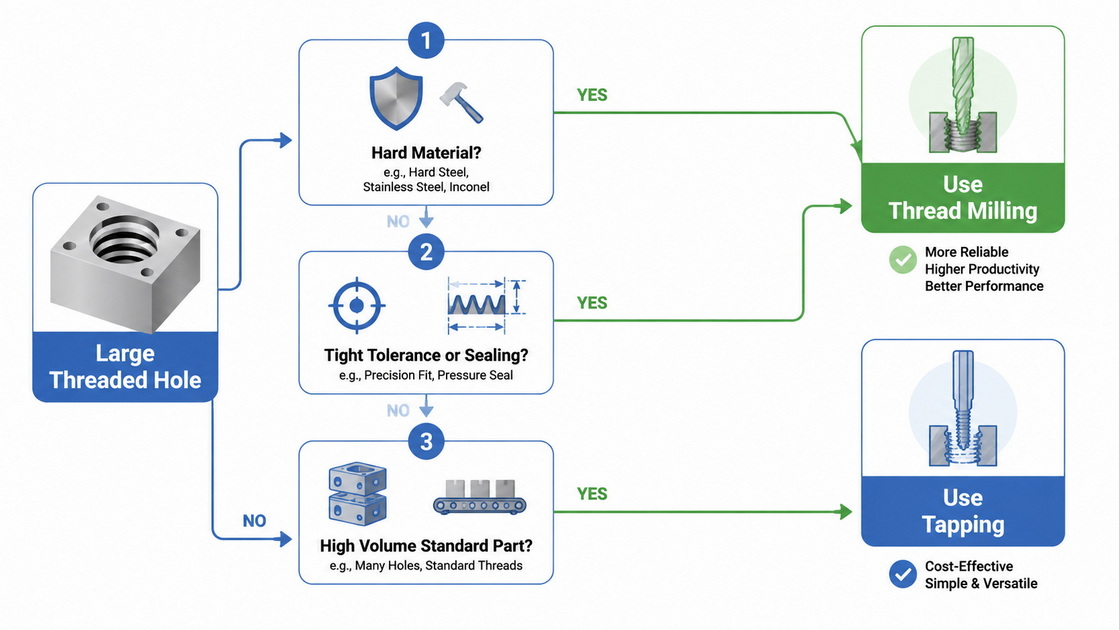
You can translate the above analysis into a checklist for programmers, process engineers and estimators. The following rules focus on large holes (for example, above M20 or 3/4 inch), where the stakes are highest: [kennametal]
1. Choose tapping when:
- The hole size is large but the material is easy‑to‑machine and non‑critical (e.g. low‑carbon steel, aluminum)
- Tolerances are moderate and minor surface variation is acceptable
- Volumes are high and cycle time dominates cost
- You have a powerful, rigid machine and suitable high‑quality taps available
2. Choose thread milling when:
- The material is hard, sticky or exotic (stainless, titanium, Inconel, hardened steels)
- Thread size is large, deep, or applied to high‑value castings or housings
- Tolerances are tight, sealing performance is critical, or design may change
- Production mix is varied and you need maximum tooling flexibility
3. Escalate to engineering review when:
- Thread engagement exceeds 2× diameter
- Edge distances are small or walls are thin
- Multiple intersecting large threads exist in one part
These rules align well with modern CNC threading design guides and help ensure that decisions are consistent across estimators, programmers and production engineers. [huayi-group]
Regardless of method, a properly sized pilot hole is critical to both thread strength and process stability. Design guidelines typically target about 65–75% thread engagement, with formulas such as "pilot diameter ≈ nominal minus pitch" for metric coarse threads, adjusted for material ductility. [huayi-group]
For large threads, slightly larger pilot diameters are often recommended to reduce torque and facilitate chip evacuation, especially when tapping. In harder materials, designers may select smaller pilot holes to maintain strength, but they must accept higher loads and may need to switch to thread milling to keep risk manageable. [jcproto]
Design references emphasize effective thread depth of about 1.5–2× diameter for most steel and aluminum applications, with total blind‑hole depth extended by several pitches to provide chip and tool clearance. A chamfer at the entrance—often around 0.5 mm deep at 45° for typical M4–M12 cases—is "non‑negotiable" to help tool entry and reduce burrs; the same logic scales up for larger diameters with proportionally larger chamfers. [huayi-group]
Maintaining sufficient edge distance is also crucial: for steels, at least 1× diameter from hole center to edge is recommended, rising to 1.2–1.5× in softer alloys. For thin walls, designers are often steered toward inserts or alternative fastening concepts rather than large tapped holes, which opens additional scope for a capable OEM to advise on design changes during RFQ and DFM reviews. [jcproto]
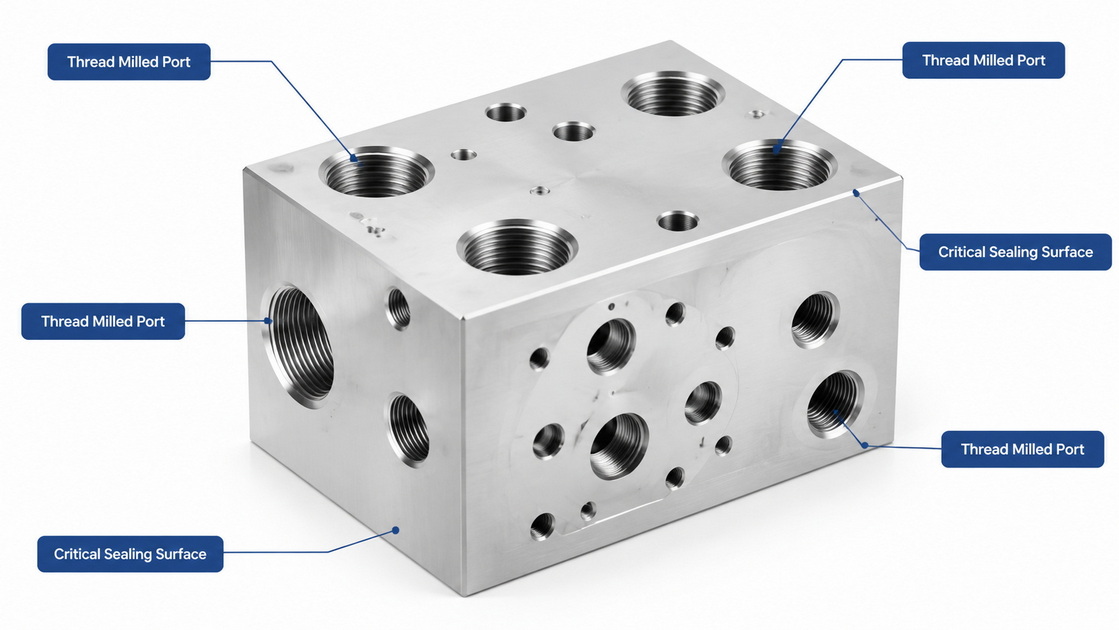
Across multiple CNC machining case studies, a clear pattern has emerged: high‑end suppliers increasingly standardize on thread milling for large or safety‑critical threads. They still use tapping for common mid‑size holes, but whenever a hole is large, deep, expensive to rework, or part of a sealing surface, thread milling becomes the default. [chinamachiningsolutions]
For a Chinese OEM like Shenzhen Feifan Hardware & Electronics serving foreign brands, adopting similar standards delivers tangible benefits:
- Stronger value proposition in RFQ responses ("we thread mill all critical large holes to minimize risk")
- Fewer scrap parts and rework when machining complex castings or high‑value billets
- Easier integration of late design changes without new tooling investment
- Clearer, more professional DFM feedback to engineers in Europe and North America
This is exactly how you move from being "a machining vendor" to being a trusted manufacturing partner in the eyes of global B2B buyers. [chinamachiningsolutions]
To make this actionable inside your team, you can use a short standard operating checklist during programming and process planning. [chinamachiningsolutions]
1. At CAM/programming stage
- Flag all threads above a defined size (e.g. M20 or 3/4 inch)
- Check material, depth, and tolerance on each large hole
- Decide tapping vs. thread milling using the rule‑set above
- Document the decision and reasoning in the process sheet
2. At DFM/quoting stage
- Review drawings for large, deep or critical threads on new RFQs
- Advise customers to adjust pilot hole sizes and depths according to recognized guidelines
- Suggest thread milling when geometry, tolerance or material raises risk
- Communicate clearly how your chosen process improves reliability
3. At production stage
- Use tool life monitoring for critical thread milling cutters
- Qualify first‑article samples with thread gauges and surface checks
- Record process parameters (feeds, speeds, strategies) for repeat orders
Embedding these steps into your workflow turns the tapping vs. thread milling decision for large holes into a repeatable, auditable process rather than an individual programmer's preference. [jcproto]
For large threaded holes, thread milling is typically the better choice whenever risk, quality, and flexibility matter more than raw cycle time. Tapping still makes sense for simpler, high‑volume large threads in easy materials, but for high‑value parts, demanding tolerances or hard alloys, thread milling offers lower breakage risk, better finish, and more control. [tnnengineering]
As an OEM/ODM CNC precision manufacturer, positioning your shop as "tapping for speed, thread milling for critical large holes" gives overseas customers confidence that you understand the full lifecycle cost of their components—far beyond the price of a single operation. If you align your internal standards and customer communication around this principle, you turn a technical detail into a real commercial advantage. [chinamachiningsolutions]
1. Is thread milling always better than tapping for large holes?
No. Thread milling is usually better for large, critical, tight‑tolerance or hard‑material holes, but tapping can still be ideal for high‑volume, standard large threads in easy materials. [linkedin]
2. What is the main risk of tapping large holes?
The main risk is tap breakage due to high torque and chip packing, which can damage or scrap expensive workpieces and cause unplanned downtime. [jlccnc]
3. Can one thread mill cover multiple thread sizes?
Yes. Many thread mills are designed to cut a range of diameters and pitches by modifying the CNC toolpath, which helps reduce tooling inventory for OEM/ODM shops. [tnnengineering]
4. How do I decide the pilot hole size for large threads?
Use standard charts targeting around 65–75% thread engagement and adjust based on material; tougher materials may justify slightly larger holes to control torque. [huayi-group]
5. When should designers involve the machinist in large‑hole thread decisions?
Designers should involve the machinist whenever threads are large, deep, near edges or in thin walls, or when materials are hard‑to‑machine, so process and geometry can be optimized together. [huayi-group]
1. JLCCNC. "Thread Milling vs. Tapping: What's the Difference and When to Use Each Method?" [Link] [jlccnc]
2. Huayi Group. "The Perfect Threaded Hole Design Specifications for CNC Machining." [Link] [huayi-group]
3. LinkedIn Article. "Thread Milling vs. Tapping: A Comprehensive Comparison." [Link] [linkedin]
4. Kennametal. "Machining Guide: Thread Milling vs. Tapping." [Link] [kennametal]
5. TNN Engineering. "Thread Milling vs. Tapping." [Link] [tnnengineering]
6. JUCHENG. "CNC Threading Design Guide: Navigating Tapping and Thread Milling." [Link] [jcproto]
7. China Machining Solutions. "Thread Milling: Proven Process and Tool Selection Guide." [Link] [chinamachiningsolutions]


