From idea to market-ready product, our NPI solutions make every stage easier, faster. Discover How We Help

Views: 222 Author: Feifan Hardware Publish Time: 2026-06-29 Origin: Site


Content Menu
● What Counts as "Thin Metal Parts"?
● Core Definitions: CNC Milling vs. Chemical Etching
>> CNC Milling for Thin Metal Parts
>> Chemical Etching for Thin Metal Parts
● Process Flow: What Actually Happens on the Shop Floor
>> Chemical Etching Process Steps
● Key Technical Differences for Thin Metal Parts
>> Material Compatibility and Surface Integrity
>> Volume, Lead Time, and Cost
● Practical Comparison Table: CNC Milling vs. Chemical Etching
● Industry Use Cases: How Buyers Actually Decide
>> Electronics and 5G Communication
>> Robotics and Precision Machinery
● Expert Decision Framework: How to Choose Between CNC Milling and Chemical Etching
● Why Global OEMs Work with Shenzhen Feifan for CNC‑Milled Thin Metal Parts
● Call to Action: Align Your Thin Metal Part Design with the Right Process
● FAQs
As a precision parts supplier in China, I've seen both CNC milling and chemical etching succeed—and fail—depending on how clearly the customer defines thickness, tolerances, volume, and cost targets for thin metal parts. This guide compares the two processes from an expert OEM/ODM perspective and shows where a Shenzhen‑based CNC manufacturer like Shenzhen Feifan Hardware & Electronics Co., Ltd. is the best fit, and where chemical etching partners make more sense. [feifanhardware]
For most industrial buyers, "thin metal parts" usually refer to flat components in the 0.03–1.5 mm thickness range used in electronics, medical devices, aerospace, and consumer products. These parts often require: [fotofab]
- Tight positional tolerances (down to ±0.025–0.05 mm for critical features) [tmnetch]
- Complex 2D geometries such as fine apertures, micro‑slots, or intricate patterns [fotofab]
- High repeatability at medium to high volumes, especially for shielding, springs, and precision washers [thinmetalparts]
Choosing between CNC milling and chemical etching is about matching this specification profile to the right manufacturing capability, not just chasing the lowest price per piece. [thinmetalparts]
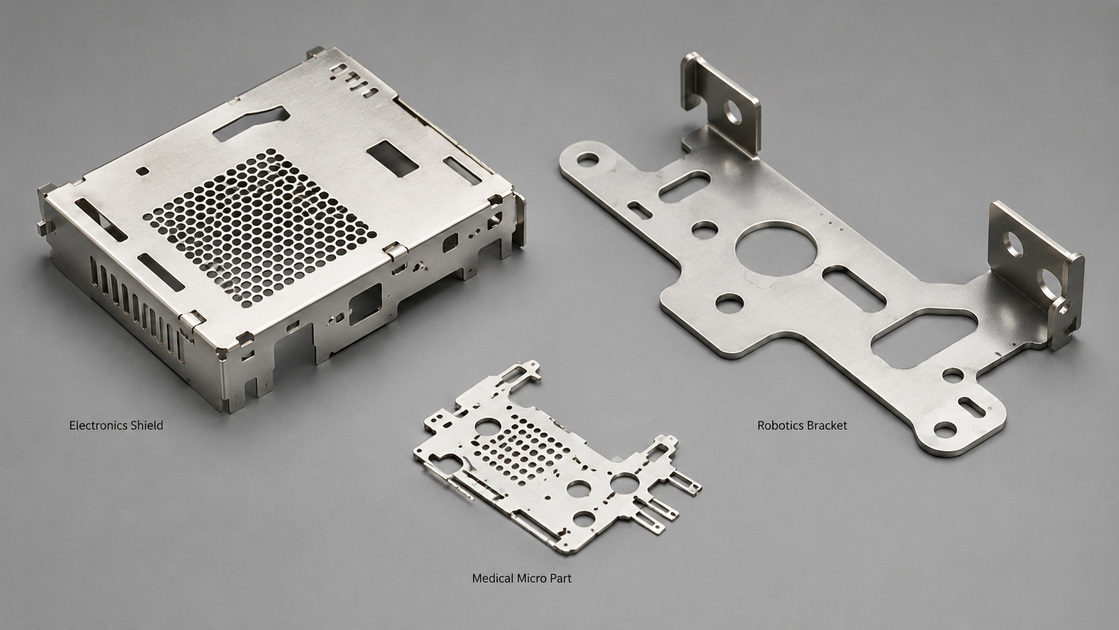
CNC milling is a subtractive machining process where rotating cutting tools remove material from a workpiece under computer numeric control (CNC). For thin metal parts, milling can: [thinmetalparts]
- Cut pockets, slots, and profiles in small plates or frames
- Produce details on housings, brackets, and structural components
- Integrate chamfers, countersinks, and 3D features in a single setup [fotofab]
Shenzhen Feifan specializes in CNC turning, milling, drilling, and surface treatment, making it suitable not only for thin plates but also for hybrid parts that combine thin sections with thicker structural features. [feifanhardware]
Chemical etching (often photochemical etching) uses photolithography masks and etchant chemistry to dissolve unprotected areas of thin sheet metal. It is particularly strong for: [tmnetch]
- Extremely fine details (down to ~25 microns feature size) [tmnetch]
- Complex 2D patterns with no need for physical tooling [thinmetalparts]
- Parts that must be stress‑free and burr‑free, such as micro‑springs or EMI shields [fotofab]
Material thickness is typically limited to ≤1.5 mm, making etching a specialist method for ultra‑thin or precision flat parts rather than general structural components. [tmnetch]
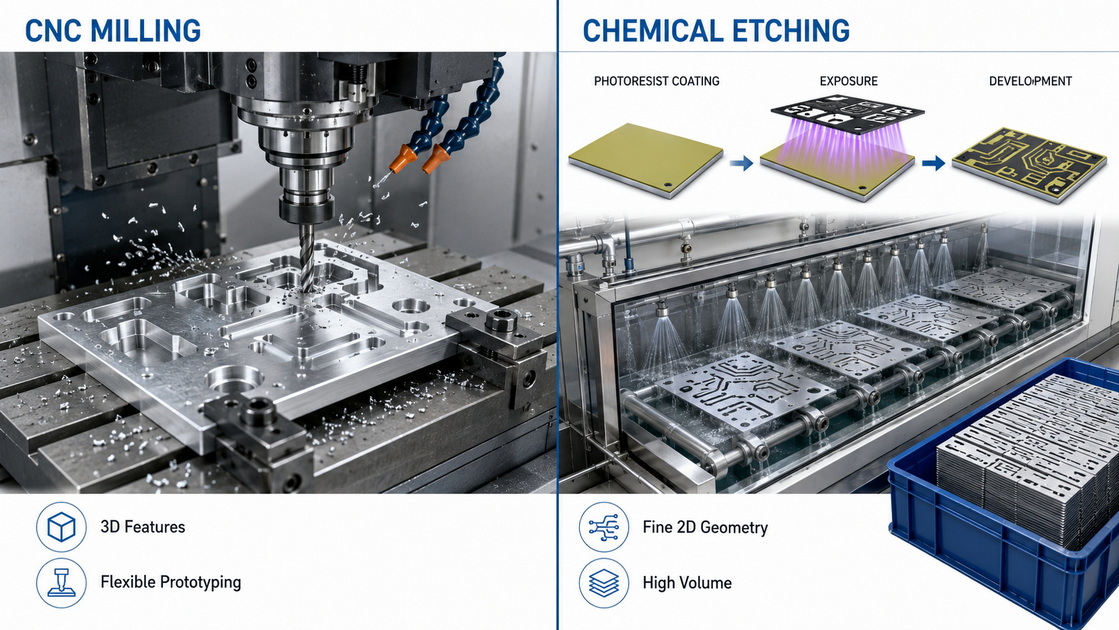
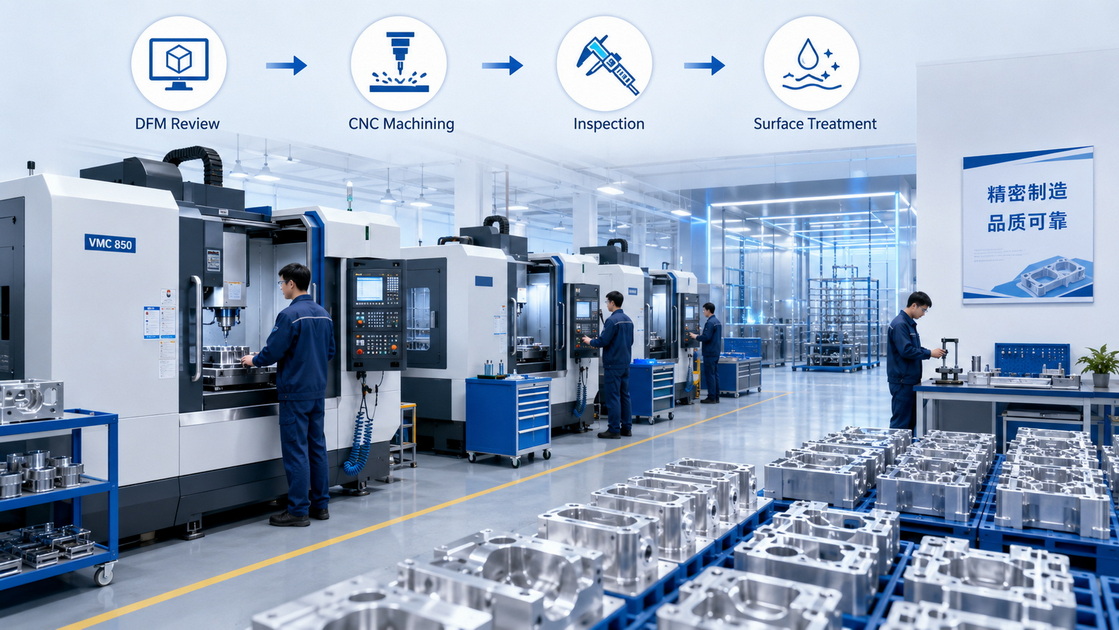
A typical CNC milling workflow for thin metal parts at a modern Chinese precision plant looks like this: [feifanhardware]
1. Design & DFM review
- Customer supplies 3D CAD and 2D drawings.
- Feifan's engineering team performs Design for Manufacturability (DFM), checking clampability, tool access, and deformation risk for thin sections. [insights.made-in-china]
2. Material selection & sourcing
- Common choices: aluminum alloys (e.g. 6061, 7075), stainless steels, brass, copper, and high‑performance alloys. [insights.made-in-china]
3. CAM programming
- Toolpaths are generated for roughing, semi‑finishing, and finishing passes with optimized feeds and speeds for thin stock. [fotofab]
4. Fixturing & machining
- Vacuum tables, soft jaws, or custom fixtures stabilize thin parts to minimize vibration and warping.
- Tool wear and thermal expansion are monitored, especially for high‑volume OEM runs. [insights.made-in-china]
5. Inspection & surface treatment
- Dimensional inspection using CMM or optical measurement is followed by polishing, anodizing, plating, or oxidation in integrated surface lines. [6wresearch]
This integrated approach—machining plus in‑house finishing—is a key strength of suppliers like Feifan for international OEM customers who want a single point of responsibility. [feifanhardware]
A typical chemical etching process for thin metal parts is more similar to PCB fabrication than mechanical machining: [tmnetch]
1. Digital design & mask preparation
- 2D CAD is converted into phototools.
- Metal sheets are coated with photoresist; the pattern is transferred via UV exposure. [tmnetch]
2. Etching
- Sheets enter spray or immersion chambers where an etchant (often chloride‑based for metals like copper or stainless steel) dissolves exposed areas.
- The process is controlled to fully penetrate the thickness in target areas. [fotofab]
3. Stripping & cleaning
- Remaining photoresist is removed, and parts are cleaned and neutralized to prevent corrosion. [tmnetch]
4. Flatness and post‑processing
- Parts are generally flat; extra forming, plating, or heat treatment may be done by secondary vendors. [fotofab]
The benefit is minimal mechanical stress, virtually no burrs, and excellent repeatability for very fine features, though the process becomes less attractive as thickness or 3D complexity increases. [fotofab]
- Chemical etching
- Typical tolerances: ±0.025–0.05 mm on feature dimensions in thin sheets. [tmnetch]
- Best for ultra‑fine apertures, micro‑filters, and complex 2D shapes.
- CNC milling
- Tolerances: ±0.05–0.25 mm, depending on material, thickness, and fixturing. [fotofab]
- Enables both 2D and 3D geometries, stepped thicknesses, and precision mating surfaces.
In practice, if your drawing is essentially a flat profile with micro‑features, etching tends to win; if you need functional 3D geometry or varied thickness, CNC milling is the safer choice. [thinmetalparts]
- Chemical etching works well with copper, stainless steel, aluminum, nickel, brass, and many specialty alloys, provided they are within the thickness limits. It introduces no tool marks and minimal heat‑affected zones, making it ideal where surface integrity is critical (e.g. medical or aerospace micro‑components). [tmnetch]
- CNC milling handles a broader range of materials and thicknesses, including thicker plates and complex alloys used in robotics, automotive, and medical equipment. With Feifan's integrated surface treatment (polishing, anodizing, plating), CNC parts can be tuned for aesthetics, wear resistance, and corrosion protection. [insights.made-in-china]
For thin parts that are both cosmetic and structural—for example, visible frames or brackets in robotics and consumer electronics—CNC milling plus controlled finishing delivers a more robust long‑term solution. [feifanhardware]
For thin metal parts, overall economics are shaped by volume and design stability: [thinmetalparts]
- Chemical etching
- Very cost‑effective for high‑volume, stable designs, because there is no mechanical tooling and sheets can be processed continuously. [fotofab]
- Mask preparation adds upfront effort, but changeovers are relatively fast once the line is set up.
- CNC milling
- More flexible for low‑to‑medium volumes and iterative design changes, especially in prototyping or early product development. [thinmetalparts]
- Modern Chinese plants with digital management and agile scheduling can still offer competitive lead times even for larger runs. [step-metalwork]
Shenzhen Feifan emphasizes 48‑hour fast sampling and minimum orders from 500 pcs, which aligns well with OEM/ODM customers who need rapid iteration before scaling up. In contrast, etching vendors are usually selected once the geometry is stable and forecast volumes justify the mask and process optimization effort. [feifanhardware]
| Factor | CNC Milling | Chemical Etching |
|---|---|---|
| Typical thickness range for thin parts | 0.5–10 mm (thin sections in larger parts also possible) fotofab | 0.03–1.5 mm, optimized for very thin sheets fotofab |
| Geometry | 2D profiles plus 3D features, steps, pockets, threads fotofab | 2D patterns only; flat parts with intricate outlines and apertures fotofab |
| Tolerances | ±0.05–0.25 mm on most industrial work fotofab | As tight as ±0.025 mm on thin sheets fotofab |
| Surface condition | Tool marks and potential burrs, but fully controllable with finishing feifanhardware | Burr‑free, low mechanical stress, minimal heat‑affected zones fotofab |
| Setup & tooling | Requires fixturing and toolpaths; good for frequent design iterations fotofab | Requires photomasks and etch setups; best when design is stable fotofab |
| Best suited industries | Robotics, automotive, medical equipment, high‑end consumer products needing 3D geometry feifanhardware | Electronics, medical micro‑parts, aerospace filters and gaskets needing ultra‑fine features fotofab |
- Chemical etching shines in EMI/RFI shields, lead frames, and micro‑spring contacts, where very fine openings and repeatability are essential. [tmnetch]
- CNC milling is used for heatsink bases, housing frames, and connector bodies that require 3D geometry and precise flatness, often combined with anodizing or plating for thermal and corrosion performance. [insights.made-in-china]
For a thin metal shielding application, etching is often the first choice; for precision housings or multi‑level brackets in communication devices, CNC milling through an integrated supplier like Feifan is more typical. [insights.made-in-china]
Robotics components frequently combine thin sections and structural elements in a single part. [global.iteschina]
- CNC milling enables complex 3D geometries, threaded interfaces, and rigid mounting features in aluminum or stainless steel. [feifanhardware]
- Thin etched parts may still be used as springs, spacers, shims, or filters, but they usually complement rather than replace machined components. [fotofab]
From a buyer's perspective, this often translates into a dual‑sourcing strategy: CNC‑machined frames and brackets from a high‑precision Chinese supplier, and etched micro‑details from specialized chemical etching partners. [step-metalwork]
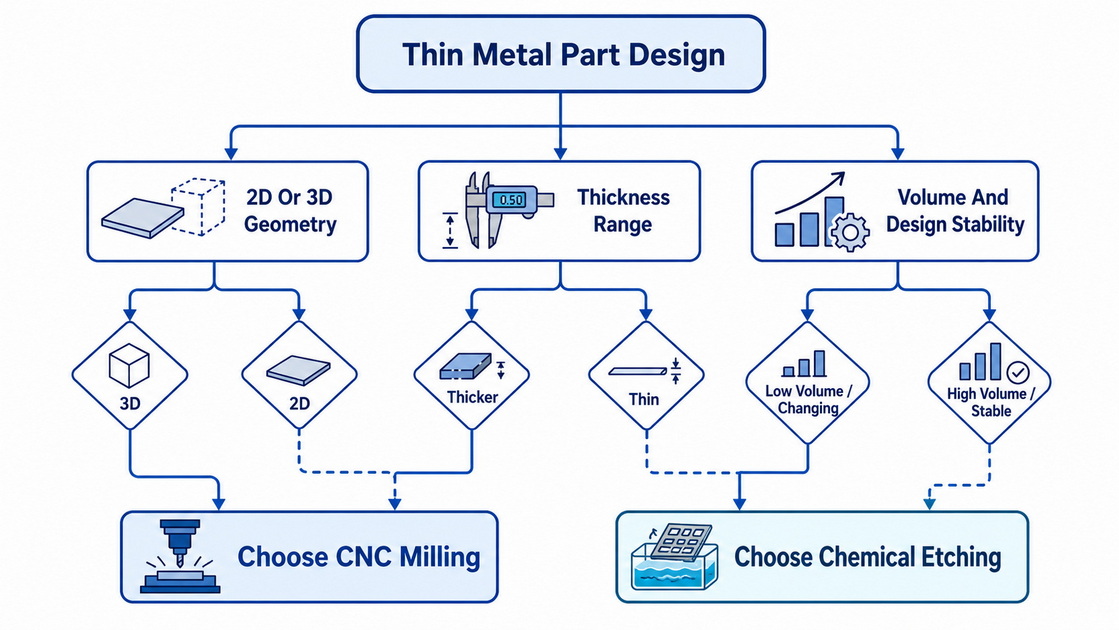
From an OEM/ODM standpoint, the most reliable way to choose is to run through a simple decision checklist during early design reviews: [thinmetalparts]
1. Is the part essentially 2D or does it need 3D features?
- Purely 2D, flat, with very fine patterns → Chemical etching.
- Requires steps, pockets, threads, or varying thickness → CNC milling.
2. What thickness range are you in?
- Below ~1.5 mm and flat → Etching has a strong advantage.
- Above 1.5 mm or combined thin and thick sections → CNC milling is more practical. [tmnetch]
3. What tolerances and edge quality are required?
- Ultra‑fine features with tight tolerances and burr‑free edges → Etching. [fotofab]
- Functional tolerances with controlled finishing, especially on 3D geometry → CNC milling. [feifanhardware]
4. What is your expected annual volume and design stability?
- High volume, stable geometry → Etching tends to be more economical per part. [tmnetch]
- Lower to medium volumes, evolving design → CNC milling offers more flexibility and lower upfront risk. [thinmetalparts]
5. Do you need integrated surface treatment and assembly?
- If you want one supplier to handle machining, surface treatment, and logistics, CNC‑oriented plants like Feifan provide a clear advantage. [insights.made-in-china]
- Etching often involves multiple vendors for forming, plating, or assembly, which can add coordination overhead. [fotofab]
As a national high‑tech enterprise founded in 2017, Shenzhen Feifan Hardware & Electronics Co., Ltd. has built a 6,000 m² digitalized production base that integrates CNC turning, milling, drilling, polishing, oxidation, and plating in one facility. Key points for overseas brands and wholesalers include: [feifanhardware]
- OEM/ODM design support: A dedicated R&D team assists with drawing analysis, material selection, and process validation to reduce risk in thin‑wall and thin‑plate designs. [insights.made-in-china]
- Quality and delivery assurance: ISO9001‑certified systems, 98% qualification rate and ~99% on‑time delivery backed by digital order and equipment monitoring. [6wresearch]
- Agile sampling and scalable production: 48‑hour fast sampling and minimum orders from 500 pcs help buyers validate designs before scaling. [step-metalwork]
For many international OEMs, the real value is not only the CNC capability but the ability to co‑engineer parts that balance precision, cost, and manufacturability—especially when combining thin sections with complex features. [insights.made-in-china]
If you're developing thin metal parts for electronics, robotics, medical or communication equipment, the safest way to avoid costly rework is to validate your design against the CNC milling vs chemical etching decision framework before locking in tooling. [thinmetalparts]
For parts that require 3D geometry, integrated finishing, and medium‑to‑high precision, you can:
- Send your drawings to Shenzhen Feifan Hardware & Electronics Co., Ltd. for a DFM review and CNC feasibility assessment, including suggestions on thickness, tolerances, and surface treatments optimized for your application. [feifanhardware]
For ultra‑thin, purely 2D parts with micro‑features, Feifan can help you define interfaces and tolerances while you source specialist chemical etching partners for the core flat components. [feifanhardware]
1. Can one project use both CNC milling and chemical etching?
Yes. Many high‑precision assemblies combine etched micro‑parts (filters, shields, apertures) with CNC‑milled frames and housings, balancing 2D feature precision with 3D structural performance. [tmnetch]
2. When does CNC milling become risky for thin metal parts?
CNC milling becomes challenging when parts are extremely thin, have long unsupported spans, or demand micro‑features approaching etching tolerances; fixturing, tool selection, and DFM must be carefully engineered to avoid deformation. [thinmetalparts]
3. Is chemical etching always cheaper than CNC milling?
Not always. Etching becomes economical once volume and design stability are high, but for prototypes, frequent design changes, or moderate volumes, CNC milling can be more cost‑effective due to lower upfront setup requirements. [thinmetalparts]
4. How early should I involve a CNC supplier like Feifan in my design?
Involving Feifan at the concept or early design stage allows DFM optimization of thickness, tolerances, and material selection, reducing later changes and improving total cost of ownership. [insights.made-in-china]
5. What information should I provide when requesting a quote for thin metal parts?
Provide 2D/3D drawings, target tolerances, expected annual volume, application industry, preferred material, and any required surface treatments so the supplier can propose the most suitable process and cost structure. [insights.made-in-china]
1. Fotofab – "A Practical Guide to Thin Metal Manufacturing Methods: Etching, Stamping, Laser, CNC, Wire EDM, 3D Printing."
https://fotofab.com/a-practical-guide-to-thin-metal-manufacturing-methods/ [fotofab]
2. Thin Metal Parts – "CNC vs Chemical Etching."
https://www.thinmetalparts.com/cnc-vs-chemical-etching/ [thinmetalparts]
3. TMNetch – "Chemical Milling vs Etching: Which Is Right For You?"
https://tmnetch.com/chemical-milling-vs-etching-which-is-right-for-you/ [tmnetch]
4. Shenzhen Feifan Hardware & Electronics Co., Ltd. – Company Profile.
https://www.feifanhardware.com/?m=home&c=Lists&a=index&tid=4 [feifanhardware]
5. Insights Made‑in‑China – "Precision Engineering in Chinese Manufacturing: A Focus on Machined and Sheet Metal Parts."
https://insights.made-in-china.com/Precision-Engineering-in-Chinese-Manufacturing-A-Focus-on-Machined-and-Sheet-Metal-Parts [insights.made-in-china]
6. STEP – "The Future of China Precision Machining: Emerging Trends."
https://www.step-metalwork.com/a-the-future-of-china-precision-machining-emerging-trends.html [step-metalwork]
7. 6Wresearch – "China Precision Machining Market (2025–2031)."
https://www.6wresearch.com/industry-report/china-precision-machining-market [6wresearch]


