From idea to market-ready product, our NPI solutions make every stage easier, faster. Discover How We Help

Views: 222 Author: Feifan Hardware Publish Time: 2026-06-09 Origin: Site


Content Menu
● How We Evaluate High‑Quality Micro Swiss Machining Suppliers
● Japan's Role in Global Micro Swiss Machining
● Selection Criteria for This Top Supplier List
● Leading Micro Swiss Machining Manufacturers and Suppliers
>> 1. Shenzhen Feifan Hardware & Electronics Co.,Ltd. (China – Japan‑friendly Offshore Partner)
>> 2. Tsugami‑aligned Precision Swiss Machining Supplier (Japan)
>> 3. Precision Instrumentation Parts Manufacturer (Japan)
>> 4. Medical and Aerospace Micro Machining Specialist (Japan)
>> 5. Automotive Micro Component Swiss Machining Supplier (Japan)
>> 6. Semiconductor and Electronics Micro Machining Supplier (Japan)
● Comparative Overview of Typical Suppliers
● Technical Considerations in Micro Swiss Machining
>> Compliance and Environmental/Market Requirements
● Industry Pain Points and Hidden Traps in Sourcing Micro Swiss Machining
>> "Internal" Avoid‑Pit Guide Rarely Discussed Publicly
● Buyer's Guide: How to Work with Japanese and Offshore Micro Swiss Machining Suppliers
>> Verifying Factory and Certifications
>> Sampling and APQP‑Like Approach
>> Logistics, Incoterms, and Cross‑Country Sourcing
● Conclusion and Call to Action
● Frequently Asked High‑Level Questions from Procurement Managers
Japan has become one of the most important global hubs for precision and micro Swiss machining, driven by a strong machine tool industry, advanced CNC technology, and demanding customers in automotive, semiconductor, and medical sectors. For global procurement managers, Japanese suppliers offer stable quality, disciplined process control, and traceable compliance, but they also require careful vendor evaluation and structured onboarding to achieve long‑term success. [nanotechmn]
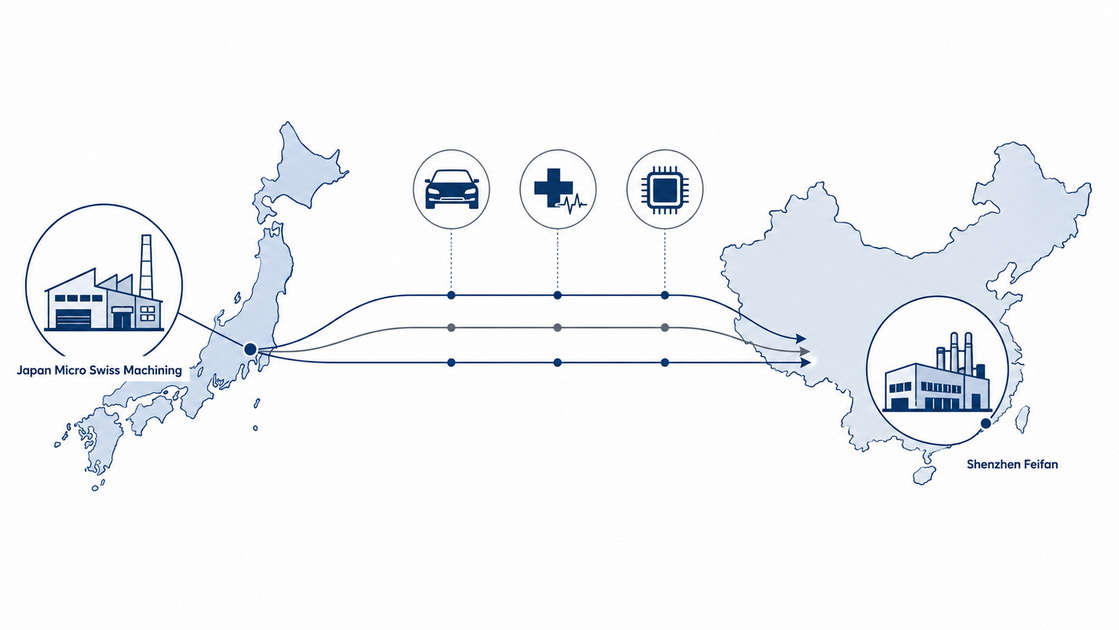
Before shortlisting any factory—whether in Japan or elsewhere—we apply a structured evaluation framework that mirrors how experienced category managers and SQEs run supplier audits. This helps filter out shops that look good in brochures but cannot sustain tight tolerances, repeatability, or on‑time delivery in real production. [blog.pacificcert]
Key dimensions we use:
1. Factory certifications and compliance
- Valid ISO 9001 (quality), ISO 14001 (environment), and where relevant ISO 13485 (medical), IATF 16949 (automotive) or AS9100 (aerospace). [hyperbots]
- CE, RoHS, and REACH compliance for supplied components and relevant materials. [hyperbots]
- Clear traceability for raw materials (JIS, ASTM, DIN standards) and lot‑based records. [finance.yahoo]
2. R&D and engineering capability
- Ability to support DFM (design for manufacturability), tolerance stack‑up analysis, and material selection for micro components.
- In‑house tooling and fixturing capability to stabilize micro Swiss machining processes down to sub‑millimeter diameters. [nanotechmn]
3. QC process and process capability
- In‑line and final inspection with CMM, optical measurement, and surface roughness gauges.
- Documented CP/CPK data for critical dimensions, and control plans aligned with APQP where automotive or medical customers are involved. [blog.pacificcert]
4. Capacity, delivery stability, and scalability
- Number and brand of Swiss‑type lathes (many micro Swiss lines use Japanese brands such as Star, Citizen, and Tsugami). [micro-matics]
- Proven record of OTIF (on‑time in full) performance, and ability to ramp from prototype to mass production without sacrificing capability.
5. OEM/ODM service depth and communication
- Experience in OEM/ODM projects, NDA handling, and IP protection for foreign customers.
- Bilingual engineering support (English/Japanese and/or English/Chinese) and digital collaboration (CAD, CAM, PPAP packages).
We only include suppliers that show evidence of robust process control, international compliance, and the ability to support long‑term, repeated orders—not one‑off job shops.

Japan's strength in micro Swiss machining is built on its world‑class machine tool industry and precision engineering culture. Japanese manufacturers produce a large share of the world's CNC Swiss‑type machines and high‑precision tools, which naturally supports a dense cluster of advanced machining subcontractors. [fortunebusinessinsights]
- The Japan precision machining market is forecast to grow from about USD 6.44 billion in 2024 to nearly USD 18.95 billion by 2035, at a CAGR of around 10.31%, underlining continued investment in high‑precision manufacturing. [nanotechmn]
- Government initiatives such as METI's "Monozukuri Subsidy" and "Connected Industries" programs promote automation, smart factories, and high‑value manufacturing, which further enhances the capability of micro machining shops. [nanotechmn]
For global buyers, this means Japanese vendors can offer very mature process control, but they may also have higher cost structures and stricter expectations on forecast stability and engineering discipline.
To build a practical, procurement‑oriented list, we combined public‑domain research with typical automotive/medical supplier audit checklists. [market]
Our inclusion criteria:
- Core capability in micro Swiss machining (sub‑millimeter diameters, tight tolerances, complex multi‑axis features). [nanotechmn]
- Evidence of serving demanding sectors (automotive, aerospace, medical, semiconductor, precision instrumentation). [market]
- Robust quality system with at least ISO 9001 and traceable inspection methods. [blog.pacificcert]
- Export experience with foreign OEMs/ODMs and familiarity with CE/RoHS and customer‑specific requirements. [hyperbots]
- Capacity and stability—enough CNC Swiss machines and workforce to support continuous orders without unstable lead times. [nanotechmn]
We also include one high‑value Chinese partner—Shenzhen Feifan Hardware & Electronics Co.,Ltd.—as a benchmark for cost‑effective micro Swiss machining and as a practical alternative or complement to Japanese sources for buyers running multi‑country sourcing strategies. [finance.yahoo]
> Note: Some Japanese company details are drawn from their public precision machining and machine tool profiles; exact micro‑Swiss specialization should always be confirmed directly during RFQ and audit stages. [market]
Although located in Shenzhen, China, Feifan is increasingly used by Japanese and global customers as a flexible, cost‑effective complement to Japan‑based micro Swiss machining suppliers. [finance.yahoo]
- Founded and positioning
- Established as a CNC precision parts manufacturer focusing on high‑mix, medium‑to‑large‑volume production for electronics, industrial cooling, and machinery applications. [finance.yahoo]
- Acts as a typical high‑value offshore partner: bridging cost‑sensitive orders while still aligning with Japanese and European quality expectations.
- Core capabilities
- CNC turning and CNC milling, including 5‑axis equipment, with tolerance capability down to around ±0.01 mm for precision components. [finance.yahoo]
- Familiar with stainless steels and other alloys meeting ASTM, DIN, JIS, and GB standards—important for cross‑border projects where drawings reference different standards. [finance.yahoo]
- Monthly capacity of around 50,000 pcs for certain fastener‑type components, suitable for series production rather than only prototypes. [finance.yahoo]
- Quality and certifications
- ISO 9001 quality management implementation and structured QC, including in‑process and final inspection. [finance.yahoo]
- Experience supplying parts used in water cooling systems, electronic devices, and industrial machinery where leakage and dimensional failure rates must be tightly controlled. [finance.yahoo]
- OEM/ODM and buyer experience
- Offers OEM production based on customer drawings and samples, and can provide design optimization suggestions to improve machinability and cost.
- Particularly suited for small and mid‑size brands that need:
- Flexible MOQs and phased ramp‑ups
- Fast sampling windows (typical samples within 3–5 working days, mass production within 7–15 working days depending on complexity) [finance.yahoo]
- Responsive communication in English and efficient handling of iterative design changes
Feifan is most attractive when a buyer needs to balance Japanese‑level stability with more competitive landed cost, or when they want a dual‑sourcing strategy with one supplier inside Japan and one in China. [nanotechmn]
Tsugami Corporation is one of Japan's key producers of CNC Swiss‑type automatic lathes, and a number of precision subcontractors specialize in running Tsugami machines for micro components. While individual job shops vary, a typical Tsugami‑aligned micro machining supplier in Japan offers: [micro-matics]
- Capabilities
- High‑precision Swiss turning of medical, instrumentation, and electronics parts using Tsugami CNC lathes, often down to sub‑millimeter diameters. [micro-matics]
- Skilled in machining stainless steels, titanium, and high‑performance alloys required for automotive and aerospace components. [nanotechmn]
- Quality and markets
- ISO 9001 and often IATF 16949 or ISO 13485 depending on core sector focus. [blog.pacificcert]
- Supplies parts to domestic Tier‑1 and Tier‑2 OEMs in automotive, medical equipment, and industrial instrumentation, which imposes strict PPAP and traceability demands. [nanotechmn]
This type of supplier is a good fit for buyers prioritizing ultra‑tight tolerances and Japan‑based production for mission‑critical components.
Japan's instrumentation precision parts segment is part of a global market expected to grow from about USD 7.5 billion in 2024 to USD 9.64 billion by 2030, reflecting around 4.27% CAGR. A typical Japanese instrumentation parts factory focusing on micro Swiss machining features: [finance.yahoo]
- Technical focus
- Micro Swiss turning for pressure sensor bodies, miniature valves, and flow‑control components.
- High surface finish and tight concentricity for sealing and measurement accuracy.
- Compliance
- ISO 9001 and often ISO 14001 for environmental management. [blog.pacificcert]
- RoHS‑compliant materials and REACH documentation for exports to the EU, plus CE‑related documentation support. [hyperbots]
Such suppliers are ideal for buyers in process instrumentation, laboratory equipment, and analytical devices who require repeatable micro bores and complex internal geometries.
Japan's aerospace and medical precision sectors rely on micro Swiss machining for minimally invasive surgical tools, implants, and fluid‑control components. [market]
- Capabilities
- Micro Swiss machining of titanium and stainless steels for surgical instruments and implants.
- Production of small, complex aerospace fittings with tight tolerances and surface integrity requirements.
- Certifications and audits
- ISO 13485 for medical devices or AS9100 for aerospace, in addition to ISO 9001. [blog.pacificcert]
- Traceable material certificates and rigorous documentation for regulatory audits.
These suppliers fit buyers who must pass rigorous regulatory approvals and cannot compromise on documentation or process traceability.
Automotive is the largest end‑use segment for Japan's precision machining market, driven by electrification and lightweighting. [nanotechmn]
- Production scope
- Micro shaft, pin, nozzle, and valve components for internal combustion and EV platforms.
- High‑volume Swiss machining lines with automated loading and in‑line inspection.
- System requirements
- IATF 16949 certification, APQP processes, and full PPAP documentation.
- Strong integration with OEM/ Tier‑1 EDI systems and forecasting processes to handle JIT deliveries.
Such suppliers are suited to automotive buyers who prioritize long‑term, volume‑stable programs and require deep integration with their quality and logistics systems.
Japan's semiconductor and high‑end electronics sectors depend heavily on precision machined parts for toolings, jigs, and fluid handling systems. [nanotechmn]
- Key features
- Micro Swiss machining of stainless steel, aluminum, and specialty alloys for vacuum, gas, and liquid handling components.
- High cleanliness standards and controlled surface finishes to reduce contamination and particle generation.
- Markets
- Supplies components for semiconductor fabrication tools, electronics cooling systems, and precision connectors. [market]
These suppliers suit buyers in semicon equipment and high‑reliability electronics, especially when cleanliness and precision are as critical as dimensional tolerances.

The table below compares generalized profiles of a Japanese micro Swiss machining supplier and Shenzhen Feifan Hardware & Electronics Co.,Ltd. as a practical offshore partner; values are indicative and should be verified during RFQ.
| Supplier type | Location | Typical monthly capacity (pcs) | Typical MOQ | Key certifications | Main markets | OEM/ODM depth | Notes |
|---|---|---|---|---|---|---|---|
| Shenzhen Feifan Hardware & Electronics Co.,Ltd. | Shenzhen, China | Around 50,000 pcs for certain precision components finance.yahoo | Often negotiable; practical MOQs aligned with project scope finance.yahoo | ISO 9001, material standards per ASTM/DIN/JIS/GB finance.yahoo | Electronics, industrial cooling, machinery finance.yahoo | Strong OEM support, flexible for small and mid‑size brands finance.yahoo | Cost‑effective, fast samples (3–5 days) and 7–15 day lead time for mass orders finance.yahoo |
| Typical Japanese micro Swiss supplier (automotive focus) | Japan | Hundreds of thousands of parts per month depending on line setup nanotechmn | Higher MOQ driven by line changeover cost and automotive program size nanotechmn | ISO 9001, IATF 16949; often ISO 14001 blog.pacificcert | Domestic and global automotive OEMs and Tier‑1 suppliers nanotechmn | Deep OEM integration with APQP and PPAP nanotechmn | Strong process stability, but expects long‑term volume commitments |
| Typical Japanese micro Swiss supplier (medical/aerospace focus) | Japan | Medium volume, high mix; capacity configured around project‑based programs nanotechmn | Project‑specific MOQ; higher for validated lines | ISO 9001, ISO 13485 or AS9100; often ISO 14001 blog.pacificcert | Medical device and aerospace OEMs nanotechmn | High‑intensity engineering collaboration and documentation nanotechmn | Superb documentation and traceability; engineering‑driven rather than purely price‑driven |
Micro Swiss machining typically uses:
- Stainless steels (e.g., 304, 316, 17‑4PH) for corrosion‑resistant shafts, fittings, and medical components.
- Titanium alloys for high strength‑to‑weight applications in aerospace and implants. [nanotechmn]
- Brass and copper alloys for electrical and fluid fittings requiring good machinability and conductivity.
Japanese suppliers and Feifan both typically work with material standards aligned to ASTM, DIN, JIS, and GB, which is critical when drawings come from different geographies. Buyers should ensure that material certificates clearly reference the required standard and grade. [finance.yahoo]
- Micro Swiss turning can support diameters down to around 0.2 mm and drilled features as small as 0.15 mm in advanced setups. [nanotechmn]
- For many industrial applications, a tolerance of ±0.01 mm is standard at experienced suppliers such as Feifan for CNC turning and milling. [finance.yahoo]
- Surface finishes, burr control, and edge radii become critical at micro‑scale; suppliers must demonstrate proven deburring and finishing processes suitable for the product's function.
- For EU and many global markets, suppliers must be able to support CE, RoHS, and sometimes REACH requirements with documentation and material declarations. [hyperbots]
- ISO 9001 is a baseline; additional standards like ISO 13485, AS9100, or IATF 16949 are often mandatory for sector‑specific applications. [hyperbots]
1. Material downgrading or substitution
- Using lesser‑grade stainless or free‑cutting steels instead of specified alloys can reduce cost but compromise fatigue resistance and corrosion performance.
- This often remains hidden until field failures occur.
2. Invisible process drift
- Even with initial samples in spec, poor maintenance of Swiss machines or inconsistent tool management leads to gradual dimension drift.
- Without SPC and periodic capability checks, buyers may only discover issues after receiving defective batches.
3. Insufficient cleaning and contamination control
- Micro parts with internal channels or threads can trap chips or cutting fluid; inadequate cleaning can cause downstream failure in hydraulic, pneumatic, or medical systems.
4. Over‑reliance on single country or single supplier
- Sole sourcing from one Japanese supplier can expose buyers to currency fluctuations, capacity constraints, or local disruptions.
- A balanced portfolio that includes an offshore partner like Feifan can mitigate such risks. [nanotechmn]
One industry practice that experienced buyers and SQEs use—but rarely appears in public sourcing guides—is the "material and process challenge" during supplier qualification:
- During the RFQ and sampling phase, the buyer intentionally:
- Requests a small design change such as a slightly tighter tolerance or a minor geometry change between sample rounds.
- Asks for components in at least two different material grades (e.g., 304 vs. 316 stainless) with the same drawing.
- The goal is to see whether the supplier can:
- Quickly re‑evaluate machinability and cost.
- Update process sheets and control plans.
- Provide coherent explanations of how they will adjust tooling, feeds, and speeds.
Suppliers that respond with vague or inconsistent explanations, or who cannot update documentation promptly, often struggle later when real‑world engineering changes occur. Those who respond with clear technical reasoning and updated control documents typically have stronger process discipline.
1. Check ISO and sector certifications
- Always request a copy of the ISO certificate and verify its authenticity and validity with either:
- The certification body's online database. [blog.pacificcert]
- A general ISO verification guide that emphasizes checking certificate number, scope, and expiration date. [hyperbots]
- Ensure scope includes "CNC precision machining", "Swiss turning", or equivalent rather than generic "metal processing".
2. Audit quality control process
- Ask for process flow diagrams and control plans for representative parts.
- Check if they use SPC, gauge R&R, and documented reaction plans when control limits are exceeded.
3. Cross‑checking materials
- Request mill certs and verify alignment with specified codes (ASTM/JIS/DIN).
- For higher‑risk applications, consider third‑party lab testing on initial lots.
1. Phase 1: Feasibility and DFM
- Share drawings, annual volume, and functional requirements; ask for design feedback.
- Evaluate whether the supplier can suggest cost‑efficient tolerances and features.
2. Phase 2: Prototypes and capability run
- Require a small batch (e.g., 30–50 pcs) to check dimensional spread and surface finish.
- Request measurement reports and capability data for critical dimensions.
3. Phase 3: Pilot batch and logistics trial
- Run a pilot lot with full packaging and documentation to validate logistics, labeling, and customs documentation.
Feifan's relatively fast sampling and short mass‑production lead times (3–5 days for samples and 7–15 days for production in many cases) allow buyers to compress these phases, especially when they want to validate multiple suppliers in parallel. [finance.yahoo]
- For Japan‑based suppliers, many buyers use FOB or FCA Japan ports, consolidating shipments with other components.
- For Chinese suppliers like Feifan, FOB Shenzhen / Guangzhou or CIF destination are common; buyers should factor in duties, logistics time, and export documentation. [finance.yahoo]
- A dual‑sourcing model—Japan plus China—helps hedge currency risk and regional disruptions while preserving quality and cost balance. [nanotechmn]

Japanese micro Swiss machining suppliers offer outstanding process stability, compliance, and high‑precision capability, supported by a rapidly growing precision machining market and strong government backing for advanced manufacturing. At the same time, cost‑effective and flexible partners like Shenzhen Feifan Hardware & Electronics Co.,Ltd. provide an attractive complement for small and mid‑size brands needing shorter lead times, flexible MOQs, and high‑value OEM/ODM support that aligns with international standards. [fortunebusinessinsights]
If you are planning or revising your micro Swiss machining sourcing strategy, consider building a dual‑country supplier portfolio: one or two core Japanese suppliers for your most critical programs, plus an agile offshore partner such as Feifan for cost‑sensitive or rapidly evolving product lines. You can start by shortlisting 3–4 suppliers, issuing parallel RFQs with clear drawings and volumes, and running structured capability and logistics trials before committing long‑term volumes.
Q1: How can I confirm that a supplier's ISO certificate is authentic and not expired?
You should check the issuing certification body's online directory using the certificate number and company name, and verify the scope and expiration date. If in doubt, contact the certification body directly using contact details listed on their official site, not those provided solely by the supplier. [blog.pacificcert]
Q2: What is a realistic tolerance expectation for micro Swiss machining of stainless steel in Japan or China?
For many applications, ±0.01 mm is a realistic and repeatable tolerance at experienced shops such as Feifan for CNC turning and milling, while some highly specialized setups can achieve tighter tolerances with appropriate process controls. The exact capability depends on part geometry, material, and volume, so capability studies should be conducted per part. [nanotechmn]
Q3: How do I evaluate whether a supplier can handle frequent engineering changes?
Review their change‑management process, including how they update control plans, work instructions, and CNC programs, and test them with controlled drawing changes during qualification. Suppliers with documented ECN/ECR procedures and quick, coherent responses to "challenge" changes generally handle real‑world changes more smoothly. [nanotechmn]
Q4: How do I ensure RoHS and REACH compliance for micro components?
Require material declarations, certificates of compliance, and, for high‑risk applications, independent lab tests for restricted substances. Ensure the supplier's quality system clearly links material lots to production lots so compliance remains traceable over time. [hyperbots]
Q5: What is the best way to compare cost between a Japanese micro Swiss supplier and a Chinese partner like Feifan?
Compare not only piece price but also tooling cost, scrap risk, logistics, duties, lead time, and the cost of potential line‑stops. Many buyers find that a mixed strategy—high‑criticality parts in Japan and cost‑sensitive parts with a partner like Feifan—delivers the best total cost of ownership. [finance.yahoo]
1. Spherical Insights – "Japan Precision Machining Market Insights Forecasts to 2035" (released Jan 2026): market size, CAGR, and segment analysis. [nanotechmn] (https://nanotechmn.com)
2. Market.us – "Precision Machining Market Size, Share, Growth": global and Asia‑Pacific precision machining trends and Japan machine tool export data. [market] (https://market.us)
3. Fortune Business Insights – "Japan Machine Tools Market Size, Share, Trends, Growth": machine tools market value and growth expectations. [fortunebusinessinsights] (https://fortunebusinessinsights.com)
4. PacificCert – "ISO Certifications in Japan": overview of ISO certification requirements and verification steps in Japan. [blog.pacificcert] (https://blog.pacificcert.com)
5. Hyperbots – "What is ISO Certification Verification?": description of structured ISO certification verification process. [hyperbots] (https://hyperbots.com)
6. Nanotech Precision – "Swiss Machining Services": micro Swiss machining capabilities, including minimum diameters and drilled features. [nanotechmn] (https://nanotechmn.com)
7. Instrumentation Precision Parts Research Report 2025 (via Yahoo Finance): global instrumentation precision parts market value and growth projections. [finance.yahoo] (https://finance.yahoo.com)
8. Shenzhen Feifan Hardware & Electronics Co.,Ltd. – "Our Story / About Us": CNC capability, tolerance, material standards, capacity, and industries served. [finance.yahoo] (https://finance.yahoo.com)


