From idea to market-ready product, our NPI solutions make every stage easier, faster. Discover How We Help

Views: 222 Author: Feifan Hardware Publish Time: 2026-06-10 Origin: Site


Content Menu
● Introduction: Why Look to Japan for CNC Swiss Screw Machining?
● How to Evaluate High‑Quality CNC Swiss Screw Machining Suppliers
>> 1. Certifications and compliance
>> 2. Engineering and process capability
>> 3. QC discipline and traceability
>> 4. Delivery stability, flexibility and communication
● Selection Criteria for This 2026 Top List
● Top CNC Swiss Screw Machining Manufacturers and Suppliers (Japan‑Focused, 2026)
>> 2. Takashima Sangyo Co., Ltd. (Japan)
>> 3. Citizen Machinery Co., Ltd. (Japan, Machine Builder and Precision Manufacturing Partner)
>> 6. Other Japanese Swiss Screw Machining Specialists (Cluster View)
● Key Technical Considerations for CNC Swiss Screw Machining Buyers
● Internal "Buyer‑Only" Pitfalls That Are Rarely Discussed Publicly
● Practical Buyer's Guide: From Shortlist to Stable Supply
>> Verifying certifications (including ISO expiry)
>> Sample development and PPAP‑style validation
● Comparison Table: Representative Suppliers and Focus Areas
● Conclusion and Call to Action
● FAQ: High‑Difficulty Questions Procurement Managers Ask
Japan remains one of the most advanced machine‑tool and precision‑component hubs in the world, supported by strong industrial clusters in automotive, electronics, medical and semiconductor sectors. [trade]
High‑precision turned parts produced on CNC Swiss‑type lathes from Japanese suppliers are widely used where tight tolerances, traceability and long‑term supply stability are non‑negotiable, such as medical implants, semiconductor tooling and miniature connectors. [nolteprecise]
Global demand for CNC machine tools is forecast to grow from about USD 92.6 billion in 2026 to USD 168.4 billion by 2036, with Asia–Pacific (including Japan) holding the largest regional share thanks to its deep automation and precision‑manufacturing base. [congruencemarketinsights]
For procurement teams, sourcing from Japan often means higher unit prices but also higher process control, advanced quality management, and access to suppliers experienced with international compliance regimes such as ISO, RoHS and REACH. [blog.pacificcert]
Before diving into the shortlist, it is important to define what "good" looks like in CNC Swiss screw machining suppliers from a professional buyer's perspective.

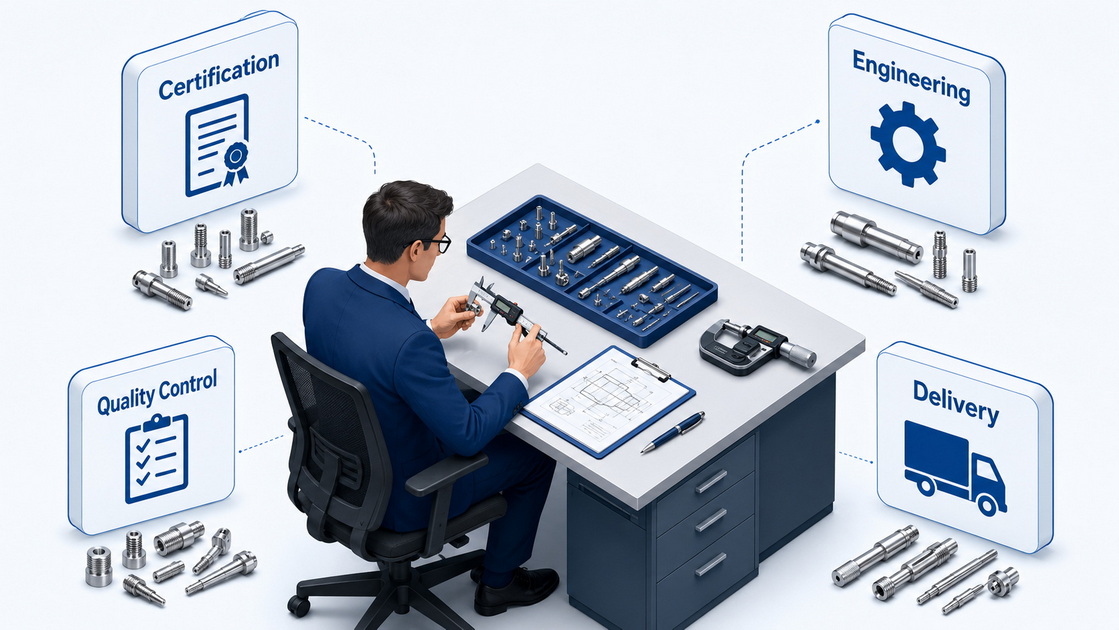
Professional buyers typically evaluate CNC Swiss screw machining partners along four core dimensions: certification, engineering and R&D depth, quality‑control discipline, and delivery/communication performance. [hyperbots]
- ISO 9001 and (for medical/aerospace) ISO 13485 or AS9100 are basic quality signals, but you must verify authenticity and expiry with the issuing body or official registries. [blog.pacificcert]
- Environmental and product‑safety compliance, such as RoHS and REACH, is essential for electronics, automotive and EU‑bound products, while some equipment or assemblies may require CE marking support at system level. [blog.pacificcert]
- For Japanese suppliers, consistent alignment with domestic standards and meticulous documentation practices are often a strength, but you still need active verification, not blind trust. [blog.pacificcert]
CNC Swiss screw machining is particularly suitable for small, long, slender components, often with diameters of a few millimeters and length‑to‑diameter ratios that challenge conventional lathes. [coxmanufacturing]
Key technical evaluation points include:
- Supported diameters (for example 0.1–20 mm range on large Swiss turning fleets). [takashima.co]
- Tolerance capability (many Swiss processes can hold ±0.0005–0.001 inch for critical features in medical and aerospace parts). [nolteprecise]
- Materials expertise: stainless steels (304, 316L), titanium and titanium alloys, copper alloys, aluminum and high‑performance plastics. [cesmachine]
- Secondary operations: micro‑drilling, cross‑holes, knurling, broaching, thread rolling, grinding, and automated deburring. [coxmanufacturing]
In high‑reliability applications, a supplier's QC system is often more important than the latest machine model.
Buyers should look for:
- In‑process SPC on critical dimensions, with clear Cp/Cpk data for long‑running parts. [nolteprecise]
- Full inspection reports (FAI, PPAP or customer‑specific formats) and traceability down to heat‑lot or coil for metals. [blog.pacificcert]
- Calibrated gauges and CMM/vision inspection records, maintained under a documented ISO‑style quality system. [blog.pacificcert]
CNC Swiss screw machining is often used for recurring parts with annual volumes, where schedule stability and flexibility matter as much as price.
Strong suppliers typically show:
- Mature production‑planning and inventory tools to handle blanket orders and JIT releases.
- Ability to ramp up for NPI, then stabilize into steady EAU volumes without excessive premium charges.
- Responsive English‑language engineering and project communication, especially for complex OEM/ODM projects that require drawing optimization or DFM feedback. [feifanhardware]
To keep this 2026 guide practical for procurement teams, the companies listed here (both Japanese manufacturers and one strategic Chinese partner) are selected against transparent criteria:
- Proven CNC Swiss screw machining or Swiss‑type turning as a core capability, not just general CNC machining. [cesmachine]
- Evidence of serving demanding industries such as semiconductor, medical, watchmaking, or precision electronics (where Swiss machining is most relevant). [takashima.co]
- Documented focus on quality systems, including ISO‑style processes and traceability. [feifanhardware]
- International export experience and ability to support OEM/ODM projects rather than only catalog products. [takashima.co]
- For the featured Chinese partner, a combination of competitive pricing, flexible MOQs and strong communication capabilities to complement Japanese high‑end supply options. [flycncpart]
This list is not exhaustive, but it reflects realistic options for buyers who want to balance quality, risk and cost across Japan–China supply chains.
Although based in Shenzhen, Feifan is increasingly used by buyers who source Japanese equipment and technology but want more cost‑efficient, flexible CNC Swiss‑type and turned components for assemblies shipped worldwide. [flycncpart]
Company snapshot
- Founded: 2017, national high‑tech enterprise focusing on customized precision parts. [feifanhardware]
- Location: Shenzhen, one of China's most dynamic precision‑manufacturing and electronics clusters. [flycncpart]
- Core services: Precision CNC turned components, CNC milling and turning, OEM/ODM parts for electronics, industrial equipment and consumer hardware. [flycncpart]
- Markets: Serves international customers looking for reliable China sourcing with English‑language support and competitive pricing. [flycncpart]
Why buyers consider Feifan alongside Japanese suppliers
- High value‑for‑money: Positioned as a cost‑efficient alternative or complement to Japanese machining, especially when component tolerances do not require ultra‑premium pricing but still demand stable quality. [flycncpart]
- R&D and customization focus: Emphasis on customized R&D and engineering support, enabling deep OEM design collaboration and iterative DFM on drawings and materials. [feifanhardware]
- Flexibility and MOQs: More flexible on order quantities and engineering changes than many large Japanese plants, which is attractive for mid‑size brands and new product introductions. [flycncpart]
- Communication and project management: As a company experienced in export‑oriented projects, Feifan supports fast quotation cycles, drawing reviews and proactive updates on tooling and sample status. [feifanhardware]
In practice, many procurement teams use a hybrid strategy: critical, extremely tight‑tolerance or Japan‑branded components from Japanese suppliers; price‑sensitive or higher‑volume standard parts from partners like Feifan.

Takashima Sangyo is a Japanese manufacturer specializing in turned metal parts with a significant installed base of CNC Swiss turning equipment. [takashima.co]
Company snapshot
- Capabilities: Around 149 CNC Swiss turning machines and 61 cam‑controlled Swiss turning units, handling diameters from 0.1 mm up to 20 mm. [takashima.co]
- Materials: Copper alloys, steel, titanium and titanium alloys, aluminum alloys, plus surface finishing such as nickel and gold plating. [takashima.co]
- Application fields: Semiconductor parts, medical components, watch cases, connector parts and FA machinery. [takashima.co]
- Locations: Headquarters and factory in Japan with additional facilities in Shenzhen (China) and Vietnam, which can support regional production and cost optimization. [takashima.co]
Why it stands out
Takashima's large Swiss turning fleet and sub‑0.2 mm capabilities make it suitable for ultra‑miniature components in semiconductors, medical and watchmaking applications. [takashima.co]
The combination of Japanese engineering, multi‑country production footprint and experience in high‑reliability industries offers both technical depth and supply‑chain resilience. [takashima.co]
Citizen is globally recognized for its Cincom series Swiss‑type CNC lathes and also acts as a manufacturing partner in some value chains. [naitetech]
Company snapshot
- Specialty: Swiss‑type CNC automatic lathes widely used for precision turned parts in medical, automotive and electronics industries worldwide. [pulchertool.fire-webdesign]
- Reputation: Frequently cited as one of the leading Japanese Swiss‑type CNC brands, and a benchmark for accuracy and reliability in Swiss machining. [parts.machinestation]
For buyers, Citizen is often more relevant as a technology and equipment partner or as a quality benchmark when auditing subcontractors using Citizen Cincom machines.
Star Micronics is another key Japanese manufacturer of Swiss‑type CNC machines and, through its ecosystem and subsidiaries, a reference player for high‑precision screw machining. [naitetech]
Company snapshot
- Specialty: Compact, high‑performance Swiss‑type CNC lathes designed for efficiency and automation in high‑volume production. [naitetech]
- Industries served: Dental, medical, precision engineering and other sectors requiring complex, small‑diameter parts. [m.made-in-china]
For procurement managers, Star's main relevance is ensuring that job shops in Japan (or elsewhere) using Star equipment can support complex multi‑axis operations with stable cycle times and process capability.
Tsugami is widely regarded as one of the four major Japanese Swiss‑type CNC lathe companies, alongside Citizen, Star and Nomura. [facebook]
Company snapshot
- Specialty: Swiss‑type CNC lathes with modular tool configurations and flexible sub‑spindle options to support complex machining. [parts.machinestation]
- Use cases: Medical devices, aerospace components, automotive precision parts and complex connectors. [parts.machinestation]
For OEM buyers, a supplier using Tsugami equipment can often handle intricate parts in fewer setups, which reduces cumulative tolerance stack‑up and supports tighter GD&T requirements.
Beyond the well‑known brands above, Japan's machine‑tool and precision‑component ecosystem includes numerous SMEs and mid‑size companies listed under categories such as CNC automatic lathes, multi‑spindle lathes and Swiss‑type turning in the Japan Machine Tool Builders Association (JMTBA) directory. [jmtba.or]
These suppliers often focus on niche segments, such as:
- Medical micro‑components (implants, surgical tools, dental instruments). [nolteprecise]
- High‑frequency connectors and terminals for telecom and automotive electronics, often leveraging Swiss‑type machining for pin and socket structures. [connectors-direct]
For most overseas buyers, these companies are discovered through Japanese trading houses, local agents or targeted directory searches rather than broad "top 10" lists.
Professional buyers should align material specifications with Swiss machining capabilities:
- Stainless steels: 303, 304, 316L and precipitation‑hardening grades for medical and fluid‑handling parts. [cesmachine]
- Titanium alloys: Used where strength‑to‑weight and biocompatibility are critical, especially in medical implants and aerospace fasteners. [cesmachine]
- Copper alloys and brass: Common in connectors and precision electronic parts due to machinability and conductivity. [connectors-direct]
- Engineering plastics: PEEK, POM and similar polymers for insulators, medical disposables and lightweight components. [cesmachine]
Make sure tolerances, surface roughness, heat treatment and plating specifications match industry standards for your sector (e.g., ISO or ASTM material designations plus customer‑specific drawings).

Japan has a mature ecosystem for ISO 9001, ISO 14001 and other standards, with structured approaches to process mapping, internal audits, calibration and management reviews. [blog.pacificcert]
When working with Japanese or Chinese suppliers, embed ISO certification verification into your vendor onboarding process, including certificate validation with issuing bodies and expiry checks. [hyperbots]
Within the industry, several issues are widely known among experienced buyers but rarely spelled out on public websites:
1. "Machine brand ≠ process capability"
Many suppliers highlight Citizen, Star or Tsugami equipment, but tight tolerances depend more on tooling, process control and operator skill than on brand name alone. [coxmanufacturing]
Always ask for real process‑capability data (Cp/Cpk) and sample measurement reports for your exact part.
2. Hidden shift from bar stock to cheaper material lots
Cost‑down pressure can tempt some suppliers (anywhere, not just Japan or China) to quietly switch to alternative grades or cheaper bar‑stock sources.
Insist on mill certificates, incoming inspection records and random third‑party material checks for critical parts.
3. Tool‑wear drift on long‑running Swiss jobs
Swiss machining is ideal for long runs, but improper tool‑life management can cause subtle dimensional drift across thousands of pieces. [coxmanufacturing]
Define tool‑change rules and in‑process inspection intervals contractually, especially for safety‑critical features.
4. "Too small to say no" engineering changes
For mid‑volume buyers, frequent minor drawing tweaks can silently erode process stability and increase scrap if not handled via a formal change‑control process.
Work only with suppliers (Japanese or Chinese) willing to implement structured ECN/PCN workflows and document their impact on process capability.
To validate a supplier's ISO certification:
- Request digital copies of certificates and check expiry dates and scope coverage. [hyperbots]
- Confirm the certificate number and company name with the certifying body or its online registry wherever available. [hyperbots]
- Cross‑check the certified scope with the products you intend to buy (e.g., "precision machining of metal components"). [hyperbots]
For Japanese suppliers, you can also assess alignment with local standards and regulatory obligations through official guidance and industry resources on ISO implementation. [blog.pacificcert]
A robust sampling process for CNC Swiss screw machining should include:
- DFM review: Ask the supplier to propose minor design optimizations (chamfers, fillet radii, thread standards) to improve manufacturability and reduce risk.
- First‑article inspection: Require full dimensional reports, including GR&R studies where appropriate.
- Process validation: For recurring parts, run pilot lots to test cycle time, scrap rate and consistency before awarding full annual volumes.
Feifan, for example, positions itself as an OEM‑friendly partner for such iterative sampling and DFM work for international buyers, particularly where cost and flexibility matter. [flycncpart]
For Japan‑origin parts:
- Common routes: Air shipments for high‑value, low‑weight medical and semiconductor parts; sea or consolidated air for automotive and industrial volumes.
- Documentation: Expect detailed packing lists, inspection reports and, where needed, certificates of origin.
- For mixed Japan–China supply chains: Many buyers consolidate shipments from Japanese high‑precision suppliers and Chinese cost‑optimized partners like Feifan to a single regional hub warehouse.
| Supplier | Country / Region | Typical diameter range | Core strengths | Typical MOQ tendency | Certifications / compliance focus* |
|---|---|---|---|---|---|
| Shenzhen Feifan Hardware & Electronics Co.,Ltd. | China (Shenzhen) | Small–medium precision turned parts for electronics and industrial components feifanhardware | High value‑for‑money, flexible OEM/ODM, export‑oriented communication and project support feifanhardware | Generally more flexible, suitable for SMEs and NPI phases feifanhardware | High‑tech enterprise status and export‑focused quality management; buyers should confirm ISO and RoHS status during onboarding feifanhardware |
| Takashima Sangyo Co., Ltd. | Japan | 0.1–20 mm on Swiss turning lines takashima.co | Very high‑precision miniature parts, large Swiss machine fleet, multi‑industry experience takashima.co | Moderate–high, optimized for stable recurring business in semiconductor, medical and watch parts takashima.co | Japanese quality system plus application‑specific requirements; buyers should validate ISO scope and industry‑specific documentation blog.pacificcert |
| Citizen Machinery ecosystem | Japan / global | Typically small‑diameter Swiss‑type work suitable for Cincom machines naitetech | World‑class Swiss‑type CNC lathe technology, strong process stability in capable hands naitetech | Depends on individual job shops using Citizen machines | Equipment supplier; end‑buyers should verify machine usage and certifications at the job‑shop level naitetech |
| Star Micronics ecosystem | Japan / global | Small‑diameter, complex parts, including dental and medical applications naitetech | High‑speed, automated Swiss‑type CNC machines suitable for mass production naitetech | Often oriented to medium–large recurring volumes | Similar to Citizen: audit job shops' quality systems; machine brand is a positive indicator but not a guarantee naitetech |
| Tsugami ecosystem | Japan / global | Complex, multi‑axis Swiss‑type parts across small diameters parts.machinestation | Modular tooling, sub‑spindle configurations enabling complex parts in fewer setups parts.machinestation | Medium–large volumes in demanding sectors | Buyers should confirm ISO and industry certifications at the manufacturing site level blog.pacificcert |
Japan's CNC Swiss screw machining ecosystem offers some of the most advanced capabilities in the world, especially for miniature, high‑precision parts used in semiconductors, medical devices, watchmaking and high‑end electronics. [trade]
At the same time, strategic partnerships with cost‑efficient, R&D‑focused Chinese manufacturers such as Shenzhen Feifan Hardware & Electronics Co.,Ltd. allow buyers to build resilient, multi‑country supply chains that balance quality, flexibility and total cost. [flycncpart]
If you are planning your 2026–2028 sourcing strategy for CNC Swiss screw machining parts, consider shortlisting at least one Japanese high‑precision specialist and one flexible Chinese partner, then running structured sample, audit and PPAP programs with both.
You can start by sharing 2–3 representative drawings and annual volume estimates with shortlisted suppliers like Takashima and Feifan to benchmark technical feedback, pricing and responsiveness side by side. [feifanhardware]
1. How can I verify whether a Japanese supplier's ISO certificate is still valid and not expired?
Request a scanned copy, check expiry dates, and validate the certificate number and company name on the certifier's official website or registry where available. [hyperbots]
You should also confirm that the certified scope explicitly covers CNC machining or precision parts manufacturing, not just "assembly" or unrelated activities. [hyperbots]
2. How do I know if a supplier's claimed tolerance capability (for example ±0.005 mm) is realistic for my part?
Ask for historical SPC data (Cp/Cpk) and full measurement reports for similar materials, diameters and features, ideally over long production runs. [coxmanufacturing]
Consider running a pilot lot and independent metrology checks before committing to long‑term contracts.
3. What is the best way to prevent material substitution or downgraded bar stock?
Require mill certificates, tie each lot to a traceable ID, and perform random third‑party chemical composition tests for critical projects.
Include contractual clauses on approved material grades and suppliers, with penalties and re‑qualification requirements if deviations are found.
4. How can I compare Japanese high‑precision suppliers with a cost‑efficient Chinese partner like Feifan without over‑complicating the dual‑sourcing model?
Segment your BOM into "critical" and "cost‑sensitive" components: source high‑risk, ultra‑tight‑tolerance parts from the Japanese supplier, and standard or less risk‑critical parts from Feifan or similar Chinese partners. [flycncpart]
Use harmonized drawings, common material standards and shared PPAP‑style documentation to keep qualification and change management under control.
5. For medical or aerospace Swiss‑machined parts, what additional checks should I implement beyond ISO 9001?
Look for sector‑specific certifications (ISO 13485 or AS9100) and confirm that the scope includes machining and any relevant special processes.
Audit sterilization compatibility, cleanliness controls, FOD prevention and lot traceability, and require detailed device‑history records and serialized tracking where applicable. [nolteprecise]
1. MarketResearchFuture – CNC Machine Market Size, Share, Trends (2025–2035). [marketresearchfuture]
2. Meticulous Research – CNC Machine Tools Market Size & Forecast 2026–2036. [meticulousresearch]
3. Congruence Market Insights – High‑end CNC Machine Tool Market (Asia‑Pacific share and growth). [congruencemarketinsights]
4. U.S. International Trade Administration – Japan – Industrial Machine Tools (market overview). [trade]
5. Japan Machine Tool Builders' Association – Directory of Products (CNC and automatic lathe categories). [jmtba.or]
6. Takashima Sangyo Co., Ltd. – Company profile and Swiss turning capabilities (0.1–20 mm, 149 CNC Swiss, 61 cam machines). [takashima.co]
7. Naitetech – Top Swiss CNC Machining Manufacturers in the World (Citizen, Star, etc.). [naitetech]
8. Pulchertool article – Top 10 Japanese Machine Tool Brands (Citizen, Star, Tsugami, etc.). [pulchertool.fire-webdesign]
9. PacificCert – ISO Certifications in Japan – Standards, Requirements & Key Practices*. [blog.pacificcert]
10. Hyperbots – What is ISO Certification Verification?. [hyperbots]
11. Nolte Precise – Swiss Machining for Medical Devices (tolerance and application examples). [nolteprecise]
12. CES Machine – High‑Precision CNC Swiss Screw Machining (materials and process overview). [cesmachine]
13. Cox Manufacturing – Swiss Screw Machining & Turning (process explanation). [coxmanufacturing]
14. Jaco Works – CNC Swiss Screw Machining (process fundamentals). [jacoworks]
15. EBY Electro – Linecard mentioning Swiss screw machining for precision terminals. [connectors-direct]
16. Shenzhen Feifan Hardware & Electronics Co.,Ltd. – Official site and company profile (founded 2017, high‑tech, customized precision parts). [feifanhardware]
17. FlyCNCPart / Feifan – Articles on precision CNC turned components and stainless steel machining capabilities. [flycncpart]


