From idea to market-ready product, our NPI solutions make every stage easier, faster. Discover How We Help

Views: 222 Author: Feifan Hardware Publish Time: 2026-06-04 Origin: Site


Content Menu
● 5-Axis CNC Machining for OEM & ODM: A Practical 2026 Guide for Complex, High-Precision Parts
● What Is 5-Axis CNC Machining?
● 3-Axis vs 3+2 vs Simultaneous 5-Axis
>> 3-Axis Machining – Best for Simple Geometry
>> 3+2-Axis (Positional 5-Axis) – A Smart Middle Ground
>> Simultaneous 5-Axis – For the Most Complex Parts
● Key Benefits of 5-Axis CNC Machining
● Potential Drawbacks and When 5-Axis Is Overkill
● How to Decide How Many Axes Your Part Really Needs
● Design Guidelines for 5-Axis CNC Parts
>> Geometry and Feature Design
>> Fixturing and Datum Strategy
● Cost and Lead Time Factors for 5-Axis CNC
● 5-Axis CNC Machining in 2026 – Market and Technology Trends
● Choosing a 5-Axis Machining Partner for OEM & ODM Projects
>> Capability and Certifications
>> DFM Support and Communication
● Example Comparison Table – When to Use Each Machining Type
● Call to Action – Move Your Complex Parts to 5-Axis
● FAQs: 5-Axis CNC Machining for OEM & ODM
5-axis CNC machining has moved from "nice-to-have" to "must-have" for OEM and ODM buyers who need complex, high-precision parts with predictable lead times and costs. In this guide, I'll walk you through 5-axis machining from the viewpoint of a manufacturing partner in Shenzhen that delivers custom CNC parts every day for overseas brands, wholesalers, and product manufacturers. [datainsightsmarket]
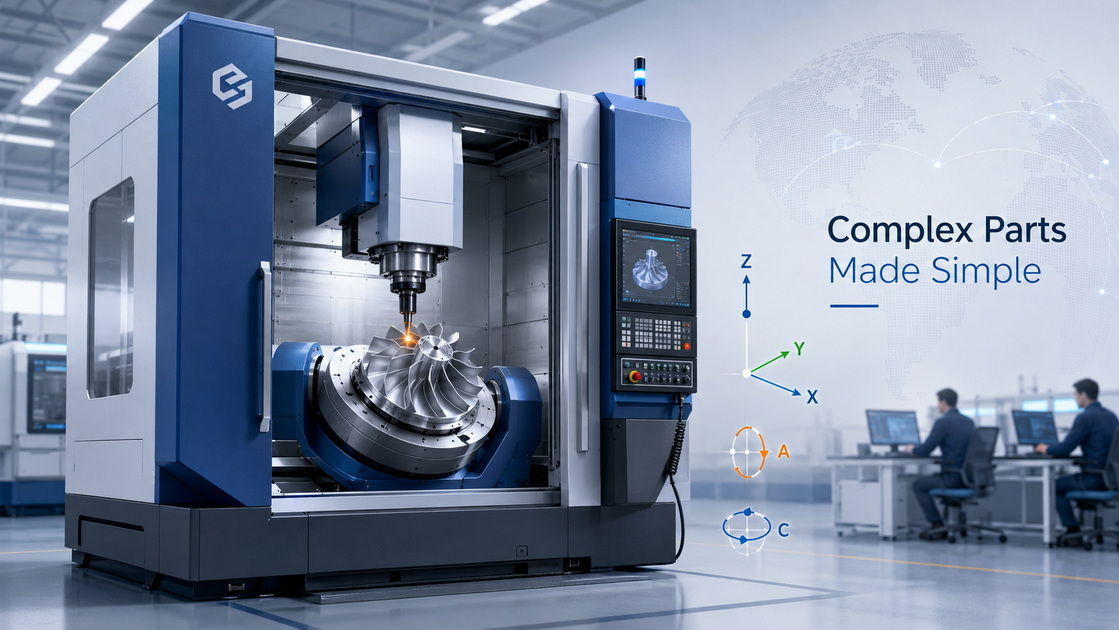
If you manage an engineering, sourcing, or supply chain team, you already know that machining risk is design risk. The earlier you understand what 5-axis CNC machining can (and cannot) do, the more reliable your projects and budgets become. [xometry]
In my experience working with international brands, what most teams really want is not just a definition of 5-axis CNC machining, but clear answers to three questions:
- When does 5-axis actually matter for my part?
- How does it impact tolerance, cost, and lead time?
- How do I choose the right manufacturing partner in China for OEM/ODM projects?
That's exactly what this article will cover, with concrete design guidelines and sourcing insights for 2026.
5-axis CNC machining is an advanced subtractive manufacturing process where the cutting tool and/or workpiece moves along three linear axes (X, Y, Z) plus two rotational axes in a single setup. This additional rotary motion lets the tool approach the workpiece from many more angles, so complex features can be machined without constant manual repositioning.
Where traditional 3-axis milling is limited to straight-line moves with a fixed tool orientation, 5-axis machines combine linear and rotary motion to remove material from several sides of a part in one coordinated cycle. Many 5-axis centers also include automated tool changers controlled by CAM software, so one program can run through multiple tools and operations without operator intervention.
For OEM and ODM buyers, the main business impact is that complex geometries and tight tolerances become feasible and repeatable at scale, even for low- to mid-volume production runs. [davantech]
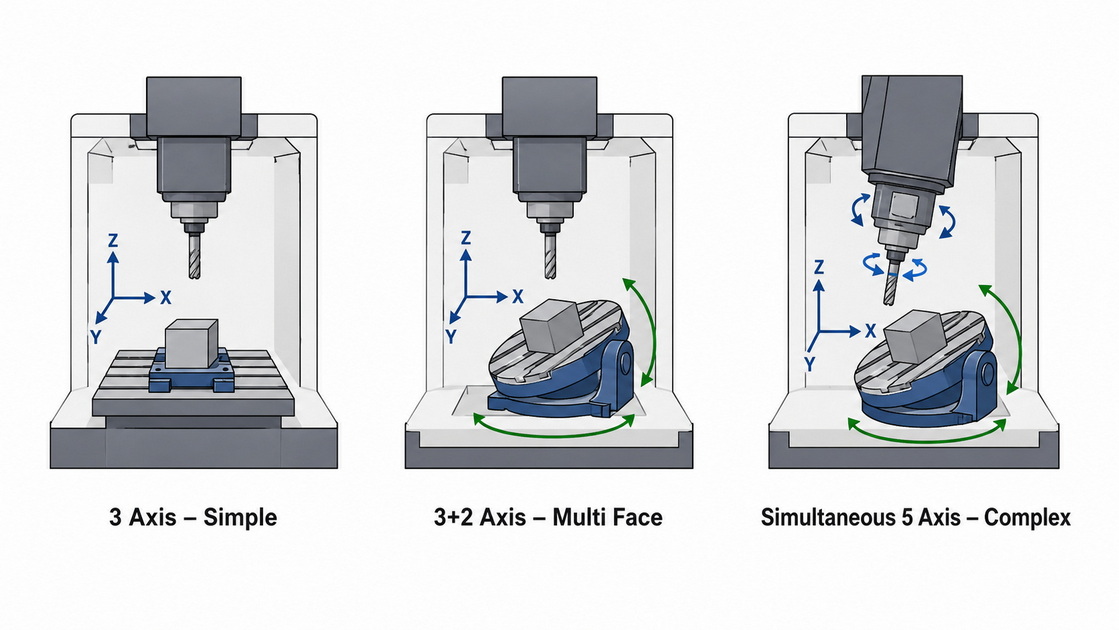
Understanding the difference between 3-axis, 3+2, and simultaneous 5-axis machining helps you specify the right process in RFQs and avoid paying for capability you do not need.
In 3-axis machining, the cutting tool moves along X, Y, and Z only, with a fixed orientation. This is ideal for simpler prismatic parts, pockets, slots, and basic contours but often requires multiple setups and fixtures to access all features on more complex components.
Each additional setup introduces cumulative positioning error and extra operator time, which can hurt both tolerance stack-up and cost. [davantech]
3+2 machining adds two rotational axes, but these rotations are used to position the part or tool at a fixed angle before cutting; material removal still happens using only the three linear axes. This means the machine can reach multiple faces of a part in a single setup while keeping toolpaths relatively simple.
Key benefits of 3+2 for OEM/ODM work:
- Fewer setups: Machining multiple faces without manual repositioning.
- Shorter, more rigid tools for better surface finish and dimensional accuracy.
- Often lower hourly rates than full simultaneous 5-axis while giving you most of the practical access advantages.
In simultaneous 5-axis machining, the machine interpolates all three linear axes and two rotational axes at the same time, continuously reorienting the tool during the cut. This is essential for parts featuring free-form surfaces, deep undercuts, turbine-style blades, or orthopedic-like organic contours. [fictiv]
You should consider simultaneous 5-axis when:
- Tool access is impossible in fixed orientations.
- You require consistent surface finish along complex 3D curves.
- Any additional setup would compromise tolerances or introduce visible blend lines.
For critical aerospace, medical, and high-end industrial parts, this is often the only realistic route to one-setup, one-piece manufacturing. [davantech]
Compared with 3-axis machining, 5-axis offers three core advantages that matter most to overseas buyers: accuracy, complexity, and speed.
1. Higher accuracy and repeatability
Because the cutting tool can approach the workpiece from multiple angles without re-clamping, the risk of misalignment and human error drops significantly. Typical CNC milling tolerances are around ±0.05 mm, but well-set-up 5-axis systems can reliably achieve ±0.02 mm or better, and in some cases as tight as ±0.005 mm for critical features. [davantech]
2. Genuinely complex one-piece designs
Parts such as turbine blades, impellers, combustion chambers, and multi-face enclosures can be machined as a single piece instead of being split into subcomponents and assembled. This reduces part count, assembly labor, and potential leak or failure points in the final product.
3. Faster time-to-market for complex parts
Multi-side machining in one setup eliminates multiple fixtures, re-clamps, and manual handling. That translates into shorter internal lead times, fewer scrap parts, and more stable delivery schedules—especially important when you are coordinating international shipping and downstream assembly. [xometry]
For many of our international customers, the greatest hidden advantage is design freedom: engineering teams can explore more optimized shapes, weight reduction, and integrated features without being constrained by what a 3-axis machine can reach.
Despite its capabilities, 5-axis machining is not always the best choice for every drawing. Recognizing when it is unnecessary can significantly lower your cost-per-part.
Main limitations include:
- Higher equipment and programming costs: 5-axis centers are more expensive to purchase and maintain, and the CAM programming is more complex, which typically increases hourly machining rates.
- Longer setup and programming times: For simple geometry, the overhead of 5-axis programming can exceed the machining time itself, especially on small batches.
- Limited global capacity: Not every shop has modern 5-axis equipment, so the pool of capable suppliers is smaller and often more fully booked. [xometry]
You may be over-specifying 5-axis if:
- Your part has only flat faces and through-holes that are accessible from 1–3 orientations.
- All critical features can be reached in 2–3 simple setups on a 3-axis mill or lathe.
- Surface finish and tolerance requirements are moderate rather than ultra-tight.
A good manufacturing partner should flag these situations and propose a lower-axis alternative to save you money, rather than pushing 5-axis on every RFQ.
When we review drawings from overseas customers, we usually walk through a simple decision checklist before recommending 3-axis, 3+2, or full 5-axis. [davantech]
Ask yourself the following:
1. Part geometry
- Does the part include angled features, deep pockets, undercuts, or internal channels that are not reachable in a vertical orientation?
- Are there critical surfaces that must remain continuous around multiple faces?
2. Tolerance and surface finish
- Are you targeting tolerances tighter than about ±0.05 mm across multiple faces? [davantech]
- Is there any sealing surface, bearing seat, or mating interface that cannot be re-fixtured without risking misalignment?
3. Production volume and mix
- For high-volume, simple parts, 3-axis is usually more economical.
- For low- to medium-volume complex parts, 5-axis offers better repeatability and lower indirect labor per piece.
4. Lead time and project risk
- Do multiple setups on 3-axis introduce schedule risk because more operator time and fixtures are required?
- Is this a critical component on the project's critical path where a single defect can delay the whole build?
As a rule of thumb: if a part requires accurate machining on multiple sides, and tool access is restricted in standard orientations, 5-axis is likely the best long-term solution—especially for repeat orders.
Good design-for-manufacturing (DFM) makes the difference between a part that is "barely machinable" and a part that is repeatable, affordable, and stable across multiple production runs. [xometry]
When designing for 5-axis:
- Avoid unnecessary complexity that does not add functional value, as every extra contour adds cycle time and tool wear.
- Use fillets on internal corners to match feasible cutter radii and avoid tool chatter or breakage.
- Add reasonable draft angles on tall walls where possible to improve chip evacuation and surface finish.
- Provide overflow or stock allowance in areas requiring secondary finishing or polishing to ensure final dimensions are met.
Even though 5-axis offers superior reach, deep pockets and extremely narrow channels can still be limited by tool length and rigidity, not axis count. [xometry]
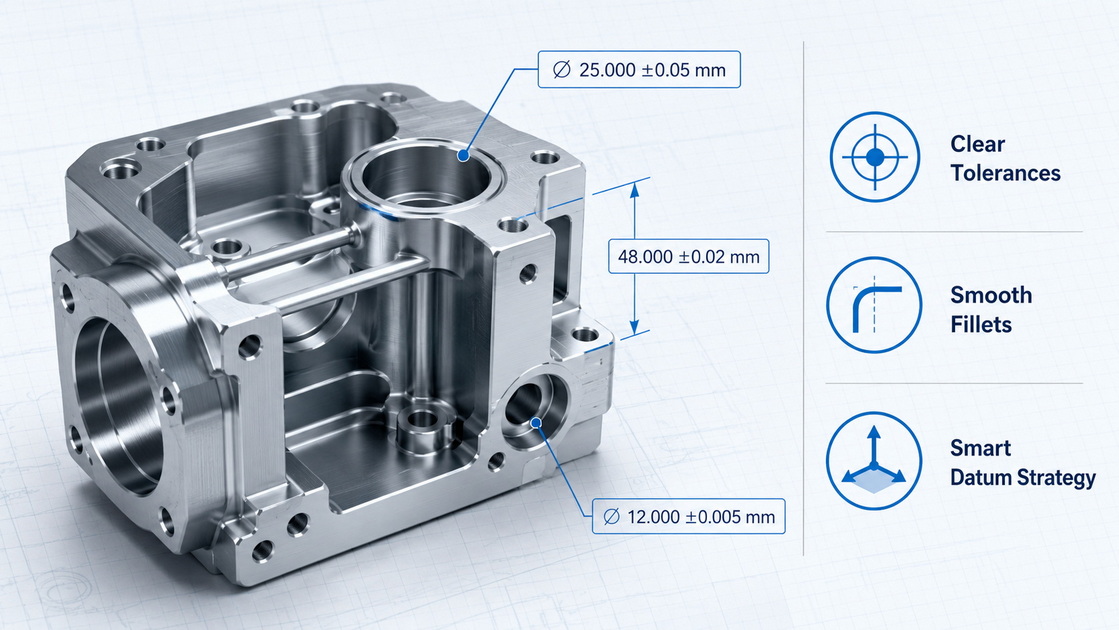
In general CNC practice:
- Standard 3-axis milling often delivers around ±0.05 mm in typical conditions. [davantech]
- 5-axis milling commonly achieves ±0.02 mm or better on well-controlled machines. [davantech]
- Under optimized conditions (stable fixturing, short tools, climate control), ±0.005 mm on critical features is feasible but should be used sparingly and explicitly marked on drawings. [etherealmachines]
To avoid misunderstandings in cross-border projects, make sure your drawings clearly indicate:
- Nominal dimensions with tolerances.
- Any ISO tolerance classes (such as ISO 2768) where applicable. [davantech]
- Surface roughness requirements (Ra).
- Geometric tolerances (GD&T) on critical fits.
Effective fixture design is crucial in 5-axis machining.
- Define primary datums so that all critical features can be referenced in a single setup whenever possible.
- Ensure fixture locations allow the tool to reach every necessary face without collision or excessive overhang.
- When sending RFQs, include your preferred datum scheme or ask the supplier to propose one; this can significantly impact both achievable tolerances and quoted price. [linkedin]
For buyers and sourcing managers, cost predictability is often as important as absolute per-unit price. 5-axis machining introduces several unique cost drivers. [davantech]
Key factors include:
- CAM programming time: Complex toolpaths require more engineering hours before a single chip is cut.
- Machine hourly rates: 5-axis machines have higher capital and maintenance costs, which translates into higher hourly shop rates versus 3-axis.
- Setup and fixturing: Custom fixtures and probes add upfront cost but can drastically reduce cycle time and scrap on recurring orders.
- Material type: Hard alloys or difficult-to-machine materials increase tool wear and cycle time regardless of axis count. [xometry]
Lead times vary widely, but straightforward 5-axis jobs may complete in a few days, while highly complex aerospace or medical parts can require several weeks from RFQ to shipment. When working with overseas suppliers, buffer in transit time and potential customs delays into your project timeline.
From 2024 to 2026, the global five-axis machining market has continued to grow, driven by demand for higher precision, automation, and complex parts in sectors like aerospace, EVs, medical devices, and robotics. Several trends are particularly relevant if you are sourcing internationally: [linkedin]
- AI-native CAM and adaptive machining: CAM software is increasingly using AI to optimize toolpaths, reduce cycle times, and extend tool life, which helps offset higher machine hourly rates. [blog.3ds]
- Digital twins and simulation: More machine shops are simulating setups and programs virtually before cutting, reducing the risk of scrap on expensive billets or castings. [blog.3ds]
- Lights-out and palletized 5-axis cells: Built-in pallet changers and automation allow unattended overnight machining, which is especially useful for repeat OEM batches. [yamazen]
For buyers, this means that the capability gap between leading and average suppliers is widening—shops that invest in these technologies can offer better consistency and shorter lead times at competitive pricing. [in-xmachineinc]
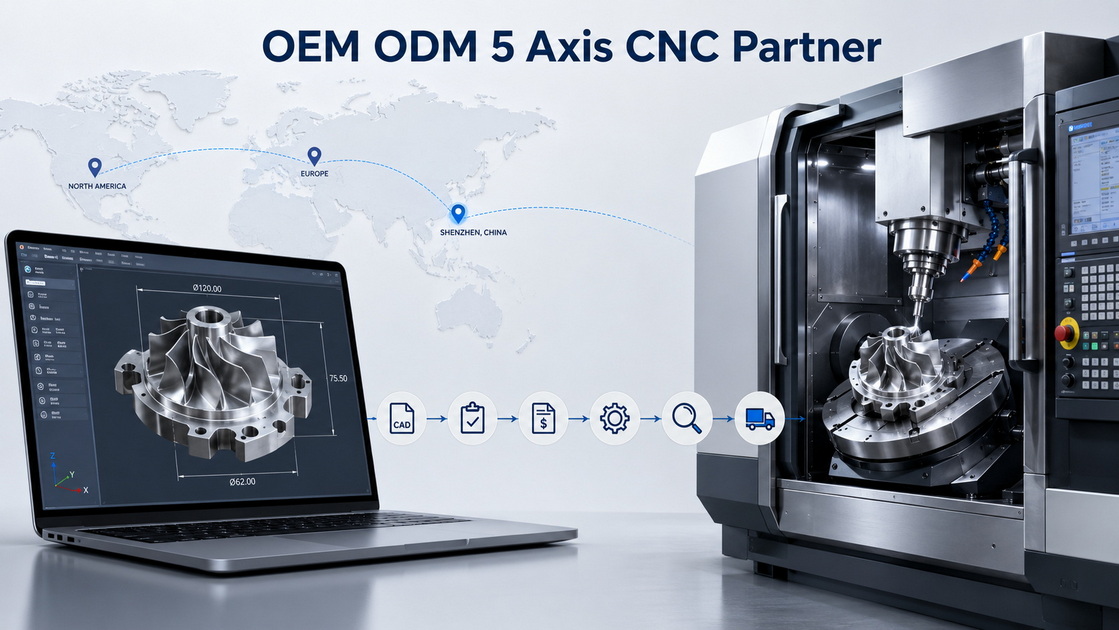
When you select a 5-axis CNC supplier in China or elsewhere, focus on capability, process control, and communication—not just unit price. [flycncpart]
Look for:
- Quality management systems such as ISO 9001, and sector-specific standards like AS9100 for aerospace.
- Demonstrated experience producing parts for your industry (automotive, aerospace, energy, medical, etc.). [fiveflute]
- Multi-axis capacity (3-axis, 4-axis, 5-axis, turning, and post-processing), so you are not forced into 5-axis when it is unnecessary.
Recent industry analyses highlight that leading Chinese machining suppliers combine modern 5-axis equipment with strong OEM/ODM experience and export-oriented quality systems. [cncprecision-machining]
A true manufacturing partner will:
- Provide early DFM feedback on your CAD and drawings, not just a price. [linkedin]
- Suggest design tweaks to reduce cost or improve manufacturability while keeping function intact.
- Offer transparent quoting that breaks out tooling, programming, and unit cost where relevant. [fiveflute]
This collaboration is especially valuable for 5-axis parts, where small design changes (like adding a fillet or opening up a corner) can dramatically reduce cycle time.
| Process type | Axes of motion | Typical tolerance | Best for | When it is not ideal |
|---|---|---|---|---|
| 3-axis CNC milling | X, Y, Z linear | Around ±0.05 mm in standard conditions davantech | Simple prismatic parts, basic pockets, plates, brackets | Complex multi-face parts, tight tolerances across several orientations |
| 3+2-axis (positional 5-axis) | 3 linear + 2 rotary (indexed) | Similar to 3-axis on each cut, but better consistency across sides | Multi-face parts, angled features, low–mid volume OEM parts | Extreme free-form surfaces requiring continuous tool reorientation |
| Simultaneous 5-axis | 3 linear + 2 rotary (continuous) | ±0.02 mm or better on capable machines davantech | Turbine blades, impellers, orthopedic-style components, complex housings | Very simple geometry where programming overhead is unnecessary |
If you are currently struggling with inconsistent quality, long lead times, or over-complicated assemblies for complex metal or plastic parts, shifting to a trusted 5-axis CNC OEM/ODM partner in China can unlock better designs at competitive costs. [flycncpart]
When you are ready, share:
1. 3D CAD files (STEP/IGES).
2. Fully dimensioned 2D drawings with key tolerances.
3. Annual volume estimates and target lead times.
We can then review your design for manufacturability, recommend the right combination of 3-axis, 3+2, and 5-axis machining, and provide a clear, itemized quotation so you can move from concept to production with confidence.
Q1. Do all complex parts really require 5-axis CNC machining?
Not always. Parts with flat faces and accessible features may be more cost-effective on 3-axis or 3+2 machines, even if they look complex at first glance. A good supplier should analyze your CAD and only recommend 5-axis when geometry, tolerance, or lead time truly demands it. [davantech]
Q2. What tolerances can I realistically expect from 5-axis machining?
Many shops can hold around ±0.02 mm on typical 5-axis milled parts, and tighter tolerances are possible on critical features with well-controlled setups. Extremely tight tolerances like ±0.005 mm should be reserved for select critical dimensions and clearly indicated in your drawings. [etherealmachines]
Q3. Is 5-axis CNC machining always more expensive than 3-axis?
Per machine-hour, yes, 5-axis centers are generally more expensive due to equipment and programming costs. However, for complex parts, the ability to machine in one setup can reduce total project cost by lowering fixture count, scrap rate, and assembly operations. [linkedin]
Q4. How should I prepare drawings and models for an overseas 5-axis supplier?
Provide clean 3D CAD files, detailed 2D drawings with all critical tolerances, surface finish requirements, and clear datum schemes. Include any special notes about mating parts or functional interfaces; this helps the supplier propose the most efficient machining strategy. [xometry]
Q5. Which industries get the most value from 5-axis CNC machining today?
Sectors with complex, high-value parts—such as aerospace, EV and automotive, medical devices, robotics, and energy—see the greatest benefit from 5-axis machining because they require complex geometries and tight tolerances. Consumer electronics and climate-tech hardware are also increasing their use of 5-axis to integrate more functions into fewer parts. [linkedin]
Fictiv – "5‑Axis CNC Machining: Precision Capabilities for Complex Parts." https://www.fictiv.com/articles/articles-5-axis-cnc-machining
Davantech – "CNC Machining Tolerances Explained: Achieving Precision and Accuracy." https://www.davantech.com/cnc-machining-tolerances-explained-achieving-precision-and-accuracy/
Data Insights Market – "Analyzing the Future of 5-Axis CNC Machines: Key Trends." https://www.datainsightsmarket.com/reports/5-axis-cnc-machines-668983
3DS DELMIA – "2026 CNC Machining Trends: 5 Key Shifts Defining Precision." https://blog.3ds.com/brands/delmia/2026-cnc-machining-trends-to-pay-attention-to/
Xometry – "CNC Machining Size Limitations: Everything You Need to Know." https://xometry.pro/en/articles/cnc-machining-size-limitations/
Wildcat Digital – "How Do You Write E-E-A-T Content?" https://wildcatdigital.co.uk/blog/how-do-you-write-e-e-a-t-content/
MarketVeep – "SEO for Manufacturing Companies: A Complete 2025 Guide." https://www.marketveep.com/blog/seo-guide-for-manufacturers
Five Flute – "CNC Machining in the Digital Manufacturing Era." https://www.fiveflute.com/guide/cnc-machining-in-the-digital-manufacturing-era/
SmartArticleBot – "AI Article Writing for SEO: The 2026 Guide." https://www.smartarticlebot.com/blogs/ai-article-writing-for-seo
Enstream Solutions – "Mastering Digital Marketing: The Ultimate SEO Guide for CNC Machine Shops." https://enstreamsolutions.wordpress.com/2024/12/18/mastering-digital-marketing-the-ultimate-seo-guide-for-cnc-machine-shops-and-precision-manufacturers/
Top 10 Custom CNC Machining Manufacturers in China – https://www.flycncpart.com/top-10-custom-cnc-machining-manufacturers-in-china.html


