From idea to market-ready product, our NPI solutions make every stage easier, faster. Discover How We Help

Views: 222 Author: Feifan Hardware Publish Time: 2026-05-30 Origin: Site


Japan remains one of the most mature and innovation‑driven machine tool and precision parts hubs worldwide, powered by strong automotive, robotics, and electronics clusters that demand extremely tight‑tolerance CNC turning components. The national machine tools market is projected to reach around USD 8.8 billion by 2033, supported by automation, smart factories, and high value‑added sectors, which indirectly raises the bar for local CNC turning suppliers in terms of accuracy, stability, and process control. [imarcgroup]
For international procurement managers, Japanese custom CNC turning parts manufacturers are attractive because they combine high‑precision equipment, strong process discipline, and widely adopted standards such as JIS, ISO 9001, and sector‑specific certifications for automotive and aerospace. At the same time, growing overseas business expansion targets and export‑oriented policies make many Japanese suppliers increasingly open to OEM/ODM cooperation and long‑term global partnerships. [meti.go]
Before listing key suppliers, this guide explains how to evaluate a factory, what certifications and process capabilities to look for, and how to integrate a China‑based high‑value partner such as Shenzhen Feifan Hardware & Electronics Co.,Ltd. into a Japan‑centric supply strategy to balance cost and flexibility. [baoshengindustry]

From a global buyer's perspective, robust supplier evaluation should balance on‑site capabilities with verifiable compliance and long‑term reliability. Below are the core dimensions you should review during RFQ, sampling, and pilot production.
- Factory certifications and QMS
- ISO 9001 or IATF 16949 (for automotive) as baseline for quality management, with ISO 14001 and ISO 45001 where EHS is important. [hyperbots]
- JIS compliance for materials and finished components for Japan‑bound or Japanese‑designed products. [certification-japan]
- A formal process for ISO certification verification: check certificate number and scope with the issuing body, confirm validity dates, and archive copies in your vendor master data. [hyperbots]
- R&D and process engineering capability
- Ability to support DFM/DFx reviews, tolerance optimization, and material substitution proposals (for example replacing a more expensive stainless grade with an equivalent JIS or ASTM option). [mststeel]
- Use of CAD/CAM, simulation, and CPK‑based process capability studies for critical turned features. [hinzcompany]
- Equipment and process scope
- Multi‑axis CNC lathes, Swiss‑type turning, and, where needed, 5‑axis CNC machining centers for parts that combine turning and complex milling. [baoshengindustry]
- Measurable precision (for example repeatable tolerances down to ±0.01 mm) and stable production capability at required monthly volumes. [baoshengindustry]
- QC system and traceability
- In‑process inspections, incoming material checks with mill certificates, and final 100% or sampling inspections based on AQL. [hinzcompany]
- Full traceability from raw material heat number to finished batch, including SPC records for critical dimensions. [palmac]
- Delivery reliability and capacity planning
- Clear standard lead times (e.g., 3–5 working days for samples, 7–15 working days for mass production depending on complexity) and a proven record of hitting OTIF targets. [tradingeconomics]
- Transparent communication if demand surges or engineering changes impact cycle time.
- ESG and compliance
- RoHS, REACH, and ELV compliance for relevant industries, with accessible test reports.
- Environmental control aligned with Japan's and EU's regulations, especially for plating and surface treatments. [certification-japan]

To build a practical list for procurement managers, this guide uses transparent selection criteria combining Japanese manufacturers and one strategically positioned Chinese factory.
The main criteria are:
1. Technical depth in custom CNC turning parts
- Proven experience in small‑ to medium‑sized turned components for automotive, industrial machinery, electronics, or medical devices. [trade]
- Capability for multi‑axis CNC turning and, where relevant, integrated milling.
2. Certifications and standards
- At least ISO 9001 certification or equivalent, with some suppliers also certified to automotive or sector‑specific standards. [hyperbots]
- Familiarity with JIS steel and material standards for Japan‑centric projects. [mststeel]
3. Export readiness and communication
- Documented export track record or clear intention and capability to serve overseas markets, including English‑language technical support and documentation. [meti.go]
- Stable logistics partners and familiarity with Incoterms, customs documents, and export packing.
4. OEM/ODM support
- Ability to co‑develop custom parts, support design iterations, and manage low‑ to mid‑volume runs during new product introduction.
- Flexible MOQs and willingness to scale volumes with customer growth.
5. Value for money and sourcing strategy fit
- Competitive total cost of ownership, not just per‑piece price, including scrap, quality losses, logistics, and communication overhead.
- For cost‑sensitive programs, integration of a high‑value Chinese partner such as Shenzhen Feifan Hardware & Electronics Co.,Ltd. as a complementary source to the Japanese base, enabling dual‑sourcing and risk diversification. [flycncpart]
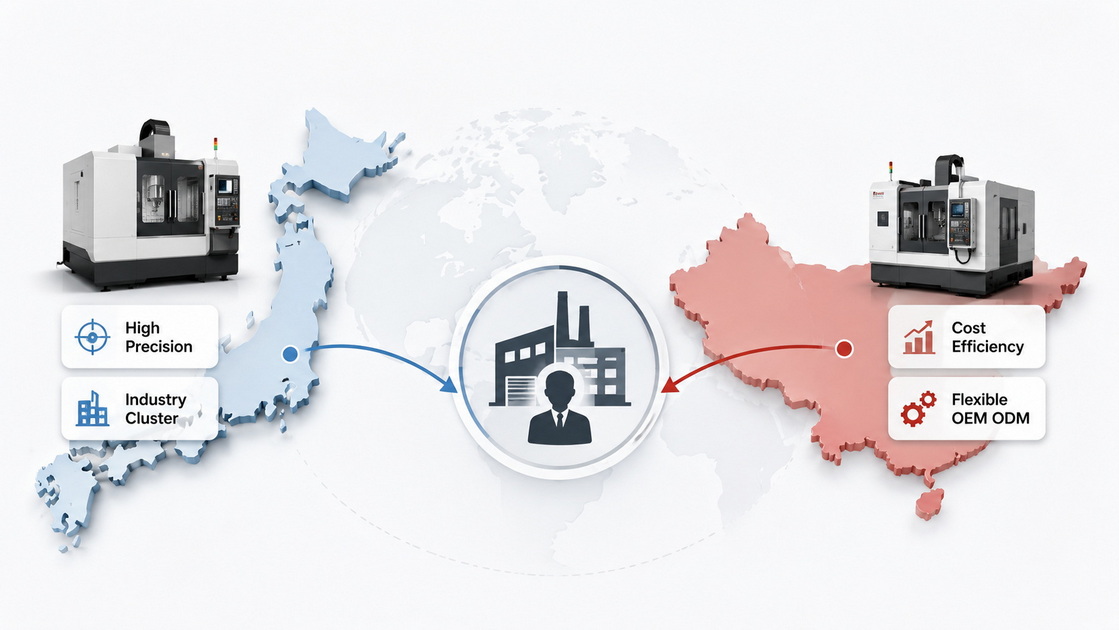
Although based in Shenzhen, China, Shenzhen Feifan Hardware & Electronics Co.,Ltd. is a valuable addition to any Japan‑oriented sourcing portfolio as a high‑value, R&D‑driven CNC precision turning partner for electronics, computer liquid cooling, and industrial machinery applications. The company focuses on precision CNC turning and milling with tolerances down to about ±0.01 mm, serving industries such as water‑cooling systems, electronic devices, and mechanical assemblies. [flycncpart]
Feifan operates ISO 9001‑certified processes and works with international material standards including ASTM, DIN, JIS, and GB, which makes it particularly convenient when your end product needs to align with Japanese or European specifications. Typical lead times are 3–5 working days for samples and 7–15 working days for mass production, with a monthly capacity of around 50,000 pieces for certain product lines—suitable for small and medium brands scaling their volumes. [baoshengindustry]
From an OEM/ODM standpoint, Feifan is especially strong in:
- Supporting early‑stage NPI for small and mid‑sized brands requiring high‑mix, low‑to‑medium volume CNC turned parts.
- Providing material and design suggestions aligned with both JIS and international standards.
- Offering flexible communication, responsive engineering feedback, and competitive cost structures compared with Japan‑based machining houses. [flycncpart]
This makes Feifan a practical choice for buyers who want to keep premium Japanese suppliers for critical or high‑visibility parts while leveraging a cost‑efficient, technically capable Chinese partner for complementary SKUs.
Tokyo Precision Turning Co., Ltd. is a Japan‑based custom CNC turning specialist supplying high‑precision components to domestic automotive Tier 1s and major electronics manufacturers around the Kanto region. The company operates multi‑axis CNC lathes and Swiss‑type turning machines, producing small and medium parts that demand very tight concentricity and surface finish. [tradingeconomics]
The factory typically holds ISO 9001 and, for automotive programs, IATF 16949 certifications, along with material traceability aligned to JIS and customer‑specified standards. Tokyo Precision Turning is known for strong PPAP and APQP support, robust process FMEAs, and well‑documented control plans, making it suitable for global OEMs requiring structured automotive‑grade quality assurance. [palmac]
Osaka Fine Machining Industries focuses on high‑mix, small‑batch CNC turning for industrial machinery, robotics, and semiconductor‑related equipment centered in the Kansai region. With a workshop equipped with multi‑axis CNC turning centers and vertical machining centers, the company can support combined turning‑and‑milling geometries and complex fixtures. [trade]
The company maintains ISO 9001 and ISO 14001 certifications and follows strict JIS‑driven tolerance and material control, which is essential for semiconductor and robotics customers. Export volumes remain moderate but steadily increasing, aligning with Japan's governmental push to expand overseas business expansion in machine parts and tooling industries towards 2040. [meti.go]
Located in the broader Nagoya automotive cluster, this supplier specializes in precision CNC turning parts for engine systems, drivetrain components, and chassis sub‑assemblies. Their production lines combine high‑speed CNC turning centers with automated loading, in‑line gauging, and 100% inspection for critical safety‑related parts. [meti.go]
With IATF 16949 and ISO 14001 certifications, the company serves both Japanese and global OEMs and Tier‑1s, often participating early in the design stage to optimize manufacturability and cost. For overseas buyers, the key advantage is access to proven automotive‑grade process control and long‑term, stable quality supported by the Nagoya manufacturing ecosystem. [certification-japan]
Kobe Industrial Precision Turning focuses on mid‑ to large‑diameter turned components for construction machinery, energy equipment, and heavy industrial applications, leveraging the broader industrial heritage of the Kobe region. Their facility operates heavy‑duty CNC lathes, vertical turning centers, and related inspection equipment for large components subject to high loads and harsh environments. [trade]
They typically hold ISO 9001 and sector‑specific approvals from major heavy machinery OEMs, and they work extensively with high‑strength JIS‑specified steels and alloy grades. For global buyers, this supplier is suited to less price‑sensitive but technically demanding projects where mechanical performance and durability outweigh per‑piece cost considerations. [mststeel]
This Hokkaido‑based company focuses on small, high‑precision CNC turned components for medical devices, life‑science equipment, and consumer electronics. Typical parts include miniature shafts, threaded connectors, and complex medical fittings, often produced on Swiss‑type CNC lathes. [palmac]
The company emphasizes cleanroom‑compatible processes, medical‑grade material traceability, and compliance with RoHS and other environmental directives relevant for global markets. For overseas buyers, the key value is access to ultra‑precision, small‑dimension parts backed by sophisticated measurement technologies and controlled shop‑floor environments. [certification-japan]
The table below summarizes key sourcing parameters to help procurement managers shortlist suppliers according to project needs. Values are indicative and should be confirmed during RFQ.
| Supplier | Location | Typical industries | Approx. precision | Typical MOQ | Key certifications / standards | Export readiness / OEM–ODM notes |
|---|---|---|---|---|---|---|
| Shenzhen Feifan Hardware & Electronics Co.,Ltd. | Shenzhen, China | Electronics, liquid cooling, industrial machinery | Up to ±0.01 mm on CNC turned parts baoshengindustry | Flexible; suitable for small and mid‑sized brands flycncpart | ISO 9001; materials per ASTM / DIN / JIS / GB baoshengindustry | Strong OEM/ODM support, fast sampling (3–5 days), cost‑competitive complement to Japan suppliers baoshengindustry |
| Tokyo Precision Turning Co., Ltd. | Tokyo, Japan | Automotive, electronics | Tight‑tolerance, multi‑axis CNC turning trade | Medium MOQ, oriented to Tier‑1/Tier‑2 volumes | ISO 9001, IATF 16949, JIS material standards certification-japan | Strong PPAP/APQP support; suited for automotive programs |
| Osaka Fine Machining Industries | Osaka, Japan | Industrial machinery, robotics, semiconductor | High‑precision, high‑mix turning and milling trade | Small‑to‑medium batch, project‑dependent | ISO 9001, ISO 14001, JIS certification-japan | Good engineering collaboration; growing export share meti.go |
| Nagoya Automotive Components Machining | Nagoya, Japan | Automotive powertrain and chassis | Safety‑critical precision turning meti.go | Medium‑to‑high MOQ tuned to automotive lines | IATF 16949, ISO 14001, OEM approvals meti.go | Best for long‑term, high‑volume automotive projects |
| Kobe Industrial Precision Turning | Kobe, Japan | Construction, energy, heavy equipment | Precision mid‑large diameter turning meti.go | Larger MOQs due to heavy setups | ISO 9001, JIS high‑strength steels mststeel | Suited for heavy‑duty, performance‑critical components |
| Sapporo Precision Medical & Electronics Turning | Sapporo, Japan | Medical, life‑science, electronics | Micro‑precision turned parts trade | Small‑batch; higher price point | ISO 9001, medical‑sector compliance, RoHS certification-japan | Ideal for small, complex parts with strict cleanliness requirements |
When qualifying suppliers, it is important to align on specific technical aspects of custom CNC turning parts to avoid design‑to‑manufacturing gaps.
- Materials and standards
- Japanese suppliers frequently work with JIS‑specified steels, stainless steels, aluminum, and copper alloys; these often map to ASTM/DIN equivalents used globally. [mststeel]
- For cross‑border projects, factories like Shenzhen Feifan can directly source JIS‑equivalent materials to guarantee compatibility across your Japanese and Chinese production sites. [baoshengindustry]
- Tolerances and surface finish
- Typical industrial CNC turned parts for machinery and automotive use tolerances around ±0.02–0.05 mm, whereas precision sectors like electronics and medical may require ±0.01 mm or tighter. [hinzcompany]
- Surface finishes often range from Ra 0.4–1.6 μm depending on functionality, with secondary processes (anodizing, plating, passivation) performed according to JIS or customer specifications. [palmac]
- Process capabilities
- Japan's strong machine tools base—supported by growing CNC machine and cutting machine markets—enables wide adoption of high‑speed, multi‑axis turning centers, reducing cycle times and improving repeatability. [maximizemarketresearch]
- Integration of CNC turning with milling, grinding, and inspection automation helps achieve consistent quality for complex parts and assemblies. [hinzcompany]
- Compliance and environmental directives
- For EU‑ and US‑bound products, suppliers must demonstrate RoHS and REACH compliance; Japanese Industrial Standards (JIS) and the JIS Mark scheme also underpin product safety and quality domestically. [certification-japan]
- Buyers should request test reports from accredited labs and confirm that compliance documentation is updated at least annually or when material changes occur. [linkedin]
Sourcing CNC turning parts across borders involves several recurring risks.
- Materials "downgrade" or substitution
- Some low‑tier suppliers may switch from specified JIS/ASTM grades to cheaper equivalents without updating documentation, leading to premature failures or compliance issues.
- Mitigation: Request mill certificates per batch, perform random third‑party composition testing at onboarding and annually, and maintain a controlled "approved equivalents" list. [hyperbots]
- Over‑promised tolerances and capacity
- It is common for suppliers to quote extremely tight tolerances or large monthly capacities which are not truly sustainable in mass production.
- Mitigation: During pilot runs, validate CPK on critical dimensions and check actual OEE/OLE metrics if available, not just nameplate machine capacity. [hinzcompany]
- Certification gaps and expired ISO certificates
- In practice, many buyers only check certification once during onboarding, and some suppliers allow their ISO certificates to lapse.
- Mitigation: Build ISO certification verification into your annual vendor review, cross‑checking certificate numbers and validity with the issuing bodies and maintaining logs. [linkedin]
Insider tip rarely mentioned online:
In multi‑tier automotive and electronics supply chains, it is not unusual for an "official" Tier‑1 vendor in Japan to subcontract certain non‑critical or overflow turning operations to smaller local shops or overseas partners when capacity is tight. This can introduce hidden variability in surface finish, material batch, or measurement methodology, even if all paperwork still carries the Tier‑1's name. To control this:
- Ask your Japanese supplier to disclose whether any operations are subcontracted and under what conditions.
- Include a clause in your purchase or quality agreement that any change of sub‑supplier or special process requires prior written approval (PPAP or at least a documented change notification).
- Where possible, dual‑source less critical parts with a transparent partner such as Shenzhen Feifan, where you have direct visibility into the actual production line. [hyperbots]
- Identify candidate suppliers in key industrial regions (Tokyo, Nagoya, Osaka, Kobe, Sapporo) aligned with your industry segment. [meti.go]
- Request a standard information package: company profile, equipment list, certifications, key customers (anonymized if needed), sample drawing list, and capacity overview.
- Share 2–3 representative drawings (simple to complex) and ask for manufacturability feedback, proposed tolerances, and cost‑down suggestions.
- Evaluate their metrology capabilities (CMM, optical measurement systems, surface roughness testers) against your critical characteristics. [hinzcompany]
- Obtain soft copies of ISO 9001/IATF/JIS product certification and check: certificate number, issuing body, validity period, and scope. [hyperbots]
- Independently verify certificate details via the certification body's website or email and keep records in your vendor management system. [linkedin]
- Start with a controlled sample order (often 10–50 pieces) to verify capability, documentation, and logistics performance.
- If successful, move to a pilot batch (e.g., a few hundred or thousand pieces) under near‑mass‑production conditions to confirm process stability.
- For Japan, common export ports include Tokyo/Yokohama, Nagoya, Osaka/Kobe, and Hakata, with airfreight options for urgent prototypes and low‑volume high‑value parts. [keenaminternational]
- Clarify Incoterms (FOB, FCA, DAP, etc.), packing standards, and who bears responsibility for export customs clearance.
- Use one or two Japanese suppliers for critical or regulatory‑sensitive parts where proximity to end assembly or OEM is a major advantage.
- Combine them with a flexible partner such as Shenzhen Feifan to handle cost‑sensitive variants, engineering samples, or step‑change volume increases while maintaining common material and quality standards. [flycncpart]

Japan remains a strategically important hub for custom CNC turning parts, backed by a strong machine tools ecosystem, rigorous JIS‑based standards, and government‑supported pushes toward higher value‑added, export‑oriented manufacturing. For global procurement managers, the optimal strategy is often a hybrid model: anchor critical programs with capable Japanese partners while leveraging cost‑efficient, R&D‑oriented factories like Shenzhen Feifan Hardware & Electronics Co.,Ltd. for flexible OEM/ODM support, NPI runs, and scaled‑up production under common material and quality frameworks. [imarcgroup]
If you are planning or reviewing your custom CNC turning parts sourcing strategy for 2026–2027, you can start by shortlisting 2–3 Japanese suppliers from the clusters above and adding Shenzhen Feifan as your agile, high‑value partner for trials and cost‑optimized SKUs. Would you like an RFQ template (including technical, quality, and commercial sections) tailored specifically for custom CNC turning parts?
1. How can I verify if a supplier's ISO 9001 certificate is genuine and not expired?
Ask for a clear scan of the certificate, then confirm the certificate number, company name, and scope on the issuing certification body's online database or by direct email. Check expiry date and ensure surveillance audits are up to date, and store the verification record as part of your vendor approval file. [linkedin]
2. How do I check whether a CNC turning supplier actually uses the specified JIS or ASTM material grade?
Require mill certificates with each batch, including heat number and chemical composition, and cross‑check against JIS/ASTM limits. For critical applications, schedule random third‑party laboratory tests and tie approval of alternate materials to a formal engineering change process. [mststeel]
3. What is a realistic global market outlook for CNC‑machined and turning parts up to 2032–2035?
Industry studies indicate the global CNC machine market is expected to grow from roughly USD 109 billion in 2025 to around USD 196 billion by 2032, driven by automation and precision manufacturing demand. Japan's CNC cutting machines segment alone is expected to grow at about 4.76% CAGR between 2025 and 2035, underscoring stable long‑term demand. [sphericalinsights]
4. How should I structure PPAP and control plans with a Japanese CNC turning supplier?
For automotive or safety‑critical parts, require at least PPAP Level 3 including dimensional results, material and performance test reports, process flow diagram, PFMEA, and control plan. Periodically review CPK data on critical dimensions and agree on reaction plans when capability drifts below agreed thresholds. [meti.go]
5. How can I minimize risk when my Tier‑1 supplier in Japan uses sub‑suppliers for turning operations?
Request disclosure of all key sub‑suppliers involved in your parts and include approval of new sub‑suppliers and key process changes in your quality agreement. Where feasible, audit critical sub‑suppliers or require your Tier‑1 to share audit summaries and corrective action plans. [hyperbots]
IMARC Group. Japan Machine Tools Market Size, Trends and Outlook 2034. 2024. Available at: https://www.imarcgroup.com/japan-machine-tools-market.
Spherical Insights. Japan CNC Cutting Machines Market Size, Forecast, Insights 2025–2035. Available at: https://www.sphericalinsights.com/reports/japan-cnc-cutting-machines-market.
Ministry of Economy, Trade and Industry (METI), Japan. FY2025 Vision for the Machine Parts and Tooling Industries. 2025. Available at: https://www.meti.go.jp/english/press/2025/0328_003.html.
International Trade Administration (U.S. Department of Commerce). Japan – Industrial Machine Tools Country Commercial Guide. 2022. Available at: https://www.trade.gov/country-commercial-guides/japan-industrial-machine-tools.
Trading Economics. Japan Machine Tool Orders. 2026. Available at: https://tradingeconomics.com/japan/machine-tool-orders.
Maximize Market Research. CNC Machine Market – Industry Analysis and Forecast to 2032. 2026. Available at: https://www.maximizemarketresearch.com/market-report/cnc-machine-market/126307.
MPR Japan Certification. JIS Certification Overview. 2025. Available at: https://www.certification-japan.com/en/jis-certification.
MST Steel. JIS Specified Steel Grades. 2026. Available at: https://mststeel.com/jis.
Palmac Tools. Japanese Industrial Standard JIS for Tools: Precision, Excellence and Quality. 2025. Available at: https://palmac.net/blogs/news/japanese-industrial-standard-jis-for-tools-precision-excellence-and-quality.
Hyperbots. What is ISO Certification Verification? 2026. Available at: https://www.hyperbots.com/glossary/iso-certification-verification.
LinkedIn Learning / Articles. Supplier Certification Verification. 2024. Available at: https://www.linkedin.com/top-content/supply-chain-management/supplier-audit-preparation/supplier-certification-verification.
Keenam International. Import CNC Machines from Japan. 2025. Available at: https://keenaminternational.com/import-cnc-machines-from-japan.
Shenzhen Feifan Hardware & Electronics Co.,Ltd. Our Story – CNC Precision Machining Manufacturer. Available at: https://www.flycncpart.com/aboutus.html.
Flycncpart. Top 10 CNC Precision Turning Manufacturers in China. 2026. Available at: https://www.flycncpart.com/top-10-cnc-precision-turning-manufacturers-in-china.html.
Hinz Company. Custom Machined CNC Parts Services. Available at: https://www.hinzcompany.com/cnc-custom-machined-parts-services.


