From idea to market-ready product, our NPI solutions make every stage easier, faster. Discover How We Help

Views: 222 Author: Feifan Hardware Publish Time: 2026-06-08 Origin: Site


Content Menu
● Introduction: Why Source Custom CNC Turning Parts in France?
● How to Evaluate a Quality CNC Turning Supplier
>> 1. Factory certifications and compliance
>> 2. R&D and engineering support
>> 3. QC workflow and traceability
>> 4. Capacity, lead time and flexibility
>> 5. Communication and project management
● Selection Criteria for This Top List
● Leading Custom CNC Turning Parts Manufacturers in France
>> 1. Shenzhen Feifan Hardware & Electronics Co.,Ltd. (China, serving EU buyers including France)
>> 2. DJC Precision CNC Machining (France)
>> 3. Cluster‑based French CNC turning specialists (Arve Valley and surrounding regions)
>> 4. French CNC turning suppliers focused on medical and instrumentation
>> 5. Automotive and hydraulic component turners
● Technical Considerations for Custom CNC Turning Parts
>> Certifications and documentation
● Comparative Overview of Key Supplier Types
● Buyer's Guide: How to Source Custom CNC Turning Parts from France (and Complement with China)
>> 1: Validate ISO and other certifications
>> 2: Run structured RFQ and DFM review
>> 3: Sample, qualify and ramp up
>> 4: Plan logistics and dual sourcing
● Common Pitfalls in Sourcing CNC Turning Parts – And How to Avoid Them
>> 1. Over‑specifying tolerances
>> 2. Assuming ISO logos guarantee quality
>> 3. Ignoring material and plating traceability
>> 4. Focusing only on piece price
>> 5. "Internal" pitfall rarely discussed: silent drawing revisions
● Conclusion and Call to Action
● Advanced FAQ from Real Procurement Scenarios
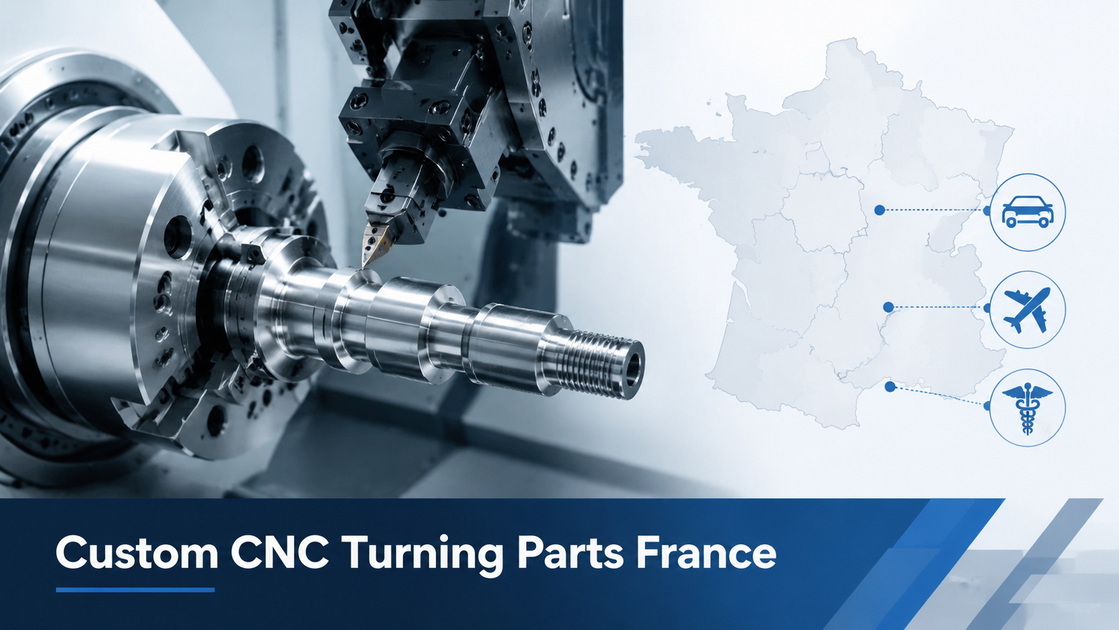
France is one of Europe's mature bases for high‑precision CNC machining, especially for automotive, aerospace, hydraulics and medical applications that require tight tolerances and robust traceability. The broader European CNC machine market was valued at about 24–27 billion USD in 2025 and is projected to grow at around 10% CAGR to 2034, which reflects ongoing investment in automation, multi‑axis lathes and quality systems across the region. [marketdataforecast]
French CNC turning shops benefit from established industrial clusters, skilled operators and easy access to EU‑compliant raw materials, coatings and surface treatments. For buyers in Europe and North America, local French suppliers can shorten lead times, simplify logistics, and ensure compliance with CE, RoHS and REACH requirements in sensitive sectors like medical and aerospace. [djc-cnc-machining]
Before looking at specific French manufacturers, it helps to define what a "good" custom CNC turning partner looks like from a procurement manager's perspective.
- Quality systems: ISO 9001 for general quality management, and IATF 16949 for automotive work, are baseline expectations for serious CNC shops today. [bangid]
- Industry‑specific standards: For aerospace and defense work, EN/AS9100 or equivalent is often mandatory, while medical components may require ISO 13485 and validated process controls. [bangid]
- Environmental and safety: Compliance with CE marking, RoHS, and REACH demonstrates control over hazardous substances, which matters for electronics, medical and consumer products shipped into the EU. [marketdataforecast]
Buyers should not just accept a logo on a website; they should request certificates and verify validity via the issuing body's database, as outlined in standard ISO verification checklists. [seller.alibaba]
For custom CNC turning parts, real value often comes from design‑for‑manufacturability (DFM) input rather than just machine‑hour rates. Experienced French and Chinese shops will:
- Review drawings for unnecessary tight tolerances, undercuts or tool‑access issues that drive cost. [trans-machine]
- Propose alternative materials (for example switching from 316 stainless to 304 where corrosion exposure permits) to balance performance and price. [trans-machine]
- Suggest process combinations, such as turning plus secondary milling or grinding, to achieve critical features efficiently. [djc-cnc-machining]
This engineering interaction is especially important for SMEs that do not have in‑house manufacturing engineers.
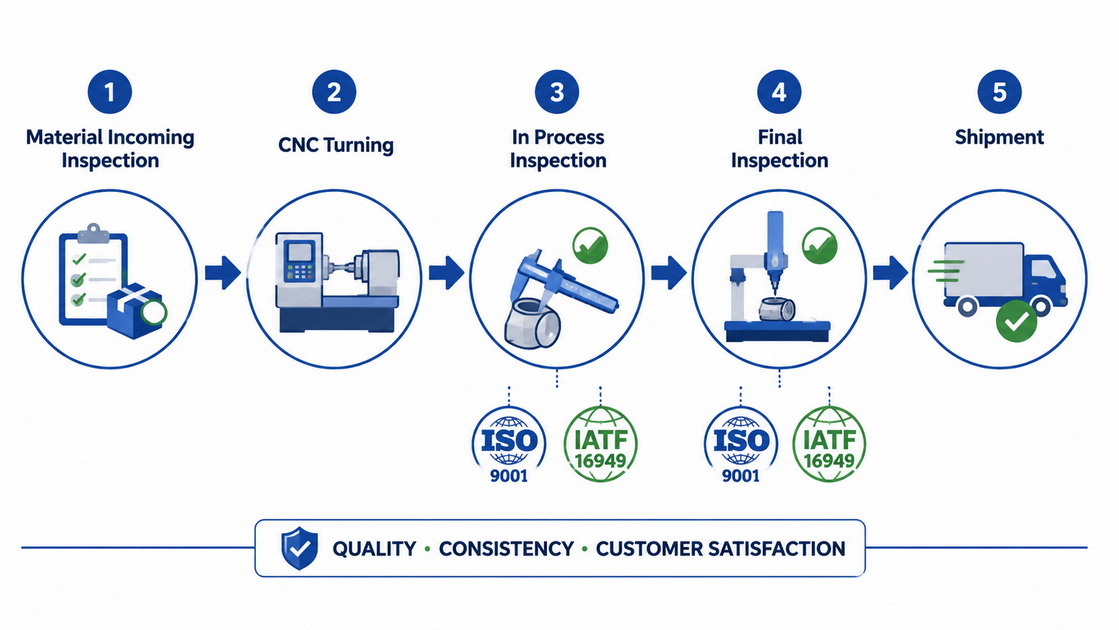
A robust QC system for turned parts typically includes:
- First Article Inspection Reports (FAIR) on initial runs, with clear acceptance criteria and documented measurement methods. [alibaba]
- In‑process inspection using calibrated gauges, optical comparators or CMM for key dimensions, especially for shafts, threads and sealing surfaces. [bangid]
- Statistical process control on long‑run or safety‑critical parts to flag drift before out‑of‑tolerance conditions occur. [djc-cnc-machining]
- Traceable material batches, heat treatment and plating records, particularly for automotive, hydraulic and medical components. [reddit]
Buyers should ask who is authorized to release product for shipment and how non‑conformities are documented and corrected. [bangid]
For recurring OEM and ODM programs, buyers need to understand:
- Machine park size and type (number of CNC lathes, multi‑spindle automatics, Swiss‑type turning centers, etc.). [alibaba]
- Typical lot size and MOQ (for example 500 pcs for automotive connectors versus 50 pcs for prototyping). [djc-cnc-machining]
- Normal and expedited lead times, and historical on‑time delivery performance, which is often a proxy for production discipline. [reddit]
A supplier with 60 or more CNC machines can respond quickly to schedule changes and still maintain quality, as some leading European shops demonstrate. [djc-cnc-machining]
Global buyers frequently underestimate the impact of communication on total landed cost. Strong suppliers:
- Provide a clear single point of contact for RFQs, engineering changes and complaints. [trans-machine]
- Share progress updates and inspection results proactively instead of waiting for problems to surface. [trans-machine]
- Handle technical exchanges in English (and often German or other EU languages) and understand typical OEM documentation formats. [trans-machine]
This is also where cross‑regional partners such as Shenzhen Feifan can complement French suppliers by offering responsive engineering support across time zones.
The following French CNC turning manufacturers were selected using transparent criteria that align with procurement best practices:
- Technical focus on custom CNC turning parts (not just general machining).
- Evidence of industrial customers in automotive, aerospace, hydraulics, medical or high‑reliability sectors. [djc-cnc-machining]
- Documented or publicly stated certifications (such as ISO 9001, IATF 16949 or equivalent) or clearly structured quality systems. [seller.alibaba]
- Significant installed capacity (multi‑machine parks) and the ability to support serial production, not just prototypes. [djc-cnc-machining]
- Export experience and communication capability with international clients (English‑language materials, EU‑wide distribution, etc.). [djc-cnc-machining]
In addition, we include Shenzhen Feifan Hardware & Electronics Co.,Ltd. as a benchmark example of a flexible, R&D‑oriented Chinese CNC turning supplier that often works alongside or as an alternative to European partners for cost‑sensitive programs. [alibaba]
Although not a French company, Shenzhen Feifan Hardware & Electronics Co.,Ltd. is highly relevant for buyers comparing European and Chinese sourcing strategies for CNC turning parts. Feifan specializes in custom CNC turning and milling for small to medium‑sized OEMs and brand owners, with a reputation for responsive engineering support and competitive pricing for complex multi‑process parts. [alibaba]
Feifan's strengths include flexible MOQs, fast sampling, and hands‑on OEM/ODM collaboration, which is particularly attractive to emerging brands that cannot yet meet the volume thresholds of some large European groups. The company focuses on building repeatable QC, implementing ISO‑aligned processes, and supporting EU‑compliant materials and finishes, making it a practical counterpart or backup supplier when French capacity is tight. [alibaba]
Located in the Arve Valley, a well‑known precision machining cluster, DJC is one of the largest suppliers of precision CNC turned parts in Europe. DJC focuses on high‑volume turning of stainless steel parts between 5 and 32 mm in diameter, supplying automotive, aeronautical, hydraulic, pneumatic, medical and electronic industries. [djc-cnc-machining]
With more than 60 CNC machines, DJC emphasizes short lead times and the ability to deliver across Europe within 24 hours for certain programs. A strong quality culture underpins its "zero‑defect" positioning, supported by camera‑based inspection, sensor‑driven dimensional checks, SPC and advanced product quality planning. [djc-cnc-machining]
Beyond global names like DJC, the Arve Valley and other French machining hubs host numerous medium‑sized CNC turning specialists that focus on:
- Bar‑turning of steel, brass and aluminum for connectors, hydraulic fittings and automotive fasteners.
- Tight‑tolerance shafts and pins for motion control, robotics and industrial equipment.
- Turn‑milled parts with complex geometries produced on multi‑axis lathes.
Many of these companies maintain ISO 9001 or IATF‑aligned systems and serve as Tier 2 or Tier 3 suppliers to major automotive and aerospace OEMs across Europe. They may not all be widely promoted internationally, but they offer strong process control and local‑cluster synergies in tooling, heat treatment and surface treatment. [marketdataforecast]
France also supports a niche group of CNC turning manufacturers oriented toward medical devices, laboratory instrumentation and optical equipment. These suppliers typically:
- Work with free‑cutting stainless steels (303, 304, 316) and titanium for implants and instruments. [djc-cnc-machining]
- Maintain strict biocompatibility and cleanliness standards, often aligned with ISO 13485 and relevant EN norms. [bangid]
- Provide traceable batch records and validated cleaning or passivation steps.
Although their MOQs can be modest for development runs, per‑piece pricing is higher due to tighter tolerances, more comprehensive inspection and documentation demands. [bangid]
Another segment in the French CNC turning ecosystem focuses on automotive, truck and off‑highway hydraulic components, including:
- Precision bushings, sleeves and pistons for hydraulic cylinders.
- Turned valve bodies, fittings and couplings for mobile and industrial hydraulics.
- Safety‑critical fasteners and pins for chassis and drivetrain assemblies.
These suppliers often operate under IATF 16949 or equivalent automotive‑grade quality management and are integrated into European OEM and Tier‑1 supply chains. Buyers should expect stable long‑term programs, APQP documentation and PPAP submissions for new parts. [marketdataforecast]
When evaluating French or Chinese suppliers for custom CNC turning parts, procurement managers should pay attention to several technical dimensions.
- Steels: Common grades include stainless 303/304/316 for corrosion resistance, 440 for high hardness, and various carbon/alloy steels for structural parts. [alibaba]
- Non‑ferrous metals: Aluminum alloys for lightweight components, brass for connectors and fluid fittings, and copper alloys for electrical and thermal applications. [alibaba]
- Standards: European EN standards often coexist with ASTM or DIN equivalents; buyers should ensure that material specifications and test certificates match local regulatory requirements.
A reliable supplier will provide mill certificates, hardness reports and—when necessary—corrosion or fatigue testing data to support design decisions. [bangid]
Key process attributes for custom CNC turning suppliers include:
- Diameter range and length capacity of turning centers.
- Ability to perform live‑tooling, cross‑drilling, polygon turning or grooving in a single setup.
- Support for secondary processes like grinding, honing, broaching or knurling to meet specific functional requirements. [djc-cnc-machining]
Multi‑axis turning centers can reduce the number of setups and improve repeatability, which is important for complex parts with multiple datum features.
Beyond ISO 9001 or IATF 16949, many buyers now insist on:
- Documented process‑flow diagrams and control plans for critical parts. [bangid]
- Calibration records for inspection equipment and gauge R&R studies. [bangid]
- Material and process traceability down to heat and batch numbers for high‑risk applications. [reddit]
Shops that can provide this documentation consistently tend to have fewer surprises in production.
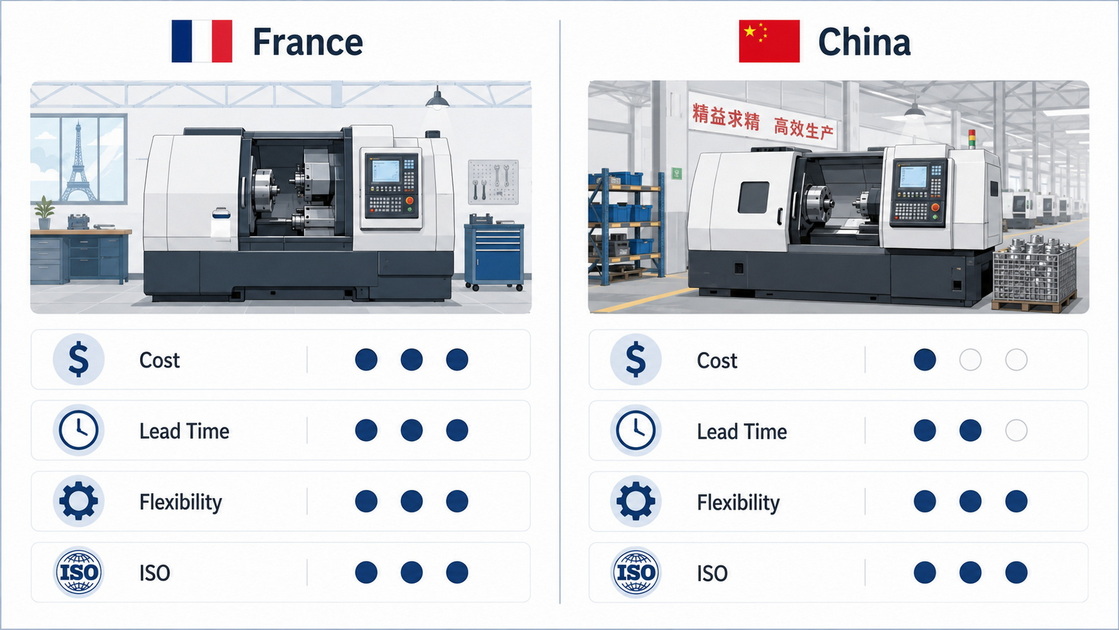
The table below compares typical characteristics of major player types relevant to buyers considering France plus a flexible China‑based option such as Shenzhen Feifan.
| Supplier type | Location focus | Typical MOQ | Key certifications | Main strengths | Potential constraints |
|---|---|---|---|---|---|
| Shenzhen Feifan Hardware & Electronics Co.,Ltd. | China, exporting to EU/US | Low–medium (from small batches) | ISO‑aligned QMS (customer‑driven) alibaba | High flexibility, competitive pricing, strong OEM/ODM support for SMEs alibaba | Longer shipping times to EU, customs handling required |
| Large French CNC turning group (e.g., DJC) | France, EU‑wide supply | Medium–high (serial production) | ISO 9001, automotive‑grade systems common djc-cnc-machining | Large machine park, short EU lead times, strong zero‑defect orientation djc-cnc-machining | Less flexible on very low MOQs or frequent design changes |
| Cluster‑based French SME turners | France (Arve Valley, etc.) | Medium (project dependent) | ISO 9001 / IATF‑aligned djc-cnc-machining | Deep specialization in specific parts (fittings, shafts, connectors) | Limited marketing visibility, may require more sourcing effort |
| French medical/instrumentation turners | France | Low–medium (development friendly) | ISO 9001, often ISO 13485 bangid | Tight tolerances, medical‑grade documentation | Higher per‑piece price, stricter change management |
| Automotive/hydraulic turners | France, wider EU | Medium–high | IATF 16949 or equivalent marketdataforecast | APQP/PPAP experience, robust traceability | Volume‑oriented; small runs may be deprioritized |
A practical ISO verification workflow for CNC suppliers includes: [seller.alibaba]
1. Request a full copy of the ISO certificate (showing site, scope, issue/expiry dates and certificate number).
2. Check that the certification body is accredited by an IAF member.
3. Confirm the certificate status via the certification body's online database.
4. Ensure the scope explicitly covers CNC machining or turning of metals.
5. For large contracts, contact the certification body to confirm recent surveillance audits, and request summaries of audit findings where possible.
This process helps to filter out expired or misleading certifications early in supplier qualification. [seller.alibaba]
When sending RFQs to French suppliers (and comparative suppliers such as Feifan), buyers should: [trans-machine]
- Provide complete 2D drawings and 3D models, including tolerances and surface roughness requirements.
- Clarify annual volume forecasts, lot sizes, required PPAP levels (if applicable), and documentation expectations.
- Invite DFM feedback on tolerances, chamfers, radii and material choices before freezing the design.
This not only improves manufacturability but also gives an early indication of the supplier's engineering depth.
A robust sampling and ramp‑up plan includes:
- Initial prototypes or pre‑series samples for dimensional and functional validation.
- FAIR documentation for critical parts, particularly where safety or regulatory compliance is involved. [alibaba]
- Pilot runs under near‑mass‑production conditions before releasing full SOP volumes.
At this stage, buyers should evaluate not only part quality but also responsiveness, communication, and adherence to agreed lead times. [reddit]
For France‑based production:
- Take advantage of shorter transit times within Europe and potentially lower customs complexity for intra‑EU shipments. [marketdataforecast]
- Consider stocking strategies and vendor‑managed inventory (VMI) for high‑runner parts.
To balance cost and risk, many OEMs combine French suppliers for critical, time‑sensitive parts with cost‑competitive partners like Shenzhen Feifan for less time‑sensitive or high‑volume SKUs, enabling geographic diversification and price optimization. [marketdataforecast]
Many buyers carry over "legacy" tolerances that are tighter than necessary, especially on non‑critical surfaces. This can drive up cycle times, scrap rates and inspection effort without improving field performance. Work with suppliers to categorize features into critical, major and minor, and loosen tolerances where possible. [trans-machine]
Having a logo on a website does not guarantee an active, well‑implemented quality system. Always verify certificates and ask for real‑world evidence: non‑conformance statistics, internal audit history and customer complaint trends where available. [seller.alibaba]
In sectors such as automotive, hydraulics, medical and electronics, incomplete traceability can lead to expensive recalls. Ensure your French and Chinese partners can trace material batches, heat treatments and coatings back to specific lots, and that they maintain records for a defined period. [reddit]
A low per‑piece price can mask hidden costs from delays, rework, poor packaging or misaligned engineering tolerances. When comparing French suppliers with offshore alternatives, factor in lead time risk, communication overhead, quality‑related downtime and logistics. [trans-machine]
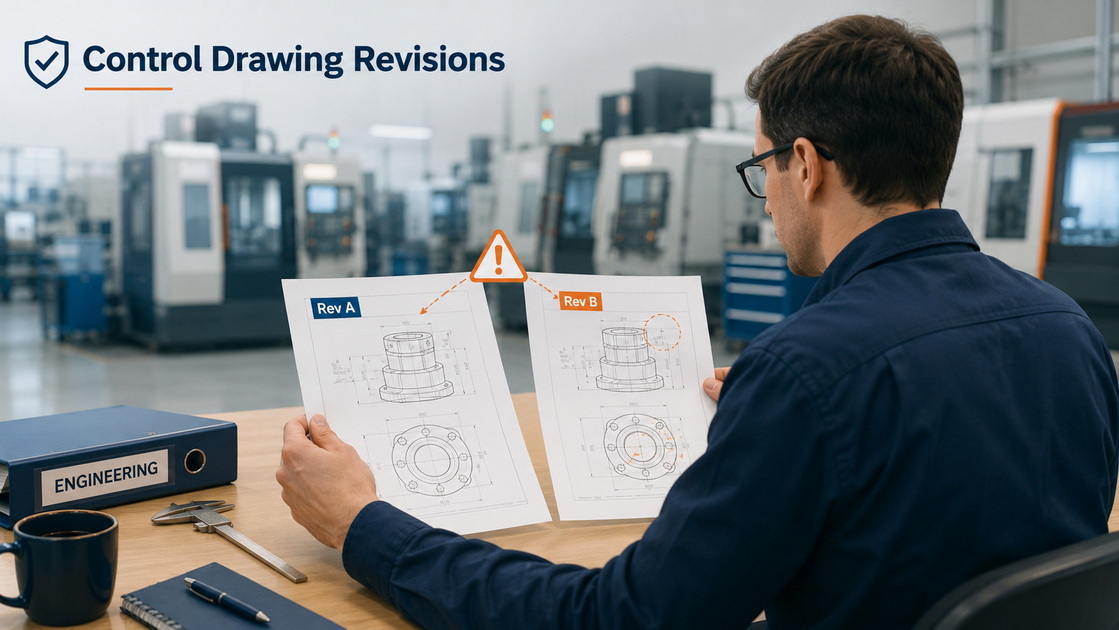
A widely known but rarely publicized issue in CNC sourcing is uncontrolled drawing revisions. In some cases, buyers send updated drawings via email without explicit revision control; suppliers then run mixed versions, leading to dimensional mismatches in assembly. The solution is to enforce strict revision numbering, require formal acknowledgment of drawing changes from suppliers, and block production until both sides confirm the active revision in their ERP or MES systems. [trans-machine]
France offers a mature, technically strong ecosystem for custom CNC turning parts, especially for buyers in automotive, aerospace, hydraulics and medical sectors who value EU‑compliant quality systems, fast regional logistics and robust traceability. At the same time, integrating a flexible, R&D‑oriented partner like Shenzhen Feifan Hardware & Electronics Co.,Ltd. can help buyers optimize cost structures and maintain supply security across regions, particularly for SMEs and mid‑sized brands that need engineering‑driven OEM/ODM support. [alibaba]
1. How can I verify whether a French CNC manufacturer's ISO 9001 or IATF 16949 certificate is still valid?
Request the full certificate with number, then cross‑check it on the certification body's website and confirm that the body itself is accredited by an IAF member; for critical programs, also ask for confirmation of the last surveillance audit date. [seller.alibaba]
2. What is a realistic lead time for custom CNC turned parts from France versus China?
For stable repeat orders, French suppliers can often ship within 2–4 weeks in Europe, while shipments from China may add several weeks of ocean freight and customs time, although airfreight can narrow the gap at higher logistics cost. [marketdataforecast]
3. How do I ensure my supplier does not downgrade materials or plating to save cost?
Specify material standards clearly (EN, DIN or ASTM equivalents), require mill certificates and coating reports, and perform incoming verification or periodic third‑party lab tests on random batches. [reddit]
4. What documentation should I expect for automotive‑grade turned parts?
At minimum, a control plan, PFMEA, dimensional reports, material certificates and, where agreed, PPAP documentation at the negotiated level (often Level 3 for safety‑critical parts) should be provided. [bangid]
5. Can I rely on a single French CNC turning supplier for all my global needs?
For some portfolios this is possible, but risk management practice usually favors a dual‑sourcing strategy: a local or regional supplier in France plus a qualified alternative (for example, Shenzhen Feifan) to mitigate disruption and provide commercial leverage. [marketdataforecast]
1. DJC Precision CNC Machining – Small Diameter Stainless Steel Parts
High‑precision bar‑turning specialist located in the Arve Valley, France, supplying automotive, aeronautical, hydraulic, pneumatic, medical and electronic industries.
2. Europe CNC Machine Market Size and Forecast
Market report outlining the size of the European CNC machine market in 2025 and projected CAGR through 2034, with breakdowns by region and application.
[https://www.marketdataforecast.com/market-reports/europe-cnc-machine-market]
3. Global CNC Machine Market Outlook to 2034
Dimension Market Research report describing global CNC machine market size, growth drivers, and regional trends, including Europe's share and growth trajectory.
[https://dimensionmarketresearch.com/report/cnc-machine-market/]
4. What ISO 9001 Certification Means for CNC Machine Shops
Detailed explanation of ISO 9001 implementation in CNC shops, including quality management principles, process control, and audit practices relevant for buyers.
5. ISO 9001 Certified CNC Machining Services – Buyer's Guide
Practical guide from a B2B platform explaining how to interpret ISO 9001 claims, verify certificates, and evaluate CNC machining suppliers on quality and documentation.
6. Premium CNC Precision Turned Components – Supplier Landscape
Overview page showing typical materials, customization options and buyer expectations for CNC precision turned components on a global B2B marketplace.
[https://www.alibaba.com/supplier/cnc-precision-turned-components.html]
7. Common Mistakes When Choosing CNC Suppliers
Practitioner discussion summarizing frequent pitfalls in sourcing CNC parts, including on‑time delivery issues, quotation transparency and quality consistency.
8. Shenzhen Feifan Hardware & Electronics Co.,Ltd. – Company Profile
Corporate information, capabilities overview and quality commitment of Shenzhen Feifan, focusing on custom CNC machining, OEM and ODM services for global buyers.


