From idea to market-ready product, our NPI solutions make every stage easier, faster. Discover How We Help

Views: 222 Author: Tomorrow Publish Time: 2025-11-18 Origin: Site
Content Menu
● How CNC Milling and CNC Turning complement each other
● Process planning and optimization
● Automation and future trends
● Choosing between CNC milling and turning
● Process integration and quality control
● Cost and lead-time considerations for buyers
● FAQ
>> 3. Can a single machine perform both milling and turning?
>> 4. How do you decide between milling and turning for a part?
>> 5. What factors influence tool life in CNC milling and turning?
CNC milling and turning are two fundamental subtractive manufacturing processes that underpin many modern production lines. Both rely on computer numerically controlled (CNC) technology to automate tool movements, delivering repeatable precision, consistent quality, and higher productivity compared with manual machining. While sharing the same core objective of transforming raw material into finished parts, they differ in how material is removed and how geometry is built, leading to complementary strengths in manufacturing environments.
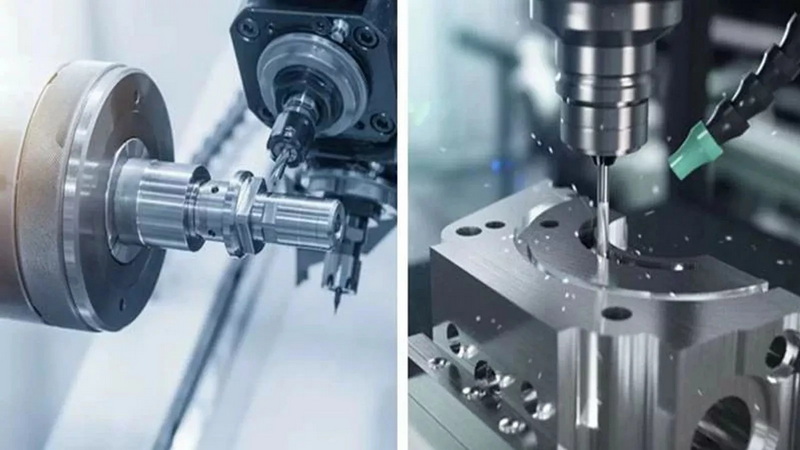
CNC milling employs rotary cutting tools to remove material from a workpiece that is typically clamped to a stationary table. The cutting tools rotate around multiple axes, allowing programmers to generate complex features and precise geometries. Common operations include face milling, pocket milling, end milling, drilling, tapping, contouring, and slotting. Modern CNC milling centers can operate in 3-, 4-, and 5-axis configurations, enabling intricate pockets, undercuts, torsionally balanced features, and curved surfaces that would be difficult or impossible with simpler machines.
Key components of a CNC milling system include the machine tool, spindle, tool changer, CNC controller, and the workholding setup. The program guiding the machine is usually written in G-code or a higher-level CAM output, instructing spindle speed, feed rate, tool path, and machining cycles. Material selection, tool geometry, and cutting strategies influence surface finish, dimensional accuracy, and production efficiency. Surface integrity depends on cutting parameters and tool wear management, which makes tool condition monitoring and maintenance planning essential.
- Climb milling versus conventional milling: Climb milling can produce superior surface finishes and longer tool life under rigid conditions, while conventional milling is more forgiving with backlash and is often preferred when workholding or machine rigidity is limited.
- Adaptive roughing: An approach that removes material aggressively while maintaining consistent engagement with the tool, reducing heat generation and tool wear.
- High-efficiency milling (HEM): Techniques that optimize chip thinning and cutting parameters to maximize material removal rates without compromising accuracy.
- Finishing passes: Light-cut passes after roughing to achieve tight tolerances and high-quality surface finishes.
- Finite element and process simulation: Predicting tool deflection, residual stresses, and potential geometric deviations before cutting begins.
CNC milling is versatile across industries such as aerospace, automotive, electronics, medical devices, tooling, and consumer products. It excels at producing shields, housings, brackets, enclosures, molds, gears, and complex geometries with high repeatability. The ability to machine in multiple axes enables features such as undercuts, internal pockets, and organic shapes that are essential in modern product design.
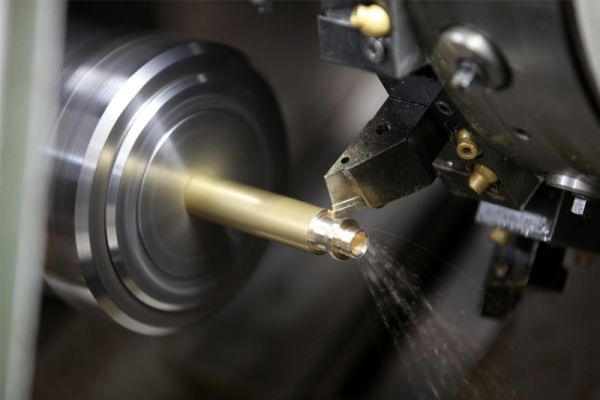
CNC turning shapes material by rotating the workpiece while stationary cutting tools remove material from its surface. The workpiece is mounted on a spindle; as it rotates, tools feed in from the side (rifling around the circumference) or end (facing and axial engagement) to create cylinders, threads, grooves, shoulders, and complex profiles. Turning is particularly efficient for producing symmetrical round parts, tubes, pins, shafts, collars, and bushings, often with highly repeatable thread tolerances.
Key components of a CNC turning system include the lathe or turning center, spindle, tool turret, live tooling for secondary operations, coolant system, and the CNC controller. Programs are typically written in G-code or CAM-generated code that defines spindle speeds, tool indices, radial and axial infeed, and specialized cutting cycles. Modern turning centers may integrate live tooling for milling-like operations while the workpiece spins, broadening the range of achievable features.
- Roughing and finishing passes: Roughing removes material quickly, followed by finishing passes to achieve tight tolerances and smoother surface finishes.
- Thread turning: Generating external or internal threads with controlled pitch, depth, and thread form.
- Grooving and parting: Creating grooves or separating parts with specialized tools and inserts.
- Boring and drilling: Enlarging holes and improving hole quality, often performed with reamers or boring bars.
- Live tooling: Driven tools rotary or milling attachments allow milling, drilling, or tapping without repositioning the part, enabling more complex assemblies in a single setup.
Turning is widely used for producing rotationally symmetric parts such as shafts, bushings, adaptors, fasteners, connectors, and precision pins. It is frequently paired with secondary operations such as milling, drilling, knurling, or broaching to complete complex assemblies. For long, slender parts, careful spindle speed and cutting parameter optimization helps prevent deflection and vibration, ensuring concentricity and surface finish targets are met.
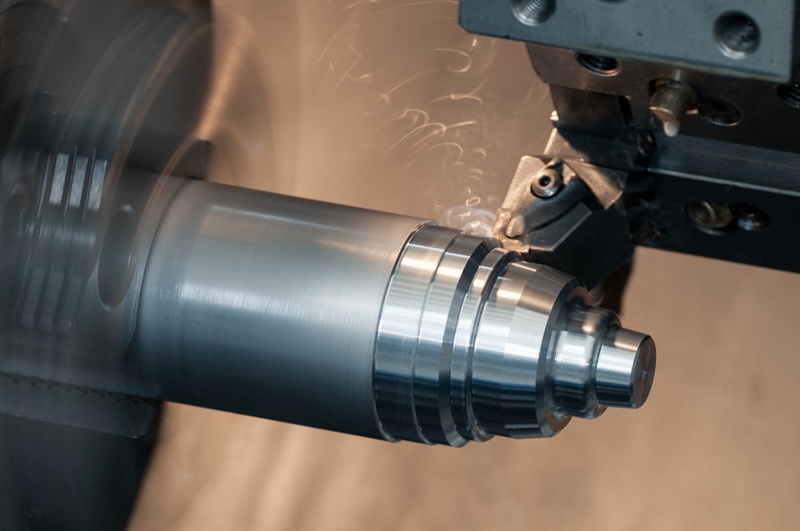
Many components require both milling and turning to achieve the final geometry. A well-planned process can minimize setups, reduce lead times, and improve accuracy. For example, a part with a cylindrical base and complex pockets or features on its faces benefits from turning to create the core geometry followed by milling to finish pockets, holes, or intricate contours. In modern manufacturing, simultaneous or sequential use of both processes on multi-axis machines or in closely integrated workflows enables highly efficient production.
CNC milling and turning handle a wide range of materials, including metals (aluminum, steel, stainless steel, brass, titanium, nickel-based alloys), polymers, composites, and ceramics. Material properties such as hardness, ductility, thermal conductivity, and machinability influence tool selection, cutting parameters, and machine stability. For harder materials, tool materials like carbide or carbide-tipped tools, together with appropriate coatings (e.g., TiAlN, TiN, AlCrN), help sustain cutting performance. Coolant strategies—high-pressure flood, through-spindle cooling, or minimum quantity lubrication (MQL)—aim to manage heat, extend tool life, and improve surface finish.
Precision in CNC machining is defined by dimensional tolerances, geometric tolerances, and surface finish requirements. Programs incorporate backlash compensation, tool length offsets, and probing cycles to ensure repeatability. Advanced machines offer in-process measurement, laser or video probing, and closed-loop feedback to tighten tolerance control. Consistent quality also depends on calibrated measuring equipment, such as CMMs, surface profilometers, and gauge blocks, used during inspections after machining and during pilot runs to validate CAM strategies.
- Design for manufacturability: Engineering features should consider tool accessibility, minimum radii, hole sizes, and wall thickness to minimize costly setups and rechecks.
- Fixtures and workholding: Rigid mounting reduces vibration and improves accuracy. Modular fixturing, zero-point clamping, and quick-change pallets speed up changeovers.
- Tool management: Selecting the right tool geometry, coatings, and wear monitoring improves cycle times and minimizes downtime. Predictive maintenance helps anticipate tool failures before they impact production.
- CAM strategies: Effective post-processing, verification, and collision checks ensure the CAM output aligns with machine conventions and tooling. Toolpath optimization reduces air-cut time and improves material utilization.
- Quality planning: Define inspection points, sampling plans, and acceptance criteria to ensure parts meet requirements consistently.
Automation in CNC shops includes robotic part loading/unloading, pallet systems, and centralized tool management. Connectivity and data analytics enable monitoring of spindle loads, temperatures, cycle times, and vibration. Cloud-based MES and manufacturing analytics can guide capacity planning and continuous improvement. Additive manufacturing interfaces are expanding capabilities, enabling hybrid processes that combine subtractive and additive techniques for complex assemblies. Digital twins and real-time process monitoring are moving firms toward predictive manufacturing, reducing downtime and increasing throughput.
- Verify workholding, tool clearance, and program safety before starting a job.
- Use appropriate PPE and machine guarding; maintain clean work areas to prevent accidents.
- Schedule regular maintenance for spindles, tool changers, coolant systems, and tool dispensers.
- Perform dry runs and simulations to validate tool paths and collision checks before cutting.
- Implement standardized inspection procedures to ensure conformance and traceability across batches.
- Part geometry: Predominantly cylindrical parts favor turning; complex 3D contours and pockets necessitate milling.
- Tolerances and surface quality: Both can achieve tight tolerances; milling is often favored for non-rotational features requiring intricate surface finishes.
- Production volume: High-volume production benefits from dedicated setups and automation—either milling or turning—optimized for repeatability.
- Material considerations: Some materials pose machining challenges that make one process more efficient than the other for cost and cycle time reasons.
- Setup time and changeovers: Reducing setups by combining milling and turning on multi-operation machines minimizes non-cut time and lowers costs.
- Tooling costs: Tool wear, replacement, and coatings influence unit costs; proper feeds and speeds extend tool life.
- Scrap and rework: Precision processes minimize waste, yet extreme tolerances or complex geometries may require rework if not planned correctly.
- Throughput and utilization: Integrated machining cells with synchronized workflows improve overall equipment effectiveness (OEE) and reduce lead times.
Synchronizing milling and turning in a shared production line or using multi-tasking machines requires robust process control. Calibration of machines, tools, and fixturing must be maintained. Inline probing and post-process inspection ensure deviations are caught early, enabling timely corrective actions. Traceability through job logs, material certificates, and coordinate measurement data supports compliance with industry standards such as ISO 9001, AS9100, or IATF 16949, depending on the sector.
- Material sourcing and availability: Premium alloys or specialized polymers can affect lead times; negotiating reliable suppliers is critical.
- Tolerancing strategy: Designing with reasonable tolerances helps reduce manufacturing cost and risk of rejection.
- Vendor capabilities: Access to robust CAM workflows, a diverse tooling inventory, and a track record of quality control supports successful outsourcing.
- Post-machining services: Deburring, heat treatment, surface finishing, coating, and assembly services add value and must be factored into total lead time and cost.
CNC milling and turning form the backbone of modern precision manufacturing, each delivering distinct strengths while complementing one another. Milling excels at producing complex geometries, multi-face features, and pockets with high repeatability across a wide range of materials. Turning shines in efficiently producing precision cylindrical parts with tight concentricity and surface finish. When integrated thoughtfully—whether on a single multifunction machine or within a well-coordinated shop floor—the two processes enable designers and manufacturers to achieve demanding geometries, tighter tolerances, and faster production cycles. With careful process planning, appropriate tooling, automation where beneficial, and rigorous quality control, CNC milling and turning offer a powerful toolkit for delivering consistent parts that meet exacting specifications across diverse industries.
CNC milling uses rotating cutting tools to remove material from a stationary workpiece, creating complex shapes and features across multiple axes.
CNC turning rotates the workpiece on a spindle while stationary tools remove material from the surface to produce cylindrical parts and radial features.
Yes, some advanced multi-tasking machines (turn-mill centers) combine milling and turning capabilities, enabling both operations with a single setup.
Consider geometry, required tolerances, surface finish, production volume, and material properties to determine the most efficient process.
Tool life is affected by material hardness, cutting speed, feed rate, depth of cut, tool geometry, coatings, and cooling conditions.


