From idea to market-ready product, our NPI solutions make every stage easier, faster. Discover How We Help

Views: 222 Author: Feifan Hardware Publish Time: 2026-05-22 Origin: Site


CNC milling and waterjet cutting each offer powerful ways to produce precision parts, but they shine in different materials, tolerances, and cost scenarios; choosing the right one depends on your part's geometry, performance requirements, and budget. [wurthmachinery]
In this in‑depth guide, we will compare CNC milling vs. waterjet cutting for precision parts from the perspective of a precision machining manufacturer serving global OEM/ODM projects, like Shenzhen Feifan Hardware & Electronics Co., Ltd. You will see where each process excels, what it really costs, how it impacts quality and lead time, and how an experienced supplier combines both to deliver the best result. [parts-cnc]
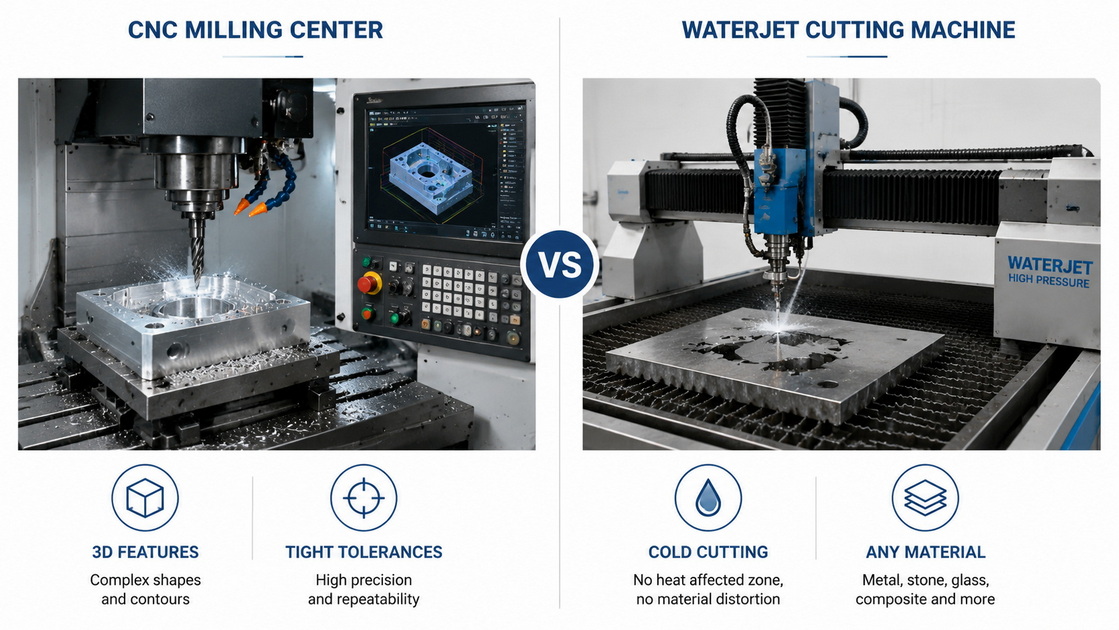
CNC milling uses rotating cutting tools to remove material from a solid block, creating 3D geometries with tight tolerances. [dmsgroup-tw]
Waterjet cutting uses a high‑pressure stream of water mixed with abrasive particles to cut shapes, typically starting from sheet or plate materials, with no heat‑affected zone. [sendcutsend]
| Factor | CNC Milling | Waterjet Cutting |
|---|---|---|
| Typical use | 3D prismatic parts, pockets, complex surfaces dmsgroup-tw | 2D profiles in sheet/plate, thick materials wurthmachinery |
| Material range | Metals, plastics, some composites dmsgroup-tw | Almost any material, including glass, stone, composites wurthmachinery |
| Heat‑affected zone | Present but controlled with coolant dmsgroup-tw | None – cold cutting process wurthmachinery |
| Tolerances | Micron‑level on critical features with proper setup dmsgroup-tw | Very high, around ±0.001–0.009 inch depending on setup wurthmachinery |
| Edge finish | Excellent, especially after finishing passes dmsgroup-tw | Excellent edge finish, minimal burrs sendcutsend |
| Cost drivers | Machine time, tooling, setup dmsgroup-tw | Abrasive consumption, pump power, slower cutting wurthmachinery |
Best‑fit summary:
- Choose CNC milling for 3D features, tapped holes, precision bosses, and functional surfaces.
- Choose waterjet for flat profiles in thick or heat‑sensitive materials, especially when you need to avoid thermal distortion. [wurthmachinery]
CNC milling removes material with a spindle‑driven cutting tool that moves in multiple axes under computer control. The machine follows a programmed toolpath, gradually shaping the part from a solid block (billet) or casting. [dmsgroup-tw]
Key characteristics:
- Multi‑axis capability: Modern mills operate in 3 to 5 axes, enabling complex geometries in a single setup. [in-xmachineinc]
- Tool variety: End mills, drills, reamers, and specialty tools handle roughing, finishing, slotting, and threading. [dmsgroup-tw]
- Coolant and lubrication: Used to reduce heat, improve tool life, and enhance surface finish. [in-xmachineinc]
Typical CNC‑milled parts:
- Precision housings and enclosures
- Automation and robotics brackets
- Manifolds, valve bodies, and custom fittings
- High‑accuracy mechanical components for EV and industrial equipment [dmsgroup-tw]
Waterjet cutting uses water pressurized to tens of thousands of psi, often mixed with garnet abrasive, to erode material along a programmed path. A CNC‑controlled nozzle travels over the plate or sheet, cutting out profiles with a very narrow kerf. [sendcutsend]
Key characteristics:
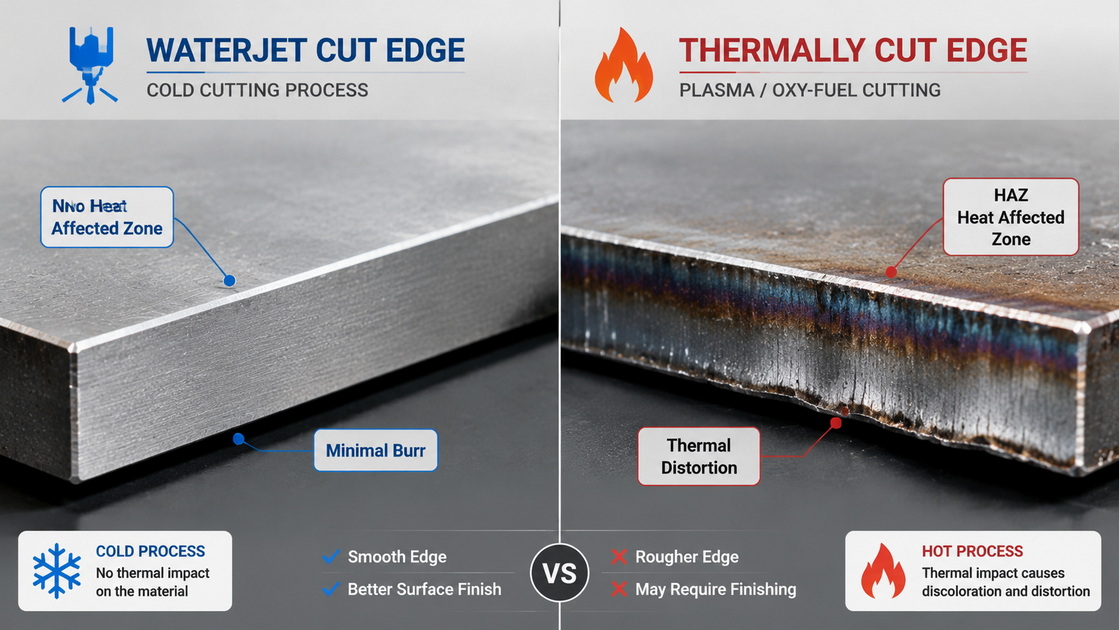
- Cold cutting process: Generates virtually no heat in the material, so there is no heat‑affected zone or thermal distortion. [wurthmachinery]
- Extreme material versatility: Can cut metals, plastics, composites, glass, stone, rubber, and more. [sendcutsend]
- High‑quality edge: Produces smooth edges with minimal burrs and no dross. [sendcutsend]
Typical waterjet‑cut parts:
- Thick plate components
- Heat‑sensitive alloys and laminates
- Prototype blanks for further CNC machining
- Architectural panels and complex flat geometries [wurthmachinery]
Both processes can achieve high precision, but they do so in different ways and at different stages.
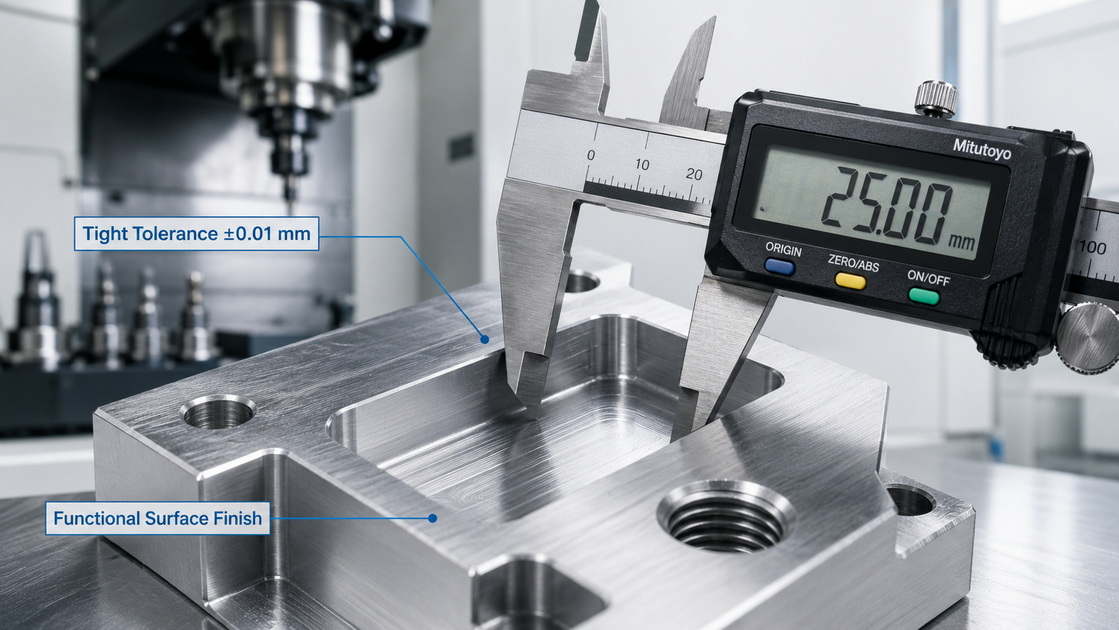
- Tolerances: With proper fixturing and programming, CNC milling can routinely hit ±0.01 mm, and tighter in special areas, especially in high‑end precision shops. [parts-cnc]
- Functional surfaces: Milling is ideal for critical fits like bearing seats, sealing faces, and precision slots. [dmsgroup-tw]
- Repeatability: Once a program and setup are validated, repeat runs deliver consistent results across large batches. [dmsgroup-tw]
- Tolerances: Industrial waterjet systems often achieve tolerances in the ±0.001–0.009 inch range, depending on material, thickness, and cut speed. [wurthmachinery]
- Edge geometry: Slight taper can occur in thicker materials, but this can be minimized with process tuning or secondary machining. [sendcutsend]
- Best use: Outstanding for near‑net 2D shapes that may later be finished by milling where tighter tolerances are needed. [sendcutsend]
Expert insight: For final precision interfaces and 3D features, CNC milling still has the edge, especially in high‑end applications like robotics, EV components, and aerospace hardware. For thick plates and multi‑material laminates, waterjet offers superb dimensional stability without heat damage. [wurthmachinery]
- Metals: Aluminum, stainless steel, carbon steel, brass, copper, and high‑strength alloys. [dmsgroup-tw]
- Plastics: Engineering plastics such as POM, PEEK, and others when fixtured correctly. [dmsgroup-tw]
- Considerations: Milling generates heat and chips; coolant and optimized parameters are used to manage temperature and avoid work hardening. [in-xmachineinc]
- Metals: All common metals and many specialty alloys. [wurthmachinery]
- Non‑metals: Glass, stone, ceramics, rubber, composites, and laminated materials. [sendcutsend]
- Heat‑sensitive parts: Ideal for materials that would warp, crack, or change properties under laser or plasma cutting. [wurthmachinery]
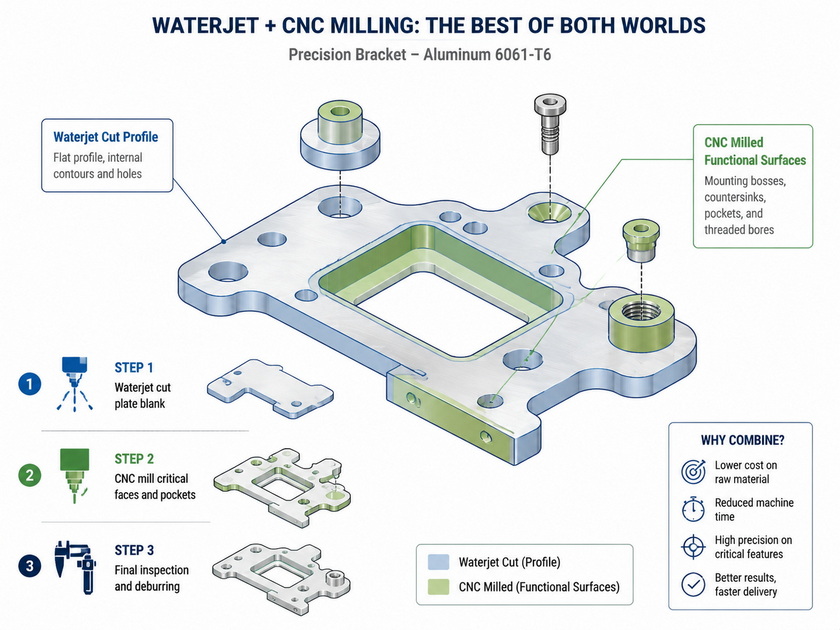
For precision mechanical components, particularly those requiring secondary machining or assembly, many manufacturers use waterjet to rough out shapes and then CNC mill critical features. [sendcutsend]
- Setup and programming time
- Machine time (cycle time per part)
- Tooling and fixture investment
- Operator skill and inspection requirements [dmsgroup-tw]
CNC milling becomes cost‑effective when:
- Parts require 3D features, multiple operations, and tight tolerances
- You need repeat orders with consistent quality
- Small to medium batch sizes balance setup cost and unit price [dmsgroup-tw]
- Abrasive consumption and disposal
- High‑pressure pump energy usage
- Nozzle wear and maintenance
- Cutting speed vs. edge quality trade‑off [wurthmachinery]
Waterjet becomes cost‑effective when:
- You cut complex 2D shapes from thick plate
- You need to process hard or heat‑sensitive materials
- You want to minimize secondary deburring and avoid thermal distortion [sendcutsend]
Hybrid strategy (expert recommendation): Many advanced manufacturers use waterjet to quickly produce flat profiles, then use CNC milling to add precision features like pockets, threads, and sealing surfaces. This combination balances cost and performance for complex precision parts. [sendcutsend]
As a Chinese precision parts manufacturer serving overseas OEM/ODM customers, a company like Shenzhen Feifan Hardware & Electronics Co., Ltd. often evaluates both CNC milling and waterjet based on application, tolerance, and budget. [parts-cnc]
Typical scenario:
1. A European automation brand needs precision aluminum brackets with tight tolerances on mounting faces but only moderate demands on the outer profile.
2. Waterjet cutting is used to produce the bracket blanks from plate with minimal thermal impact.
3. CNC milling then finishes the critical faces, bores, and threads to micrometer‑level precision. [dmsgroup-tw]
This hybrid process shortens lead time, reduces material waste, and ensures that high‑precision features come from controlled CNC operations. [sendcutsend]
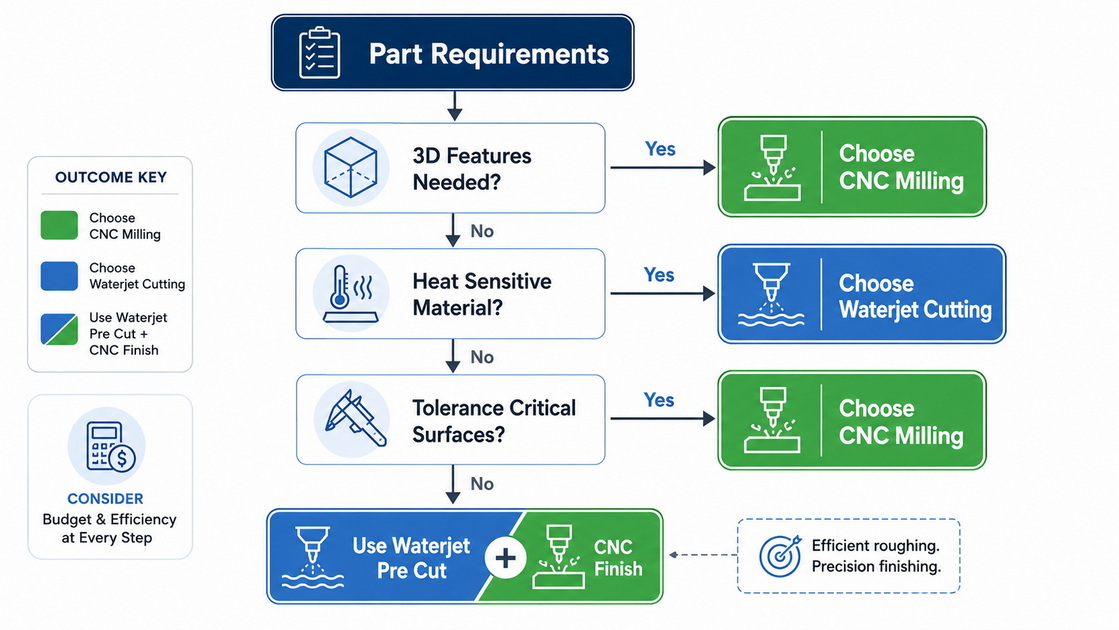
Use this step‑by‑step approach when choosing between the two processes for your next precision part project.
- Mostly 2D profile, constant thickness?
- Waterjet is often the best starting point.
- Complex 3D geometry, pockets, steps, or multiple faces?
- CNC milling is required.
- Heat‑sensitive or multi‑material laminates?
- Favor waterjet to avoid heat‑affected zones. [wurthmachinery]
- Standard aluminum or steel components?
- CNC milling or a hybrid route works well. [dmsgroup-tw]
- Micron‑level fits and functional surfaces?
- Plan for CNC milling on critical features. [dmsgroup-tw]
- General‑purpose structural components with moderate tolerance?
- Waterjet alone may be sufficient. [wurthmachinery]
- Prototype and low volume: Flexibility matters; waterjet plus limited milling can minimize upfront tooling costs. [sendcutsend]
- Medium to high volume: CNC milling with optimized setups delivers consistent quality and lower cost per part. [dmsgroup-tw]
Modern precision manufacturing is evolving, and these trends directly influence how CNC milling and waterjet are used.
Industry reports highlight the growth of multi‑axis CNC machining and hybrid processes, where shops integrate different technologies to handle complex parts in fewer setups. This trend favors combining CNC milling with cutting technologies like waterjet to maximize flexibility and throughput. [in-xmachineinc]
- IoT sensors and digital twins allow real‑time monitoring of machine health and part quality, improving consistency and reducing scrap. [in-xmachineinc]
- Sustainability initiatives include optimizing cutting paths, recycling scrap, and reducing coolant and abrasive usage, which affects both milling and waterjet strategies. [in-xmachineinc]
Manufacturers that adopt these practices offer better traceability, reliability, and environmental performance, which matters for global OEMs and brands. [in-xmachineinc]
From an industry practitioner's standpoint, CNC milling is usually the preferred choice when:
- The part has complex 3D features and multiple machined faces
- You need high precision on threads, bores, and functional interfaces
- You require repeatable quality across large batches
- The material is a standard metal suited to conventional machining [dmsgroup-tw]
CNC milling also integrates well with automation, robotics, and EV components, where consistent dimensional accuracy is critical. [dmsgroup-tw]
Experienced manufacturers turn to waterjet when:
- Cutting very thick plates or hard materials where other methods struggle
- Processing mixed or layered materials, such as composite stacks
- Avoiding heat‑affected zones is a top priority (e.g., certain aerospace or high‑strength steels) [wurthmachinery]
- Producing flat profiles quickly for later machining operations [sendcutsend]
Waterjet can be the most economical option when part geometry is mostly 2D and tolerances are moderate, especially for heat‑sensitive or exotic materials. [wurthmachinery]
A seasoned precision parts supplier can guide you through this choice and optimize the process for your project.
Key value‑adds from an expert partner:
- Design for manufacturability (DFM): Reviewing your drawings to align tolerances, features, and materials with the most efficient process.
- Process planning: Deciding where waterjet pre‑cutting is sufficient and where CNC finishing is needed.
- Global project experience: Understanding export requirements, quality documentation, and communication needs for international OEMs. [parts-cnc]
Shenzhen Feifan Hardware & Electronics Co., Ltd., for example, can support you from early design consultation through prototype and mass production of CNC‑milled precision parts, while coordinating with cutting partners when waterjet is the optimal front‑end process. [parts-cnc]
If you are evaluating CNC milling vs. waterjet cutting for your next precision part, the most effective step is to share your drawings, target tolerances, and annual volumes with an experienced OEM/ODM partner. A manufacturer like Shenzhen Feifan Hardware & Electronics Co., Ltd. can recommend the best combination of processes, provide DFM feedback, and deliver a detailed quotation tailored to your application. [parts-cnc]
Next step: Prepare your 2D/3D files and tolerance requirements, then request a manufacturability review and CNC milling quotation to see how much cost and lead time you can save.
1. Can waterjet cutting replace CNC milling completely?
No. Waterjet is excellent for cutting 2D profiles and heat‑sensitive materials, but CNC milling is still required for 3D features, precise bores, threads, and critical functional surfaces. [sendcutsend]
2. Which process is better for tight tolerances?
For final critical features, CNC milling usually offers tighter and more controllable tolerances, especially when you need micrometer‑level fits across multiple faces. Waterjet can deliver excellent precision for flat profiles, but some parts still benefit from a finishing milling operation. [sendcutsend]
3. Is waterjet cutting more expensive than CNC milling?
Waterjet can be more expensive on a per‑part basis due to abrasive consumption and energy usage, but it may reduce secondary operations and scrap when dealing with thick or heat‑sensitive materials. Total cost depends on part geometry, material, and volume. [wurthmachinery]
4. Can CNC milling handle very hard materials?
Yes, but tool wear and machining time increase with material hardness. For extremely hard or exotic materials, some manufacturers use waterjet to rough cut blanks and then perform limited CNC milling on critical areas. [sendcutsend]
5. How do I choose the right supplier for CNC milling or waterjet?
Look for suppliers with proven precision machining experience, clear quality certifications, and a track record in your industry. OEM/ODM specialists who understand export markets and offer DFM support can help you optimize both process choice and total cost. [parts-cnc]
1. Wurth Machinery. "Plasma vs. Laser vs. Waterjet: Complete 2025 CNC Comparison."
https://www.wurthmachinery.com/blog/plasma-vs-laser-vs-waterjet/ [wurthmachinery]
2. SendCutSend. "CNC vs. Laser vs. Waterjet Cutting: How We Choose."
https://sendcutsend.com/blog/laser-cutting-waterjet-cutting-cnc-routing-how-we-choose-the-perfect-cut-for-your-part/ [sendcutsend]
3. In‑X Machine Inc. "2026 Advancements in Precision CNC Machining."
https://in-xmachineinc.com/blogs/2026-precision-cnc-machining-advancements/ [in-xmachineinc]
4. DMS Group. "Why CNC Machining Remains Essential for High-End Parts in 2026."
https://www.dmsgroup-tw.com/blog/manufacturing-capabilities-8/2026-precision-manufacturing-trends-cnc-machining-high-end-parts-4 [dmsgroup-tw]
5. Parts-CNC. "Quality CNC Turning Parts & CNC Milling Parts Factory from China."
https://www.parts-cnc.com [parts-cnc]


