From idea to market-ready product, our NPI solutions make every stage easier, faster. Discover How We Help

Views: 222 Author: Feifan Hardware Publish Time: 2026-05-17 Origin: Site


If you source CNC precision parts from China, understanding the parts of a CNC machine and the CNC block diagram helps you evaluate suppliers, tolerances, and process stability more intelligently. In this guide, I break down the 13 core components, explain how they work together, and add practical insights from a manufacturing and OEM/ODM perspective. [cnchonscn]
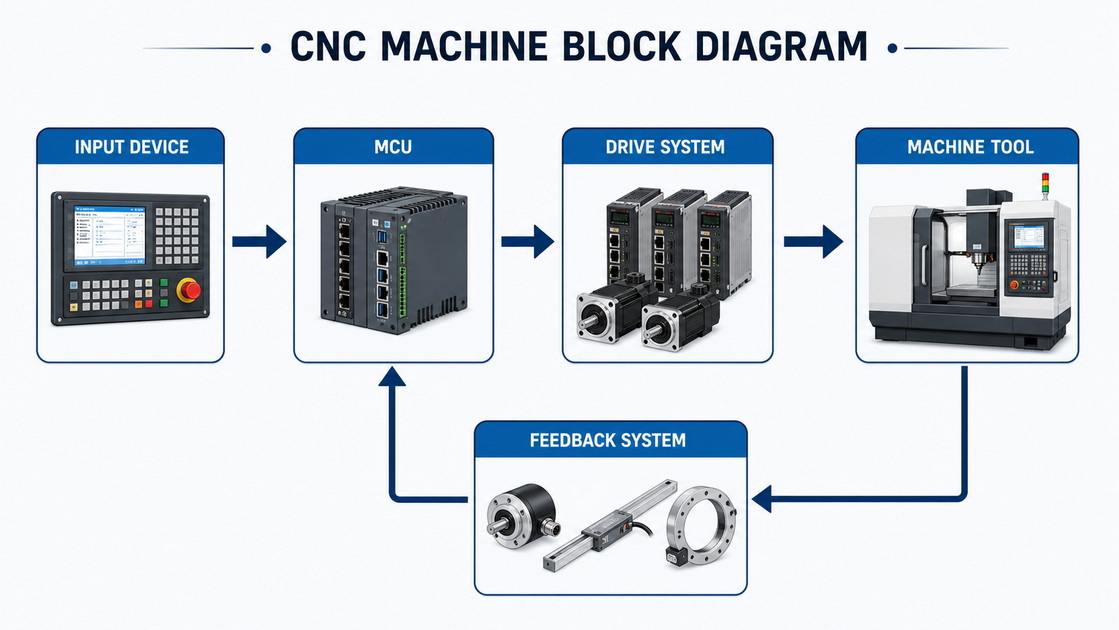
A CNC machine is more than a spindle and a control screen. It is a coordinated system of input, control, drive, feedback, motion, workholding, and auxiliary subsystems that must work together for accurate machining. When any one element is weak, the final part can suffer from chatter, dimensional drift, poor surface finish, or inconsistent repeatability. [xometry]
For buyers, this matters because the machine architecture directly affects lead time, yield, and tolerance capability. For manufacturers like us, it also affects how reliably we can produce OEM and ODM precision components for overseas brands, wholesalers, and industrial producers. [xometry]
A typical CNC block diagram follows a simple logic chain:
1. Input device loads the program.
2. CNC controller / MCU interprets the code.
3. Drive system converts instructions into motion.
4. Machine tool performs cutting.
5. Feedback system measures actual movement and corrects errors. [cnchonscn]
This closed-loop structure is what makes modern CNC machining repeatable and scalable. In practical terms, it is the reason a well-set CNC machine can produce the same part consistently across hundreds or thousands of cycles. [cnchonscn]

The input device is where the machining program enters the CNC system. It may be a keyboard, USB drive, or network connection that transfers G-code or related instructions to the controller. In modern production, networked program transfer is especially useful because it reduces manual handling and lowers the risk of version errors. [runsom]
The Machine Control Unit (MCU) is the brain of the CNC machine. It reads the program, interprets motion commands, and coordinates the machine's subsystems. It also manages operations like spindle control, coolant activation, and tool change sequencing. [scribd]
The control panel is the operator's command center. It combines buttons, screen interfaces, and often a touchscreen so operators can monitor status, adjust settings, and respond to alarms. Good panel design improves usability and reduces setup mistakes, especially in high-mix production environments. [runsom]

The drive system converts controller signals into movement. It includes motors, amplifiers, transmission elements, and motion hardware that move the axes with precision. In a CNC environment, this subsystem is essential because poor drive performance shows up immediately as lost accuracy or inconsistent feed motion. [xometry]
The machine tool is the physical cutting platform that removes material from the workpiece. Depending on the machine type, this may be a milling head, lathe tool, drill head, or another cutting assembly. The machine tool is where programmed motion becomes actual part geometry. [runsom]
The feedback system measures actual position and motion, then sends that data back to the controller. Encoders and probing devices are common examples. This closed-loop correction is one of the biggest reasons CNC machining can hold tight tolerances more consistently than manual processes. [cnchonscn]
The bed is the main structural base of the machine. It supports the worktable and critical assemblies while resisting vibration and deflection during cutting. A stiff bed helps protect accuracy, especially during heavy cuts or high-speed operations. [xometry]
The headstock is a core component of a CNC lathe. It contains the spindle drive and supporting structure that rotate the workpiece at controlled speed. In turning applications, the quality of the headstock affects vibration, concentricity, and finish quality. [runsom]
The tailstock supports long or slender workpieces on a lathe. It reduces deflection and helps maintain stability during turning or drilling. For shaft-like parts, this support is often the difference between an acceptable part and one that bends out of tolerance. [runsom]
The tailstock quill is the extendable element inside the tailstock. It advances toward the workpiece to provide support or hold tooling such as drills and centers. Smooth quill movement matters because any looseness or misalignment can affect hole accuracy and axial support. [runsom]
The footswitch gives the operator hands-free control for certain actions. On lathes, it can help with chucking or tailstock-related actions during loading and unloading. It is a small component, but it improves workflow efficiency and operator ergonomics in daily production. [runsom]
The chuck secures the workpiece on a lathe. It must grip firmly and concentrically so the part does not slip under cutting forces. For OEM machining, chuck selection is a major quality decision because part geometry, material type, and cutting load all affect holding requirements. [xometry]

The display unit shows machine status, alarms, dimensions, tool data, and program information. In practice, it functions as the operator's live feedback window. Clear display layout improves decision-making and helps reduce setup errors and downtime. [xometry]
| Part | Main Function | Why It Matters |
|---|---|---|
| Input device | Loads the program | Prevents program transfer errors |
| MCU | Interprets instructions | Controls all machine actions |
| Control panel | Operator interface | Improves usability and safety |
| Drive system | Produces motion | Affects accuracy and speed |
| Machine tool | Removes material | Determines the final part shape |
| Feedback system | Measures actual movement | Enables closed-loop correction |
| Bed | Structural support | Reduces vibration and distortion |
| Headstock | Rotates the spindle/workpiece | Critical for turning accuracy |
| Tailstock | Supports long parts | Prevents bending and chatter |
| Tailstock quill | Extends support/tooling | Improves axial precision |
| Footswitch | Hands-free control | Improves workflow efficiency |
| Chuck | Clamps the workpiece | Prevents slippage |
| Display unit | Shows operating data | Helps operators monitor and adjust |
Many older explanations stop at the basics. In real production, however, modern CNC performance is influenced by servo tuning, spindle reliability, probing systems, tool monitoring, and machine thermal stability. Industrial OEM suppliers increasingly rely on these supporting systems to keep quality consistent across long production runs. [fanucamerica]
This matters for precision part buyers because a machine that looks similar on paper may perform very differently in practice. Two suppliers can use the same material and program, but the one with stronger motion control, better feedback, and better maintenance discipline usually delivers more stable results. [fanuc.co]-01.pdf)
If you are evaluating a CNC manufacturer, ask these questions:
- What type of servo drives and spindle system do you use?
- Do you run closed-loop feedback with encoders or probing?
- How do you control thermal drift during long runs?
- What tolerances can you hold consistently on repeated orders?
- How do you manage tool wear, calibration, and inspection? [us.mitsubishielectric]
These questions help you judge whether a supplier is simply running machines or actually controlling process capability. That distinction is important when you need OEM/ODM parts that must fit into branded products, assemblies, or export-grade equipment. [almcorp]
As a CNC precision parts manufacturer, your customers care about more than machine names. They care about whether the supplier can repeatedly produce parts that meet tolerance, surface, and assembly requirements. A manufacturer that understands the machine architecture is usually better positioned to control variation, detect problems early, and deliver stable OEM/ODM output. [almcorp]
For brands and wholesalers, this translates into fewer rejects, better delivery reliability, and stronger long-term sourcing confidence. For industrial manufacturers, it reduces hidden risk across procurement and production planning. [xometry]

If your business needs custom CNC precision parts, OEM machining support, or ODM production for export markets, position your factory not just as a machine shop, but as a controlled manufacturing partner. A clear capability statement, strong process explanation, and machine-level expertise can improve both trust and conversion rates. [vivemarketing]
A CNC block diagram is a simplified visual map of how input, control, drive, feedback, and machine elements work together in a CNC system. It helps explain the logic of CNC motion and closed-loop control. [cnchonscn]
The CNC controller or MCU is often considered the most important part because it interprets the program and coordinates machine movement. Without it, the rest of the system cannot function properly. [cnchonscn]
The feedback system verifies actual position and speed, then sends corrections back to the controller. This is essential for accuracy, repeatability, and dimensional consistency. [xometry]
A CNC lathe rotates the workpiece while the tool stays relatively fixed, while a CNC mill usually rotates the cutting tool and moves the workpiece along multiple axes. Each is suited to different part geometries and manufacturing needs. [runsom]
The chuck holds the workpiece securely during cutting. If clamping is weak or concentricity is poor, the part can slip, vibrate, or lose dimensional accuracy. [xometry]
Buyers can use it to assess supplier capability, understand where quality variation comes from, and ask better technical questions during sourcing. That leads to more reliable OEM and ODM partnerships. [almcorp]
1. Runsom Precision, "Exploring the CNC Block Diagram and its 13 Key Components." [https://www.runsom.com/blog/13-parts-of-a-cnc-machine-cnc-block-diagram/] [runsom]
2. Xometry, "40 Parts of a CNC Machine and Block Diagram of CNC Components" (updated April 1, 2026). [https://www.xometry.com/resources/machining/parts-of-a-cnc-machine/] [gushwork]
3. FANUC America, "AC Servo Motor Drivers | CNC Spindle Motor Drives." [https://www.fanucamerica.com/products/cnc/servo-drive-motor] [fanucamerica]
4. Mitsubishi Electric, "CNC Servo/Spindle Drive Series." [https://us.mitsubishielectric.com/fa/en/products/cnt/computerized-numerical-controllers/drive-units/drive-series/] [us.mitsubishielectric]
5. FANUC, "Servo alpha i-D series." [https://www.fanuc.co.jp/en/product/catalog/pdf/servo/Servo_alphai-D(E)-01.pdf]-01.pdf) [fanuc.co]-01.pdf)
6. Thomasnet, "13 Ways To Improve Your Manufacturing Blog (For SEO and More)." [https://blog.thomasnet.com/ways-to-improve-manufacturing-blog] [blog.thomasnet]
7. Gushwork, "SEO for CNC Machine Shops: Proven Tactics to Rank Higher." [https://www.gushwork.ai/blog/seo-for-cnc-companies-industry] [gushwork]
8. Athena SWC, "Accelerate Growth with These CNC Machining SEO Strategies." [https://www.athenaswc.com/resources/blog/the-heat-is-on-accelerate-growth-with-these-cnc-machining-seo-strategies/] [athenaswc]
9. Manufacturing SEO, "SEO For CNC Machining Businesses." [https://manufacturing-seo.com/cnc-machining-seo/] [manufacturing-seo]
10. Manufacturing SEO, "SEO for Manufacturing Companies: 18 Ways to Increase..." [https://almcorp.com/blog/seo-for-manufacturing-companies/] [almcorp]


