From idea to market-ready product, our NPI solutions make every stage easier, faster. Discover How We Help

Views: 222 Author: Feifan Hardware Publish Time: 2026-05-28 Origin: Site
When you are sourcing CNC precision parts from China, the decision between 3-axis vs 5-axis CNC machining directly shapes your part cost, lead time, and long‑term product reliability. As an OEM/ODM precision parts manufacturer in Shenzhen, I have seen well‑informed choices save tens of thousands of dollars over a product lifecycle—while poor choices led to redesigns, delays, and quality claims. [ycmalliance]
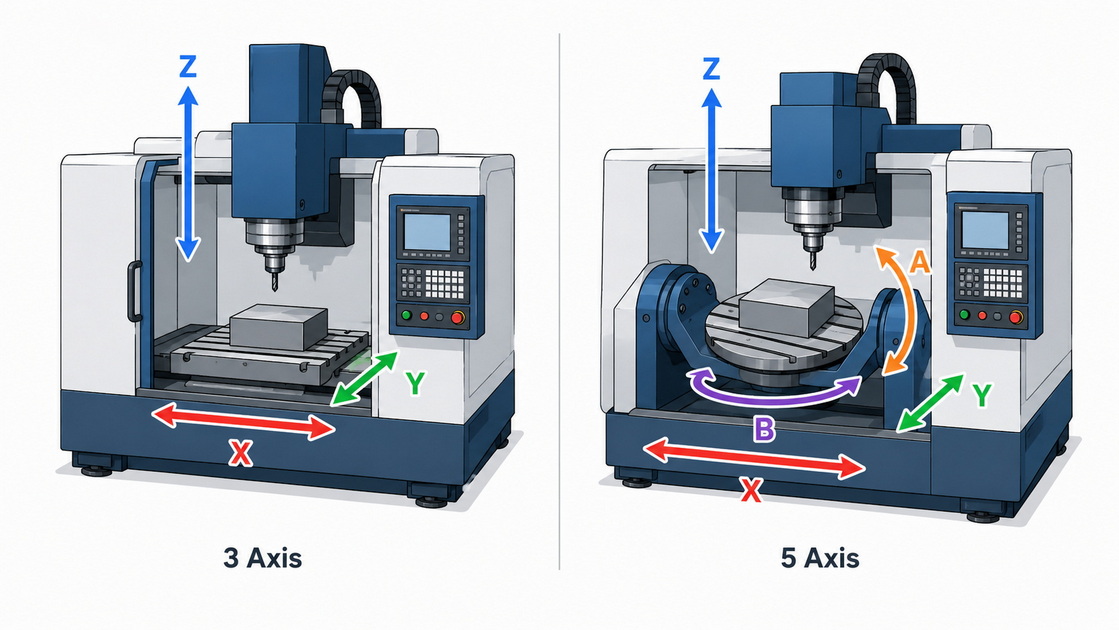
At its core, CNC machining is about how many directions the cutting tool or workpiece can move while material is being removed. [xometry]
- 3‑axis machines move the tool along X, Y, and Z – left–right, front–back, and up–down. [xometry]
- 5‑axis machines add two rotational axes, usually called A and B (or A and C), to tilt or rotate the tool or part. [ycmalliance]
In practical terms, more axes mean more freedom to reach complex features in a single setup, but also higher machine cost, programming complexity, and operator skill requirements. [protolabs]
Here is how I typically explain the difference to new buyers during project kickoff calls. [ycmalliance]
| Aspect | 3-Axis CNC Machining xometry | 5-Axis CNC Machining xometry |
|---|---|---|
| Tool movement | X, Y, Z linear only | X, Y, Z plus two rotary axes (A, B/C) |
| Typical parts | Prismatic blocks, plates, simple housings | Complex 3D surfaces, undercuts, multi‑angle features |
| Setups | Often multiple setups and fixturing | Fewer setups, multi‑side machining in one clamping |
| Accuracy risk | Higher risk of stack‑up error from re‑clamping | Better positional accuracy for multi‑face features |
| Programming | Simpler CAM programming | Advanced CAM and post‑processing needed |
| Hourly rate | Lower machine rate | Higher machine and operator cost |
| Best use cases | Cost‑sensitive, moderate‑complexity parts | High‑value, tight‑tolerance, complex components |
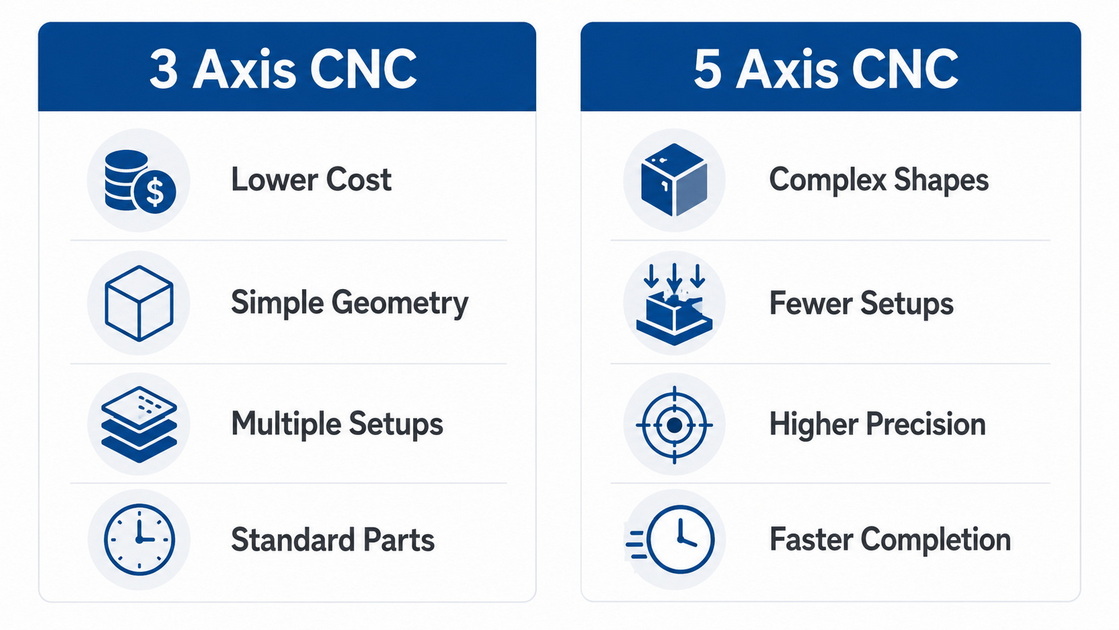
This high‑level comparison is a good starting point, but real decisions must consider geometry, tolerance, volumes, and your project's total cost of ownership. [criterionprecision]
A 3‑axis CNC mill is often the most cost‑effective way to produce simple to moderately complex parts. From my experience with international OEM projects, 3-axis makes sense when: [criterionprecision]
- Your part has accessible features from one or two directions. [xometry]
- Tolerances are demanding but not extreme across multiple faces. [xometry]
- You need competitive pricing for medium to large batches. [criterionprecision]
Advantages I emphasize to buyers:
1. Lower machining cost – Machine purchase price and hourly rate are lower than 5‑axis. [xometry]
2. Shorter programming time – Toolpaths are simpler, which speeds up new‑product introduction. [ycmalliance]
3. Stable, mature process – Globally, most machine shops are optimized for 3‑axis work, so capacity is abundant. [mmsonline]
A typical example: aluminum brackets, sensor mounts, or simple housings with pockets and tapped holes on one or two faces. These are ideal for 3‑axis with smart fixture design. [xometry]
The main limitation of 3‑axis machining is access. Whenever I see deep cavities, steep angles, or multiple critical faces, I immediately check whether 3-axis would force too many setups. [xometry]
Key risks:
- Multiple re‑clampings increase geometric errors across faces. [xometry]
- Deep features may need long, slender tools, raising vibration and surface finish issues. [xometry]
- Complex shapes might require manual deburring or secondary operations, adding hidden cost. [protolabs]
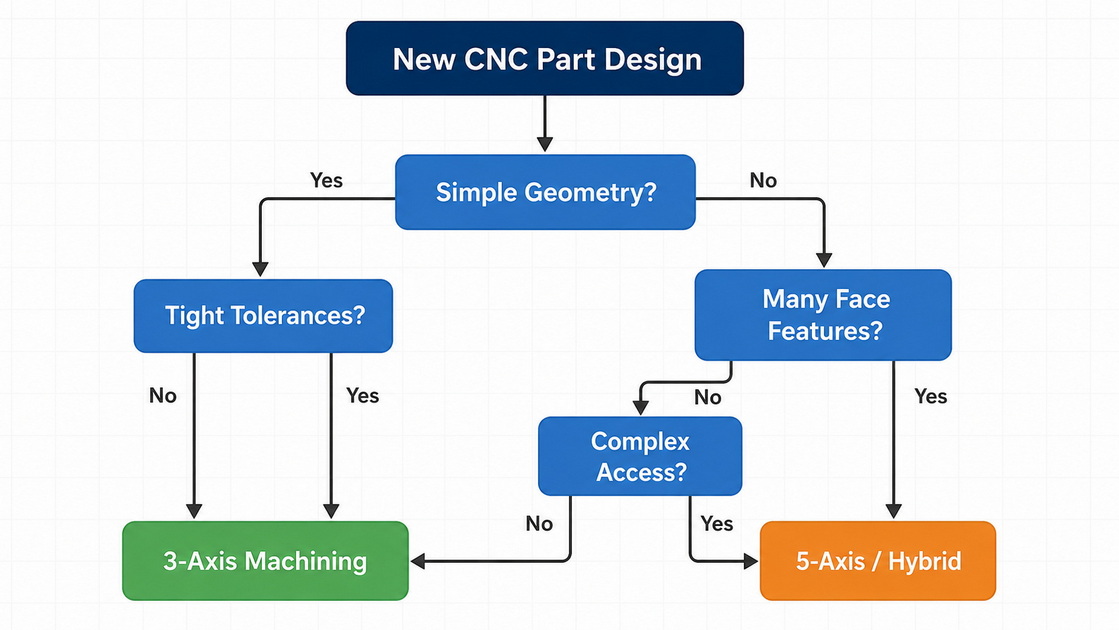
If your engineering team is pushing for aggressive tolerances across three or more faces, or looking at organic 3D forms, we usually evaluate 5-axis early to avoid painful iterations later. [protolabs]
Not all "5‑axis" machines are equal. In industry practice we usually talk about two main categories. [protolabs]
- 5‑axis indexed (3+2): The rotary axes position the part or tool to a fixed angle, then cutting occurs in 3 axes. [protolabs]
- 5‑axis continuous: All five axes can move simultaneously, ideal for complex free‑form surfaces. [protolabs]
For many OEM parts—connectors, medical housings, small automotive components—indexed 5‑axis is enough to machine multiple faces efficiently in one clamping. Fully simultaneous 5‑axis is more relevant for turbine blades, impellers, and high‑end aerospace or medical implants. [pdfs.semanticscholar]
From an OEM/ODM supplier's perspective, we recommend 5‑axis when:
- Your part has features on 3–5 faces that must maintain tight geometric relationships. [ycmalliance]
- There are undercuts, deep pockets, or compound angles that are impossible or risky with 3‑axis. [protolabs]
- You care about both aesthetics and functional accuracy, such as for high‑end consumer or medical devices. [shieldworksmfg]
The benefits that matter most to overseas buyers:
1. Reduced setups, higher accuracy – One‑and‑done clamping minimizes stack‑up errors and improves repeatability. [protolabs]
2. Better surface quality – Shorter, more rigid tools can reach features at optimal angles. [ycmalliance]
3. Shorter lead times for complex parts – Less manual handling and fewer fixtures reduce total processing time. [protolabs]
These advantages are becoming more important as the global CNC machine market continues to grow—projected to reach over 250 billion USD by 2034 with a double‑digit CAGR—driven by tighter tolerances and more complex designs across industries. [fortunebusinessinsights]
The flip side is that 5‑axis machining is not automatically "better" for every part. [ycmalliance]
- Machine hourly rates and tooling are more expensive. [xometry]
- Programming and setup require higher‑skill engineers. [mmsonline]
- For simple geometries, the cost premium may bring no measurable benefit. [ycmalliance]
In other words, if your part is essentially a milled block with standard pockets and holes, insisting on 5‑axis is a classic way to pay more for no real gain. [criterionprecision]
When customers send us drawings or 3D models, we walk through a structured evaluation that you can also use internally. [criterionprecision]
1. Geometry screening
- Are there features that cannot be reached from one or two directions?
- Are there undercuts or compound angles?
2. Tolerance and functional requirements
- Which dimensions are critical to function, and across how many faces?
- Do you need high‑precision alignment between multiple features?
3. Volume and cost targets
- What is your annual volume and expected lifetime demand?
- Is your priority lowest piece price, fastest lead time, or maximum reliability?
4. Material and surface finish
- Harder materials and premium finishes can magnify the benefits of 5‑axis. [xometry]
We then simulate alternative process plans—3‑axis with multiple setups vs 5‑axis in one setup—and share clear cost and risk trade‑offs with your engineering and procurement teams. [alibaba]
Imagine a small aluminum electronics housing with precision connector pockets on four sides, tight perpendicularity requirements, and EMI‑critical sealing surfaces.
- A 3‑axis route might need 3–4 setups, multiple fixtures, and manual deburring, each step adding cost and tolerance risk. [criterionprecision]
- A 5‑axis indexed setup can machine all key faces in one or two clampings, improving consistency and reducing handling time. [mmsonline]
In practice, we often start prototypes on 5‑axis to de‑risk the project, then re‑evaluate 3‑axis options if volume and cost targets require it. [criterionprecision]
Because we serve international OEM and ODM customers, the 3‑axis vs 5‑axis choice also depends on your business model. [minew]
If you provide the design, our main role is to optimize manufacturability and cost without compromising function. In this scenario we: [shieldworksmfg]
- Perform DFM reviews to suggest design tweaks that allow 3‑axis machining where possible. [minew]
- Recommend 5‑axis only where necessary—e.g., for critical sealing surfaces, alignment features, or aesthetics. [protolabs]
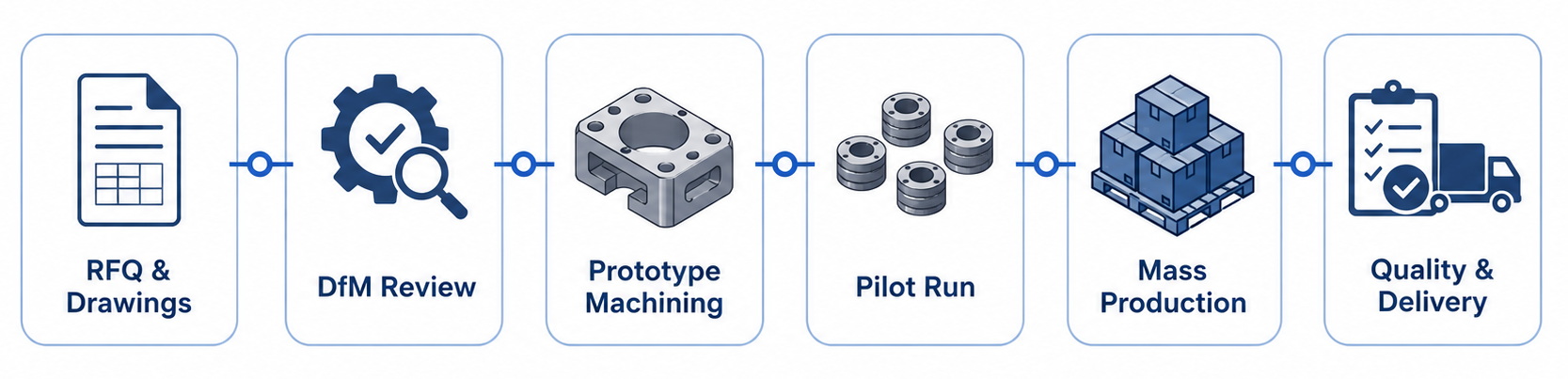
- Map a realistic time frame including design confirmation, prototype runs, pilot builds, and mass production. [minew]
Clear, explicit specifications are critical here; more than 90% of successful OEM/ODM projects start from detailed requirements rather than vague descriptions. [minew]
In ODM projects, we help design both the product and the manufacturing route. That allows us to: [alibaba]
- Shape the geometry from day one so it matches the most efficient machining strategy. [alibaba]
- Consolidate parts and reduce operations, using 5‑axis where it significantly simplifies assemblies. [pdfs.semanticscholar]
- Balance industrial design ambition with realistic tooling and machining costs. [shieldworksmfg]
For many global brands, this co‑design approach is the fastest way to bring differentiated products to market while keeping total landed cost under control. [alibaba]
The best 3‑axis shop will outperform a poorly run 5‑axis shop almost every time. When evaluating potential partners, look beyond equipment lists and focus on: [mmsonline]
- Proven experience in your product category. [alibaba]
- Compliance with international standards such as ISO 9001, and sector‑specific certifications where required. [alibaba]
- Robust QC processes, traceability, and preventive maintenance practices. [mmsonline]
Third‑party audits, unannounced inspections, and controlled pilot runs are powerful tools to validate real capability before committing to large volumes. [minew]
Based on industry best practices and our own experience, I recommend this three‑phase approach for any new CNC supplier. [minew]
1. Document review
- Business license, export qualifications, quality certificates, case studies. [alibaba]
2. Sample and pilot runs
- Order prototypes and a small pilot batch; validate dimensions, stability, and process capability. [mmsonline]
3. On‑site or virtual audit
- Inspect raw material control, machining cells, QC labs, and training systems. [minew]
This process costs time, but it dramatically lowers the risk of quality escapes and delivery surprises in mass production. [alibaba]
Use this quick checklist when preparing a new RFQ for CNC precision parts. [criterionprecision]
Likely 3‑axis candidates:
- Mostly flat or prismatic shapes with features accessible from 1–2 directions. [xometry]
- Tolerances are important but not extremely tight across multiple faces. [criterionprecision]
- Annual volumes are high and cost pressure is strong. [criterionprecision]
Likely 5‑axis candidates:
- Complex 3D shapes, curved surfaces, or organic forms. [ycmalliance]
- Critical features on 3–5 faces that must be precisely related. [ycmalliance]
- Premium segments such as aerospace, medical, high‑end automotive, or specialized industrial equipment. [pdfs.semanticscholar]
When in doubt, share your CAD data with your manufacturing partner and ask for two quotes—one assuming optimized 3‑axis, one assuming 5‑axis—then compare total cost, risks, and lead time. [criterionprecision]
For overseas brands, wholesalers, and manufacturers, choosing between 3‑axis and 5‑axis is not just an engineering question—it is a strategic sourcing decision. The right partner will not simply push their most expensive machines; instead, they will help you balance geometry, performance, and cost over the entire product lifecycle. [shieldworksmfg]
As a Shenzhen‑based precision machinist providing OEM and ODM services to global customers, my team focuses on:
- Early‑stage DFM support to choose the optimal machining path. [alibaba]
- Transparent cost breakdowns for 3‑axis vs 5‑axis options. [xometry]
- Stable quality, clear communication, and reliable delivery for long‑term cooperation. [minew]
If you are evaluating a new CNC project or struggling with existing suppliers, you are welcome to share your drawings and requirements so we can propose a tailored, data‑driven machining strategy. [alibaba]
If you are unsure whether 3-axis or 5-axis CNC machining is right for your next project, send us your CAD files, material requirements, target quantities, and quality standards. We will perform a free manufacturability assessment, compare practical 3‑axis and 5‑axis process routes, and provide clear recommendations on cost, risk, and lead time, tailored to your market and application. [alibaba]
Q1: Is 5-axis CNC always more accurate than 3-axis?
Not always; accuracy depends on machine condition, fixturing, and process control, but 5‑axis often improves geometric relationships between features by reducing setups. [protolabs]
Q2: How do I know if my part really needs 5-axis machining?
Look for multi‑face critical features, undercuts, complex curves, or strict geometric tolerances across several faces—those are typical indicators that 5‑axis may add real value. [ycmalliance]
Q3: Can I prototype on 5-axis and move to 3-axis for mass production?
Yes, many OEMs prototype on 5‑axis to validate design intent, then re‑evaluate 3‑axis or hybrid process plans once volumes and cost targets are clear. [criterionprecision]
Q4: Does 5-axis always cost more per part?
Machine hourly rates are higher, but fewer setups and reduced manual work can offset some of that cost, especially for complex parts. [protolabs]
Q5: What documents should I prepare before contacting a CNC OEM/ODM supplier in China?
Provide 2D drawings, 3D models, material specs, surface finish requirements, target quantities, and functional notes; clear and explicit requirements greatly increase project success. [shieldworksmfg]
1. Xometry – "3-Axis vs. 5-Axis CNC: Advantages and Disadvantages." [xometry]
2. YCM Alliance – "The Differences Between 3-Axis and 5-Axis CNC Machining." [ycmalliance]
3. Protolabs – "CNC Machining: 3-Axis vs. 5-Axis Indexed vs. 5-Axis Continuous." [protolabs]
4. Fortune Business Insights – "CNC (Computer Numerical Control) Machine Market Size ." [fortunebusinessinsights]
5. Alibaba Insights – "OEM ODM Supplier in China: Guide to Sourcing from Manufacturing." [alibaba]
6. Minew – "How should we do a successful OEM/ODM project in China?" [minew]
7. Shield Works – "OEM vs ODM: Which Manufacturing Model Suits Your Needs Best in China?" [shieldworksmfg]
8. Criterion Precision – "2.5, 3, and 5 Axis CNC Machines: Comparison Guide." [criterionprecision]
9. Modern Machine Shop – "2026 Top Shops." [mmsonline]
10. Short literature review on optimization of five-axis CNC machines. [pdfs.semanticscholar]


