From idea to market-ready product, our NPI solutions make every stage easier, faster. Discover How We Help

Views: 222 Author: Tomorrow Publish Time: 2025-12-21 Origin: Site
Content Menu
● Understanding CNC Machining Basics
● What Makes 5 Axis CNC Machining Unique
● How 5 Axis CNC Machining Works
>> Simultaneous vs. Positional 5-Axis Machining
● Types of 5 Axis CNC Machines
>> 4. Gantry or Bridge Configuration
● Benefits of 5 Axis CNC Machining
>> 1. Fewer Setups and Greater Efficiency
>> 2. Enhanced Precision and Accuracy
>> 5. Complex Geometrical Freedom
● Common Applications Across Industries
>> Aerospace
>> Automotive
>> Medical
>> Energy and Power Generation
● Programming and Software Tools
● Materials Used in 5 Axis CNC Machining
● Key Challenges and Considerations
>> 2. Complex Programming and Setup
>> 3. Maintenance and Calibration
>> 4. Training and Skill Development
● The Future of 5 Axis CNC Machining
>> Integration with Smart Manufacturing
● Quality Control and Inspection
● Safety and Environmental Impact
● FAQs About 5 Axis CNC Machining
>> 1. What are the main differences between 3-axis and 5-axis CNC machining?
>> 2. What industries benefit most from 5-axis machining?
>> 3. Is 5-axis CNC machining cost-effective in the long term?
>> 4. How accurate are modern 5-axis CNC machines?
>> 5. Can 5-axis machines handle different materials?
CNC (Computer Numerical Control) machining represents one of the most transformative advances in modern manufacturing. It enables precision, repeatability, and efficiency that manual methods can't match. Among all CNC technologies, 5-axis machining is regarded as the most advanced and versatile. It allows movement along five different axes at the same time, permitting complex shapes, detailed contours, and smoother finishes to be produced in fewer setups.
From aerospace engines to medical implants, 5-axis machining is the backbone of production where precision and complexity meet. This article dives deep into what 5-axis CNC machining is, how it works, its various types, key advantages, applications, challenges, and the future role it plays in intelligent manufacturing.
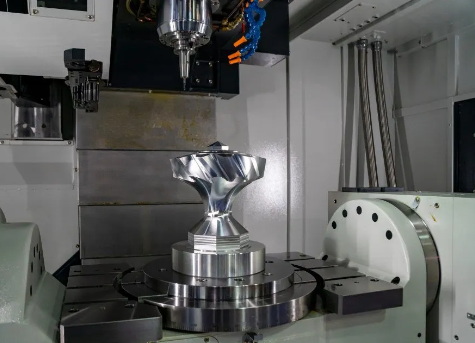
To fully appreciate the strength of 5-axis CNC technology, it's important to understand how CNC machining works. CNC machining is a subtractive process, meaning it removes material from a solid workpiece to reveal the final form. The machine is guided by pre-programmed computer code that dictates tool movement across coordinates.
Traditional CNC machining involves three main linear axes:
- X-axis: Left to right movement.
- Y-axis: Front to back movement.
- Z-axis: Up and down movement.
These three directions define 3-axis machining, the simplest form of CNC operation. While efficient for flat parts and simple cuts, it limits access to complex surfaces. Operators must manually reposition or re-fixture the part multiple times to machine different sides, increasing both production time and potential error.
5-axis machining adds two rotational axes, known as the A-axis (rotation around X-axis) and the B-axis (rotation around Y-axis). These additional movements enable a cutting tool to approach a workpiece from virtually any direction without changing its setup.
This multidimensional capability offers several major advantages:
- Simultaneous cutting on multiple surfaces.
- Reduced repositioning, minimizing human involvement.
- Access to hard-to-reach areas with minimal tool interference.
- Improved accuracy and finish across complex geometries.
This flexibility makes 5-axis CNC machining ideal for industries that rely heavily on precision-engineered components, from aircraft turbines to medical prosthetics.
The process starts with a digital 3D CAD model of the part that is imported into CAM (Computer-Aided Manufacturing) software. The software then generates a toolpath, a programmed sequence of tool movements to achieve the desired geometry.
There are two primary modes of operation:
1. Simultaneous 5-axis machining:
All five axes move at once, allowing for continuous contact with the part surface. This method delivers higher precision and is ideal for freeform geometries, like propellers or turbine blades.
2. Positional (3+2) machining:
The two rotational axes are used to orient the part before linear cutting occurs. While not as dynamic as simultaneous machining, it's faster to program and still reduces setup time substantially.
Both modes rely on advanced servo motors and feedback systems to synchronize motion at high speeds while maintaining micron-level precision.
The trunnion design features a table that tilts and rotates, allowing the workpiece itself to move. Since the cutting tool remains stationary, this configuration ensures higher rigidity and precise angular positioning—perfect for machining intricate parts like turbines or engine housings.
In the swivel head type, the spindle moves rather than the table. This allows machining of large, heavy parts that are difficult to reposition. The spindle tilts and rotates at different angles, enabling high accessibility without part movement.
Some premium systems combine trunnion and swivel mechanisms, offering incredible flexibility. These hybrid designs provide simultaneous motion of both table and head, accommodating virtually any part geometry and size.
In large-scale manufacturing, gantry-style 5-axis machines are used for handling massive components like aircraft fuselage parts. The tool head moves over a stationary work zone, ensuring stability and space efficiency.
5-axis machining offers numerous performance and economic benefits that justify its premium investment.
Whereas traditional 3-axis operations may require multiple re-fixtures, 5-axis machining completes the job in a single cycle. This drastically reduces non-productive time and manual labor.
The minimal repositioning ensures that the reference coordinate remains constant, reducing the chance of alignment errors. The computer-controlled motion delivers consistent results even across long production runs.
Optimized tool angles in 5-axis machining allow cutters to maintain constant contact with the surface, minimizing tool marks. The resulting parts often require little or no post-processing.
Balanced cutting pressure and proper tool orientation distribute wear more evenly, extending tool life and minimizing downtime.
Design engineers can explore more creative and aerodynamic shapes without worrying about manufacturing limitations. Features such as deep cavities or contoured surfaces become achievable with accuracy.

The aerospace industry demands high-performance materials like titanium and Inconel, which require precision cutting. 5-axis machining enables the creation of lightweight yet strong structures such as turbine blades, ribs, and bulkheads that enhance aerodynamics.
For high-performance vehicles, complex engine ports, transmission casings, and die cast molds rely on the precision of 5-axis CNC systems. They help achieve both tighter tolerances and smoother finishes essential for performance and reliability.
Medical components must meet exact standards and intricate geometries. From orthopedic implants to dental crowns, 5-axis machining delivers smooth, organic contours and tight tolerances necessary for patient safety.
Energy industries utilize 5-axis machining for manufacturing turbine blades, impellers, and compressors—components that must withstand extreme heat and pressure while maintaining aerodynamic efficiency.
Complex molds used in injection molding and die casting rely on precision curvature and fine detailing. 5-axis machining ensures perfect mold geometry, reducing part defects and extending mold life.
Makers of smartphones, laptops, and wearables utilize 5-axis machining for aluminum casings and mechanical housings to achieve seamless designs with ultra-smooth finishes.
5-axis machining requires advanced software capable of managing both geometry and motion control. Popular CAM platforms include:
- Autodesk PowerMill
- Mastercam
- Siemens NX
- CATIA
- SolidCAM
Key steps in programming include:
1. Importing or designing the CAD model.
2. Choosing the cutting strategy (contouring, pocketing, surfacing).
3. Defining the tool paths and feed rates.
4. Running a simulation to check for collisions.
5. Exporting instructions as G-code.
Accurate simulations ensure safe operations by detecting potential tool interference or overcuts before the material is ever touched.
The versatility of 5-axis technology allows it to handle a wide range of materials with unmatched precision, including:
- Aluminum: Lightweight and easy to machine; common in aerospace and electronics.
- Titanium: Resistant to heat and corrosion; widely used in aerospace and medical fields.
- Stainless Steel: Ideal for durability and strength in industrial and energy applications.
- Brass/Copper: Preferred for electrical and decorative components due to conductivity and finish.
- Engineering Plastics: Used for prototypes, gears, and low-friction components.
The machine's ability to maintain consistent cutting parameters for each material ensures maximum quality and reduced waste.
Despite its advantages, 5-axis CNC machining presents challenges that require careful planning.
The machines, software, and tooling systems involved can be costly. However, the cost often balances out through savings in time, reduced waste, and lower labor costs over time.
Multi-axis synchronization demands highly skilled programmers. Even minor errors in toolpath calculation can lead to costly scrap or tool damage.
Due to the extra degrees of motion, machines require robust maintenance schedules. Regular calibration ensures alignment and prevents accuracy drift.
Operators and engineers need advanced training to understand kinematics, material behavior, and software integration. Many companies invest in simulation-based training to speed up proficiency.
As innovation continues, the role of 5-axis machining is expanding alongside Industry 4.0 technologies. Artificial Intelligence (AI), machine learning, and real-time analytics are optimizing toolpath decisions and predictive maintenance.
Modern CNC machines are now connected through IoT (Internet of Things) systems that enable continuous performance monitoring, ensuring maximum uptime and quality control.
Manufacturers are combining CNC machining with additive manufacturing (3D printing) to produce near-net shapes, followed by precision finishing. This hybrid process reduces material costs and enhances sustainability.
With material efficiency and intelligent cooling management, newer 5-axis machines help manufacturers reduce waste, energy consumption, and environmental impact.
Quality assurance is crucial in 5-axis machining. High-precision parts often go through:
- In-process probing: Automated sensors measure key dimensions during cutting.
- CMM (Coordinate Measuring Machines): Provides detailed geometric validation.
- Laser scanning and surface mapping: Used for complex shapes and texture analysis.
Digital inspection data can be instantly compared to CAD models, ensuring exact conformity with design specifications.
Modern 5-axis machines come equipped with safety interlocks, automatic tool changers, and coolant management systems. Operators are shielded from debris, and automated lubrication systems reduce friction, heat, and wear.
Additionally, improved chip evacuation and coolant recycling systems make operations more eco-friendly while maintaining a clean workspace.
5-axis CNC machining represents the pinnacle of precision manufacturing. Its ability to move along five axes allows for complex geometries, reduced setups, and exceptional surface finishes that no other process can match. Though initial investments and programming complexity are considerable, the payoff in accuracy, efficiency, and versatility is immense.
From aerospace turbines and automotive components to surgical instruments and electronic housings, 5-axis CNC machining drives innovation across industries. As AI and digital manufacturing evolve, the technology will only become smarter, faster, and more accessible — shaping the future of industrial production.

3-axis machines operate in three directions (X, Y, and Z), while 5-axis machines add two rotational axes. These extra motions allow greater precision and the ability to create intricate shapes in fewer setups.
Industries such as aerospace, medical, automotive, and energy gain the most from 5-axis machining due to their need for high precision, lightweight structures, and complex geometries.
Yes. Although the initial investment is significant, reduced setup time, less waste, improved accuracy, and faster cycle times ultimately lower overall production costs.
Advanced machines can achieve positioning accuracy as fine as ±0.002 mm and repeatability down to ±0.001 mm, making them ideal for critical tolerance components.
Absolutely. From metals like aluminum, titanium, and stainless steel to plastics and composites, 5-axis machines handle a wide range of materials with consistent precision.


