From idea to market-ready product, our NPI solutions make every stage easier, faster. Discover How We Help

Views: 222 Author: Tomorrow Publish Time: 2026-01-19 Origin: Site


Content Menu
● Why Calibration Matters For Accuracy
● Essential Tools And Preparation
● Environmental And Thermal Conditions
● Step 1: Level And Secure The Machine
● Step 2: Check Axis Travel Accuracy
● Step 3: Measure And Reduce Backlash
● Step 4: Verify Axis Squareness
● Step 5: Check Spindle Alignment And Tram
● Step 6: Inspect Table Flatness And Alignment
● Step 7: Calibrate Tool Length And Work Probes
● Step 8: Run Test Cuts And Verification Programs
● Thermal Compensation And Advanced Techniques
● Maintenance And Calibration Frequency
● Lubrication, Cleanliness, And Long-Term Stability
● Documentation, Standards, And Quality Systems
● Practical Tips For Everyday Accuracy
● FAQ
>> 1. How often should a CNC milling machine be calibrated?
>> 2. What are the most critical parameters to check during calibration?
>> 3. Can electronic compensation replace mechanical adjustment?
>> 4. Do hobby-grade CNC mills require the same calibration procedures?
>> 5. What signs indicate that a CNC milling machine needs recalibration?
Calibrating a CNC milling machine is essential to maintain accuracy, surface finish, and tool life in production. Proper calibration reduces scrap, minimizes downtime, and ensures the machine cuts exactly to programmed dimensions.

CNC calibration is the process of verifying and adjusting a machine so its actual motion matches commanded motion within a defined tolerance. It involves checking axes travel, squareness, spindle alignment, table geometry, backlash, and probing systems.
Calibration is not a one-time task but a recurring maintenance activity tied to machine usage, environment, and quality requirements. High-precision shops often schedule calibration at fixed intervals or after crashes, major repairs, or relocation.
Modern CNC milling machines are capable of extremely tight tolerances, but their performance degrades over time due to wear, temperature changes, vibration, and accidental impacts. Without systematic calibration, these small deviations accumulate and cause significant dimensional errors on parts.
Accurate calibration also supports repeatability, which is the ability to produce identical parts across multiple setups and batches. Consistent performance is especially critical in aerospace, medical, mold, and automotive industries, where deviations can lead to functional failures or expensive rework.
Before starting, gather the basic metrology tools required for geometric and positional checks.
- Precision spirit or machinist's level for base and column leveling.
- Dial indicators and magnetic bases for runout, backlash, and alignment checks.
- Micrometers, calipers, and gauge blocks or length standards for travel accuracy.
- Granite square or precision square to verify axis squareness.
- Ballbar or laser interferometer for high-end volumetric accuracy testing where available.
Prepare the machine by cleaning chips and coolant from the table, fixtures, and spindle taper. Warm up the axes and spindle according to the manufacturer's recommendation to minimize thermal drift during measurements.
Calibration results are only meaningful if the machine and environment are stable. Temperature changes cause machine components, fixtures, and workpieces to expand or contract, which directly affects measurement and cutting accuracy.
Many shops standardize around approximately 20 °C room temperature and try to keep variations within a narrow band. Allow the machine to run a warm-up cycle so castings, spindle, and ballscrews reach a steady thermal state, and avoid opening doors or windows that cause drafts during critical measurements.
A stable, level foundation is the base of reliable CNC geometry. An out-of-level machine can distort casting geometry and introduce position errors on every axis.
- Place a precision level on the machine base or table following the manufacturer's instructions.
- Adjust leveling screws gradually, checking both front-to-back and side-to-side directions until the bubble is centered in all required positions.
- Verify that anchor bolts or floor fasteners are tight and that no pads are loose or rocking.
After leveling, recheck the level at several points on the table travel to confirm the base is not twisted. A twisted base can cause the axes to move along a warped plane even if each local point appears level.
Axis calibration ensures that when the control commands a given distance, the machine actually moves that distance. Errors here directly translate into undersized or oversized parts across the work envelope.
- Mount a dial indicator or laser length standard aligned with each axis one at a time.
- Command incremental moves over a known distance, such as 100 mm or 4 in, and record the actual displacement.
- Compare the measured travel to the commanded travel and calculate the scale error for each axis.
On many controls, linear scale or ballscrew pitch errors can be compensated by adjusting axis gain or entering scale factors in the parameters. For large or inconsistent errors, inspect mechanical elements such as couplings, ballscrews, and linear guides before relying solely on electronic compensation.
Backlash is the lost motion when an axis reverses direction due to clearance in screws, nuts, or drive components. Excessive backlash causes dimensional variation, poor surface finish, and positioning errors in interpolated moves.
- Set up a dial indicator against a fixed reference on the table or spindle.
- Jog the axis toward the indicator until it just starts to move, zero the indicator, and then reverse direction in small increments while watching for lag before motion.
- Record the deadband value; repeat at several points along the travel to identify localized wear.
Reduce backlash by adjusting ballscrew nuts, checking thrust bearings, tightening couplings, or replacing worn components as needed. Many CNC controls also offer backlash compensation parameters, but mechanical issues should be corrected first to avoid unstable behavior.
Axis squareness errors lead to out-of-square pockets, distorted hole patterns, and taper on parts that should be orthogonal. In milling machines, the X-to-Y and Z-to-X or Z-to-Y relationships are particularly important.
- Use a granite square or precision square on the machine table and sweep it with a dial indicator attached to the spindle.
- Check X relative to Y by traversing one axis while the indicator reads the square, then repeat for other axis pairs.
- Alternatively, use a ballbar to run circular tests and analyze squareness error in specialized software.
If squareness is out of tolerance, adjust axis alignment by loosening and realigning rails, carriages, or bridge structures according to the builder's procedure. On some machines, minor deviations can be compensated electronically, but gross misalignment still requires mechanical correction.
Spindle alignment affects perpendicularity between the tool axis and the table surface, which drives surface flatness and wall parallelism. Mis-tram produces characteristic scallops or steps on milled faces and uneven wall thicknesses.
- Mount an indicator in the spindle and sweep a large circle on the table or a precision reference plate.
- Observe indicator deviation around the circle to quantify spindle nod (front-back) and tilt (side-side).
- Adjust the head, column, or spindle cartridge shims to minimize deviation until readings fall within acceptable limits.
Also inspect spindle runout by indicating a precision test bar or gauge pin held in the taper or collet. Excessive runout may indicate taper damage, contamination, or bearing issues that must be addressed to achieve repeatable calibration.
Table geometry and alignment with the machine axes influence how workpieces are clamped and machined. A warped or misaligned table can negate otherwise accurate axis and spindle calibration.
- Sweep the table surface in X and Y with an indicator on the spindle to map flatness and parallelism.
- Check that T-slots or locating surfaces are parallel to the axes by indicating along their length.
- Shim or regrind the table as required, following the manufacturer's guidance for allowed corrections.
On machines with removable pallets or modular tables, verify each pallet individually because small stack-up errors can accumulate through multiple interfaces. Always repeat key checks after any heavy re-machining or scraping of the table.
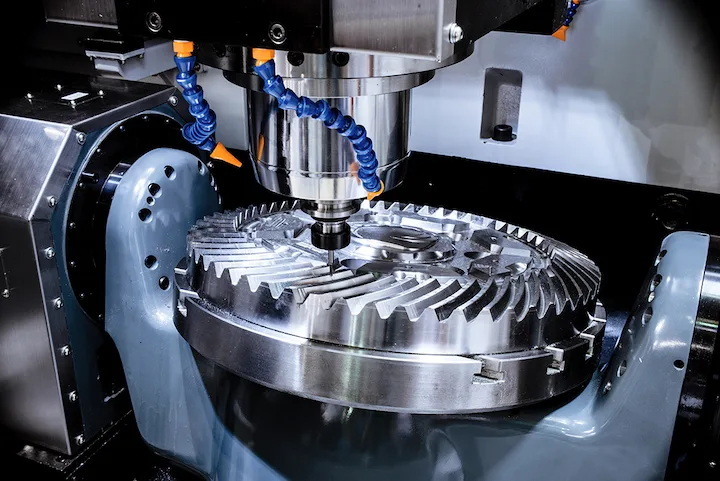
Modern CNC mills often rely on tool setting and workpiece probing to automate offsets and measurements. Probe calibration ensures that compensated values match physical reality so automated routines remain accurate.
- Securely mount the tool probe or work probe, confirming there is no looseness in the base, stylus, or extension rods.
- Follow the machine or probe manufacturer's calibration cycle, typically using a reference tool for tool probes or a calibration sphere or ring gauge for work probes.
- The control measures probe deflection positions, averages repeated touches, and stores offset data internally.
After calibration, verify by probing the calibration artifact again and checking that measured size and location match known values within the specified tolerance. If readings drift beyond the target range on high-precision systems, recheck mounting and repeat the calibration cycle.
Once geometric and probing calibrations are complete, practical cutting tests confirm that the machine behaves accurately under real machining conditions. These verification cuts also help reveal thermal or dynamic errors that static measurements might miss.
- Program a test part containing bores, pockets, slots, and features that challenge multiple axes and tool paths.
- Measure the test part with calibrated instruments to evaluate size, position, circularity, and squareness.
- Compare results with blueprint tolerances and determine whether further adjustment or parameter compensation is needed.
Keep records of test part results and calibration parameters as a traceable history for quality audits and future troubleshooting. Over time, trend analysis of these records helps predict when mechanical components are wearing and require proactive service.
On high-end machines, thermal compensation and volumetric compensation are used to further refine accuracy. Thermal compensation uses sensors placed on the machine structure and spindle to monitor temperature and automatically adjust axis positions in real time.
Volumetric compensation corrects three-dimensional errors across the entire working volume using data from laser interferometers or other precision systems. These methods are more complex and costlier to implement, but they significantly improve accuracy in demanding applications such as aerospace components, precision molds, and high-speed machining of hardened materials.
The ideal calibration interval depends on machine usage, required tolerances, and shop environment. Heavy roughing in abrasive materials or operation in temperature-variable environments typically requires more frequent checks.
- Establish a routine that includes daily quick checks, monthly geometric spot checks, and annual full calibration for most production mills.
- Recalibrate immediately after crashes, major component replacement, or relocation to another foundation.
Following documented procedures and using consistent reference standards help reduce variation between different technicians and calibration events. Many companies integrate calibration tasks into formal preventive maintenance programs to ensure continuity and compliance.
Calibration alone cannot compensate for poor maintenance. Lubrication, cleanliness, and inspection are essential for preserving the machine's calibrated condition over time.
- Check and replenish way oil, spindle lubrication, and grease points according to the manufacturer's schedule.
- Inspect linear ways, ballscrews, and bearings for signs of scoring, debris, or rust, and correct issues immediately.
- Keep toolholders, collets, and workholding devices clean and in good condition to prevent misalignment and runout.
When maintenance is performed regularly, wear progresses more slowly, and calibration settings remain valid longer. This significantly reduces unexpected downtime and the cost of emergency repairs.
For facilities operating under strict quality systems, documenting calibration is as important as performing it. Detailed records provide traceability and demonstrate that machines are capable of meeting specified tolerances.
Many shops reference international standards when defining their calibration procedures and acceptance criteria. Common examples include standards that cover geometric accuracy, axis positioning accuracy and repeatability, and probing system performance. Aligning shop practices with these frameworks helps ensure consistent quality and simplifies customer audits.
Even between major calibration events, operators can take simple actions to preserve accuracy.
- Use warm-up programs at the start of each shift, especially in temperature-sensitive work.
- Avoid overloading vises and fixtures, which can distort parts and machine components.
- Monitor scrap rates and dimensional trends, and flag any unusual patterns promptly.
These practices make it easier to spot a drifting machine before serious quality problems develop. Early intervention often requires only minor adjustments rather than complete rebuilds or extensive downtime.
Calibrating a CNC milling machine is a structured process that starts with leveling and geometric checks and extends through axis accuracy, backlash reduction, spindle and table alignment, and probe calibration. Systematic execution of these steps produces measurable gains in dimensional accuracy, surface finish, and overall process stability. By combining regular calibration with advanced techniques, disciplined maintenance, and well-planned test cuts, shops can maintain predictable performance, reduce scrap, and extend machine life even in demanding production environments.
Contact us to get more information!
Most production environments benefit from a full calibration at least once per year, with interim checks scheduled monthly or quarterly. Critical or high-precision applications may require more frequent verification, especially after heavy use or environmental changes.
Key parameters include axis travel accuracy, backlash, squareness between axes, spindle tram, and table flatness. For machines using automation, calibration of tool and work probes is equally important to maintain reliable offsets and inspection results.
Electronic compensation can correct small, predictable errors such as minor scale deviations or limited backlash. However, significant geometric misalignment, excessive wear, or unstable mechanical components should always be corrected mechanically before relying on software compensation.
Hobby-grade or light-duty CNC mills follow the same basic principles of leveling, axis verification, and squareness checks, but often with simpler tools and looser tolerances. Even on small machines, systematic calibration greatly improves repeatability and reduces frustration during complex jobs.
Common indicators include dimensions drifting out of tolerance, holes going out of round, surfaces showing unusual scallops, and inconsistent results between fixtures or pallets. Frequent tool compensation changes or increased scrap rates are also strong signals that calibration or mechanical inspection is overdue.
1. https://www.3erp.com/blog/cnc-machining-tool-calibration/
2. https://exactmachineservice.com/blog/best-practices-for-cnc-machine-tool-calibration/
3. https://www.kesmt.com/how-to-calibrate-cnc-milling-machine/
4. https://dmscncrouters.com/blog/calibrating-your-cnc-machine/
5. https://miscpro.com/2019/12/31/constants-of-cnc-accuracy-testing-travel-accuracy-backlash-squareness-deflection-repeatability/
6. https://www.renishaw.com/media/pdf/en/bb47fe94826748c2a265a1ac3e260065.pdf
7. https://qdmetrology.com/it/calibrating-cnc-probe-tool-key-considerations/
8. https://www.machinestation.us/cnc-machine-calibration-guide-how-to-keep-your-machine-precise/
9. https://support.hurco.com/wp-content/uploads/hurco_mill/Probing/Appendix_B__Tool_Probe_Calibration.htm
10. https://www.avidcnc.com/support/instructions/machineSetup/levelingSquaringAndTramming/
11. https://www.cncoptimization.com/resources/articles/iso-standards/
12. https://exactmachineservice.com/blog/guide-to-cnc-machine-maintenance-and-calibration/


