From idea to market-ready product, our NPI solutions make every stage easier, faster. Discover How We Help

Views: 222 Author: Tomorrow Publish Time: 2025-12-09 Origin: Site


Content Menu
● What Is CNC Machining Cost Per Hour?
● Key Cost Components in CNC Machining
>> 1. Machine Cost and Depreciation
>> 3. Energy and Utility Costs
>> 5. Overhead and Maintenance
● The Comprehensive Cost Formula
● Cost Differences by Machine Type
● Additional Factors Affecting Machining Cost
>> Tolerance and Surface Finish Requirements
● Strategies to Reduce CNC Machining Cost Per Hour
● FAQ
>> 1. What is the average CNC machining cost per hour?
>> 2. How does machine utilization affect cost?
>> 3. Can automation lower hourly CNC costs?
>> 4. What can cause sudden increases in hourly cost?
>> 5. What software tools assist in cost estimation?
Understanding how to calculate CNC machining cost per hour is fundamental for manufacturers, engineers, and business owners aiming to ensure profitability and efficiency. Accurately determining machining costs allows companies to set fair prices for customers while sustaining long-term operational stability.
CNC (Computer Numerical Control) machining is a pillar of modern manufacturing. From complex aerospace components to medical implants, every precision part produced on a CNC machine has hidden costs that go far beyond the visible process of cutting, milling, or drilling. Estimating these costs correctly helps manufacturers remain competitive in industries where profit margins are constantly shrinking.

The term “CNC machining cost per hour” refers to the total operating cost required to run a CNC machine for one hour of active production. It represents a combination of fixed and variable expenses such as machine investment, operator wages, maintenance, power consumption, tooling wear, and general overhead.
This hourly rate serves as the foundation for quotation and cost estimation. Whether a company is pricing one-off prototypes or mass production batches, understanding the exact machining rate prevents underquoting or overcharging clients.
Several variables influence the hourly cost of a CNC machine. These can be broadly divided into five core categories.
1. Machine Purchase and Depreciation
2. Operator Labor
3. Energy and Power Consumption
4. Tooling and Consumables
5. Overhead and Facility Costs
Each factor has a unique impact on the total rate, and ignoring any component leads to inaccurate pricing.
CNC machines require high upfront investment. Their cost depends on type, brand, accuracy, and automation level. To spread this cost evenly over time, depreciation is calculated based on the projected life expectancy and annual usage.
For instance, a $150,000 CNC lathe expected to last 10 years with annual utilization of 2,500 hours and a resale value of $15,000 has:
(150,000 - 15,000) / (10 * 2,500) = $5.40 per hour
This depreciation value should be included when computing the hourly rate. Failing to do so causes hidden financial losses because the machine's eventual replacement cost isn't fully recovered during its operational life.
Some manufacturers also include financing interest if the machine was purchased with a loan. Adding annual interest payments divided by total yearly operating hours can provide a more accurate picture of real cost.
Even though automation reduces operator involvement, human supervision remains indispensable. Labor costs include direct wages, employee benefits, training, and ancillary assistance such as setup technicians or QC inspectors.
Example:
If an operator earns $30/hour and manages two CNC machines, the labor cost per machine per hour becomes:
30/2 = $15 per hour
Additional costs like programming, setup, and inspection time can range from 20% to 50% of base labor costs depending on complexity. Skilled programmers might command higher wages, especially in industries such as aerospace or mold manufacturing.
Efficient labor allocation significantly affects profitability. Multi-machine supervision, shift optimization, and workforce cross-training are key strategies to balance productivity and cost.
CNC machines can consume considerable energy, particularly during heavy machining operations or high-speed cutting. Power usage varies based on spindle load, feed rate, and machine type.
To estimate power cost per hour, multiply energy consumption (in kWh) by local electricity tariffs. Example:
9 kWh *0.14 =$1.26 \text{ per hour}
Besides normal electricity usage, consider supportive equipment such as coolant pumps, air compressors, extraction systems, and climate control, which may increase consumption by another 10–15%.
Modern CNC equipment with energy-saving modes can reduce idle energy consumption by 10–25%, contributing to lower hourly costs over time.
Tooling includes cutting inserts, end mills, drills, tool holders, and fixtures, which wear out depending on the material and machining parameters. Consumables also include lubricants, coolants, and filters.
For example:
A carbide end mill costing \$90 that lasts 9 machining hours equals:
90/9 = $10 per hour
Add coolant and maintenance consumables (say $1.50/hour), resulting in a total tooling cost of $11.50/hour. If machining hardened steel, this cost may double due to faster tool wear.
Optimizing feeds and speeds, using efficient tool paths, and adopting proper cooling help reduce tool wear and hourly tooling costs significantly.
Overhead represents all additional expenses that keep the facility running but aren't directly traceable to one specific job. These include rent, insurance, management salaries, administration, IT, cleaning, and property taxes.
Typically, overhead is added as a percentage (20–40%) of total direct costs. Maintenance costs, on the other hand, should be calculated based on service schedules and spare part replacements.
Example:
If annual maintenance totals \$6,000 over 2,000 hours of operation:
6,000 /2,000 = $3 per hour}
Proper preventive maintenance prevents unplanned downtime and extends equipment life, indirectly lowering long-term depreciation cost.
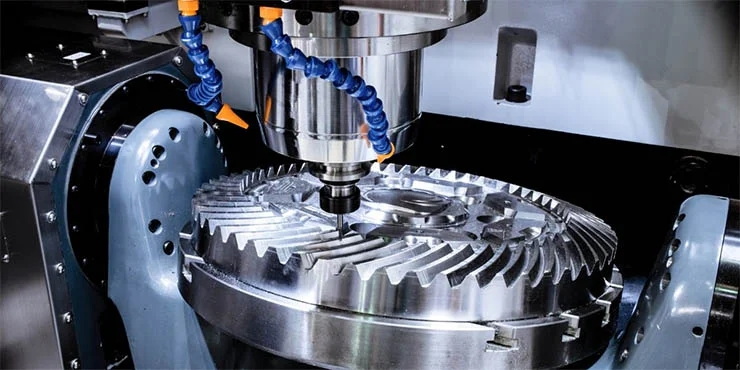
The complete CNC machining cost per hour can be expressed as:
Hourly Cost= D + L + E + T + M + (O * (D+L+E+T+M))
Where:
D = Depreciation
L = Labor cost
E = Energy
T= Tooling & Consumables
M= Maintenance
O = Overhead rate (in decimal form)
Assume:
D = $5.40
L = $15.00
E = $1.26
T = $11.50
M = $3.00
O = 30\%
Subtotal:
5.40 + 15 + 1.26 + 11.50 + 3 = $36.16
Overhead:
36.16 * 0.3 = $10.85
Total CNC Machining Cost Per Hour = $47.01
This value accurately represents the machine's operational hourly rate.
Machine complexity and automation level largely determine the hourly cost.
| Machine Type | Hourly Cost Range | Notes |
|---|---|---|
| CNC Lathe | $30–$60 | Suitable for cylindrical parts; simpler setup. |
| CNC Milling Machine | $50–$100 | Versatile; used for 2D and 3D parts. |
| 5-Axis CNC Center | $100–$200 | High precision and complex geometry. |
| CNC EDM | $150–$250 | For ultra-precise electrical discharge machining. |
| CNC Laser Cutting | $90–$180 | Fast, precise, used in sheet metal fabrication. |
These ranges vary based on country, electricity rates, and production scale.
Different metals require different cutting conditions. Aluminum is easy to machine, while Inconel or hardened steel increases tool wear, thus raising the cost per hour.
Tight tolerances and mirror finishes require slower speeds and more tool passes, lengthening machining time and increasing hourly expenses.
Short-run jobs or prototypes may require hours of setup and CAM programming. To price fairly, distribute setup costs over batch quantities. For example, a \$200 setup charge for a batch of 20 parts adds \$10 to each part's cost.
Higher machine uptime dilutes fixed costs like depreciation and rent. A machine running 80% of available hours will exhibit lower effective hourly cost than one running only 50%.
Automated pallet changers, robotic loading systems, and tool presetting reduce labor requirements, enhancing cost efficiency per hour over the long term.
1. Schedule preventive maintenance to prevent downtime.
2. Optimize toolpaths with CAD/CAM software to shorten cycle times.
3. Use high-efficiency cutting tools to extend tool life and reduce consumable costs.
4. Monitor energy consumption and switch to energy-efficient machinery or inverter-driven systems.
5. Train operators for multi-machine handling to minimize labor cost.
6. Improve scheduling and workflow to maximize overall equipment effectiveness (OEE).
Adopting lean manufacturing principles and continuous improvement methods like Kaizen and 5S also reduces inefficient operations contributing to cost per hour.
Calculating CNC machining cost per hour provides a foundation for accurate pricing, informed decision-making, and sustainable profitability. By combining machine depreciation, labor, energy, tooling, maintenance, and overhead, manufacturers can uncover the true operational cost of each machine.
A transparent costing system supports better quotation accuracy, cost optimization, and financial planning. Whether in small workshops or large-scale factories, consistent cost monitoring ensures efficiency, competitiveness, and long-term business success.
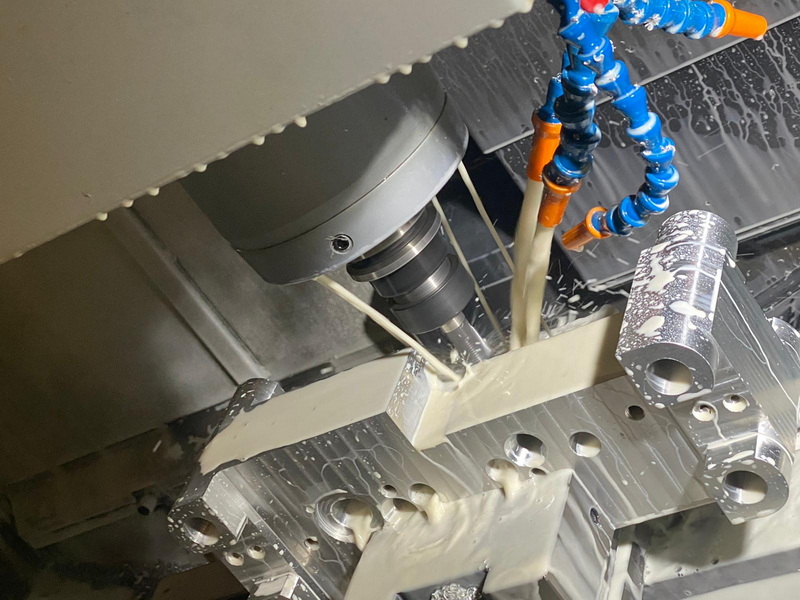
Most machines operate between \$35 and \$120 per hour, depending on size, precision, and application. Advanced 5-axis or EDM systems may exceed \$200 per hour.
Low machine utilization increases hourly cost because fixed expenses like rent and depreciation remain constant. Higher utilization improves cost dilution and profitability.
Yes. Automation reduces labor involvement, optimizes machine uptime, and minimizes operator fatigue, leading to lower effective hourly costs over time.
Unexpected tooling failure, machine downtime, power inefficiencies, or poor scheduling often result in temporary cost spikes. Preventive maintenance and production planning help mitigate them.
Software such as Autodesk Fusion 360, Mastercam, SolidCAM, and Costimator provide automated machining time and cost calculation functions, improving estimation accuracy.


