From idea to market-ready product, our NPI solutions make every stage easier, faster. Discover How We Help

Views: 222 Author: Feifan Hardware Publish Time: 2026-04-24 Origin: Site


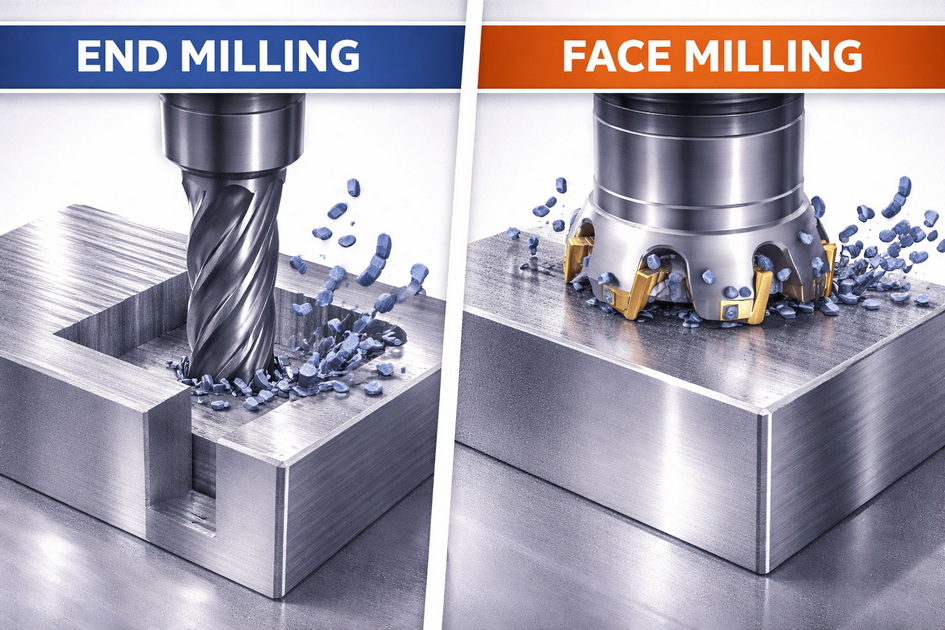
If you are choosing between end milling and face milling, the most important difference is not just tool shape. It is how each process affects surface finish, flatness, tool marks, and final part quality. [unionfab]
For OEM and ODM buyers, especially in precision hardware and electronics parts, this decision can directly influence visual appearance, dimensional accuracy, and downstream assembly performance. [datron]
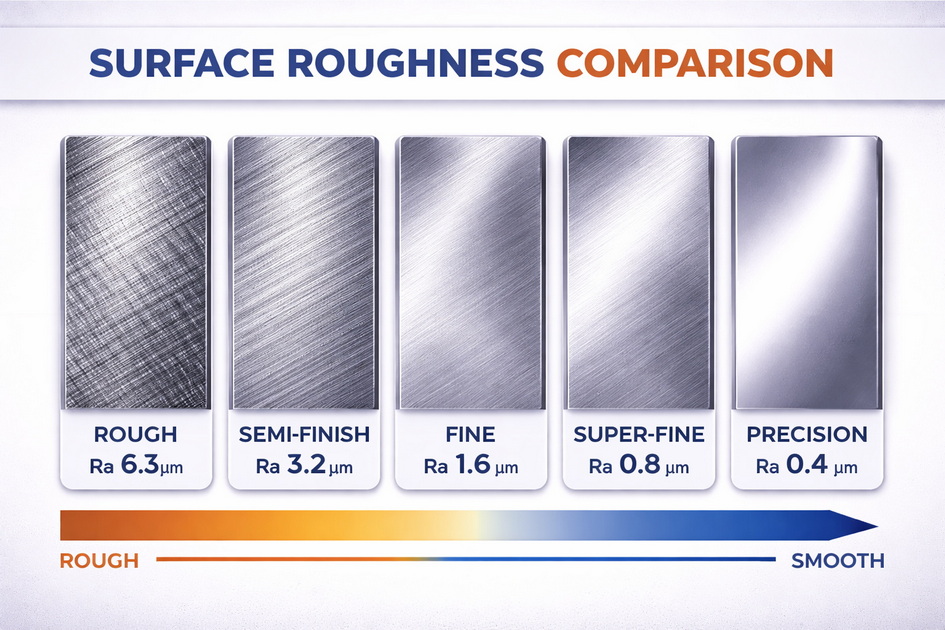
Surface finish is more than a cosmetic detail. It affects friction, sealing, coating adhesion, wear resistance, and how smoothly parts fit together in assembly. [rapiddirect]
In machining, surface finish is commonly described with parameters such as Ra, Rz, and related texture indicators, which are widely used in technical drawings and quality requirements. [iso]
For manufacturers, the practical goal is simple: achieve the required finish without overprocessing the part and raising cost unnecessarily. [sandvik.coromant]
| Factor | End Milling | Face Milling |
|---|---|---|
| Main cutting area | Side and end of the tool | Face of the cutter and inserts |
| Best for | Slots, pockets, contours, shoulders, complex geometry | Flat surfaces, large-area facing, final leveling |
| Typical finish result | Excellent on detailed features and edges | Better for flatness and broad smooth surfaces |
| Speed on large surfaces | Slower | Faster |
| Surface consistency | Strong in small zones and complex shapes | Strong across wide flat areas |
| Common finishing advantage | Precision and feature detail | Uniform surface quality and smoother flatness |
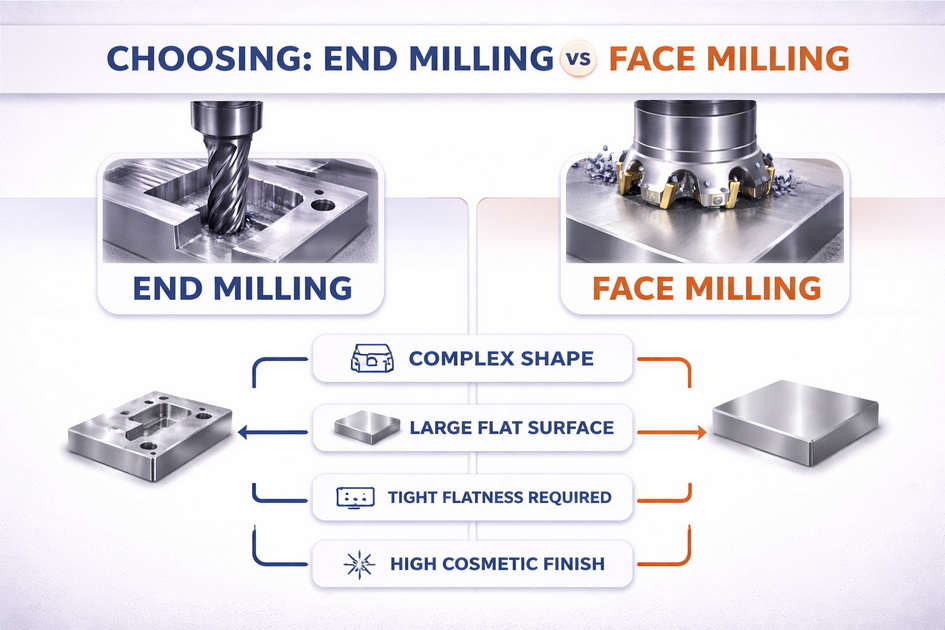
Face milling is generally the stronger choice for wide, flat surfaces, while end milling is better when the part contains complex geometry or small features that need controlled finishing. [unionfab]
End milling uses the sides and tip of the tool, which makes it highly versatile for contouring, slotting, pocketing, and shoulder work. That versatility is exactly why it is so common in precision CNC parts manufacturing. [xometry]
When used for finishing, an end mill can produce a very good surface, especially on edges, walls, small pockets, and shaped features. However, on large flat areas, it may leave more visible tool marks than face milling unless the toolpath and parameters are carefully optimized. [unionfab]
From a process-control perspective, end milling finish quality depends heavily on tool rigidity, runout, feed rate, step-over, spindle stability, and chip evacuation. [datron]
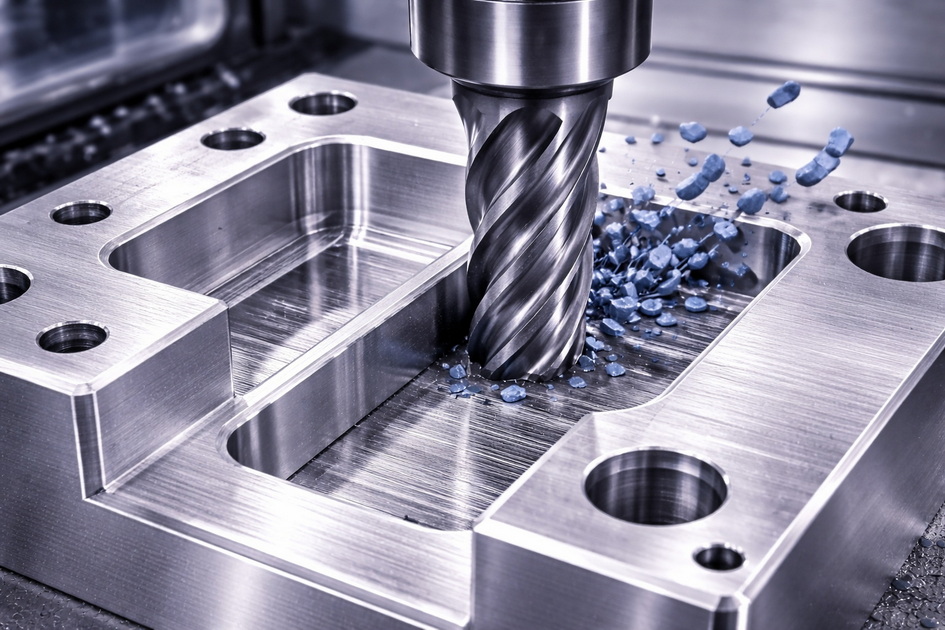
- Side walls and vertical faces.
- Pockets and cavities.
- Complex 3D contours.
- Small surfaces where face mills cannot reach easily.
- Finishing passes that require sharp geometry control.
A practical example: if a buyer wants a machined housing with internal channels, bosses, and tight dimensional tolerances, end milling is usually the process that delivers the needed detail. In this case, the finish is judged not only by smoothness but also by how cleanly the cutter defines the functional geometry. [jlccnc]
Face milling is designed to level and smooth broad surfaces. It is the classic choice for creating a flat top face on plates, blocks, bases, and mounting surfaces. [jlccnc]
This process often produces a more uniform finish on large flat areas because the cutter engages the surface in a way that supports consistent contact and controlled material removal. In many production settings, face milling is preferred when flatness and appearance matter more than intricate detail. [unionfab]
Sandvik Coromant notes that excellent surface finishes can be achieved in face milling, especially when using the right cutter geometry and, in finishing operations, wiper inserts. [sandvik.coromant]
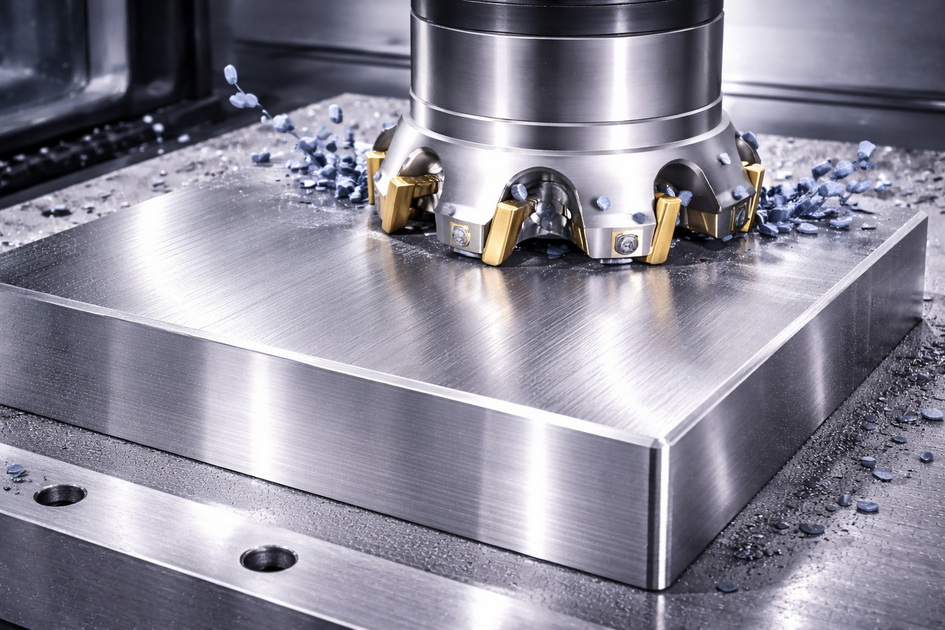
- Large flat top surfaces.
- Final leveling before secondary machining.
- Broad faces that must look clean and uniform.
- Parts that need strong seating or mating surfaces.
- Production work where consistency across many parts matters.
For example, if your part will be mounted against another component, face milling often gives the better functional finish because the surface is flatter and more stable for assembly. [rapiddirect]
The phrase "better finish" does not always mean the same thing. In practice, surface finish can refer to smoothness, flatness, waviness, visual consistency, or all four. [iso]
Face milling usually wins on large-area flatness and consistent broad-surface appearance. End milling usually wins on feature-level finish, especially when the geometry is complex or the tool must reach narrow areas. [unionfab]
- Tool geometry, especially insert style and helix angle.
- Cutter engagement and entering angle.
- Spindle rigidity and machine stability.
- Feed, speed, and depth of cut.
- Toolpath strategy, including climb milling and exit control. [datron]
A useful rule of thumb: use face milling to make the surface look and behave flat, then use end milling to refine the functional details around it. That workflow is common in OEM part production because it balances efficiency, finish quality, and cost. [jlccnc]
The surface finish difference is not only about tool type. It is also about how the tool is used. Even a high-quality face mill can produce poor results if the setup is unstable or the cutting parameters are wrong. [datron]
1. Use rigid fixturing to reduce vibration and chatter.
2. Keep runout low and verify tool balance.
3. Use climb milling where the setup allows it.
4. Reduce feed and step-over for the final pass.
5. Match insert geometry to the material.
6. Use wiper inserts for better face-milled surfaces when appropriate. [datron]
For face milling, wiper inserts are especially valuable because they can improve surface quality at higher feed rates. Sandvik Coromant explains that wiper inserts can help maintain good finish quality and even allow higher feed per revolution under the right conditions. [sandvik.coromant]
For end milling, the strongest gains often come from reducing tool deflection, using sharp cutters, and optimizing tool paths so the cutter does not repeatedly enter and exit the material in a way that marks the surface. [hotean]
In my view as a manufacturing content strategist, the best machining strategy is to separate appearance surfaces from functional geometry. That means face milling should handle broad reference planes, while end milling should refine pockets, steps, and contour details. This approach is especially effective for export parts where buyers expect both consistency and visual quality. [rapiddirect]
For precision hardware suppliers, the biggest mistake is choosing one milling method for the entire part. That often increases cycle time or leaves finish defects in the wrong area. A hybrid process usually delivers the best balance of quality and cost. [jlccnc]
- Use face milling for the initial leveling pass.
- Use end milling for critical features and side walls.
- Apply a finishing pass only where the drawing demands it.
- Inspect surface roughness requirements before locking the process route.
This is also how many OEM/ODM programs reduce rework: the process is planned around the required finish, not around one universal tool choice. [rapiddirect]
| Part condition | Better choice | Why |
|---|---|---|
| Large flat surface | Face milling | Better flatness and consistency |
| Pocket or slot | End milling | Tool can reach internal geometry |
| Thin wall | Depends on stability | Lower cutting forces may be needed |
| Aesthetic top surface | Face milling | Cleaner broad-surface finish |
| Complex 3D feature | End milling | Better contour control |
| Final preparation for assembly | Face milling | Improves seating and contact |
Many finish problems come from process mistakes, not from the cutter itself. The most common issue is using a roughing strategy for a finishing requirement. [datron]
- Using too high a feed during the final pass.
- Ignoring vibration caused by weak fixturing.
- Choosing the wrong cutter diameter for the workpiece.
- Allowing chips to recut the surface.
- Using end milling on large faces when face milling would be more efficient. [datron]
If surface finish is critical, the final pass should be treated as a separate operation with its own settings. That is one of the easiest ways to improve consistency across batches. [rapiddirect]
For overseas brands, wholesalers, and manufacturers, the right milling choice depends on what the part must do after machining. If the surface must seal, seat, or appear premium, face milling often deserves priority. If the geometry is intricate, end milling becomes essential. [rapiddirect]
When sourcing from a China OEM/ODM supplier, it helps to share:
- 2D drawings with surface roughness callouts.
- Critical flatness or cosmetic requirements.
- Material type and hardness.
- Any secondary processes such as anodizing, plating, or polishing.
- Expected annual volume and tolerance targets.
This information helps the factory choose the proper cutter, path, and finish strategy from the start. [iso]
Need precision CNC parts with the right surface finish from the first run? Send us your drawing, material, and finish requirements, and we will recommend the best machining method for your OEM or ODM project.
No. Face milling is usually better for large flat areas, but end milling can produce excellent finish on pockets, walls, and complex features. [unionfab]
Yes, but it is often less efficient and may leave more visible tool marks on large surfaces. [xometry]
Cutter geometry, insert quality, stable fixturing, and finishing tools such as wiper inserts all help improve face-milled surfaces. [sandvik.coromant]
It depends on rigidity and cutting force direction. In weak setups, tool choice and entering angle matter more than tool name alone. [sandvik.coromant]
Optimize cutting parameters, reduce chatter, use climb milling when suitable, and apply a dedicated finishing pass. [datron]
Face milling is usually better for broad cosmetic surfaces, while end milling is better for detailed or shaped areas. [rapiddirect]
1. Sandvik Coromant. "Face milling." https://www.sandvik.coromant.com/en-us/knowledge/milling/face-milling [sandvik.coromant]
2. DATRON. "Achieve The Perfect CNC Machining Surface Finish." https://www.datron.com/resources/blog/cnc-machining-the-perfect-surface-finish/ [datron]
3. Unionfab. "Face Mill vs. End Mill: A Complete Comparison Guide." https://www.unionfab.com/blog/2024/06/face-mill-vs-end-mill [unionfab]
4. Xometry. "Face Milling vs. End Milling: What Are the Differences?" https://www.xometry.com/resources/machining/face-milling-vs-end-milling/ [xometry]
5. RapidDirect. "Face Milling vs End Milling: Key Differences & Applications." https://www.rapiddirect.com/blog/face-milling-vs-end-milling/ [rapiddirect]
6. ISO. "ISO 1302:1992 - Technical drawings — Method of indicating surface texture." https://www.iso.org/standard/5883.html [iso]
7. KEYENCE. "Understanding Surface Roughness Symbols." https://www.keyence.com/ss/products/microscope/roughness/line/roughness-symbols.jsp [keyence]
8. DATRON. "CNC Machining Surface Finish Guide." https://www.datron.com/resources/blog/cnc-machining-the-perfect-surface-finish/ [rapiddirect]


