From idea to market-ready product, our NPI solutions make every stage easier, faster. Discover How We Help

Views: 222 Author: Feifan Hardware Publish Time: 2026-04-29 Origin: Site
For mass production, die casting usually wins on unit cost and cycle time, while CNC milling wins on precision, flexibility, and lower upfront risk. The right choice depends on part geometry, tolerance demands, material needs, and whether you are scaling a proven design or still refining it. [hlhrapid]
As a Chinese OEM/ODM precision parts manufacturer, Shenzhen Feifan Hardware & Electronics Co.,Ltd. would typically frame this decision around one question: Are you optimizing for speed at scale, or control at every stage? That is the real trade-off behind CNC Milling vs. Die Casting for Mass Production. [aleader-china]
Many buyers compare these two processes only by price. That is a mistake, because the true cost of a part includes tooling, scrap, lead time, rework, surface finishing, and quality risk. Die casting can deliver very low per-unit costs once tooling is approved, but CNC milling avoids mold investment and supports faster design changes. [jccasting]
For brands, wholesalers, and product manufacturers, this matters most when a product moves from prototype to launch. A part that looks cheap on paper can become expensive if tolerances drift, tooling changes are needed, or demand forecasts are wrong. [watry]
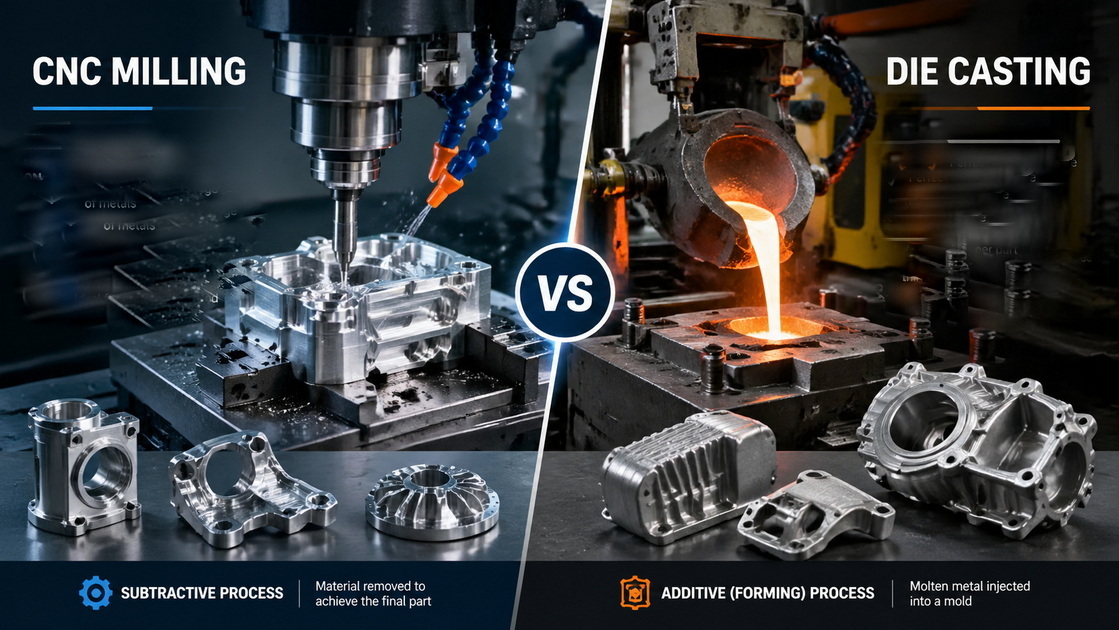
CNC milling is a subtractive process. It starts with a solid block of metal and removes material until the final geometry is formed. This makes it excellent for tight tolerances, intricate features, and repeated engineering changes. [staubinc]
Die casting is a formative process. Molten metal is injected into a steel die, then solidified into near-net-shape parts. Once the tool is ready, production is fast and consistent, especially for aluminum and zinc parts in high volumes. [aleader-china]
| Factor | CNC Milling | Die Casting |
|---|---|---|
| Best volume range | Low to medium, and bridge production | Medium to very high volume fictiv |
| Upfront tooling | Low or none | High die cost aleader-china |
| Per-part cost at scale | Higher | Lower hlhrapid |
| Tolerance control | Generally tighter | Good, but usually less tight than CNC aleader-china |
| Design flexibility | Very high | Lower after tooling boona-prototypes |
| Lead time | Faster for first-off parts | Longer due to die development tx-industries |
| Material efficiency | More waste | Better material efficiency, more near-net-shape watry |
| Surface finish | Often needs finishing | Often smoother out of tool jccasting |
A practical rule appears repeatedly in recent industry guidance: CNC machining is often preferred for smaller runs or when design changes are still likely, while die casting becomes more economical once the program reaches true mass-production scale. [fictiv]
The biggest cost difference is not machine time alone. CNC milling has lower entry cost because there is no die to build, but every part consumes machine time. Die casting front-loads cost into tooling, then reduces unit cost as volume rises. [rapiddirect]
In many production scenarios, CNC is more cost-effective below roughly 1,000 to 5,000 units, while die casting becomes attractive at higher annual volumes or when demand is stable enough to justify the die investment. Exact break-even depends on geometry, finish requirements, alloy choice, and post-processing. [tx-industries]
1. If your design may change, choose CNC first.
2. If your geometry is stable and demand is predictable, evaluate die casting.
3. If you need both, use CNC for prototype and pilot runs, then transfer to die casting for scale. [boona-prototypes]
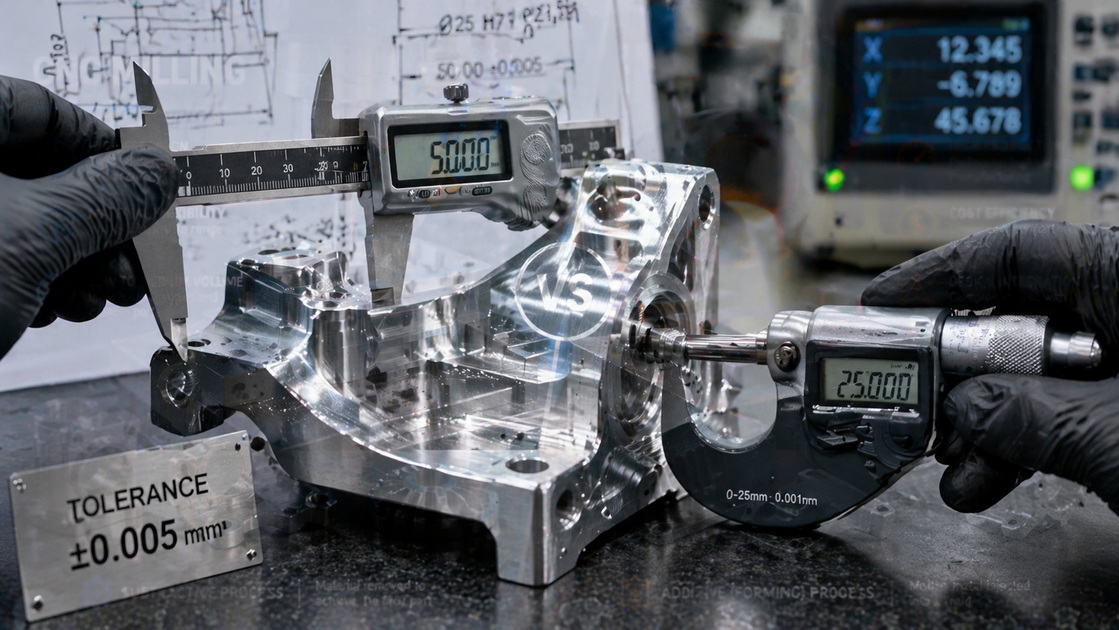
If your part has critical fit features, CNC milling is usually the safer option. CNC is widely used for high-precision components because the process can maintain tighter dimensional control across complex features and frequent revisions. [wisensemachining]
Die casting is still highly repeatable, but it is better understood as a process for consistent mass output rather than ultra-tight custom precision. For many enclosures, housings, brackets, and thermal components, that is enough. For mating interfaces, thin tolerance stacks, and engineering-critical surfaces, CNC often remains the better finishing or final-machining step. [ferrcasting]
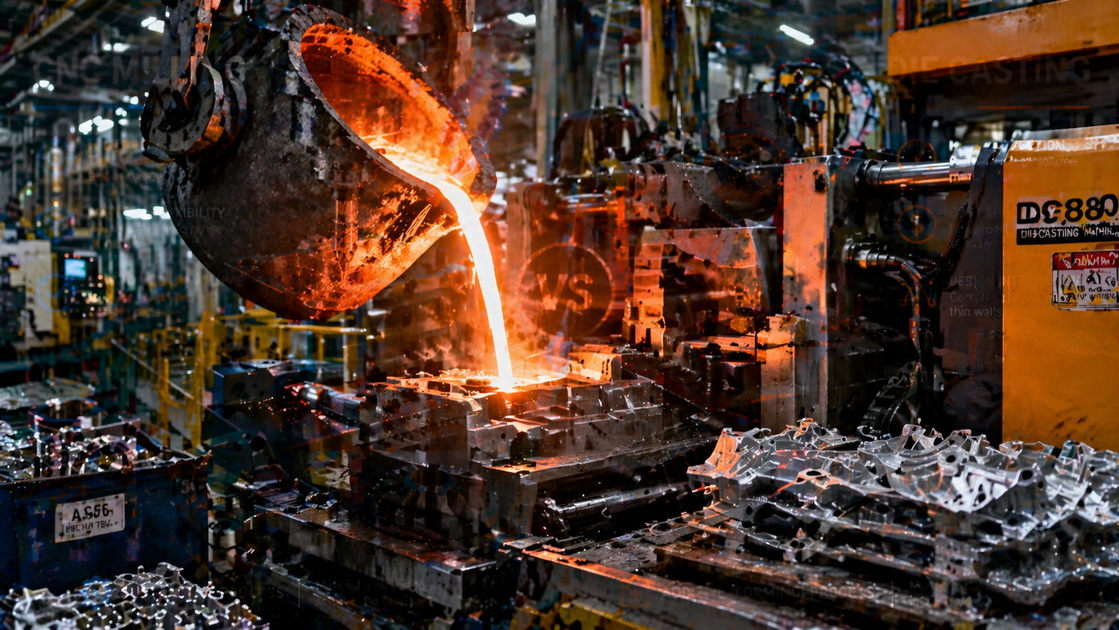
Die casting wins once the die is approved. Cycle times can be extremely short, and multi-cavity tooling can produce large quantities rapidly, which is why die casting is favored for mass production programs. [kenwalt]
CNC milling scales differently. It can run continuously and support high-volume machining, but each additional unit still requires machine time and often multiple operations. That makes it slower and costlier at scale, even though it is simpler to launch. [jiga]
CNC milling is extremely versatile because it can process many metals and even non-metals. That flexibility makes it valuable when the part is still evolving or when the project demands special alloys, unusual geometries, or mixed process routes. [jccasting]
Die casting is more constrained in material choice, with aluminum and zinc among the most common options. On the other hand, it excels at producing thin walls, complex external shapes, and integrated features that would be expensive to machine repeatedly. [watry]
This is an area where die casting often has an advantage in production efficiency. Because it is near-net-shape, less material is removed, and leftover metal can often be recycled, reducing waste compared with subtractive machining. [ferrcasting]
For aluminum specifically, recycling is a major sustainability lever in the industry. The International Aluminium Institute reports that recycled aluminium can save 95.5% of the energy needed for primary aluminium production, which strengthens the case for recycled-content manufacturing strategies in mass production. [worldclimatefoundation]
- You need tight tolerances.
- Your design is still being revised.
- Quantities are low to moderate.
- You want fast pilot production or bridge manufacturing.
- The part needs frequent engineering updates. [fictiv]
- Your volume is high and stable.
- You want a lower cost per part.
- The geometry is suitable for molding.
- You can accept tooling lead time and upfront die cost.
- You want near-net-shape output with efficient throughput. [hlhrapid]
A reliable sourcing team should not ask only "Which process is cheaper?" A better question is "Which process gives the lowest total risk over the product lifecycle?" That is the mindset used by experienced OEM suppliers serving overseas brand owners and industrial buyers. [millercnc]
A strong decision workflow is:
1. Confirm the annual demand forecast.
2. Review tolerance-critical dimensions.
3. Evaluate whether the design is frozen.
4. Estimate tooling payback.
5. Compare secondary operations.
6. Decide whether CNC, die casting, or a hybrid route is best. [newaydiecast]
One of the most practical strategies is to combine both processes. Many manufacturers prototype or validate with CNC milling, then transition to die casting once the design is stable. In some cases, the die-cast part still receives CNC finishing on critical surfaces, giving buyers a balance of speed, cost, and precision. [boona-prototypes]
This hybrid model is especially useful for hardware housings, electronic enclosures, brackets, and industrial components where a few surfaces require exact machining but the body can be die-cast. It is often the smartest path for OEM and ODM programs. [watry]
If your product is heading toward volume production, request a process review before committing to tooling. A good OEM partner should help you compare CNC milling, die casting, and hybrid finishing so you can reduce cost without sacrificing quality. For precision hardware programs, that early decision can save weeks of lead time and a significant amount of total project cost. [newaydiecast]
Not always. CNC milling is better for precision, flexibility, and smaller or changing orders, while die casting is usually better for stable, high-volume production. [aleader-china]
Because the tooling cost is spread across many units, and each cycle produces parts quickly with less machining time per part. [hlhrapid]
Yes, but CNC milling usually achieves tighter tolerances and is preferred for critical surfaces or mating features. [staubinc]
CNC milling is usually faster for the first parts because it does not require die manufacturing, while die casting has a longer initial lead time due to tooling. [tx-industries]
Yes. A common approach is die casting for the main body and CNC milling for precision features, threads, or sealing surfaces. [staubinc]
Die casting often produces less waste per part, and recycled aluminum can significantly reduce energy use in the overall supply chain. [international-aluminium]
1. [HLH Rapid — Casting vs. CNC Machining] [hlhrapid]
2. [Aleader China — CNC Machining vs. Die Casting: A Detailed Analysis] [aleader-china]
3. [Watry Industries — CNC Machining VS Die Casting] [watry]
4. [KenWalt — High-Volume Precision: Die Casting vs CNC Machining] [kenwalt]
5. [JCCasting — Die Casting vs CNC Machining] [jccasting]
6. [Fictiv — Casting vs CNC Machining: Comparison & Decision Guide] [fictiv]
7. [Jiga — High Volume CNC Machining] [jiga]
8. [Watry Industries — Benefits of Die Casting] [watry]
9. [Boona Prototypes — CNC Machining vs Die Casting for Small Batch Production] [boona-prototypes]
10. [Rapiddirect — CNC Machining Cost Audit] [rapiddirect]
11. [TX Industries — Lead Time for Producing Die Casting Parts] [tx-industries]
12. [Neway Die Cast — Typical Lead Times for Aluminum Die Casting Production] [newaydiecast]
13. [Neway Die Cast — Tool Development and Pilot Production Lead Times] [newaydiecast]
14. [International Aluminium Institute — Aluminium recycling saves 95% of the energy needed for primary aluminium production] [international-aluminium]
15. [World Climate Foundation — Aluminium recycling efficiency rate] [worldclimatefoundation]
16. [Wisense Machining — What is ISO 9001 in CNC Machining?] [wisensemachining]
17. [Miller CNC — ISO 9001:2015-Certified Quality Process] [millercnc]


