From idea to market-ready product, our NPI solutions make every stage easier, faster. Discover How We Help

Views: 222 Author: Feifan Hardware Publish Time: 2026-04-20 Origin: Site
When buyers compare CNC milling vs. CNC turning, they are usually trying to answer one practical question: which process makes my part better, faster, and more cost-effectively? For OEM and ODM projects, the right answer depends on part shape, material, tolerance, production volume, and the final application. CNC turning is usually the best choice for round or symmetrical parts, while CNC milling is stronger for flat surfaces, pockets, contours, and complex 3D geometries. [rcoeng]
From a manufacturer's perspective, the smartest decision is not "milling or turning" in isolation. It is often a process strategy that balances design intent, machinability, inspection risk, and total landed cost. That is especially important for overseas buyers sourcing precision parts from China, where supplier capability, lead time, and quality control can affect the entire program. [wisensemachining]
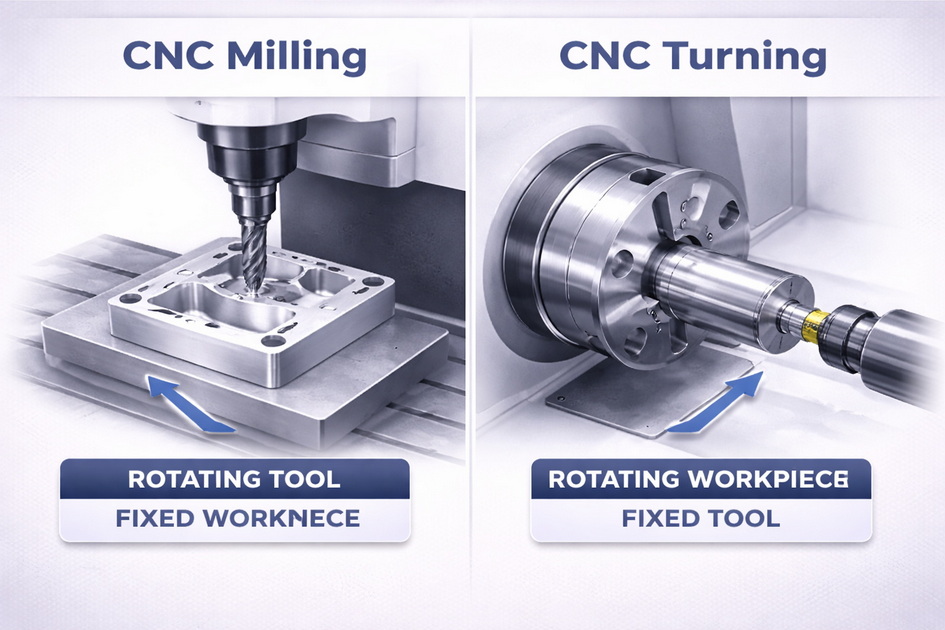
CNC milling is a subtractive machining process in which the cutting tool rotates while the workpiece stays fixed. It is ideal for parts that need slots, holes, flat faces, pockets, angled features, and irregular contours. Because the tool can move across multiple axes, milling is often the best fit for parts with complex geometry and many non-cylindrical features. [precisioncncmachining]
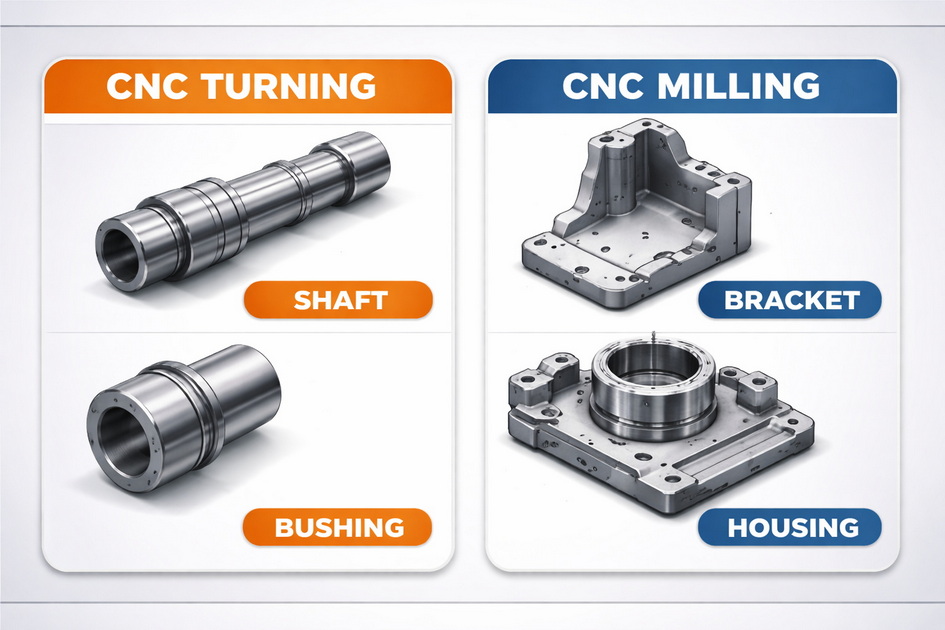
In real production, CNC milling is widely used for housings, brackets, enclosures, molds, fixtures, and precision components with difficult surface requirements. It can also be extended to 3-axis, 4-axis, or 5-axis setups when the part demands more angles or fewer repositioning steps. For buyers, the main trade-off is that higher geometric freedom can also mean longer programming time and more setup complexity. [blog.3ds]
- Housings and enclosures.
- Mounting plates and brackets.
- Heat sinks and custom mechanical bodies.
- Mold inserts and prototype structures.
- Parts with pockets, ribs, or multi-surface features. [wigglesworth]
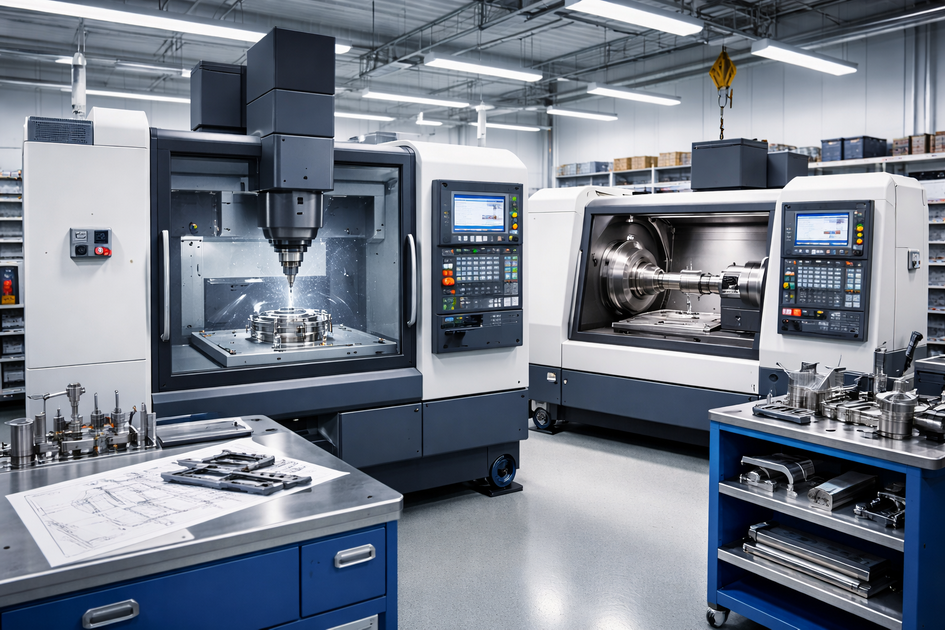
CNC turning works in the opposite way: the workpiece rotates while the cutting tool stays relatively stationary. This makes it highly efficient for round, tubular, or axis-symmetrical parts such as shafts, bushings, couplings, pins, collars, and threaded components. Turning naturally produces concentric geometry, which is a major advantage for parts where roundness and symmetry matter most. [fractory]
For many buyers, turning is the faster and more economical choice when the design is primarily cylindrical. It often requires fewer tool changes and can deliver excellent repeatability in high-volume runs. That is why turning is commonly used for automotive, industrial, electronics, and precision hardware components that rely on circular dimensions and smooth outer diameters. [superior-machining]
- Shafts and axles.
- Bushings and sleeves.
- Pins, collars, and fasteners.
- Threaded cylindrical parts.
- Symmetrical industrial hardware components. [wigglesworth]
| Factor | CNC Milling | CNC Turning |
|---|---|---|
| Primary motion | Rotating tool | Rotating workpiece |
| Best geometry | Complex, irregular, multi-surface | Round, tubular, symmetrical |
| Strength | Flexibility and feature complexity | Speed and concentric accuracy |
| Typical parts | Housings, brackets, molds | Shafts, bushings, pins |
| Setup efficiency | Can require more repositioning | Often fewer setups |
| Best for volume | Prototypes and complex runs | High-volume cylindrical parts |
The table above is useful because the real selection criterion is usually part geometry, not machine preference. If the part is mostly round, turning often wins on efficiency. If the part contains multiple planes, cavities, or asymmetric features, milling usually provides the better path to manufacture. [cowetatechprecision]
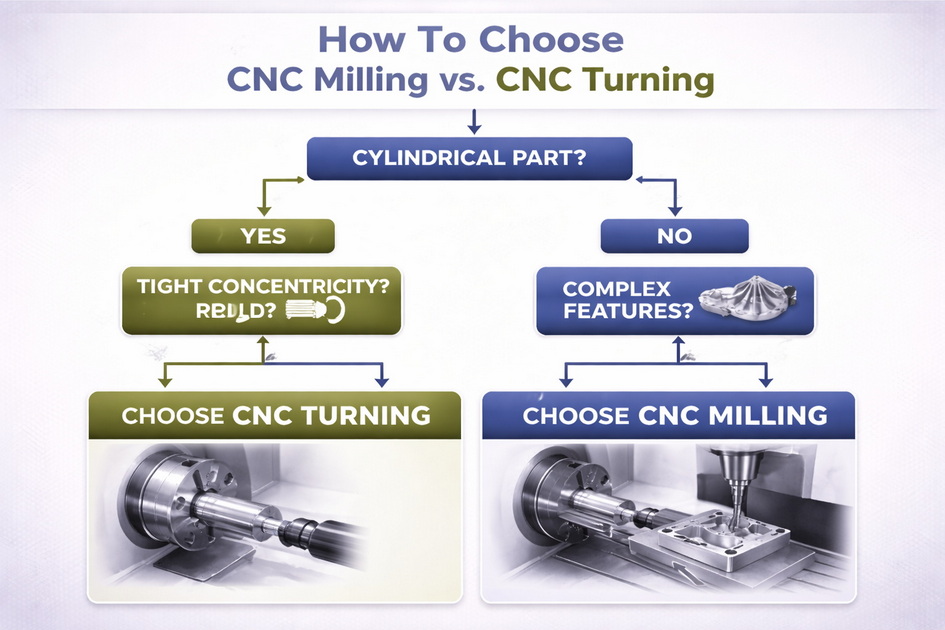
A practical decision framework helps buyers avoid unnecessary cost and rework. Instead of asking "Which process is better?", ask "Which process matches the functional demands of this part?" That shift improves quoting accuracy, cycle time planning, and manufacturability. [sansmachining]
- The part is round, cylindrical, or tubular.
- Concentricity and symmetry are critical.
- The part includes threads, grooves, or outer diameters.
- You need high repeatability in larger quantities.
- The design is relatively simple and rotational. [rcoeng]
- The part has flat faces, pockets, or slots.
- The geometry is irregular or highly custom.
- The design needs multi-angle machining.
- The part includes complex 3D contours.
- You need flexibility for prototypes or design changes. [precisioncncmachining]
- The part has a turned base plus milled features.
- You want to reduce handling and secondary operations.
- The component must balance speed, precision, and complexity.
- A mill-turn workflow can lower total cost and shorten lead time. [mdaltd]
Both CNC milling and CNC turning can achieve tight tolerances on modern equipment, but they are naturally stronger in different areas. Turning is especially strong for concentricity, cylindrical accuracy, and roundness because the workpiece rotation creates a stable geometry. Milling is stronger when precision must be maintained across multiple planes, complex faces, or non-symmetrical features. [superior-machining]
For buyers in aerospace, medical, EV, and industrial electronics, the process choice often depends on whether the part's critical dimension is rotational or spatial. In 2026, precision machining demand continues to expand in these sectors, and multi-axis capability is becoming more important for complex geometry and lightweight components. [in-xmachineinc]
One important UX insight for buyers is this: the "best" process is not always the one with the tightest nominal tolerance. A more stable process with fewer setups can outperform a more "precise" process that requires repeated repositioning and increases variation risk. [wisensemachining]
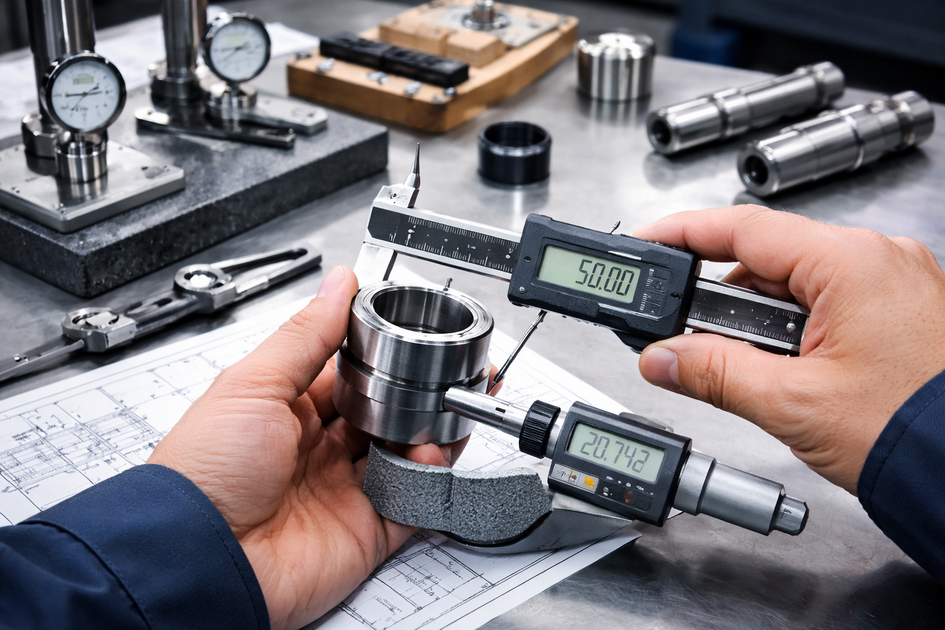
Cost is not just machine time. It also includes setup, toolpath programming, inspection, scrap risk, material utilization, and post-processing. Turning is often cheaper for simple cylindrical parts because it can remove material quickly with fewer operations. Milling can become more expensive when the part requires multiple re-clamps or complex tool paths. [rcoeng]
Lead time follows a similar pattern. If the component is simple and round, turning may produce faster turnaround. If the component has many surfaces or needs 5-axis access, milling may take longer to program and machine, but it may still be the right choice if it eliminates secondary operations. [ms-machining]
For OEM and ODM buyers, the real cost question is usually total cost per qualified part, not just single-piece machining cost. A slightly higher machining price can be justified if it reduces assembly issues, rejects, or overseas communication delays. [alta-eng]
Material behavior matters more than many buyers expect. Aluminum is often highly machinable in both processes, which makes it popular in precision parts for electronics, EVs, and industrial devices. Stainless steel, brass, and engineering plastics can also be machined effectively, but tool wear, heat, chip control, and cycle time should be evaluated before production begins. [pftworld]
For high-performance sectors, material selection and process selection should be made together. Lightweight aluminum parts for EV and aerospace applications often benefit from multi-axis milling when geometry is complex, while shafts, connectors, and sleeves are often better suited to turning. [chencancnc]
- Aluminum: Excellent for both milling and turning.
- Brass: Very efficient for precision turning parts.
- Stainless steel: Strong but more demanding on tools and cycle time.
- Plastics: Suitable for both, but clamping and heat control matter more. [pftworld]
From the production floor, the best machining choice often comes down to how the part will be inspected. If the part's critical dimensions are concentric and round, turning reduces variation sources. If the part's critical dimensions are distributed across multiple faces, milling may be easier to validate with CMM inspection and in-process checks. [sansmachining]
This is where a reliable OEM/ODM partner adds value. A professional supplier should not only quote a process, but also recommend the sequence that minimizes risk, improves dimensional consistency, and protects the buyer's final assembly. In our view, process engineering is part of quality engineering. [facebook]
The CNC machining sector is being shaped by automation, digital twins, AI-supported process control, and stronger demand from aerospace, medical, EV, and advanced mobility industries. Market reports and trend analyses indicate continued growth in precision machining, with CNC remaining a central manufacturing method in 2026 and beyond. [fortunebusinessinsights]
For buyers, this means sourcing decisions should increasingly consider a supplier's engineering maturity, quality documentation, and ability to support complex parts consistently. ISO 9001-style process control, traceability, and in-process inspection are becoming more important as customers expect lower defect rates and better delivery reliability. [alta-eng]
A useful practical insight is that modern CNC buyers are not only purchasing metal parts. They are purchasing repeatable manufacturing confidence. That is a major reason why suppliers with strong engineering communication and quality systems outperform low-cost shops over time. [wisensemachining]
If you are sourcing custom parts from China, the machining method should be only one part of the supplier evaluation. You should also check whether the factory can support design optimization, fixture planning, first-article inspection, and stable mass production. [sansmachining]
1. Confirm the critical dimensions.
2. Identify the most important surface requirements.
3. Share annual volume and forecast.
4. Ask whether the part can be milled, turned, or combined in a mill-turn workflow.
5. Request inspection reports and material certificates. [wisensemachining]
This checklist reduces revision cycles and helps the supplier offer the right process from day one. For B2B buyers, that often saves more money than negotiating a slightly lower unit price. [alta-eng]
CNC milling vs. CNC turning is not a debate about which method is universally superior. It is a decision about geometry, precision needs, material, volume, and total manufacturing efficiency. If your part is round and symmetrical, turning is often the better choice. If your part is irregular, multi-surface, or highly complex, milling usually delivers the best result. [fractory]
For OEM and ODM projects, the best outcomes usually come from early process planning, not late-stage correction. At Shenzhen Feifan Hardware & Electronics Co., Ltd., we recommend sharing drawings, tolerances, material requirements, and target volume early so the process can be optimized before production starts. Request a manufacturability review first, then choose the process that protects quality, cost, and lead time. [facebook]
Not always. Turning is often more accurate for concentric, cylindrical features, while milling is better for complex geometry and multi-surface control. [superior-machining]
CNC turning is often faster for simple round parts because it usually has fewer setups and continuous rotation. Milling can be faster for complex parts only when it replaces multiple secondary operations. [precisioncncmachining]
Yes. Many precision parts are made with a combined process, especially when the base shape is round but the part also needs slots, flats, or holes. [mdaltd]
Both can work well, but the right choice depends on geometry. Aluminum parts with complex contours often suit milling, while round aluminum components often suit turning. [pftworld]
Send the 2D drawing, 3D file if available, material, tolerance requirements, surface finish, expected quantity, and target delivery time. This helps the supplier recommend the correct process and quote more accurately. [sansmachining]
Because process selection affects quality risk, unit cost, lead time, and assembly performance. A good process choice can reduce scrap and improve long-term supply stability. [alta-eng]
1. RapidDirect. "CNC Turning vs Milling: Which Is Best For Your Project." https://www.rapiddirect.com/blog/cnc-turning-vs-milling-differences/ [rapiddirect]
2. Precision CNC Machining. "Comparing CNC Milling vs. CNC Turning: Which Is Best?" https://precisioncncmachining.com/comparing-cnc-milling-vs-cnc-turning/ [precisioncncmachining]
3. Fractory. "What Is the Difference Between CNC Milling & Turning?" https://fractory.com/cnc-milling-vs-cnc-turning-difference/ [fractory]
4. RCO Engineering. "CNC Milling vs. Turning: Choosing the Best." https://www.rcoeng.com/blog/cnc-milling-vs-turning [rcoeng]
5. Wisense Machining. "What is ISO 9001 in CNC Machining? A Guide to Quality and Trust." https://wisensemachining.com/what-is-iso-9001-in-cnc-machining/ [wisensemachining]
6. Sans Machining. "Ensuring Quality Control In CNC Machining: Best Practices and Standards." https://www.sansmachining.com/ensuring-quality-control-in-cnc-machining-best-practices-and-standards/ [sansmachining]
7. 3DS / DELMIA. "2026 CNC Machining Trends: 5 Key Shifts Defining Precision Manufacturing." https://blog.3ds.com/brands/delmia/2026-cnc-machining-trends-to-pay-attention-to/ [blog.3ds]
8. In-X Machine. "2026 Advancements in Precision CNC Machining." https://in-xmachineinc.com/blogs/2026-precision-cnc-machining-advancements/ [in-xmachineinc]
9. Fortune Business Insights. "Precision Machining Market Size, Share | Growth Forecast ." https://www.fortunebusinessinsights.com/precision-machining-market-115757 [fortunebusinessinsights]
10. Shenzhen Feifan Hardware & Electronics company-related sourcing context from provided background and web presence. [facebook]


