From idea to market-ready product, our NPI solutions make every stage easier, faster. Discover How We Help

Views: 222 Author: Feifan Hardware Publish Time: 2026-04-21 Origin: Site
A practical guide for OEM/ODM buyers, brand owners, and engineers choosing the right CNC milling strategy for precision parts.
For Shenzhen Feifan Hardware & Electronics Co., Ltd., the real question is not whether 3-axis or 5-axis machining is "better." It is which process delivers the right balance of cost, geometry, tolerance, lead time, and part quality for the customer's actual application. In precision manufacturing, complexity almost always changes the economics, and the wrong machining choice can increase scrap, rework, and inspection burden. [factorem]
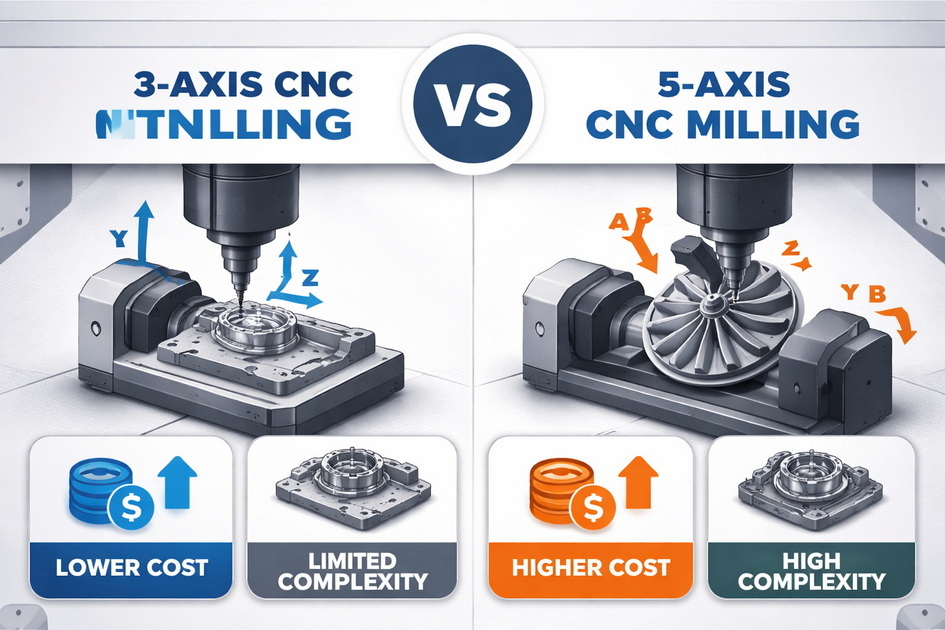
3-axis and 5-axis CNC milling are not competing in the same way a budget tool competes with a premium tool. They solve different manufacturing problems. A 3-axis machine is usually the more economical choice for simple parts with planar surfaces, holes, and basic pockets, while 5-axis machining becomes more valuable when parts have multiple faces, compound angles, undercuts, or difficult-to-reach features. [xometry]
This matters especially for OEM and ODM projects. Brand owners often focus on unit price, but engineers and procurement teams should also weigh setup count, fixturing risk, programming time, inspection effort, and total landed cost. In many cases, a part that looks cheaper on a 3-axis quote becomes more expensive after multiple setups and quality adjustments. [super-ingenuity]
3-axis CNC milling moves the cutting tool along the X, Y, and Z axes. That makes it ideal for parts that can be machined from one direction or with limited repositioning. It is widely used for brackets, housings, plates, enclosures, simple mechanical components, and many precision metal parts that do not require access from many angles. [mqjmcnc]
From a production perspective, 3-axis machining is attractive because it is easier to program, easier to operate, and usually cheaper to maintain. Toolpaths are simpler, operator training is lighter, and the machine itself costs much less than a 5-axis center. For high-volume parts with stable geometry, 3-axis can be extremely efficient. [zintilon]
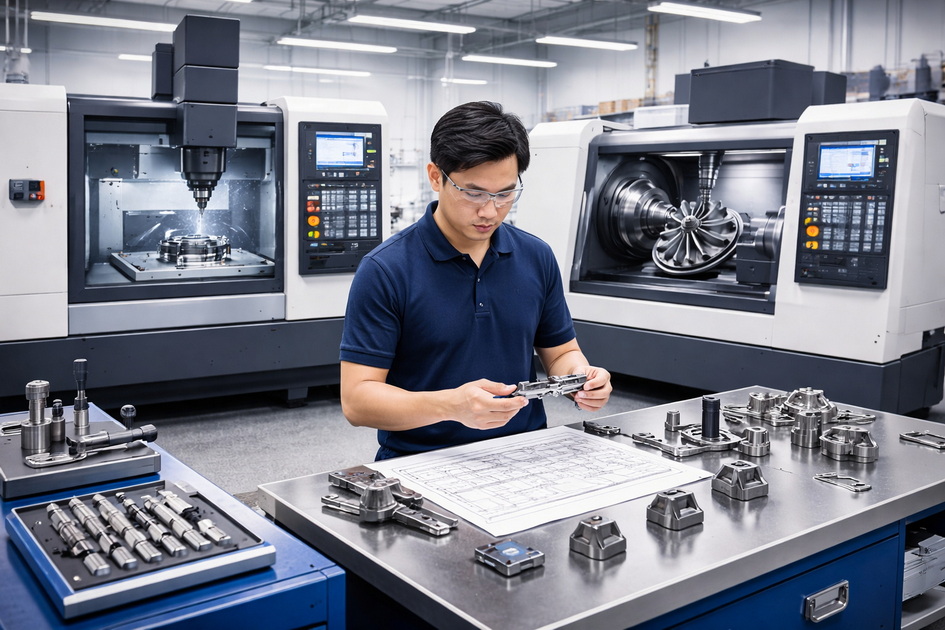
5-axis CNC milling adds two rotational axes to the standard X, Y, and Z motion. That extra motion allows the tool to approach the part from many angles, often in a single setup. For complex geometry, this is a major advantage because it improves access, reduces repositioning, and can produce more consistent surfaces and tighter feature alignment. [factorem]
5-axis is especially valuable for aerospace components, medical parts, impellers, mold inserts, and precision parts with angled walls or multi-face features. The process can reduce clamping errors and improve geometric accuracy when part orientation is critical. However, that capability comes with higher machine cost, more advanced CAM programming, and greater operator skill requirements. [xometry]
The biggest cost difference is not only machine purchase price. It is the full production ecosystem around the machine. 3-axis equipment typically has a lower capital cost, lower maintenance burden, and lower programming complexity, which makes it easier to keep part prices competitive. [zintilon]
5-axis machines are more expensive to buy and run, and they require more advanced software, more careful calibration, and more experienced programmers. But they can reduce part cost when geometry is complex enough that multiple 3-axis setups would otherwise be needed. In other words, higher hourly machine cost does not always mean higher total part cost. [rapiddirect]
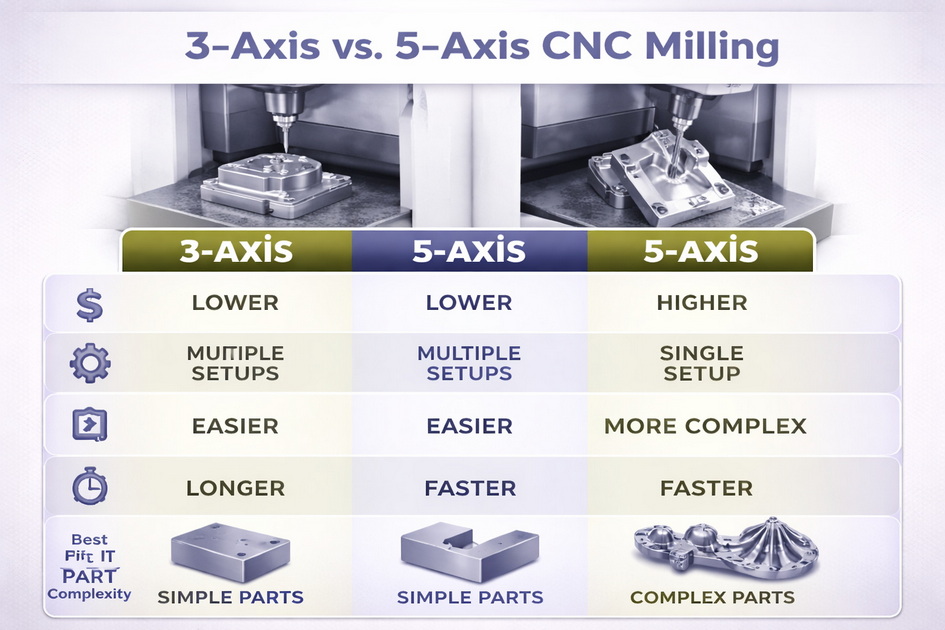
| Factor | 3-Axis CNC Milling | 5-Axis CNC Milling |
|---|---|---|
| Machine investment | Lower xometry | Much higher xometry |
| Programming complexity | Lower zintilon | Higher zintilon |
| Setup count | Often multiple setups factorem | Often fewer setups super-ingenuity |
| Fixturing demand | Moderate | Can be lower for complex parts ptsmake |
| Maintenance cost | Lower xometry | Higher xometry |
| Best fit | Simple to moderate parts factorem | Highly complex parts factorem |
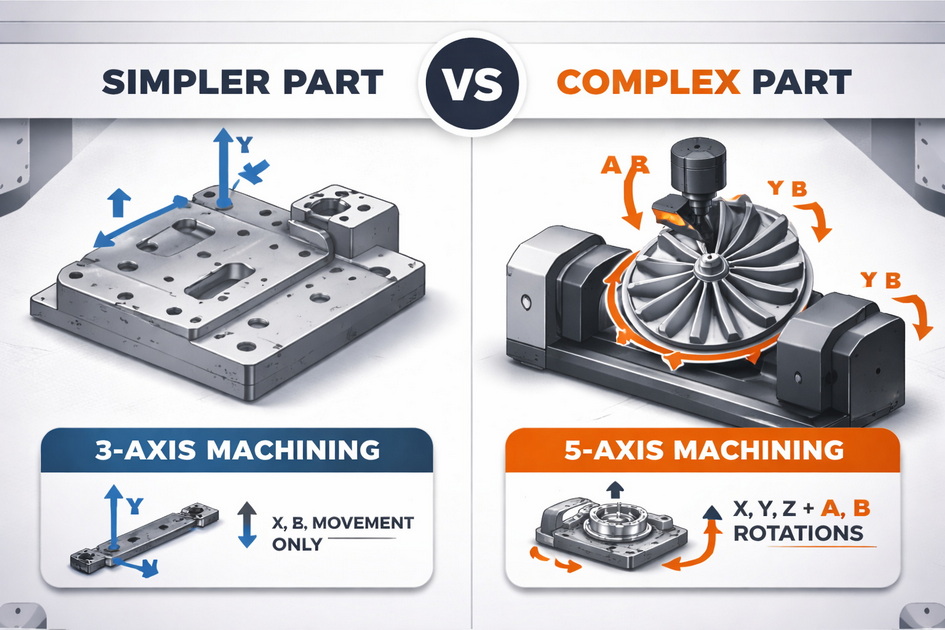
Complexity is the real divider between these two methods. 3-axis machining works best when the part can be approached from one direction and does not require angled cuts, compound surfaces, or deep undercuts. Once features spread across several faces, the process often needs repeated re-clamping, which increases time and risk. [super-ingenuity]
5-axis milling removes much of that friction. It can machine around corners, reach difficult features, and maintain better feature alignment across multiple surfaces. For precise components, fewer setups often mean fewer opportunities for human error, better repeatability, and less cumulative tolerance stack-up. [gdandtbasics]
Precision buyers often assume the highest-axis machine automatically guarantees the best part. That is not always true. Measurement discipline, GD&T clarity, workholding strategy, and process control matter just as much as machine capability. [nvlpubs.nist]
NIST emphasizes the role of metrology and measurement science in high-value manufacturing, while ASME Y14.5 helps communicate geometric intent clearly to reduce guesswork and rework. In practice, a well-controlled 3-axis process can outperform a poorly managed 5-axis process on simple parts. The key is matching the machine to the geometry and applying the correct quality system. [nist]
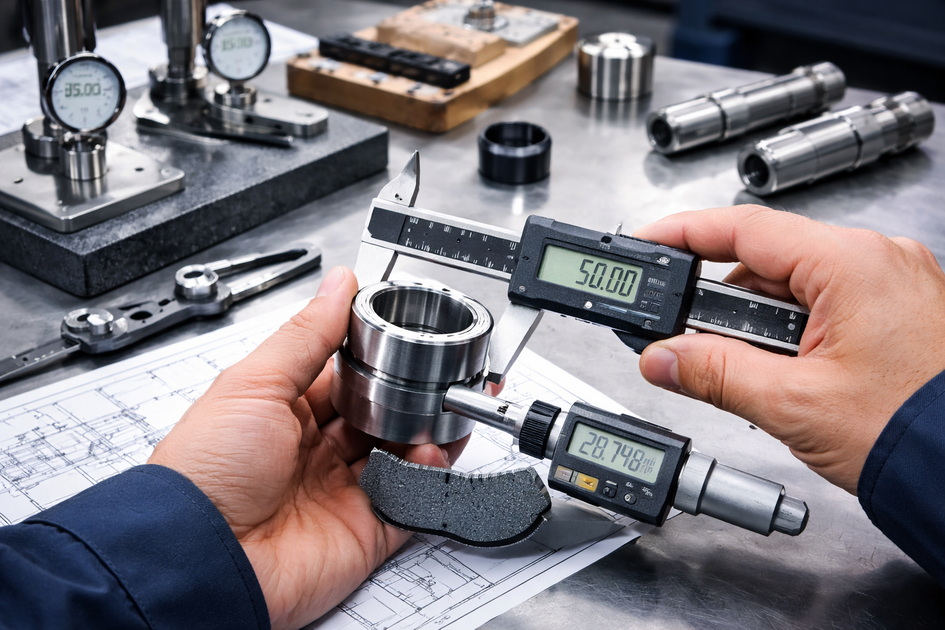
Here is a simple way to think about it.
- Choose 3-axis when the part is flat, prismatic, or mostly accessible from the top and sides.
- Choose 5-axis when the part has multiple angled features, complex contours, or critical relationships between faces.
- Choose 3-axis when unit cost matters most and the geometry is straightforward.
- Choose 5-axis when setup reduction, accuracy between faces, or surface consistency is the real priority. [factorem]
For example, a machined aluminum mounting plate with drilled holes and shallow pockets is usually a strong 3-axis candidate. A compact aerospace-style connector body with angled channels and multi-face tolerances is usually a better 5-axis candidate. The part geometry, not the marketing label, should drive the decision. [rapiddirect]
Many buyers compare only the visible quote line. That can be misleading. Real CNC cost is affected by programming time, fixturing, cycle time, inspection time, and rework risk, especially on complex parts. [ptsmake]
A lower hourly rate on 3-axis can still become expensive if the part needs repeated setups. A 5-axis quote can look expensive at first, but the total cost may fall when the part can be completed in fewer operations with less handling and less scrap risk. For OEM sourcing teams, this is where DFM review pays off. [cesarcnc]
The CNC industry is moving toward smarter, more integrated production. Recent industry reporting highlights growing use of automation, AI-driven machining, digital twins, remote monitoring, and lights-out production cells. These trends do not eliminate the 3-axis versus 5-axis decision, but they make process selection more data-driven. [casttechnologies]
For exporters and OEM suppliers, this means customers increasingly expect not just machining capacity, but engineering support, inspection transparency, and reliable lead times. A supplier that can explain why 3-axis is enough for one part and why 5-axis is worth it for another builds stronger trust and reduces sourcing friction. [anebonmetal]
A practical sourcing workflow can reduce mistakes.
1. Review the part drawing and identify critical faces, angles, and tolerances.
2. Count how many setups a 3-axis process would need.
3. Estimate fixture complexity, not just cutting time.
4. Check whether feature alignment across faces is critical.
5. Compare total cost, including inspection and rework risk.
6. Select the lowest-complexity process that still protects function and quality. [ptsmake]
This approach is especially useful for OEM/ODM projects where the part may evolve during prototyping. It also helps procurement teams avoid over-specifying 5-axis when a simpler and faster route will meet the requirement.
If your part is simple, stable, and volume-sensitive, 3-axis milling is usually the smarter cost choice. If your part has multiple faces, angled features, or tight inter-feature alignment requirements, 5-axis milling often delivers better total value even at a higher hourly rate. [xometry]
For overseas buyers sourcing OEM or ODM precision parts, the best decision is not based on machine prestige. It is based on geometry, tolerance, volume, and total manufacturing risk. A good supplier should help you choose the process that protects both performance and margin.
If you are evaluating a custom CNC part, send your drawing, material, tolerance requirements, and annual volume for a process review. A manufacturing-minded quotation can reveal whether 3-axis or 5-axis is the more cost-effective route for your project.
1. Is 5-axis always more accurate than 3-axis?
Not automatically. Accuracy depends on machine condition, programming, fixturing, and inspection control as much as on axis count. [nvlpubs.nist]
2. When should I choose 3-axis CNC milling?
Choose 3-axis for parts with simple geometry, limited angled features, and strong cost pressure. [factorem]
3. When is 5-axis worth the extra cost?
It is worth it when multiple setups would be required on 3-axis, or when face-to-face alignment and complex geometry are critical. [super-ingenuity]
4. Does 5-axis reduce lead time?
Often yes, because fewer setups can reduce handling, fixturing, and repositioning time. [super-ingenuity]
5. How can I lower CNC cost without reducing quality?
Simplify geometry where possible, clarify tolerances with GD&T, and ask for DFM feedback before production. [gdandtbasics]
1. Xometry, "3-Axis vs. 5-Axis CNC: Advantages and Disadvantages," https://www.xometry.com/resources/machining/3-axis-vs-5-axis-cnc/ [xometry]
2. Factorem, "3-Axis vs. 5-Axis CNC: Choosing the Right Capability," https://www.factorem.co/knowledge-hub/3-axis-vs-5-axis-cnc-choosing-the-right-capability-for-cost-complexity [factorem]
3. Zintilon, "CNC Machining Precision | 3-Axis vs 5-Axis Technology," https://www.zintilon.com/blog/3-axis-vs-5-axis-cnc-machining/ [zintilon]
4. NIST, "Metrology," https://www.nist.gov/metrology [nist]
5. NIST, "Machining," https://www.nist.gov/machining [nist]
6. NISTIR 5628, "Precision in machining: research challenges," https://nvlpubs.nist.gov/nistpubs/Legacy/IR/nistir5628.pdf [nvlpubs.nist]
7. GD&T Basics, "The ASME Y14.5 GD&T Standard," https://www.gdandtbasics.com/asme-y14-5-gdt-standard/ [gdandtbasics]
8. RapidDirect, "CNC Machining Costs: Tips and Strategies For Cost-Saving," https://www.rapiddirect.com/blog/cnc-machining-cost-calculation/ [rapiddirect]
9. PTSMake, "Mastering Complex CNC Machining: Key Design & Cost Strategies," https://www.ptsmake.com/mastering-complex-cnc-machining-key-design-cost-strategies/ [ptsmake]
10. 3DS DELMIA, "2026 CNC Machining Trends," https://blog.3ds.com/brands/delmia/2026-cnc-machining-trends-to-pay-attention-to/ [blog.3ds]


