From idea to market-ready product, our NPI solutions make every stage easier, faster. Discover How We Help

Views: 222 Author: Tomorrow Publish Time: 2025-11-24 Origin: Site
Content Menu
● Basic Axes in CNC Turning Machines
● Additional Axes in Advanced CNC Turning Machines
● Classification of CNC Turning Machines by Axis Count
● Advantages of Multi-Axis Turning Machines
● Practical Examples of CNC Turning Machine Axes in Use
● FAQ
>> 1. How many axes does a standard CNC turning machine have?
>> 2. What is the purpose of the C-axis in CNC turning machines?
>> 3. What additional axes exist beyond the basic X and Z in CNC turning machines?
>> 4. Why are more axes beneficial in CNC turning machines?
>> 5. What types of parts require multi-axis CNC turning machines?
CNC turning machines primarily operate with two essential axes: the X-axis and the Z-axis. These two linear axes define the fundamental movements of the cutting tool relative to the rotating workpiece. The Z-axis controls the tool's longitudinal movement along the length of the workpiece, while the X-axis manages the tool's radial movement, toward or away from the centerline of the part. This combination enables precise and efficient machining of cylindrical parts. However, more advanced CNC turning machines can include additional axes, such as rotational and transverse axes, enhancing their machining capabilities for complex and multi-dimensional parts.

Traditional CNC turning centers are classified as 2-axis machines, relying on the X and Z linear axes. In this setup:
- The Z-axis moves the cutting tool parallel to the spindle's axis, controlling depth along the length of the workpiece.
- The X-axis moves the tool perpendicular to the spindle axis, allowing diameter control by moving the tool closer or further from the centerline of the rotating workpiece.
The workpiece itself rotates around the spindle in a circular manner, securing the material and enabling turning operations such as facing, taper turning, and contouring. The interaction between the rotary motion of the workpiece and the linear movements of the tool defines the standard turning process.
With advances in CNC technology, many turning centers incorporate extra axes beyond the basic two to increase capacity for more complex operations:
- C-axis: This rotational axis allows the spindle or turret to rotate around the Z-axis, enabling live tooling capabilities such as milling, drilling, and tapping on the cylindrical surface without removing the workpiece. It adds flexibility for multi-sided machining.
- Y-axis: Some multi-axis CNC lathes include the Y-axis for lateral tool movement perpendicular to both the X and Z axes. This facilitates off-center milling and cutting, broadening the machine's operational range.
- Secondary rotary axes (A and B): In the context of 5-axis machines or certain multi-axis lathes, the A-axis represents rotation around the X-axis, and the B-axis rotation around the Y-axis. These allow tilting or swiveling of tools or parts for machining angled and complex surfaces.
These added axes transform the turning machine into a multi-functional machining center, capable of performing operations traditionally done on milling machines, thus reducing setup times and increasing accuracy.
| Machine Type | Axes Included | Key Features and Applications |
|---|---|---|
| Basic CNC Turning Machine | X-axis, Z-axis | Standard turning operations: facing, contouring, tapering |
| 3-Axis Turning Center | X-axis, Z-axis, C-axis | Live tooling for milling/drilling, indexed rotary movements |
| 4-Axis Turning Center | X-axis, Z-axis, Y-axis, C-axis | Off-center milling, complex part geometries machining |
| 5-Axis Turning Center | X, Y, Z linear + A, B or C rotary | Full multi-axis machining for very complex parts |
The selection depends on the part complexity, production volume, and machining requirements. More axes increase machine capabilities but also cost and programming complexity.
The incorporation of additional axes beyond the basics offers significant benefits:
- Enhanced versatility: Machines with more axes can perform a wide variety of operations, including drilling, milling, and tapping, alongside traditional turning.
- Reduced setup times: Multi-axis capabilities minimize the need to reposition or re-clamp the workpiece, streamlining production workflows.
- Improved accuracy: Consistent handling of the workpiece in a single setup reduces errors introduced by manual repositioning.
- Complex part manufacturing: Enables efficient machining of geometrically complex parts such as turbine blades, automotive components, and aerospace parts with intricate curves and multiple faces.
- A 2-axis CNC lathe is ideal for producing simple cylindrical parts such as shafts, pins, and bushings.
- A 3 or 4-axis turning center suits jobs requiring drilling holes or milling flats on cylindrical surfaces without removing the part.
- A 5-axis turning machine is employed in industries demanding complex shapes, such as medical implants and aerospace components where parts require machining from nearly all sides.
A standard CNC turning machine generally operates with two axes: the X-axis for radial tool movement and the Z-axis for longitudinal tool movement relative to a rotating workpiece. However, advances in CNC technology have introduced additional axes—such as the Y-axis and rotary C, A, or B axes—that transform turning centers into multi-axis machining centers. These expanded capabilities enable more complex machining, including milling and drilling in single setups, improving efficiency, precision, and productivity. The choice of axis configuration depends on the machining complexity, desired precision, and production needs.
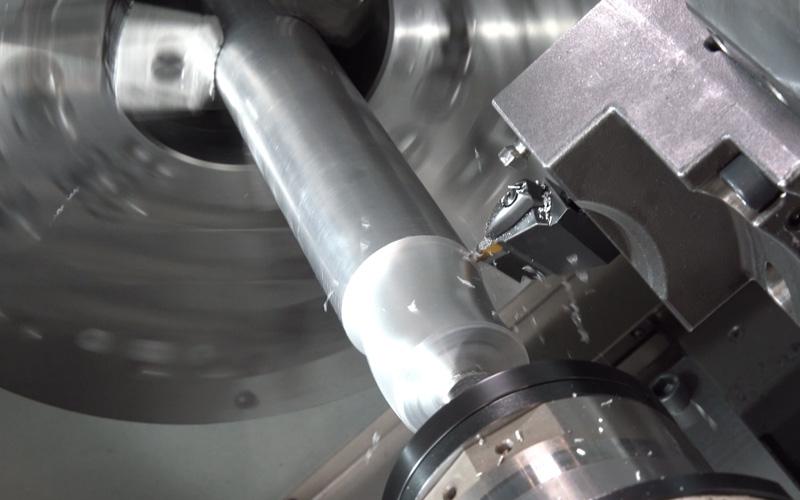
A standard CNC turning machine typically operates with two axes: the X-axis and the Z-axis.
The C-axis provides rotational control of the spindle or turret around the workpiece's axis, enabling live tooling functions such as milling or drilling on the part.
Additional axes include the Y-axis for lateral tool movement and rotational axes like A and B for tilting or swiveling tools or parts.
More axes allow for complex multi-sided machining in one setup, reduce part repositioning, enhance precision, and expand machining capabilities beyond traditional turning.
Parts with intricate geometries, such as aerospace components, medical devices, and automotive parts, often require multi-axis turning for efficient and precise manufacturing.
[1](https://xometry.pro/en/articles/cnc-machining-size-limitations/)
[2](https://www.scan2cad.com/blog/cnc/cnc-machine-axis/)
[3](https://ezgmfg.com/what-are-5-axis-cnc-machines/)
[4](https://www.cncyangsen.com/how-many-axes-in-a-cnc-lathe-machine)
[5](https://dmscncrouters.com/blog/3-4-5-how-many-axes-does-my-cnc-machine-need/)
[6](https://waykenrm.com/blogs/cnc-machine-axes/)
[7](https://www.makerverse.com/resources/cnc-machining-guides/multi-axis-cnc-machining-explained/)
[8](https://www.machinemetrics.com/blog/cnc-turning-center-basics)
[9](https://www.mastercam.com/news/blog/what-are-the-axes-in-5-axis-machining/)
[10](https://www.3erp.com/blog/cnc-lathe/)


