From idea to market-ready product, our NPI solutions make every stage easier, faster. Discover How We Help

Views: 222 Author: Tomorrow Publish Time: 2026-01-02 Origin: Site


Content Menu
● The Rise of AI in Manufacturing
● Key Areas Where AI Enhances CNC Machining
>> 2. Process Optimization and Tool Path Planning
>> 3. Quality Assurance and Computer Vision
>> 4. Intelligent Programming and CAM Automation
>> 5. Adaptive Machining and Real-Time Adjustment
● Benefits of AI-Driven CNC Machining
● Challenges Preventing Full AI Takeover
● Case Studies: AI in Real Manufacturing Environments
>> Medical Device Manufacturing
● Future Developments: What's Next for AI in Machining?
● Ethical, Social, and Economic Impacts
● Training the Next Generation of Machinists
● FAQ
>> (1) What is AI's main role in CNC machining?
>> (2) Will AI replace human machinists entirely?
>> (3) How does AI improve machining precision and quality?
>> (4) What are the biggest challenges in implementing AI for CNC machines?
>> (5) What skills should future machinists develop?
The accelerating pace of artificial intelligence (AI) development has sparked a powerful debate across nearly every industrial sector. As algorithms, sensors, and data-driven systems grow more sophisticated, many professionals in manufacturing are asking a pressing question: Will AI take over CNC machining?
CNC machining—short for Computer Numerical Control—has long been the backbone of precision manufacturing. It creates everything from automotive parts and aerospace components to surgical devices and complex molds. The process is already a form of automation, using programmed instructions to mill, drill, or cut materials with high accuracy. But the growing presence of AI adds a new layer: intelligence, adaptability, and self-learning.
This article explores how AI is reshaping CNC machining, analyzing its benefits, challenges, future potential, and impact on human roles in the manufacturing environment.
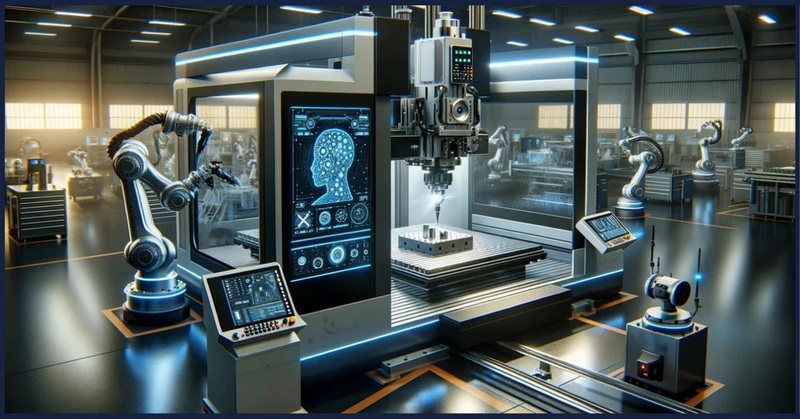
CNC machining converts digital designs into real-world components using coded instructions known as G-code. A CNC machine interprets the code to move tools across multiple axes (commonly three to five), removing material to achieve precise dimensions.
Traditional CNC systems are deterministic—machines follow exact commands without deviation. The quality of the final part depends on human operators and programmers who design tool paths, choose cutting speeds, and set tolerances. Their expertise ensures that parts conform to design specifications despite variations in material quality or environmental conditions.
However, this rigidity also limits flexibility. When something goes wrong—a tool wears out, a workpiece vibrates, or ambient temperature changes—human intervention is required to diagnose and correct the problem. That's where AI begins to make a difference.
Artificial intelligence in manufacturing is not a futuristic concept—it's already happening. Highly automated plants are using algorithms to optimize scheduling, monitor machine health, predict maintenance needs, and analyze production data for efficiency gains.
AI combines machine learning, computer vision, natural language processing, and robotics. In CNC machining, its integration means smarter feedback systems, real-time process optimization, and autonomous corrective actions. AI does not replace the hardware but revolutionizes the way machines interpret information.
For instance, a typical AI-enhanced CNC system can learn from sensor feedback. It collects vibration data, detects abnormal forces, and automatically adjusts cutting parameters, ensuring consistent quality even under varying conditions.
Traditional maintenance strategies rely on fixed schedules or reactive measures after machine failure. AI introduces *predictive maintenance*, where systems continuously monitor temperature, vibration, torque, and acoustic emissions.
Machine learning models analyze this sensor data to anticipate tool wear or spindle damage before failure. A machinist can then replace components at optimal times, maximizing uptime and minimizing cost.
For example, Siemens and FANUC have already integrated predictive tools into industrial CNC controllers, showing reductions in downtime by up to 30%.
AI excels at analyzing massive datasets. In machining, this translates to dynamic adjustments in cutting parameters—feed rate, depth of cut, tool engagement, and spindle speed.
Unlike static CAM programming, AI-driven optimization uses historical production results to identify patterns that yield the best performance. It learns which parameters produce the smoothest finishes or minimal tool deflection.
The result is not only greater precision but faster machining cycles and lower material waste. A single AI-driven optimization can shorten production time without compromising accuracy, saving manufacturers significant operational costs over time.
Quality assurance has traditionally been labor-intensive, requiring manual inspection or post-process measurement. AI-equipped vision systems now automate much of this work.
High-resolution cameras combined with neural networks inspect parts instantly during production. These systems can detect surface anomalies, incorrect dimensions, and tool marks invisible to the naked eye.
The continuous feedback ensures errors are corrected immediately rather than after batch completion, significantly improving first-pass yield and reducing scrap rates.
One of the most challenging aspects of CNC machining is generating efficient tool paths. Human programmers must balance performance, efficiency, and safety. AI-powered CAM systems automate this process by interpreting CAD models directly and generating optimized G-code.
The new generation of intelligent CAM software applies reinforcement learning, where the system improves each time it processes a new design. For complex geometries such as turbine blades or engine housings, AI can identify the best machining strategy automatically—minimizing tool changes and machining time.
This innovation not only accelerates production but also lowers the skill barrier for new operators.
Adaptive machining represents the most advanced application of AI in CNC systems. Equipped with real-time sensors, machines alter their behavior based on feedback without human input.
If the machine detects increased spindle load due to harder material zones, AI algorithms instantly adjust speed or feed rate to maintain stability. Similarly, during micro-milling or finishing operations, AI tunes parameters to reduce chatter and achieve superior surface finishes.
This adaptability transforms the CNC machine from a passive executor into a responsive, learning system—capable of self-optimization in changing conditions.
AI brings measurable advantages across production lines:
- Enhanced Efficiency: Processes become faster, with less idle time and fewer manual adjustments.
- Reduced Scrap: Optimized parameters and predictive analytics lead to fewer part defects.
- Cost Reduction: Intelligent maintenance planning minimizes unplanned repairs and downtime.
- Performance Consistency: AI ensures stable quality levels regardless of operator skill.
- Improved Design Feedback: Engineers gain real-time insight into performance, enabling better product design.
Ultimately, AI improves both the economics and sustainability of machining operations, enabling leaner, smarter production flows.
Despite remarkable progress, a full AI takeover remains distant. Manufacturing conditions are complex, and human knowledge still plays a vital role.
1. Data Quality and Quantity: AI learns from data. Insufficient or poor-quality data—such as uncalibrated sensors or inconsistent logging—limits performance.
2. System Integration: Many older CNC machines lack the sensors or network infrastructure necessary for AI retrofitting.
3. High Upfront Cost: Initial setup, training, and software licensing can burden small-to-medium manufacturers.
4. Safety and Accountability: Machines acting autonomously must meet strict safety standards. Humans are still needed to approve decisions.
5. Limited Contextual Awareness: AI cannot yet interpret ambiguous design tolerances, customer-specific constraints, or one-off creative requirements.
Therefore, while AI can automate execution, strategic decision-making still depends on human expertise.
Instead of replacing machinists, AI is changing what they do. The machinist of the future will spend less time operating controls and more time supervising intelligent systems.
Their focus will shift from manual operation to:
- Data interpretation and validation.
- AI model calibration and error analysis.
- Process optimization and digital twin monitoring.
- Collaboration with engineers to design manufacturable parts.
This evolution mirrors historical transitions seen in industrial revolutions: from manual labor to automation management. As a result, cross-disciplinary education in manufacturing, programming, and data science is becoming essential.
In aerospace machining, precision and repeatability are paramount. Rolls-Royce and GE Aviation use AI to monitor turbine blade production. Machine-learning models analyze vibration signatures to ensure dimensional conformance and detect tool wear early. These initiatives have increased output quality while lowering scrap rates.
Major automakers like BMW and Toyota have established AI-controlled machining cells that run lights-out production. AI predicts most maintenance needs and schedules automatic calibration at non-peak hours. As a result, plant utilization rates and component uniformity have improved dramatically.
The medical industry requires ultra-precise micro-machining. AI-assisted CNC systems detect tool dullness and microburr formation in real time, preventing defective surgical tools or implants from advancing to later stages. This level of precision is nearly impossible with manual supervision alone.
Looking forward, several breakthroughs are expected:
1. Digital Twins: AI will create virtual replicas of entire machining systems to simulate and optimize processes before production begins.
2. Fully Connected Factories: Machines will share data across networks, creating distributed AI systems that learn collectively.
3. Natural Language Interfaces: Operators will soon give spoken commands—“Optimize this tool path for aluminum”—and the AI will respond instantly.
4. AI-Augmented CAM and Design Integration: Design software will automatically consider manufacturing constraints, shortening the product development cycle.
5. Sustainability Metrics: AI will balance performance with environmental factors, reducing energy use and raw material waste.
Such developments hint at a balanced partnership: machines handle optimization and execution, while humans oversee innovation and ethics.
With automation comes responsibility. The rise of AI can lead to workforce displacement if skill development lags behind adoption. Policymakers and educational institutions must support continuous learning initiatives to ensure machinists can adapt.
Ethically, transparency in AI decision-making—especially in safety-critical industries—is vital. Manufacturers must document AI's role in production to ensure accountability and compliance with global standards.
Economically, AI-driven machining increases competitiveness by shortening lead times and expanding customization capabilities. However, it may widen gaps between high-tech enterprises and smaller workshops that cannot afford advanced systems.
The challenge lies in democratizing AI so all participants in the supply chain can benefit.
Technical education must evolve alongside technology. Modern machining programs now incorporate modules on automation, robotics, and data analytics. Students are taught how to:
- Operate and train AI-equipped machines.
- Interpret sensor data for diagnostics.
- Develop digital twins and run virtual simulations.
- Integrate machine learning algorithms into manufacturing workflows.
Companies that invest in continual reskilling report higher adoption success and lower turnover rates. The synergy between education and evolving technology ensures that human skill remains relevant.
AI will not replace CNC machining—nor will it replace human machinists. Instead, it will redefine both. Through predictive analytics, intelligent programming, adaptive control, and computer vision, AI enhances the precision, productivity, and safety of machining processes.
The most successful factories in the coming decade will be those that integrate AI thoughtfully, creating harmonious collaboration between human intelligence and automated precision. In this new paradigm, AI serves as a partner, not a competitor—an amplifier of human creativity and technical expertise.
CNC machining is evolving from a mechanical art into a data-driven science, powered by algorithms that learn, adapt, and improve continuously. The future of manufacturing will belong to those who embrace this convergence confidently.
AI primarily serves as an intelligent assistant—processing sensor data, predicting maintenance needs, and optimizing production parameters in real time to boost efficiency.
No. Human oversight remains essential for creative design interpretation, troubleshooting, and decision-making. AI complements, not eliminates, skilled machinists.
By analyzing sensor data continuously, AI systems detect microscopic variations that could affect results, then automatically adjust tool paths or speeds for consistent accuracy.
The main challenges include data quality, high integration costs, system compatibility, and maintaining cybersecurity against potential data breaches or hacking risks.
Machinists should combine traditional machining knowledge with data analytics, programming, and understanding of AI systems, enabling them to manage and optimize intelligent machines effectively.


