From idea to market-ready product, our NPI solutions make every stage easier, faster. Discover How We Help


Content Menu
● Key Movements and Principles
● Common CNC Turning Operations
>> Facing
>> Parallel (Straight) Turning
>> Grooving
>> Threading
>> Drilling
>> Parting
>> Knurling
>> Live Tooling
>> Profiling
● Surface Finishes and Tolerances
● Applications Across Industries
● FAQ
>> 1. What materials can be processed by CNC turning?
>> 2. How does CNC turning differ from CNC milling?
>> 3. What are the main CNC turning operations?
>> 4. How is a CNC turning machine programmed?
>> 5. Which industries benefit most from CNC turning?
Turning in CNC (Computer Numerical Control) is an advanced subtractive manufacturing process where a workpiece, typically a cylindrical bar, is rotated at high speed while stationary cutting tools remove material to achieve precise geometries. Widely used in modern industry, CNC turning is essential for components requiring exceptional accuracy, repeatability, and cylindrical features.[1][3]

CNC turning uses computer-controlled lathes, known as CNC turning centers, where the workpiece is clamped in a chuck and spun rapidly. The cutting tool, mounted on a tool turret, moves in pre-programmed patterns along the workpiece, removing material layer by layer. The process supports manufacturing of shafts, bushings, fasteners, pins, and more, typically made of metal or plastic.[3][5]
CNC turning involves three critical movements:
- Rotation: The workpiece spins continuously on its axis, controlled by the lathe spindle.
- Feed: The cutting tool advances in straight or angled motion against the workpiece.
- Penetration: The tool penetrates the surface, controlling depth and cut geometry.[4]
The CNC program directs the spindle speed (RPM), the feed rate (IPM or mm/min), and tool pathways for consistent quality and dimensional accuracy.[2][1]
The process generally involves:
1. Designing a 3D CAD model of the part.
2. Converting the model into G-code, which sets machining instructions.
3. Setting up the CNC lathe and loading tools.
4. Securing the workpiece.
5. Running the automated cutting cycles.
6. Post-processing, such as finishing and inspection.[2][3]
Facing removes material from the end of the workpiece, creating a perfectly flat surface perpendicular to the rotational axis. This foundational operation is usually performed first.[6][3]
Straight turning produces cylindrical profiles along the length of the workpiece. The cutting tool moves parallel to the axis, which is fundamental for axles, rods, and pins.[5][7]
Tapered turning shapes a conical surface by moving the cutting tool at an angle to the axis. Components like valves or connectors often require this geometry.[3][5]
Grooving uses a specific tool to cut narrow channels along the circumference, which can serve functional or assembly purposes.[1][6]
Threading equips the exterior or interior of the workpiece with spiral threads for fasteners, bolts, and screws. The CNC lathe synchronizes tool movement and rotation for precise pitch and depth.[6][2][3]
Drilling in CNC turning employs stationary drill bits mounted in the tool turret or tailstock. These bits bore precise holes, often required for internal passages or subsequent assembly.[8][3]
Parting separates finished parts from the remaining bar stock, using a thin blade-like tool to make a complete cutoff groove.[3][6]
Knurling is the process of pressing patterned textures onto the surface, adding grip or aesthetic features to controls and handles.[1][6]
- Boring enlarges existing holes, improving their dimensional precision and surface finish.
- Reaming further refines hole diameters, achieving exact specifications for tight fits.[1][3]
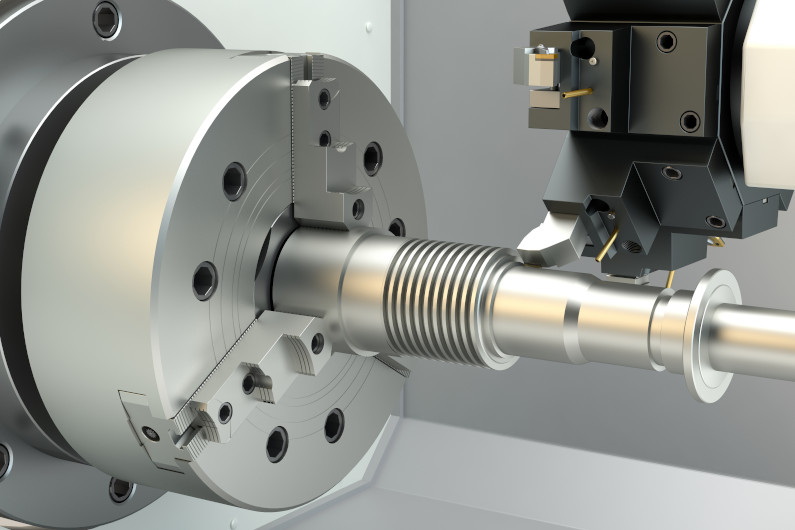
Some advanced CNC lathes feature "live tooling," where tools can rotate independently, allowing complex features like cross-holes or milled flats without removing the part for secondary machining.[3]
Profiling produces complex curves and contours, combining tool movements to achieve custom shapes beyond basic cylinders or tapers.
CNC turning delivers exceptionally smooth finishes and can hold tolerances within microns. Final surface quality varies based on tool sharpness, feed rate, material, and specific finishing processes, such as polishing, anodizing, or heat treating.[2]
A broad spectrum of materials can be processed by CNC turning, including:
- Metals: Steel, stainless steel, brass, aluminum, titanium, copper.
- Plastics: Nylon, PEEK, PTFE, ABS, polycarbonate.
- Composites and specialty alloys, depending on industry needs.[1][3]
CNC turning is pivotal in:
- Automotive: High-precision shafts, bushings, threaded fasteners.
- Aerospace: Lightweight, complex geometries for flight-critical parts.
- Medical Devices: Hermetic components for surgical tools and instruments.
- Electronics: Connectors, pins, and specialized housings.
- General Manufacturing: Custom parts, prototypes, and mass production items.[5][3]
- Accuracy: Parts meet exact design specifications, essential for demanding sectors.
- Efficiency: Automated cycles reduce lead time for high-volume runs.
- Repeatability: Achieves uniform results across thousands of parts.
- Material Optimization: Minimal waste due to precise computation.
- Versatility: Suitable for simple and complex cylindrical shapes.[2][3][1]
- Geometric Constraints: Primarily suited for rotationally symmetrical parts; for non-cylindrical shapes, other techniques like CNC milling are needed.
- Setup and Skills: Requires significant up-front programming and operator training.
- Tool Wear and Heat: Continuous cutting can cause wear and thermal buildup; regular maintenance and coolant systems are essential.[1]
Continued advancements in automation, AI integration, and high-speed machining are expanding the capabilities of CNC turning centers. Live tooling, real-time process monitoring, and new smart materials enable rapid prototyping and flexible short-run manufacturing, further reducing costs.
Turning in CNC is a cornerstone of modern manufacturing, enabling production of high-precision, cylindrical parts from numerous materials. By harnessing computer automation, this subtractive process guarantees accuracy, repeatability, and speed for industries demanding rigorous quality standards. While best suited for rotational parts, innovations in tooling and programming continue to push the boundaries of what CNC turning can achieve.
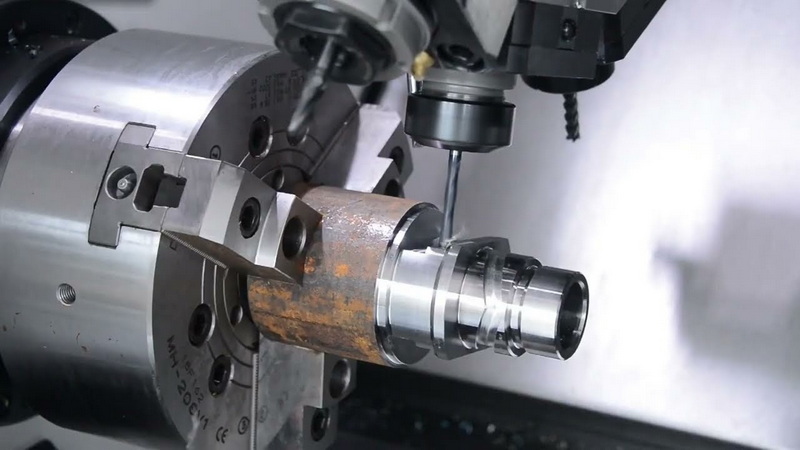
CNC turning works with metals such as steel, brass, aluminum, titanium, and copper, as well as plastics and composites suited to specific applications.[3][1]
Turning spins the workpiece while the tool remains static, ideal for round parts. Milling fixes the workpiece while the tool moves around it to create complex shapes.[2][3]
Operations include facing, straight turning, taper turning, grooving, threading, drilling, parting, knurling, boring, and reaming.[6][3][1]
Programming starts with a digital design, conversion to a machining code (G-code), setup of tools and workpiece, and then automated cycles under computer control.[2][1]
Automotive, aerospace, medical, electronics, and machinery manufacturing use CNC turning for precision components essential to their products.[5][3]
[1](https://www.rapiddirect.com/blog/what-is-cnc-turning/)
[2](https://geomiq.com/blog/what-is-cnc-turning/)
[3](https://www.wevolver.com/article/what-is-cnc-turning)
[4](https://waykenrm.com/blogs/what-is-cnc-turning/)
[5](https://interscopemfg.com/cnc-turning-guide/)
[6](https://www.uti.edu/blog/cnc/turning)
[7](https://www.youtube.com/watch?v=AwZPyzGEGG4)
[8](https://www.fictiv.com/articles/introduction-to-cnc-turning)
[9](https://www.3erp.com/blog/cnc-turning/)
[10](https://pioneerserviceinc.com/blog/what-is-cnc-turning/)


