From idea to market-ready product, our NPI solutions make every stage easier, faster. Discover How We Help

Views: 222 Author: Tomorrow Publish Time: 2026-01-13 Origin: Site


Content Menu
● Understanding CNC Turning and Its Cutting Process
● What Is a CNC Turning Insert?
● The Work and Function of Inserts in CNC Turning Machines
>> 2. Chip Formation and Control
>> 4. Heat Resistance and Wear Reduction
>> 5. Cost Efficiency and Productivity
● Common Materials Used for CNC Turning Inserts
● Types of Turning Inserts by Shape and Application
● How Insert Geometry Affects Cutting Performance
● Insert Coatings and Their Benefits
● Factors Affecting Insert Life and Performance
● Advantages of Using Inserts in CNC Turning
● FAQ
>> 1. What is the main function of an insert in CNC turning?
>> 2. How do I choose the correct insert for my CNC turning operation?
>> 4. Can turning inserts be reused or resharpened?
>> 5. What happens if the wrong insert is used?
CNC (Computer Numerical Control) turning machines are essential in modern precision manufacturing, allowing the production of complex cylindrical and conical components with extreme accuracy. One of the most critical elements in this operation is the insert — a cutting tool component that is responsible for the actual material removal process. Inserts determine the surface finish, accuracy, and efficiency of the turning operation. Understanding their function, materials, types, and working principles is key to mastering CNC turning.

CNC turning involves a rotating workpiece while a stationary cutting tool, equipped with a replaceable insert, removes material to achieve the desired shape. The precision of this process depends not only on the machine control but also on the insert geometry, grade, and cutting parameters.
The cutting insert is clamped into a holder that positions it accurately relative to the workpiece. During operation, the insert's cutting edge engages the work material, shaving off layers in the form of chips. Each pass removes a specific amount of material based on feed rate, cutting depth, and spindle speed.
A CNC turning insert is a replaceable piece of hardened material—commonly carbide, ceramic, cermet, or polycrystalline diamond (PCD)—that serves as the cutting edge during machining. Unlike traditional single-piece tools that need resharpening, inserts are designed to be indexed or replaced once a cutting edge becomes dull.
Modern inserts feature sophisticated coatings and geometries that significantly increase tool life and surface quality. They come in standardized shapes, such as triangular (T), square (S), round (R), or diamond (D), each suitable for specific cutting conditions.
The insert performs several critical roles during CNC turning. Each of these functions contributes to precision, productivity, and cost-efficiency.
The primary purpose of a turning insert is to remove material from the workpiece. As the insert's cutting edge makes contact with the rotating material, it shears away layers in a controlled manner, converting raw stock into the desired form.
Effective chip control prevents tool damage and ensures smooth machining operations. Inserts are designed with chip breakers or grooves to manage chip flow, ensuring chips are broken into smaller pieces rather than forming long coils that can interfere with the tool or surface quality.
The geometry and sharpness of the insert influence the surface finish of the final product. A properly selected insert can produce mirror-like finishes on metals or smooth surfaces on composite materials, reducing the need for secondary polishing processes.
Inserts often face high cutting temperatures and frictional forces. Coatings such as titanium nitride (TiN), aluminum oxide (Al₂O₃), or titanium carbonitride (TiCN) enhance heat resistance and hardness. This prevents premature wear and maintains dimensional accuracy across long production runs.
Since inserts are replaceable, operators can quickly change them without removing the entire tool setup. This modularity saves machining time and reduces overall maintenance costs, ensuring consistent productivity in mass production environments.
Different insert materials are suited for specific applications and workpiece types. Below are the most commonly used materials:
- Carbide Inserts: Offer excellent hardness and wear resistance, ideal for high-speed machining.
- Ceramic Inserts: Suitable for finishing hard materials at very high speeds, though they can be brittle.
- Cermet Inserts: Blend ceramic and metallic properties for fine surface finishes.
- CBN Inserts (Cubic Boron Nitride): Perfect for machining hard steels or cast irons.
- PCD Inserts (Polycrystalline Diamond): Best for non-ferrous and composite materials due to extreme hardness and low friction.
Selecting the correct insert material depends on factors like the hardness of the workpiece, cutting conditions, and desired finish.
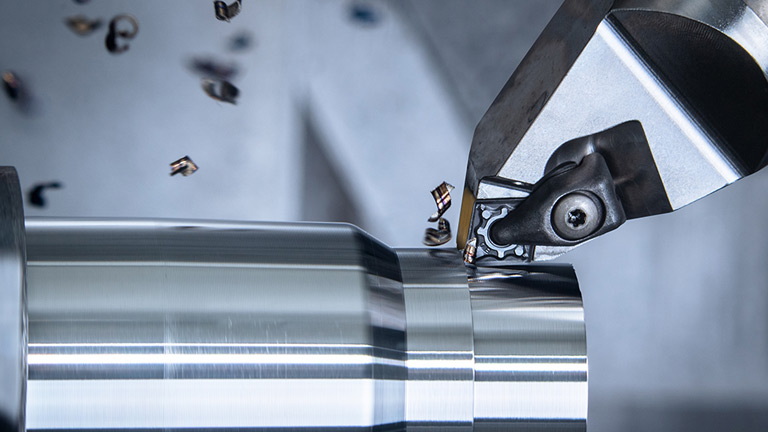
Inserts are classified by their geometry, each suited for different cutting operations:
- Triangle (T): Strong structure, offering multiple cutting edges for general purposes.
- Diamond (D and V): Used for precise finishing and profiling operations.
- Round (R): Provides smooth cutting and strength for interrupted cuts.
- Square (S): Ideal for heavy roughing with sturdy edge support.
- Rectangular or Parallel Inserts: Used in grooving, threading, or parting-off operations.
Each shape influences chip flow, cutting pressure, and the achievable surface roughness.
Insert geometry defines how the tool interacts with material. Key geometric features include:
- Rake Angle: Controls cutting forces and chip direction. Positive rake reduces cutting pressure but weakens edge strength.
- Nose Radius: A larger radius improves finish but increases cutting forces.
- Relief Angle: Prevents rubbing between insert and workpiece.
- Chip Breaker Design: Helps in chip control and heat dissipation.
For example, roughing inserts often have larger nose radii and robust edges, while finishing inserts use sharper, smaller radii for smoothness.
Modern insert coatings play a vital role in extending tool life. Some common coatings and their benefits include:
- TiN (Titanium Nitride): Improves wear resistance and reduces friction.
- TiCN (Titanium Carbonitride): Adds toughness for interrupted cuts.
- Al₂O₃ (Aluminum Oxide): Provides thermal stability for continuous cuts.
- TiAlN (Titanium Aluminum Nitride): Withstands extremely high temperatures, ideal for dry machining.
These coatings also reduce built-up edge formation, which can degrade surface finish and precision.
Several operational and environmental factors influence how long an insert lasts:
1. Feed rate and spindle speed: Excessive speed creates high heat, leading to premature wear.
2. Cutting depth: Too deep a cut can overload the insert and cause breakage.
3. Coolant use: Proper cooling lowers temperature and extends tool life.
4. Toolholder rigidity: A stable holder ensures consistent cutting angles and prevents vibration.
5. Material hardness: Harder materials require tougher inserts with suitable coatings.
Balancing these parameters ensures maximum performance and cost efficiency.
Using replaceable inserts provides several operational and economic advantages:
- Reduced downtime during tool changes.
- Consistent machining quality across long production runs.
- Lower tool regrinding and maintenance costs.
- Versatility in handling different materials and finishing requirements.
- Environmentally friendly due to optimized material usage.
The insert in a CNC turning machine is more than just a cutting edge — it represents the heart of the machining process. Its material composition, coating, geometry, and design directly determine the quality, efficiency, and precision of every component produced. Selecting the right insert for the right application ensures smooth chip flow, prolonged tool life, and superior surface finish. With continuous advancements in insert technology and materials, CNC turning continues to set higher standards in modern manufacturing.
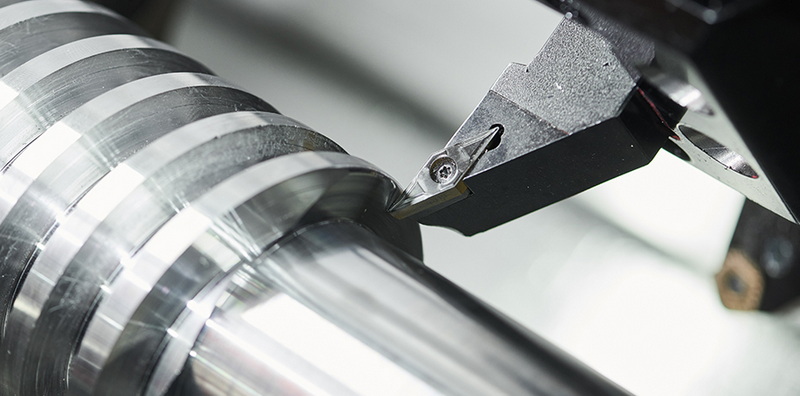
The insert's main function is to remove material from the workpiece accurately and efficiently, shaping it into the desired form while maintaining a smooth surface finish.
Consider workpiece material, type of operation (roughing or finishing), cutting speed, and required surface quality when selecting an insert. Manufacturers provide selection charts to assist in making the right choice.
Coatings protect the insert from heat, friction, and wear, improving lifespan and surface quality while allowing faster cutting speeds.
Most inserts are indexable, meaning they can be rotated to use a new cutting edge. However, once all edges wear out, the insert is replaced rather than resharpened.
Using an incorrect insert can cause poor surface finish, rapid tool wear, or even damage to the workpiece or machine due to improper chip control or excessive cutting pressure.


