From idea to market-ready product, our NPI solutions make every stage easier, faster. Discover How We Help

Views: 222 Author: Tomorrow Publish Time: 2025-12-30 Origin: Site


Content Menu
● Key Differences Between CNC Machining and CNC Turning
● Expanded Industrial Applications
● CNC Machining vs. Turning: Which Should You Choose?
● The Role of Software and Automation
● Emerging Trends in CNC Technology
● FAQ
>> 1. What materials can be used in CNC machining and turning?
>> 2. Which is faster, CNC machining or CNC turning?
>> 3. Can a single machine perform both machining and turning?
>> 4. What industries benefit most from CNC turning?
>> 5. How accurate are CNC machines compared to manual machining?
Understanding the distinction between CNC machining and CNC turning is essential for engineers, machinists, and manufacturers involved in precision production. Although these two methods often operate in the same manufacturing environment and share computer numerical control technology, their mechanical functions and outputs are fundamentally different.
CNC machining and turning have become the backbone of modern manufacturing. They combine precision, consistency, and speed by automating the tool paths and eliminating most manual handling errors. Leveraging advanced software, these systems translate digital models into real, tangible parts with impeccable accuracy. Knowing which process to use—and when—is critical for balancing production efficiency, cost, and quality.
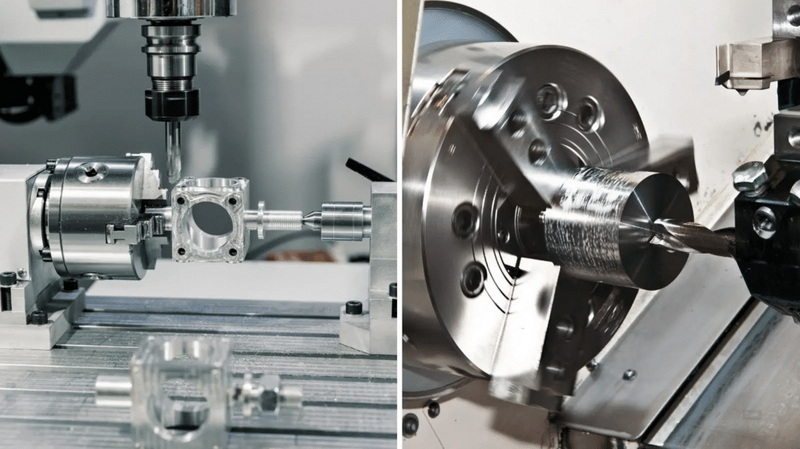
CNC machining is a subtractive manufacturing technique that removes material from a solid block (known as a workpiece) using various rotating cutting tools guided by programmed computer commands. The term “machining” encompasses multiple processes such as milling, drilling, and routing, all of which may occur on the same multi-axis CNC milling machine.
The procedure begins with a 3D CAD (Computer-Aided Design) model, which is converted into a CAM (Computer-Aided Manufacturing) file that defines the machine's tool paths. These instructions guide the machine in performing controlled cuts, ensuring exact repetition for every identical part.
Common forms of CNC machining include:
- CNC Milling: The most common form, in which rotary cutting tools move across multiple axes to carve material.
- CNC Drilling: Creates precise circular holes at defined depths and diameters.
- CNC Routing: Typically used for softer materials like plastics or wood but follows the same principle.
- CNC Grinding: Used for finishing surfaces to achieve a refined smoothness and tight tolerances.
Each of these is programmed using G-code, which specifies the spindle speed, cutting depth, feed rate, and toolpath geometry.
To perform CNC machining, the process is divided into several key stages. Each contributes to the precision and functionality of the final part:
1. Design Phase: Engineers create a CAD file of the desired component's geometry.
2. Programming: CAM software converts the CAD design into G-code, defining tool paths, cutting depths, and speeds.
3. Machine Setup: Operators install cutting tools, secure the workpiece, and load the program into the machine.
4. Material Removal: The machine follows the programmed sequence, moving the tool along various axes to carve the part.
5. Inspection and Finishing: The finished part undergoes dimensional verification, surface finishing, and quality checks.
Most CNC machining centers support 3 to 5 axes of movement. A 5-axis machine allows the tool to move simultaneously in multiple directions and angles, achieving sculpted contours and reducing repositioning. This flexibility makes CNC machining the go-to method for industries needing intricate or multi-faceted components.
CNC turning is a specialized machining process used primarily for creating cylindrical or conical parts. Unlike milling, where the cutting tool rotates, in turning, the workpiece itself rotates while a stationary cutting tool removes material along its surface. The operation takes place on a CNC lathe or turning center.
This process is fundamental for producing symmetrical shapes, such as shafts, bushings, bolts, and pulleys. Turning offers tighter control over diameters and surface finishes due to the consistent rotational speed of the spindle.
CNC turning centers often include automated tool changers and multi-axis capabilities, allowing different cuts in a single cycle. Some advanced machines combine turning with milling, adding slots, grooves, and drill holes without repositioning the part—a significant efficiency advantage.
The CNC turning process consists of several precise steps:
1. Mounting the Workpiece: A cylindrical bar or billet is clamped in the machine's chuck.
2. Programming Tool Movements: The machine reads the G-code detailing feed rate, depth of cut, and spindle speed.
3. Rotational Cutting: The spindle spins the workpiece at high speeds while a stationary cutting tool trims material along the X and Z axes.
4. Secondary Operations: Features such as threading, tapering, and grooving can be added during the same setup.
5. Finishing and Measurement: The part is inspected for dimensional accuracy and surface quality before finalizing.
Because the part's rotation provides the cutting force, CNC turning yields smooth finishes and high roundness precision that are hard to achieve through other methods.
While both techniques are part of CNC operations, they differ in fundamental mechanics, motion control, and application scope:
| Feature | CNC Machining | CNC Turning |
|---|---|---|
| Primary motion | Tool rotates while workpiece stays fixed | Workpiece rotates while the tool stays fixed |
| Typical output | Prismatic and complex geometries | Cylindrical or spherical parts |
| Axes of control | 3, 4, or 5 axes | Typically 2, with advanced centers supporting up to 6 |
| Machine type | Milling machine or machining center | Lathe or turning center |
| Production speed | Moderate; suited for complex parts | Faster; best for simple, symmetrical parts |
| Applications | Housing components, molds, mechanical assemblies | Rotating shafts, bushings, fittings, fasteners |
The appropriate technique depends on part geometry. Components with angular surfaces or multiple faces benefit from CNC machining, while circular or rotational parts are best made using CNC turning.
Both CNC machining and turning have revolutionized production across multiple fields:
- Aerospace: Produces high-tolerance turbine blades, casings, and landing components where weight, precision, and safety are critical.
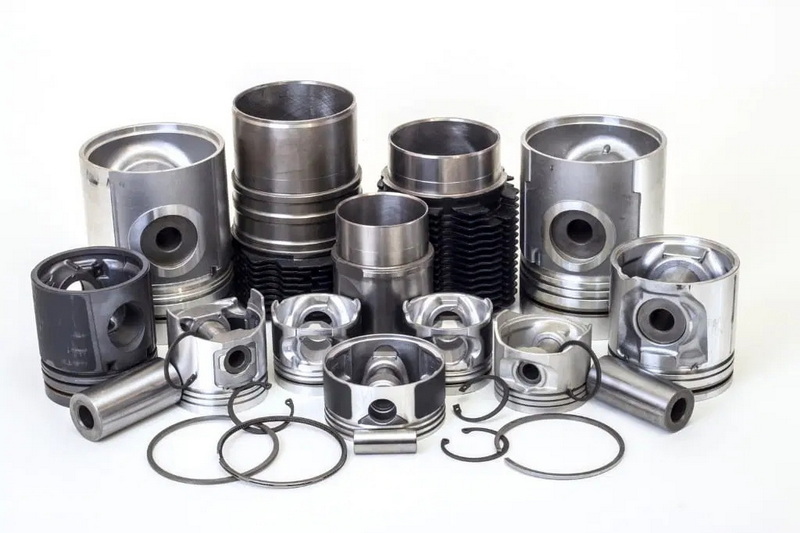
- Automotive: Manufactures parts such as engine pistons, crankshafts, and transmission shafts that must endure high stress.
- Medical Devices: CNC systems create orthopedic implants, joint replacements, and surgical instruments from titanium and stainless steel.
- Defense: Produces weapon system components, optical housings, and rugged mechanical assemblies.
- Consumer Electronics: Helps fabricate heat sinks, casings, and connectors that demand refined designs.
- Energy Sector: Forms turbine components, valves, and drill heads for power generation and oil extraction.
This versatility makes CNC technology indispensable across industries that value reliability, repeatability, and time efficiency.
- Exceptional precision: Achieves extremely tight tolerances within ±0.005 mm.
- High complexity capability: Suitable for intricate shapes or cavity-rich designs.
- Material diversity: Works efficiently with metals, composites, polymers, and ceramics.
- Automation and repeatability: Delivers consistent results for large production runs.
- Minimal human errors: Reduces dependence on manual skill, improving overall quality control.
- Superior for round components: Produces consistent diameters and concentric features.
- Fast and efficient: Shorter production cycles mean lower manufacturing costs.
- Excellent surface finish: Achieves smoother surfaces directly from the lathe.
- Integration-ready: Compatible with milling attachments for hybrid operations.
- Cost-effective for volume production: Ideal for scalable manufacturing of standard shapes.
Selecting between CNC machining and CNC turning depends on several design and production factors:
1. Geometry: If the design involves flat faces, holes, or pockets, machining is more suitable. Cylindrical or conical shapes favor turning.
2. Tolerance Requirements: Turning generally yields superior circular precision, whereas machining excels in complex angular accuracy.
3. Production Volume: Turning is more efficient for bulk runs with simpler parts; machining suits complex or specialized components.
4. Cost Considerations: Turning minimizes waste for symmetrical designs; machining costs more for material removal but offers versatility.
Increasingly, hybrid CNC systems combine these capabilities into one machine—allowing milling, drilling, and turning in a single setup. This trend streamlines workflows, reduces handling, and enhances part alignment accuracy.
Modern CNC machining and turning rely heavily on software integration. Advanced CAD/CAM systems now feature AI-driven toolpath optimization that minimizes cycle time and extends tool life. Real-time sensors monitor temperature, vibration, and tool wear to adjust parameters dynamically.
Automation continues to evolve through the use of robotic arms, pallet changers, and automated quality inspection systems, collectively known as “smart machining.” This integration helps factories achieve higher throughput, reduced downtime, and predictive maintenance for long-term savings.
In Industry 4.0 environments, CNC machines can communicate with ERP and MES systems, aligning production capacity, scheduling, and inventory management. This data connectivity enhances transparency and decision-making, allowing manufacturers to meet tighter deadlines with fewer resources.
Despite their advantages, both processes face challenges that require continuous innovation:
- Initial investment costs for CNC systems remain high, making them less accessible for small workshops.
- Complex programming demands skilled operators familiar with CAM software and G-code.
- Tool wear management is essential to maintain accuracy during extended runs.
- Material waste in machining can be significant compared to additive methods such as 3D printing.
However, continuous advancements in machine design, cutting-tool technology, and simulation software are steadily addressing these limitations.
CNC machining and turning continue to evolve through innovations like:
- Multi-tasking machines: Combining several operations into a single automated process.
- AI integration: Adaptive control systems that optimize performance based on predictive analysis.
- Hybrid manufacturing: Merging additive manufacturing (3D printing) with subtractive machining for efficiency.
- Digital twins: Virtual replicas of machining environments for real-time monitoring and process simulation.
These developments reflect the growing demand for precision, customization, and sustainable production.
Both CNC machining and CNC turning remain indispensable methods in modern manufacturing. While machining is ideal for crafting complex, multidimensional shapes, turning excels at producing cylindrical and symmetrical parts with exceptional surface finishes.
By understanding their distinctions—along with how they complement each other—manufacturers can improve efficiency, accuracy, and cost control. With advancements in automation, hybrid design, and intelligent systems, CNC technology continues to shape the future of precision production with greater flexibility and innovation.
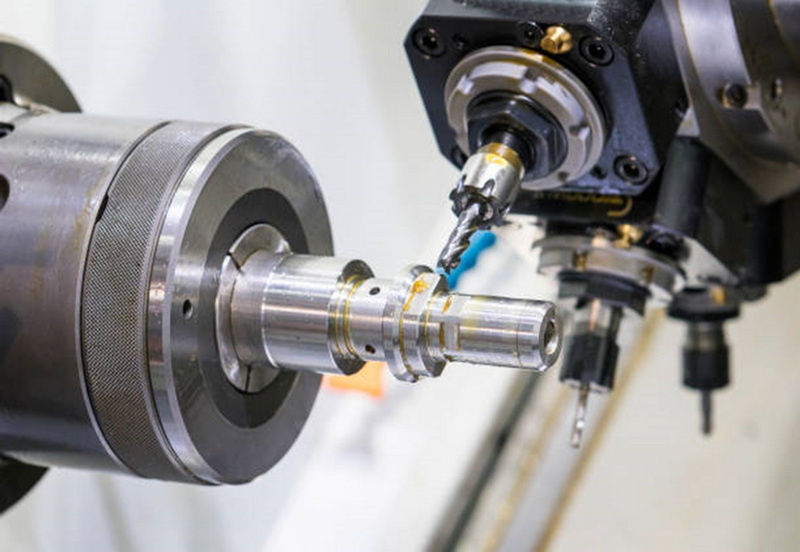
Both methods handle metals like steel, aluminum, titanium, and brass, as well as plastics and composites. Specialized tools allow machining even of ceramics and hardened alloys.
Turning tends to be faster for cylindrical parts due to its continuous rotational cutting, while machining suits slower, multi-surface operations.
Yes. Modern multitasking centers combine milling and turning functions to create complex parts without re-clamping, improving efficiency.
Aerospace, automotive, and energy sectors rely heavily on turning for precision shafts, fasteners, and rotational components requiring balance and symmetry.
CNC systems achieve tolerances as tight as ±0.005 mm or better, offering consistency over thousands of parts—far beyond manual capabilities.


