From idea to market-ready product, our NPI solutions make every stage easier, faster. Discover How We Help

Views: 222 Author: Tomorrow Publish Time: 2025-11-27 Origin: Site
Content Menu
>> 2. Generating the CNC Program
>> 4. Execution of Machining Operations
>> 5. Inspection and Quality Control
>> CNC Lathes and Turning Centers
>> Electrical Discharge Machines (EDM)
● Materials Used in CNC Machining
● Applications of CNC Machining
>> 1. What does CNC stand for, and why is it important?
>> 2. What materials can be used in CNC machining?
>> 3. How accurate is CNC machining?
>> 4. What is the difference between 3-axis and 5-axis CNC machining?
>> 5. Is CNC machining suitable for small batch production?
CNC machining is one of the most vital manufacturing technologies driving the modern industrial era. From aerospace to automotive, from healthcare devices to electronics, CNC machining plays a crucial role in producing precision components efficiently and consistently. But what exactly is CNC machining, and how does it work? Understanding the process and its benefits offers insight into why it has become indispensable in global production.
This article explains the principles of CNC machining, explores its workflow, examines its advantages, and discusses the different types of CNC machines used across industries.
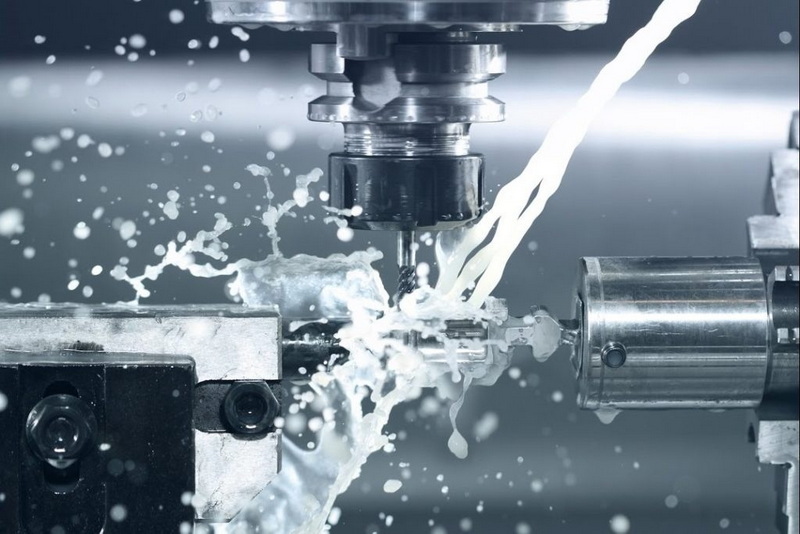
CNC stands for Computer Numerical Control. CNC machining refers to a subtractive manufacturing process that uses computerized controls to operate and manipulate machine tools such as mills, lathes, grinders, and routers to shape raw materials into custom-designed parts.
Unlike manual machining, which requires an operator to control each step physically, CNC machining follows programmed commands. These instructions, typically derived from a CAD (Computer-Aided Design) model and converted into CAM (Computer-Aided Manufacturing) data, guide the machine's movements with high precision.
The main goal of CNC machining is to ensure accuracy, repeatability, and efficiency during the fabrication of complex parts that require tight tolerances.
The CNC machining process can be broken down into several essential steps. Each step contributes to transforming a digital design into a physical, precisely machined product.
The CNC machining process begins with the creation of a 3D CAD model. Engineers use specialized design software to create detailed digital representations of the part, specifying dimensions, tolerances, and material properties. The quality of this design directly affects the accuracy of the final component.
Once the CAD model is finalized, it is converted into a language that the CNC machine understands. This is achieved through CAM software, which generates G-code or M-code. G-code dictates tool movements, speeds, and paths, while M-code controls auxiliary machine functions like coolant flow or spindle rotation.
The next step involves preparing the machining center. The operator mounts the raw workpiece—whether metal, plastic, wood, or composite—onto the machine's worktable or fixture. Proper clamping and alignment are critical to achieving consistent results.
After setup, the machine runs the programmed instructions. The cutting tools move across multiple axes (commonly 3 to 5) to remove material precisely according to the program. Modern CNC machines can perform operations such as milling, turning, drilling, boring, tapping, and grinding with extreme consistency.
Once machining is complete, the final part undergoes dimensional inspection and quality verification. This step ensures that all specifications match the original design. Advanced CNC setups may include automated probing and measurement systems for in-process inspection to reduce manual errors.
Different CNC machines perform specific functions depending on the type of operation and part geometry. Below are the most commonly used types across manufacturing industries:
CNC milling involves rotating cutters that remove material from the surface of a workpiece. It is versatile and suitable for producing complex shapes, holes, and pockets. Multi-axis milling centers, such as 5-axis machines, allow for intricate contours and undercuts.
CNC turning machines use a rotating workpiece while stationary cutting tools remove material. They are ideal for manufacturing cylindrical components such as shafts, fasteners, and bushings. Modern turning centers often integrate milling and drilling capabilities.
CNC drilling creates precise holes with controlled depth and diameter. It is often integrated into milling or turning centers, allowing for secondary hole-making operations during the same setup.
Used for high-precision finishing, CNC grinders produce fine surface finishes and accurate dimensions. They are essential in toolmaking, automotive part finishing, and aerospace component production.
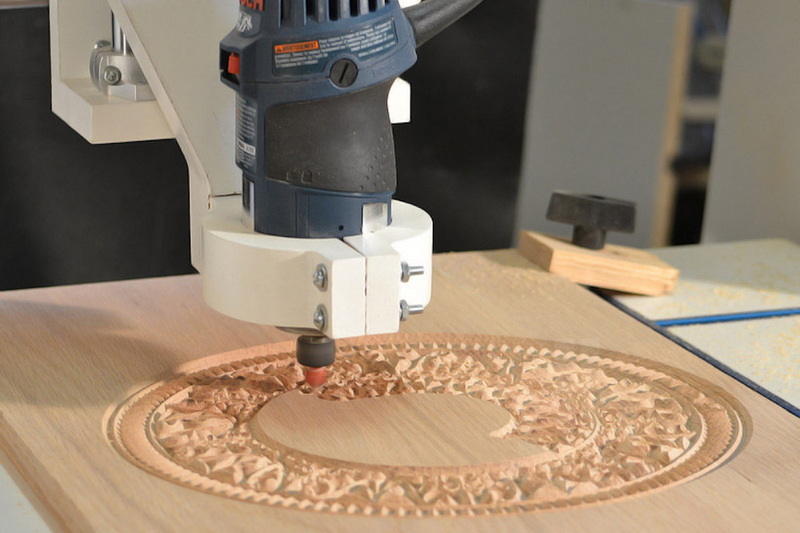
CNC routers are similar to milling machines but are designed mainly for softer materials such as wood, plastics, and composites. They are common in woodworking, furniture, and sign-making industries.
CNC EDM uses electrical sparks to erode material from hard metals. It's used for tooling, molds, and dies, especially when conventional cutting methods are ineffective.
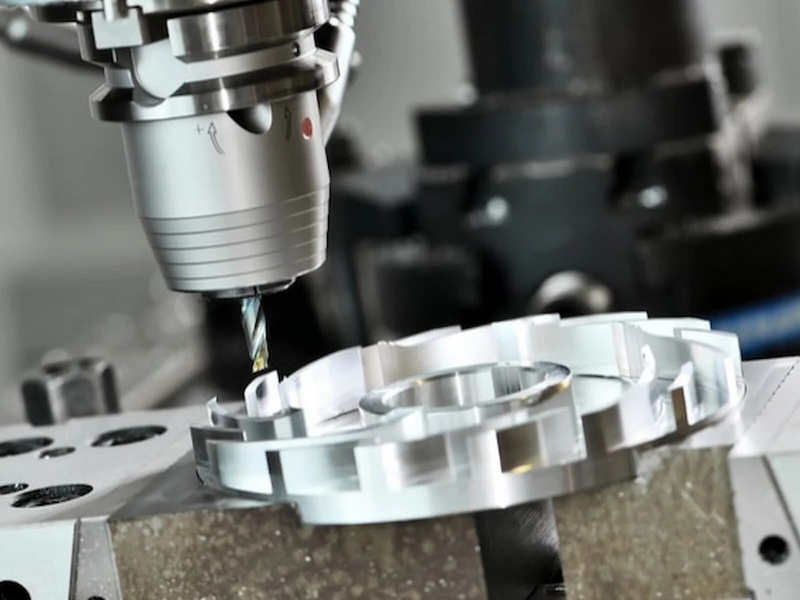
CNC machines can work with various materials, allowing manufacturers to choose the right feedstock for their intended application. Common materials include:
- Metals: Aluminum, steel, brass, copper, titanium, and magnesium.
- Plastics: ABS, nylon, PEEK, polyethylene, polypropylene, and PVC.
- Composites: Carbon fiber and fiberglass-reinforced resins.
- Others: Ceramics and wood for specialized products.
Material selection depends on mechanical requirements, cost, thermal properties, and intended use environment.
CNC machining offers multiple advantages that make it a cornerstone of global manufacturing. Key benefits include:
- High precision: Achieves tight tolerances and repeatable accuracy.
- Consistency: Reproduces identical components across large production runs.
- Efficiency: Rapid production with minimal manual intervention.
- Flexibility: Easily reprogrammable for design changes or new product lines.
- Scalability: Suitable for prototypes and mass production.
- Safety: Automated operation reduces the risk of human error and accidents.
These benefits allow manufacturers to maintain quality while meeting modern production demands for speed and reliability.
CNC machining is widely applied across multiple industries, transforming how parts and products are made due to its precision and versatility.
- Aerospace: CNC machining manufactures heat-resistant turbine blades, engine chambers, fuselage parts, wing sections, landing gear assemblies, and titanium brackets that reduce weight while maintaining strength. Companies like NASA, Boeing, and Airbus rely heavily on CNC technology for these components.
- Automotive: CNC machining produces engine parts, transmission components, hydraulic systems, battery housings, and electric vehicle drivetrain parts. Major manufacturers such as Tesla, Tata Motors, and Mahindra use CNC machining to improve durability and precision.
- Medical: Customized implants, surgical tools, MRI machine components, orthotic devices, and research equipment are made through CNC machining. The industry demands high precision for patient safety and performance.
- Electronics: CNC machines create micro-components, heat sinks, camera housings, printed circuit boards (PCBs), and connectors used in smartphones, laptops, and other high-tech devices. The miniaturization trend necessitates CNC for tight tolerances.
- Defense and Military: CNC machining fabricates components for weapons, military vehicles, protective casings, and monitoring devices. Precision and reliability are critical in this sector.
- Energy: Both renewable and non-renewable energy industries utilize CNC machining for turbine blades, gearboxes, generator housings, solar panel mounts, pipelines, and drilling equipment.
- Furniture and Woodworking: CNC routers enable mass customization of kitchen units, countertops, office furniture, decorative panels, and ergonomic models. Companies like IKEA benefit from CNC's ability to optimize material use and maintain eco-friendly practices.
- Agriculture: Tractors, irrigation systems, harvesters, tanks, and various farming tools are produced with CNC machining, supporting both small and large-scale farming equipment manufacturers.
- Food and Beverage: CNC produces molds, die castings, bakeware, packaging containers, and processing machine components, enhancing efficiency and food safety.
- Semiconductors: CNC machining is essential in manufacturing molds, casings, wafer carriers, heat sinks, and connectors required for semiconductor fabrication.
These diverse applications illustrate CNC machining's universal importance and growing penetration across industries worldwide.[1][2][3]
The future of CNC machining is poised for significant advancement with innovations such as:
- AI-driven predictive maintenance that reduces machine downtime.
- Real-time monitoring using Industrial Internet of Things (IIoT) technology to optimize operations.
- Increasing automation with robotic part loading/unloading to enhance throughput.
- Hybrid machines combining additive (3D printing) and subtractive methods for greater design freedom.
- Focus on sustainability through optimized material usage, energy-efficient machines, and reduced waste.
These trends will continue to improve productivity, quality, and environmental impact in manufacturing processes globally.
CNC machining is the backbone of precision manufacturing, combining advanced software control with mechanical precision to produce complex components across industries. It provides unmatched accuracy, scalability, and consistency—qualities essential to modern engineering and production. As automation and digitalization expand, CNC machining continues to evolve as a key enabler of industrial innovation worldwide.
CNC means Computer Numerical Control. It automates machine tool operations, improving accuracy, speed, and productivity compared to manual machining.
CNC machining is compatible with metals such as aluminum and steel, plastics like ABS and PEEK, and composite materials including carbon fiber.
Modern CNC machines achieve tolerances within ±0.005 mm, depending on material, tool condition, and calibration standards.
3-axis machines move tools along X, Y, and Z axes. 5-axis machines add two rotational axes, enabling complex geometry production with fewer setups.
Yes, CNC machining is highly adaptable. It supports both prototype creation and low-volume runs cost-effectively compared to mass production methods.
[1](https://venttup.com/cnc-machining-industries-applications/)
[2](https://www.3erp.com/blog/cnc-machining-applications-and-uses/)
[3](https://www.americanmicroinc.com/resources/industries-use-cnc-machinery/)
[4](https://qviro.com/blog/what-industries-use-cnc-machines/)
[5](https://astromachineworks.com/cnc-machine-industries/)
[6](https://www.reddit.com/r/MechanicalEngineering/comments/1953x9j/which_industrys_uses_cnc_milling_the_most_for/)
[7](https://durexinc.com/top-industries-using-cnc-machining/)
[8](https://www.ametals.com/post/7-uses-of-cnc-machining)
[9](https://millenniumprecision.com/7-key-industries-benefit-cnc-machining/)
[10](https://resources.hartfordtechnologies.com/blog/industries-that-rely-on-cnc-machining)


