From idea to market-ready product, our NPI solutions make every stage easier, faster. Discover How We Help

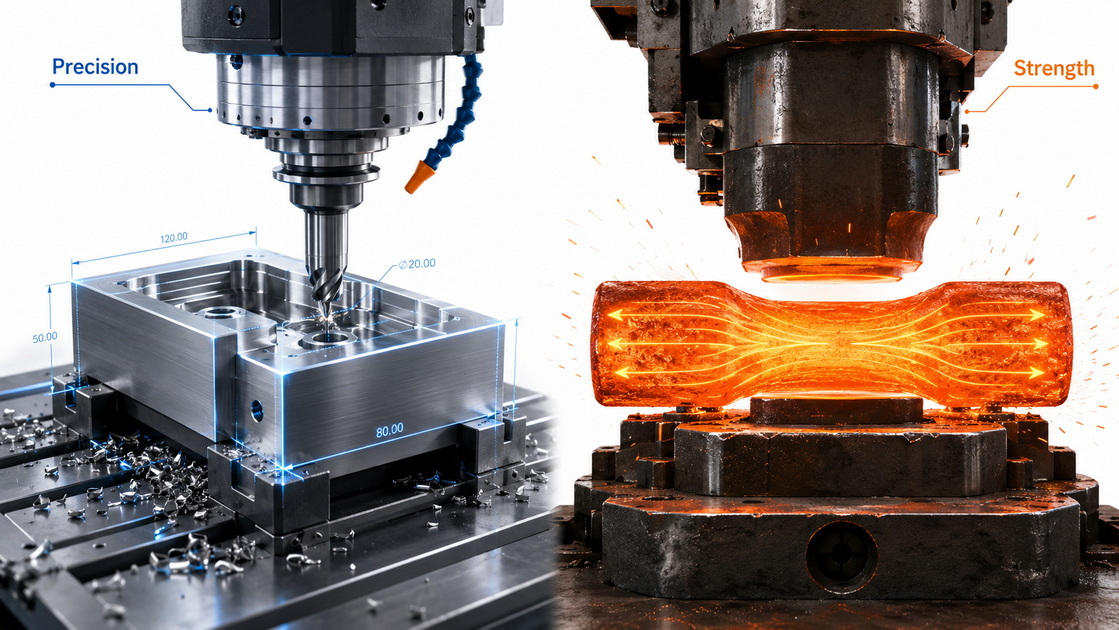
This article explores how CNC milling and forging serve different roles in modern manufacturing, especially for B2B buyers sourcing precision metal components. It explains CNC milling as a highly flexible, computer-controlled process that delivers tight tolerances, complex geometries, and excellent repeatability, making it ideal for prototypes, small-to-medium batches, and parts with critical fit requirements. In contrast, forging is presented as a strength-focused forming process that improves grain flow and fatigue resistance, offering superior durability for load-bearing and safety-critical components. By comparing the two processes in terms of strength, precision, tooling cost, lead time, and design freedom, the article helps engineers and procurement teams quickly identify which route best matches their application. It also highlights a hybrid strategy—combining forging for structural performance with CNC finishing for dimensional accuracy—as a practical solution for OEM and ODM p
CNC Milling Vs. Laser Cutting for Thick Plate Components is a practical B2B guide comparing accuracy, thickness limits, edge quality, cost, and lead time. Built for OEM and ODM buyers, it explains when CNC milling, laser cutting, or a hybrid process delivers the best result.
This article compares dry milling and wet milling for hard metals from an engineering and manufacturing perspective. It explains how each method handles heat, affects tool life, surface finish, chip evacuation, and production cost, while offering practical guidance for OEM and ODM buyers selecting the right CNC machining process.
This article explains 10 expert CAD design tips for CNC machining, with practical DFM guidance, ISO tolerance strategy, GD&T usage, and finishing considerations. It is written for OEM/ODM buyers and engineers who want better manufacturability, lower cost, and more reliable CNC parts.
Sinker EDM vs wire EDM: which process is best for your precision part? This expert SEO guide compares geometry, tolerance, surface finish, cost, and real applications, helping OEM and ODM buyers choose the right EDM method for molds, dies, and conductive components.
Spotface and counterbore holes are small machining features with a major impact on assembly quality, fastener seating, and product reliability. This guide explains the differences, symbols, applications, tolerances, and CNC best practices for OEM and ODM manufacturing.
CNC Milling vs. Manual Milling is a critical comparison for precision manufacturing buyers. This article explains why automation improves repeatability, tight tolerances, and production scalability, with OEM and ODM insights from a Shenzhen CNC parts manufacturer.
This article compares 3-axis and 5-axis CNC milling from a cost-versus-complexity perspective for OEM/ODM buyers and engineers. It explains machine capability, hidden costs, tolerance control, and practical selection logic, helping readers choose the most economical process without sacrificing quality or precision.
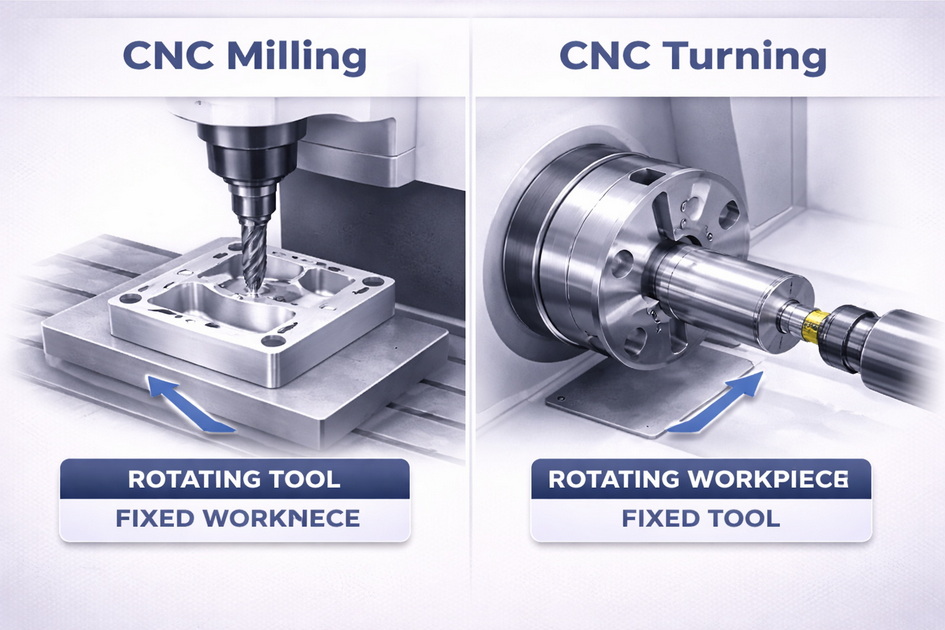
CNC milling and CNC turning are two core precision machining processes, but they solve different manufacturing problems. This article explains when to choose each method, with OEM/ODM insights, current industry trends, and practical decision rules for better quality, cost, and lead time.