From idea to market-ready product, our NPI solutions make every stage easier, faster. Discover How We Help

Views: 222 Author: Tomorrow Publish Time: 2025-11-28 Origin: Site


Content Menu
>> Step 1: Understanding CNC Milling Principles
>> Step 2: Designing the Frame and Structure
>> Step 3: Choosing Motors and Motion Components
>> Step 4: Building the Spindle Assembly
>> Step 5: Electronics and Control System
>> Step 6: Assembling the Mechanical Components
>> Step 7: Installing and Calibrating Software
>> Step 8: Testing and Fine-Tuning
>> Step 9: Operating the CNC Milling Machine
>> Step 10: Scaling Up Like CNC Machining Service Manufacturers and Suppliers
● Additional Details on CNC Milling Machine Construction
>> Material Selection and Preparation
>> Electrical Wiring and Safety
>> Software and G-code Preparation
>> Maintenance and Troubleshooting
● FAQ
>> 1. What materials can a CNC milling machine cut?
>> 2. How accurate is a homemade CNC milling machine?
>> 3. What software is best for controlling a CNC milling machine?
>> 4. How much does it cost to build a CNC milling machine?
>> 5. How long does it take to build one?
Building a CNC milling machine from scratch is both a technical challenge and a rewarding learning experience. This process involves understanding mechanical design, electronics, motion control, and software integration. A properly built machine can perform precision cutting, engraving, drilling, and complex 3D shaping on materials like metal, wood, and plastic.
This article explains step-by-step how to make a CNC milling machine, from basic design concepts to calibration and operation, helping readers understand the process used by professional CNC machining service manufacturers and suppliers.

CNC (Computer Numerical Control) milling machines are automated tools that carve and cut materials according to programmed instructions. They translate a digital design (G-code) into precise movements along the X, Y, and Z axes. The machine's spindle rotates a cutting tool at high speed, removing material layer by layer to form a finished part.
Modern CNC milling machines are central to industries such as automotive, aerospace, and electronics. Many CNC machining service manufacturers and suppliers rely on these machines to produce high-tolerance components consistently and efficiently.
Before building a CNC milling machine, it's essential to understand its working principles. A typical CNC mill includes components like:
- Frame or base: Provides structural rigidity.
- Spindle: Holds and spins the cutting tool.
- Linear motion system: Enables movement across axes.
- Stepper or servo motors: Drive motion through precise control signals.
- Controller board: Interprets G-code and directs machine actions.
- Power supply: Provides energy to motors and electronics.
Knowing how these parts interact helps prevent design flaws and system inefficiencies.
Professional CNC machining service manufacturers and suppliers optimize each component to achieve high accuracy and long service life. For DIY builders, selecting compatible parts is essential to ensure consistent performance.
The frame forms the backbone of your CNC milling machine. It must be strong enough to resist vibration, bending, and deflection. The most common materials include:
- Steel: Offers maximum strength but increases weight.
- Aluminum: Lightweight with good stiffness, ideal for small-to-medium machines.
- Cast iron: Used in industrial-grade machining centers for superior vibration damping.
Design considerations include:
1. Bed size: Determines the maximum workpiece dimensions.
2. Tool clearance: Ensures the spindle and tool can access all machining zones.
3. Mounting points: Allow secure attachment of linear rails and lead screws.
A square or gantry-type design is common. Gantry designs are more compact and suitable for smaller CNC machining setups.
Precise motion is what defines a CNC milling machine. The right selection of motors and drives determines performance accuracy.
Stepper Motors
Stepper motors are cost-effective and widely used for hobbyist CNC mills. They move in fixed increments and offer decent torque for small loads.
Servo Motors
Servo motors continuously monitor position via encoders, offering smoother, faster, and more accurate motion. They are the preferred choice for professional CNC machining service manufacturers and suppliers.
Linear Motion Components
To convert rotary motion into linear motion, use lead screws or ball screws:
- Lead screws are affordable and ideal for light-duty tasks.
- Ball screws provide higher efficiency and smoother movement with reduced backlash.
Additionally, install linear bearings or guide rails to ensure stable, frictionless movement. The combination of ball screws and linear rails produces industrial-grade motion quality.
The spindle is the heart of a CNC milling machine. It spins the cutting tool at high speed to shape materials accurately. Designing a spindle involves considering speed, torque, cooling, and tool-holding systems.
Essential Spindle Elements
- Motor: Drives the spindle rotation.
- Collet or chuck: Holds the cutting tool firmly.
- Bearings: Must withstand both radial and axial loads.
- Cooling system: Maintains temperature stability during prolonged operation.
Air-cooled spindles are simple to maintain, while liquid-cooled models offer superior performance during heavy machining. Commercial CNC machining service manufacturers often prefer water-cooled spindles to achieve continuous high-speed performance.
The electronic system acts as the brain of the CNC milling machine. It interprets G-code commands from CAD/CAM software and sends signals to the motors.
Key Components
- Controller board: Interfaces with a computer to process motion commands.
- Motor drivers: Amplify control signals to power the motors.
- Limit switches: Prevent the machine from moving beyond safe limits.
- Emergency stop button: Provides instant shutdown in case of malfunction.
- Power supply: Delivers stable voltage and current to all components.
Open-source controllers like GRBL or LinuxCNC are cost-effective for beginners. Industrial CNC machining service manufacturers and suppliers use proprietary controllers for better precision, feedback, and advanced features.
Once all parts are prepared, assembly begins. The process requires patience and alignment precision:
1. Install the frame and base.
2. Mount linear rails and ball screws. Ensure they are parallel and properly aligned.
3. Attach the spindle and Z-axis assembly.
4. Connect the stepper or servo motors.
5. Wire all electronic components.
Use precision tools to measure distances and verify angular alignment. Small errors at this stage can cause accuracy issues during operation.
Software integration transforms the machine from mechanical hardware into an intelligent system.
Control Software
Mach3, GRBL, and LinuxCNC are popular CNC software options. Each allows users to input G-code generated by CAD/CAM software like Fusion 360, SolidWorks, or Mastercam.
Steps for Calibration
- Test each axis movement and confirm proper direction and distance.
- Set step-per-unit values so motion matches the design scale.
- Establish zero points to define workpiece origin.
- Run dry simulations without cutting material to verify accuracy.
Tuning parameters like acceleration and speed balancing ensure smooth motion and reduce stress on components.
Testing ensures your CNC milling machine performs up to expectations. Begin with basic motion verification, then progress to cutting soft materials such as foam or wood before tackling metals.
Evaluation Points
- Repeatability: Check if the machine returns to the same coordinates consistently.
- Surface finish: Inspect milled parts for chatter marks or roughness.
- Accuracy: Measure milled features against design dimensions.
- Noise and vibration: Excessive vibration may indicate misalignment or imbalance.
Machine calibration and upgrades—such as improved spindle mounts, stronger frames, or higher-resolution encoders—can greatly enhance long-term performance.
Once testing is complete, the CNC milling machine is ready for operation.
1. Load the digital 3D model or 2D drawing into CAM software.
2. Generate the toolpath using post-processors compatible with your controller.
3. Secure the raw material on the machine's bed.
4. Install the correct cutting tool for the job.
5. Start machining while monitoring feed rates, spindle speed, and temperature.
Proper maintenance includes cleaning chips, checking lubrication points, and tightening bolts regularly to maintain accuracy and durability.
For those aiming to move beyond DIY projects, scaling operations requires adopting industrial practices. Professional CNC machining service manufacturers and suppliers rely on multiple advanced machining centers networked through computer-based manufacturing systems.
Key improvements include:
- Automated tool changers for faster cycle times.
- High-speed spindles for fine finishing.
- Rigid frames to support heavy-duty production.
- Closed-loop servo control for extreme precision.
Adopting these features allows small workshops to upgrade into professional CNC service providers capable of meeting large production demands with consistent quality.
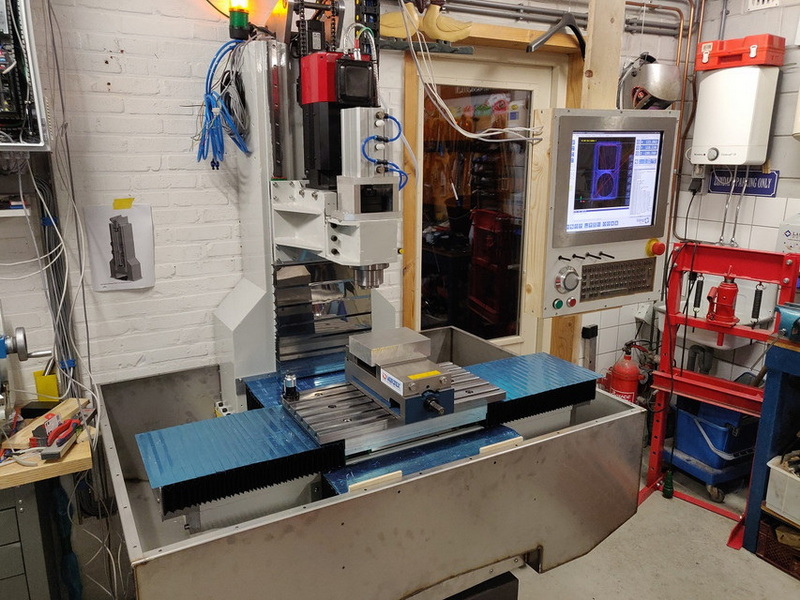
Choosing the right material for the machine frame and components is critical. Aluminum profiles or steel plates provide a balance between rigidity and weight. The worktable must be flat and sturdy to hold the workpiece securely during machining, often made with T-slotted aluminum or steel plates for easy clamping.
Precision in machining frame components is necessary. Using square profiles and machining mating surfaces to exact specifications reduces assembly errors and vibration during operation.
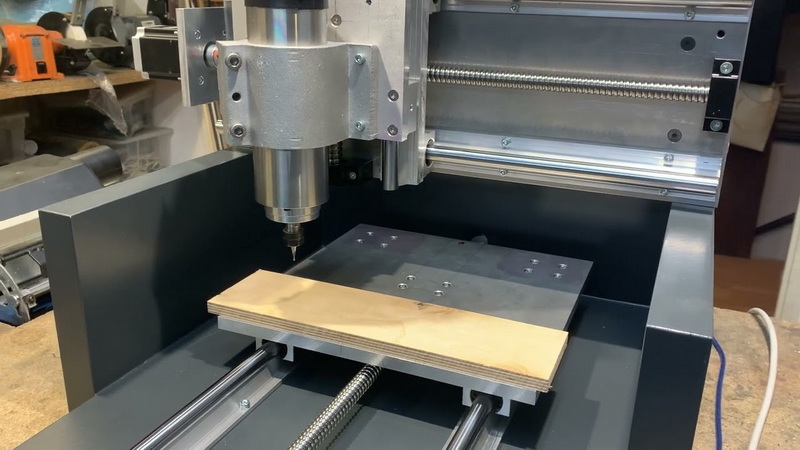
The work surface or table is where the raw material is mounted. Professional CNC machining service manufacturers and suppliers often use T-slot tables, facilitating fast and flexible clamping with T-nuts and bolts. For DIY machines, a flat plywood board or MDF sheet can function as the surface, though it may require frequent replacement.
Chip accumulation can affect machine accuracy and cause mechanical failures. Installing dust covers over guide rails and vacuum or air blow systems helps maintain cleanliness. Some homemade designs use flexible rubber covers or bellows to protect critical components from dust.
The choice of spindle motor affects the types of materials you can machine. For light-duty or hobbyist machines, a Dremel or Kress router with variable speed is common. For industrial-grade machines, high-frequency water-cooled spindles provide consistent power and fine control for metals.
Depending on the machine size and user needs, tool holders can range from basic collets to advanced automatic tool changers. Manual tool changing is sufficient for many DIY setups, while automated changers increase productivity for manufacturers.
Proper wiring is essential to protect electronics and users. Use shielded cables for motor wires, cable carriers to organize wiring along moving axes, and circuit breakers to prevent electrical hazards. Emergency stop buttons must be easily accessible and tested regularly.
Generating toolpaths involves multiple steps in CAD and CAM software:
- Designing the part with accurate dimensions.
- Choosing appropriate cutting tools based on material and geometry.
- Setting cutting parameters like feed rate, spindle speed, and depth.
- Simulating the toolpath to prevent collisions.
- Exporting G-code compatible with the selected CNC controller.
Starting with simple projects helps users build confidence before moving to complex parts.
Routine maintenance keeps the machine in top form. This includes lubricating linear guides and lead screws, tightening bolts, cleaning chips, and updating software.
Common troubleshooting steps:
- Correct axis movement direction.
- Checking for loose wiring or connectors.
- Adjusting motor tuning parameters.
- Inspecting mechanical wear or damage.
Building a CNC milling machine demands mechanical knowledge, electronic skills, and patience. By following systematic steps—from selecting materials and components to assembling and calibrating systems—anyone can create a high-performance CNC milling system.
Whether constructing a DIY unit or preparing for professional manufacturing, mastering the CNC machine's principles provides insight into how industries operate. CNC machining service manufacturers and suppliers apply these same principles daily to produce the components that drive modern engineering and innovation.
CNC milling machines can cut a wide range of materials, including wood, aluminum, steel, brass, and plastic. The choice depends on spindle power, cutting tools, and machine rigidity.
A well-built CNC milling machine can achieve accuracy within 0.05 to 0.1 mm. Using high-quality ball screws and linear guides enhances precision comparable to professional equipment.
Mach3, GRBL, and LinuxCNC are popular control options. For industrial CNC machining service manufacturers and suppliers, professional platforms like Siemens or Fanuc controllers are preferred.
A basic DIY CNC mill can cost between $800 and $2000, depending on component quality. Commercial-grade machines from established CNC machining service manufacturers and suppliers range from $10,000 to over $100,000.
Building a functional CNC milling machine can take several weeks to months, depending on experience, component availability, and complexity of design.
[1](https://www.elephant-cnc.com/blog/cnc-milling-machine-process/)
[2](https://www.instructables.com/Building-your-own-CNC-milling-machine/)
[3](https://www.speedtigertools.com/solution/ins.php?index_id=107)
[4](https://fractory.com/cnc-milling/)
[5](https://cncwmt.com/qa/mastering-cnc-milling-machines-a-comprehensive-guide-to-operation-and-beyond/)
[6](https://www.uti.edu/blog/cnc/milling)
[7](https://www.camaster.com/cnc-machine-setup-101-a-beginners-guide-in-2024/)
[8](https://hppi.com/knowledge-base/cnc-machining/cnc-milling)
[9](https://www.cnccookbook.com/cnc-spindle-mill/)
[10](https://www.cadrex.com/cnc-machining-starter-guide)


