From idea to market-ready product, our NPI solutions make every stage easier, faster. Discover How We Help

Views: 222 Author: Tomorrow Publish Time: 2025-12-03 Origin: Site


Content Menu
● Key Factors Affecting CNC Machining Cost
>> Step-by-Step Material Cost Breakdown
>> Estimating Setup and Programming Expenses
>> Machining Time and Hourly Rate Analysis
>> Tooling and Wear Considerations
>> Labor and Quality Control Costs
>> Post-Processing and Finishing Operations
>> Overhead Allocation Methods
● Real-World Example Calculation
● Advanced Strategies to Minimize Costs
● FAQ
>> 1. How do machine types influence CNC machining hourly rates?
>> 2. What role does production quantity play in per-part CNC costs?
>> 3. How can design features increase or decrease CNC machining expenses?
>> 4. Why are material choices critical in cost estimation?
>> 5. What overhead elements should be included in total CNC cost?
Calculating CNC machining cost requires breaking down multiple components such as material expenses, machine operating time, labor charges, tooling requirements, setup fees, post-processing operations, and overhead allocations. Manufacturers typically use a formula that sums these elements to arrive at a per-part or total project cost, often expressed per hour or per unit depending on production volume. Accurate estimation helps engineers, procurement teams, and manufacturers budget effectively and optimize designs for affordability.[1][2][11]

Several interconnected factors drive CNC machining expenses, each contributing variably based on part complexity, material selection, and production scale.
- Material Costs: Depend on type, density, and quantity; aluminum costs $5-$10 per pound, while titanium reaches $20-$50 per unit due to machining difficulty.[2]
- Machine Time and Hourly Rates: Largest component; 3-axis mills charge $20-$100 per hour, 5-axis up to $150 per hour for intricate geometries.[1][2]
- Labor Costs: Cover programming at $30 per hour, setup, operation, inspection, and quality control by skilled technicians.[1]
- Tooling and Consumables: Include end mills, drills, coolants, and replacements; hard materials accelerate wear, raising expenses.[11]
- Setup and Programming: Initial fixturing, CAM software paths, and test runs; complex parts demand multiple setups.[12]
- Post-Processing: Deburring, anodizing, or coating adds $10-$50 per part based on finish specifications.[2]
- Overhead and Profit Margin: Facility utilities, depreciation, maintenance, and 10-30% markup spread across jobs.[5]
Part volume influences per-unit pricing; low runs amplify setup costs, while high volumes dilute them.[1]
Select raw stock slightly larger than the final part to allow for machining allowances. Weigh or measure volume, then multiply by per-pound or per-kilogram rates. Aluminum 6061 billets cost $3-$5/kg, stainless steel $8-$16/kg, and plastics like ABS $1-$2/lb. Exotic alloys like Inconel demand $30-$70 per unit due to scarcity and handling. Waste factor adds 10-20% for chips and scraps.[5][2]
Programming involves CAD-to-CAM conversion, simulating toolpaths to avoid collisions. Simple parts take 1-2 hours at $30-$50/hour; complex ones 4-8 hours. Fixtures or custom jaws cost $100-$500, amortized over quantity. Multiple orientations for undercuts multiply setups, doubling time.[12][1]
Use CAM software like Mastercam or Fusion 360 to simulate cycles. Factors include feed rates (e.g., 0.002-0.01 inches per tooth), spindle speeds (5,000-20,000 RPM), and tool changes. A 3-axis mill processes basic aluminum at $50/hour; 5-axis for contours hits $75-$150/hour due to simultaneous axes control. Include non-cutting time like tool swaps (5-10% of total).[2][1]
| Machine Type | Hourly Rate (USD) | Typical Applications tfgusa+1 |
|---|---|---|
| 3-Axis Mill | $20-$100 | Flat surfaces, pockets |
| 4-Axis Mill | $40-$125 | Rotational features |
| 5-Axis Mill | $75-$150 | Complex curves, impellers |
| CNC Lathe | $30-$80 | Cylindrical parts |
| Swiss Mach. | $50-$120 | Precision shafts |
Standard carbide tools cost $20-$100 each; custom ones $200+. Tool life varies: aluminum allows 10,000 parts per insert, titanium 500. Budget 5-15% of machining cost for replacements, plus lubricants at $0.50/hour.[6][11]
Operators load stock, monitor cycles, and perform in-process checks. Rates range $25-$60/hour regionally. Final inspections use CMMs or calipers, adding 0.5-1 hour per batch. Rejection rates (1-5%) factor in rework.[4]
Surface finishes below Ra 32 require tumbling ($5-$15/part) or electropolishing ($20-$40). Coatings like powder coat add $10-$30, heat treatments $50-$200 depending on alloy.[2]
Overheads total 20-50% of direct costs, covering rent, insurance, and depreciation. Allocate via machine hours or direct labor hours for accuracy.[5]
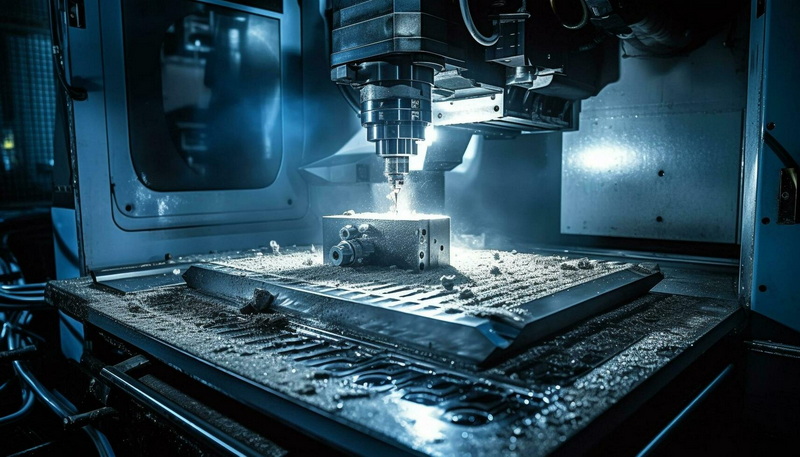
Consider 100 aluminum brackets (6061, 0.5kg each, 1.5-hour cycle on 3-axis mill at $60/hour):
- Material: 0.5kg x $5/kg x 100 = $250
- Setup/Programming: $300 / 100 = $3/part
- Machining: 1.5hr x $60 x 100 = $9,000
- Tooling: $200 / 100 = $2/part
- Labor: $40/part
- Finishing: $15/part
- Overhead (30%): $2,889 total /100 = $29/part
Total per part: $3 + $2.50 + $90 + $2 + $40 + $15 + $29 = $181.50. For 1,000 units, per-part drops to $112 due to fixed cost dilution.[11][2]
- Design for manufacturability: Avoid deep cavities (>4x diameter), thin walls (<0.8mm), or sharp internal corners.
- Batch optimization: Minimum economic quantity often 50-100 parts.
- Material substitution: Swap stainless for aluminum where strength allows.
- Supplier negotiation: Request quotes from multiple shops, including China-based for 20-40% savings.[12]
- Software tools: Use online calculators from platforms like Xometry for instant estimates.[7]
- Multi-axis efficiency: 5-axis reduces setups despite higher rates.
Tolerances below ±0.001" inflate costs 2-5x via slower feeds.[8]
Mastering CNC machining cost calculation empowers better decision-making across design, sourcing, and production phases. By dissecting material, time, labor, and ancillary costs through structured formulas and examples, manufacturers achieve precise budgeting and substantial savings. Implementing design optimizations and volume strategies further enhances value, making CNC viable for prototypes to high-volume runs.
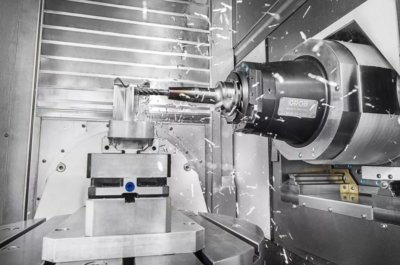
3-axis machines cost $20-$100/hour for basic work, while 5-axis reach $75-$150/hour for complex features due to advanced capabilities and setup needs.[1][2]
Larger quantities spread fixed setup and tooling over more units, reducing per-part cost; low runs amplify these expenses significantly.[11][5]
Features like undercuts or tight tolerances extend machining time and require specialized tools, raising costs; simplified geometries cut time by 30-50%.[8][12]
Machinability affects speed and tooling wear; affordable aluminum machines quickly at low rates, versus titanium needing slow feeds and expensive tools.[5][2]
Overheads encompass depreciation, utilities, maintenance, and profit; typically 20-50% of direct costs, allocated per machine hour.[6][1]
[1](https://www.tfgusa.com/cnc-machining-cost/)
[2](https://yijinsolution.com/cnc-guides/cnc-machining-cost/)
[3](https://www.rapiddirect.com/blog/cnc-machining-cost-calculation/)
[4](https://www.reddit.com/r/AskEngineers/comments/w5zdxn/how_do_you_calculate_the_cost_for_cnc_machining/)
[5](https://hlhrapid.com/blog/cnc-machining-cost/)
[6](https://hwacheonasia.com/cnc-machining-cost-calculation-what-you-need-to-know/)
[7](https://www.xometry.com/resources/machining/cnc-machining-cost-calculation/)
[8](https://www.fictiv.com/articles/calculating-the-cost-of-cnc-machining-custom-parts)
[9](https://deburringtechnologies.com/job-costing-for-cnc-machining-centers-challenges-and-opportunities/)
[10](https://www.youtube.com/watch?v=LL-tpsk7l-0)
[11](https://www.longshengmfg.com/calculating-cnc-machining-costs/)
[12](https://hmaking.com/how-cnc-machining-cost-is-calculated-complete-guide-for-engineers-procurement-teams/)


