From idea to market-ready product, our NPI solutions make every stage easier, faster. Discover How We Help

Views: 222 Author: Tomorrow Publish Time: 2025-12-06 Origin: Site
Content Menu
● Role of C-Axis in Turning Centers
● Advanced Multi-Axis Configurations
>> Additional Axes: B, U, and V
● Axis Configurations by Machine Type
● Programming Multi-Axis Turning Operations
● Advantages of Increased Axes Count
● Limitations and Considerations
● Applications Across Industries
● Selecting the Right Axis Configuration
● FAQ
>> 1. What are the primary axes in a basic CNC turning machine?
>> 2. How does the C-axis enhance CNC turning?
>> 3. What is the role of the Y-axis in turning operations?
>> 4. Can CNC turning machines have more than 5 axes?
>> 5. What factors determine the number of axes needed in CNC turning?
CNC turning represents a cornerstone of modern machining, where a workpiece rotates while a cutting tool removes material to create precise cylindrical parts. The number of axes in CNC turning machines determines their capability to handle complex geometries. Basic setups feature 2 axes, while advanced configurations extend to 5 or more axes for multifaceted operations. The axis count directly impacts the machine's versatility, precision, and ability to reduce setup times, which is crucial for competitive manufacturing.[1][2]
Standard CNC lathes usually include linear movements along specific directions, enabling fundamental turning processes like facing, threading, and contouring. As technology evolves, the introduction of additional axes transforms a lathe from a simple turning machine to a multifunctional machining center capable of handling a range of secondary operations without removing the workpiece. Understanding these axes and their functions helps in selecting the right machine for specific industrial applications.[1]

The X-axis controls the radial movement of the cutting tool perpendicular to the spindle centerline. This allows the tool to approach or retreat from the workpiece's diameter, which is essential for controlling the depth of cut and finishing the surface of cylindrical parts. Precise control along the X-axis ensures that the desired outer or inner diameter is achieved with tight tolerances. Depending on the machine's size and make, the X-axis travel can range from around 100mm to over 500mm with very high resolution, often as fine as 0.001mm, enabling intricate surface finishes and dimensional accuracy.[1]
In practice, the X-axis is often programmed with G-code commands where negative positions represent tool movements toward the workpiece centerline. This axis is foundational because variations in diameter define many critical features of turned components such as shafts, bushings, and rings.[1]
The Z-axis controls movement along the length of the workpiece, parallel to the spindle's rotational axis. It facilitates straight turning, tapering, contouring, and threading by enabling the tool to travel longitudinally. The Z-axis stroke length is generally longer than the X-axis and is designed to accommodate longer parts like shafts or rods. This axis is vital for defining the length and shape of features along the part's axis.[3][1]
Operators often use the chuck face as the zero point for the Z-axis to simplify program referencing. Rapid Z-axis traverses help reduce non-cutting time between machining cycles, significantly improving manufacturing efficiency in batch production. However, maintaining rigidity and precision in the Z-axis is essential, especially for thin or elongated parts to avoid deflections that compromise part straightness.[3]
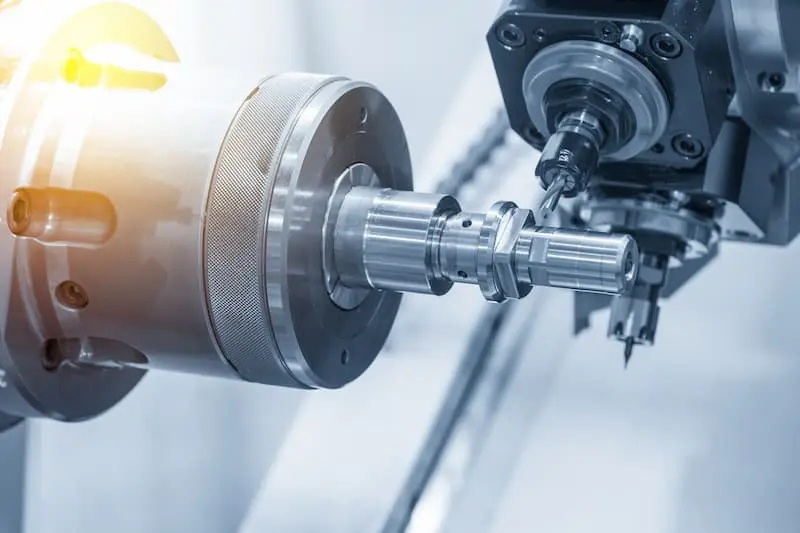
The C-axis adds rotational control to the spindle, permitting the lathe to act as a turning center rather than just a turning machine. This rotational axis allows the spindle to be indexed or rotate continuously under CNC command, making live tooling possible. The C-axis enables perpendicular milling, drilling, and other machining operations directly on the workpiece without needing to transfer it between machines, increasing accuracy and reducing production time.[1]
High-end turning centers feature C-axis resolutions up to 0.001 degrees, allowing extremely precise angular positioning for milling complex shapes like polygonal forms or spline shafts. Activating the C-axis requires secure clamping, often hydraulic or pneumatic, to withstand cutting forces during milling. The addition of the C-axis transforms a traditional lathe into a sophisticated multitasking machine, expanding its capabilities significantly.[1]
The Y-axis introduces a secondary linear movement perpendicular to both the X and Z axes, allowing the cutting tool to move off-center. This enables eccentric turning and off-axis milling operations without relying entirely on the C-axis for rotational control. Y-axis travel usually matches around half the X-axis travel to maintain balanced force distribution and accessibility. This axis is common in mill-turn machines, which combine turning and milling processes in one setup for intricate parts such as those requiring pockets or drill holes on the part face.[1]
The Y-axis dramatically reduces the need for secondary setups by enabling a wider variety of features to be machined in a single operation. This axis often operates in coordination with the C-axis, allowing for multi-directional machining on complex geometries. Programming Y-axis movements requires careful consideration of tool clearances and collision avoidance, given the limited space in multi-axis turning centers.[1]
Beyond the conventional axes, some advanced turning centers include the B-axis, which allows tool tilt or swivel, enabling angled cuts such as chamfers and undercuts on the workpiece without repositioning. U and V axes generally relate to sub-spindle or secondary tool post movements parallel to the X and Z axes, allowing simultaneous machining and further improving productivity in twin-turret machines. These configurations extend the basic 2 or 3-axis systems to 5 or more axes capable of handling highly complex parts with 3D features.[2][1]
The B-axis swivels the tool holder up to about 120 degrees, giving turning centers the ability to perform complex 3D contouring similar to what traditional milling centers can achieve. The U and V axes optimize the use of multiple tools working in tandem in high-mix, high-volume manufacturing environments, leveraging synchronized paths and advanced CAM software.[1]
| Machine Type | Primary Axes | Additional Axes | Typical Applications |
|---|---|---|---|
| 2-Axis Lathe | X, Z | None | Simple shafts, bushings |
| 3-Axis Turning Center | X, Z, C | None | Threading, polygon milling |
| Y-Axis Lathe | X, Z, Y | C optional | Eccentric features, face milling |
| Mill-Turn (5-Axis) | X, Z, C, Y, B | U/V possible | Complex turbines, automotive gears |
This table illustrates how machine capabilities escalate with each additional axis, enabling more complex part features and reducing secondary operations. Increasing axes facilitates a wider range of machining without moving the workpiece, thus improving accuracy and efficiency.[1]
Programming multi-axis CNC turning machines involves advanced G-code commands and CAM software to coordinate simultaneous movements. For instance, G19 is used for selecting the YZ plane in programming, while C-axis interpolation is integrated with linear feed moves (G01) for milling along rotational axes. These programming techniques allow helical threading, polygon milling, and complex contouring in single setups.[1]
CAM software generates tool paths by simulating the 5-axis moves, ensuring collision avoidance and optimal cutting strategies. Post-processors convert these paths into machine-specific G & M codes compatible with controllers like Fanuc or Siemens. Operators conduct dry runs and use probing cycles to verify program accuracy before actual machining to prevent errors.[3]
Tool offset management becomes critical with multiple cutting tools installed simultaneously, often requiring wear compensation and real-time adjustments based on feedback. Macro programming and canned cycles streamline repetitive complex operations, reducing cycle times for production. Simulation software provides visualization of 3D paths and tool orientations, further enhancing programming accuracy.[1]
The addition of axes significantly expands machining capabilities, allowing a broader range of complex part shapes in fewer setups. Multi-axis turning reduces fixturing requirements and minimizes errors caused by repositioning, leading to better part quality and consistency. With 5-axis setups, manufacturers achieve geometries impossible on simpler machines, such as curved profiles, deep grooves, or cross-holes.[2][1]
Enhanced precision and surface finish result from maintaining a single reference frame throughout the machining process, preserving tolerances and reducing rework. These benefits translate to faster prototype development and more cost-effective production of intricate parts. Improved tool access and reduced cycle times also boost shop floor productivity.[1]
While more axes increase capability, they come at a higher initial equipment cost, requiring a larger investment compared to 2-axis lathes. Programming complexity and operator training requirements increase with each additional axis, demanding skilled technicians. Maintenance is more intensive due to additional servo motors, encoders, and hydraulic systems involved in advanced axis control.[2][1]
Machine tool workspace constraints may limit tool accessibility in tightly packed multi-axis heads, necessitating careful machine selection. Managing vibrations and thermal effects in axes like Y and B are critical for maintaining part accuracy. Shops must ensure software compatibility and adequate training for operators to fully leverage multi-axis functions safely and effectively.[1]
Different sectors exploit multi-axis CNC turning to meet their specialized needs. Aerospace manufacturers rely heavily on 5-axis turning for turbine blades with complex surfaces and integral vanes. The automotive industry uses Y and C-axis machines to produce transmission gears, cams, and eccentric shafts requiring milling features alongside turning.[2][1]
Medical device makers produce implants and surgical instruments with intricate geometries using U and V axes. Oil and gas sectors fabricate valve bodies and connectors with multi-axis chamfers and drilled holes. Electronics companies benefit from rapid 3-axis cycles to create housings and connectors. Defense contractors push boundaries with highly customized parts necessitating 6 or more axes for rotorcraft and missile components.[1]
Choosing CNC turning axes depends on part geometry complexity, tolerances, production volume, and budget constraints. Simple geometries with basic diameter and length features can be produced efficiently on 2 or 3-axis lathes. More complex parts requiring milling or angular features benefit from 4 or 5-axis machines. Higher initial costs are offset by reduced cycle times and improved accuracy over the part's lifecycle.[1]
Shop floor environment, including available space, power, and software infrastructure, plays a role in selecting machines. Many manufacturers prefer modular machines upgradeable with extra axes to future-proof their investment. Pilot machining runs and sample parts help evaluate axis sufficiency before committing to large purchases or complex new programs.[2][1]
CNC turning machines vary widely in the number of axes, from the basic 2-axis configuration controlling radial (X) and longitudinal (Z) movements, up to advanced 5 or more axes incorporating rotating (C), off-center (Y), tilting (B), and multiple tool axes (U, V). The choice of axes impacts the complexity, precision, and efficiency of machining. Multi-axis capabilities enable manufacturers to produce highly intricate components with fewer setups, reduced handling, and better finishes. Selecting the proper CNC turning axis configuration is essential for balancing cost, productivity, and part quality in modern manufacturing environments.[2][1]
The primary axes are X (radial movement) and Z (longitudinal travel), which control diameter and length cuts respectively. The spindle rotation is not typically counted as an axis but is crucial for the cutting process.[1]
The C-axis adds rotational control of the spindle, enabling milling, drilling, and polygon cutting on the lathe. It expands turning machines into turning centers capable of live tooling, reducing the need for secondary operations.[1]
The Y-axis provides off-center tool movement perpendicular to the X and Z axes, allowing complex features like eccentric turning and face milling in a single setup, improving productivity and part quality.[1]
Yes, some advanced turning centers have additional axes like U, V, and B, making 6 or more axes possible mainly for specialized applications requiring complex simultaneous machining operations.[2][1]
Part complexity, tolerance requirements, production volume, and budget are key factors. Simple cylindrical parts can be made on 2-3 axis machines, whereas parts with milling features or angled cuts need 4-5 or more axes.[1]
[1](https://www.precisionsteeltube.com/news/which_axes_are_there_in_cnc_turning-155213.html)
[2](https://www.zintilon.com/zh-CN/blog/5-axis-cnc-machining/)
[3](https://www.cnctraining.gr/en/activities/blog/272-cnc-turning-the-fundamentals-you-need-to-know)


