From idea to market-ready product, our NPI solutions make every stage easier, faster. Discover How We Help

Views: 222 Author: Tomorrow Publish Time: 2025-11-28 Origin: Site


Content Menu
● What Does “Axis” Mean in CNC Milling?
● The Basic 3-Axis CNC Milling Machine
● What Is a 4-Axis CNC Milling Machine?
● Exploring 5-Axis CNC Milling Machines
● 6-Axis and Multi-Axis CNC Milling Machines
● Comparison Table of CNC Milling Axes
● Choosing the Right Number of Axes
● Applications of Multi-Axis CNC Milling
● Technological Trends in CNC Axes Development
● FAQ about CNC Milling Machine Axes
>> (1) What is the main difference between 3-axis and 5-axis CNC milling?
>> (2) Is a 4-axis CNC milling machine suitable for small factories?
>> (3) Why do aerospace companies prefer 5-axis machines?
>> (4) What are the cost differences between 3-axis and 5-axis machines?
>> (5) How does more axes improve machining quality?
Understanding how many axis in CNC milling machine is essential for anyone working in precision manufacturing, engineering, or design. CNC milling machines come in various configurations, each designed to deliver different degrees of accuracy, speed, and versatility. The number of axes determines the machine's movement capability and the complexity of parts it can produce. From basic 3-axis milling machines to advanced 5-axis or even multi-axis systems, the evolution of CNC milling technology has revolutionized modern manufacturing.
This article explores the meaning of axes in CNC milling, the functions of each configuration, their advantages, and how to choose the right machine for specific applications.
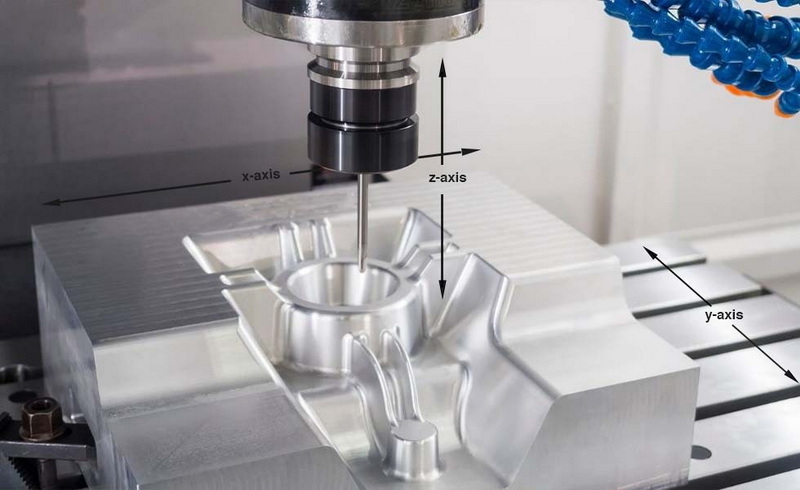
In CNC (Computer Numerical Control) machining, an axis represents a direction or rotation in which the cutting tool or the workpiece can move. Each axis offers a line or rotational movement that influences how the machine can access and shape the material. The more axes a machine has, the more complex and precise its machining operations can be.
For example, a 3-axis machine can move a tool along three linear directions – X, Y, and Z. In contrast, machines with additional axes introduce rotations (typically called A, B, or C axes) that allow for multi-sided machining without repositioning the workpiece.
Axes are fundamental to defining a CNC machine's capabilities and directly reflect the complexity of tasks it can achieve in one setup.
The 3-axis CNC milling machine is the most common type found in workshops worldwide. It operates along three linear axes:
- X-axis – moves left to right
- Y-axis – moves front to back
- Z-axis – moves up and down
These three movements allow the machine to cut a wide variety of materials including metals, plastics, and composites. 3-axis machines are ideal for flat or shallow contoured parts such as plates, brackets, and housings.
However, a 3-axis system cannot efficiently reach complex geometries or angled surfaces without manual repositioning, which increases production time and introduces potential alignment errors.
Advantages of 3-axis CNC milling machines:
- Simple operation and programming
- Cost-effective for parts with basic contours
- Widely available with low maintenance needs
- Suitable for many mechanical and industrial applications
Despite their limitations, 3-axis systems dominate entry-level CNC production due to their reliability and cost efficiency.
The 4-axis CNC milling machine adds a rotational axis—commonly called the A-axis—typically rotating the workpiece around the X-axis. This added rotation allows the cutting tool to approach the material from different angles without manual repositioning.
This configuration is particularly useful for machining cylindrical parts, cams, helical shapes, and other complex contours.
Typical features of 4-axis CNC milling:
- Fixed cutting tool moves along X, Y, Z axes
- Workpiece rotates around one additional rotational axis (A-axis)
- Enables access to multiple sides of a part in a single setup
4-axis machining significantly enhances efficiency and precision by reducing downtime between setups and enabling the machining of angled or curved features otherwise impossible with 3-axis machines.
Main benefits:
- Improved consistency and part repeatability
- Enhanced production speed for cylindrical or angled surfaces
- Better precision due to reduced manual repositioning
However, within a single setup, only one rotational axis can usually be used, so all angled features must be aligned accordingly or require additional fixture setups.
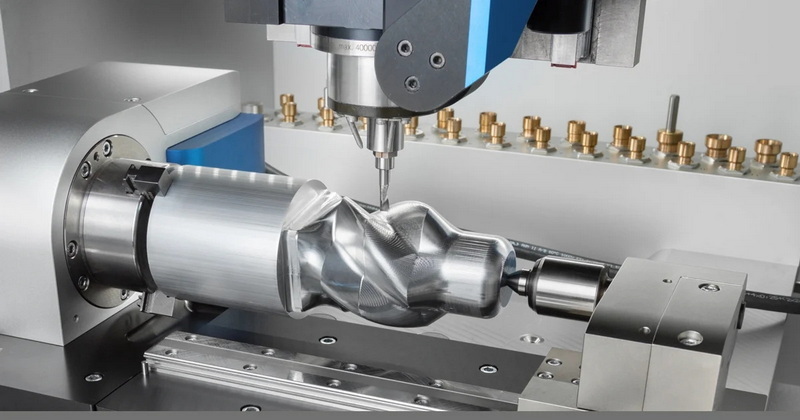
The 5-axis CNC milling machine offers the ability to move a cutting tool or workpiece in five different axes—three linear (X, Y, Z) and two rotational (commonly A and B or A and C). This allows the tool to tilt and rotate simultaneously, virtually reaching any surface orientation.
Axes in a standard 5-axis system:
- X-axis: left to right
- Y-axis: front to back
- Z-axis: up and down
- A-axis: rotation around X-axis
- B-axis (or C-axis): rotation around Y-axis or Z-axis
5-axis machining enables complex part geometries with undercuts, deep cavities, and precise compound angles to be machined in a single setup without removing or repositioning the workpiece.
Key advantages:
- Cuts complex 3D shapes in one setup
- Minimizes setup time and potential errors
- Improves surface finish with smoother tool paths
- Increases manufacturing efficiency and tightens tolerances
5-axis CNC machines are widely used in aerospace, automotive, medical device manufacturing, and mold making, where precision and complex geometries are critical.
Technical notes:
- 3+2 Axis machining refers to positioning the two rotary axes independently (non-simultaneous rotation), enabling complex 3D shapes to be machined but without simultaneous rotation during cutting.
- Fully simultaneous 5-axis CNC machines rotate two axes while the cutting tool moves in X, Y, Z concurrently, increasing complexity and precision.
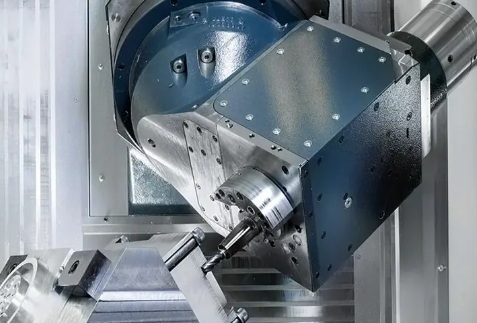
Beyond 5-axis, CNC milling machines with 6 or more axes are available, mainly in specialized industrial applications.
Typical configurations include:
- 6-axis CNC machines with three linear axes (X, Y, Z) plus three rotational axes (A, B, C) for full spatial control.
- 7-axis and 9-axis machines that integrate milling with turning or robotic arms allow for greater flexibility and higher automation.
These systems enable:
- Ultra-precise multi-directional machining
- Reduced cycle times for highly complex parts
- Ability to machine intricate features without multiple setups
They are often used in high-tech aerospace, defense, medical implants, and mold industries where high volume and tight tolerances justify the investment.
| CNC Type | Axes of Movement | Description | Applications |
|---|---|---|---|
| 3-Axis | X, Y, Z | Basic linear movement | Flat or simple parts |
| 4-Axis | X, Y, Z, A | Adds rotation around X-axis | Cylindrical parts, helical shapes |
| 5-Axis | X, Y, Z, A, B (or C) | Dual rotational axes | Complex 3D geometries |
| 6-Axis | X, Y, Z, A, B, C | Full spatial control | Aerospace, medical, molds |
| 9-Axis+ | Multiple combined axes | Milling + turning + robotic arms | Ultra-complex, high-precision parts |
Choosing the appropriate CNC milling machine depends on several factors:
- Part complexity: Simple flat parts suit 3-axis; complex contoured parts require 5-axis or more.
- Production volume: Higher axes machines minimize setup time, ideal for large batches.
- Budget: Advanced multi-axis machines have higher costs but offer long-term productivity gains.
- Operator skill and software: More axes require advanced programming knowledge and CAM software capability.
- Material type and tolerance requirements: Harder materials and tighter tolerances benefit from multi-axis capabilities.
Investing in higher-axis machines enhances versatility but must align strategically with manufacturing goals.
The axes capability directly impacts the industries and parts CNC machines serve:
- Aerospace: turbine blades, structural housings, complex engine parts
- Medical: orthopedic implants, dental prosthetics
- Automotive: engine blocks, transmission parts, chassis components
- Electronics: heat sinks, precision enclosures
- Tool and die making: high-precision molds and dies
Multi-axis CNC milling simplifies machining complicated shapes, reduces tooling changes, and increases quality control, driving advances across modern manufacturing sectors.
Industry advancements continue to expand CNC milling capabilities:
- AI-driven tool path optimization for smoother and faster multi-axis motion
- Hybrid machines combining additive (3D printing) and subtractive (milling) processes
- Digital twin technology predicting machining performance and errors
- Robotic integrations expanding beyond traditional axis constraints
These innovations push multi-axis CNC milling to higher levels of automation, efficiency, and precision.
In summary, the number of axes in a CNC milling machine defines its movement capabilities and machining complexity. While 3-axis machines are sufficient for basic operations, 4-axis and 5-axis provide improved efficiency and the ability to machine complex geometries. Advanced 6-axis and multi-axis systems allow ultra-precise machining for demanding industries. Choosing the right configuration depends on production needs, part geometry, budget, and skill level.
3-axis milling involves 3 linear movements along X, Y, and Z axes. 5-axis machines add two rotational axes allowing the tool or workpiece to move in multiple angles simultaneously, enabling more complex shapes in a single setup.
Yes. 4-axis machines offer more flexibility than 3-axis at a reasonable cost, allowing small manufacturers to machine cylindrical and angled parts without extensive setups.
Aerospace parts require machining of complex geometries with high precision. 5-axis CNC machines reduce the need for multiple setups and improve dimensional accuracy, essential for aerospace components.
3-axis machines are less expensive upfront but may increase labor costs due to multiple setups. 5-axis machines have higher initial costs but reduce cycle times and improve part quality.
Additional axes allow the cutting tool to maintain optimal orientation, reducing tool wear and improving surface finish. It minimizes manual part repositioning, reducing errors and improving tolerance consistency.
[1](https://www.cloudnc.com/blog/cnc-best-practices-3-whats-the-difference-between-3-axis-4-axis-5-axis-milling)
[2](https://www.ycmalliance.com/the-differences-between-3-axis-and-5-axis-cnc-machining/)
[3](https://www.advancecnc.com/5-4-3-axis-cnc-milling-machines/)
[4](https://www.youtube.com/watch?v=cexZ7ec_Tmk)
[5](https://www.fictiv.com/articles/3-axis-to-12-axis-cnc-milling-machine-capabilities-compared)
[6](https://www.datron.com/resources/blog/difference-between-3-axis-4-axis-and-5-axis-milling/)
[7](https://www.scan2cad.com/blog/cnc/cnc-machine-axis/)
[8](https://hlhrapid.com/blog/3-axis-to-12-axis-comparing-different-cnc-milling-machines/)
[9](https://5-axis.org/machine-configurations-and-styles/)
[10](https://rapidaxis.com/blog/the-differences-between-simultaneous-5-axis-and-32-axis-machining/)


