From idea to market-ready product, our NPI solutions make every stage easier, faster. Discover How We Help

Views: 222 Author: Tomorrow Publish Time: 2026-01-18 Origin: Site


Content Menu
● CNC Machining vs. 3D Printing: A Detailed Comparison
>> Material Utilization and Waste
>> Accuracy, Surface Finish, and Tolerances
>> Production Speed and Scalability
>> Cost Efficiency and Economies of Scale
● Comparative Applications Across Industries
>> 3D Printing
● Material Compatibility in Depth
● Environmental Impact and Sustainability
● Technological Trends and Future Outlook
● Choosing the Right Technology
● FAQ
>> 1. What is the key difference between CNC machining and 3D printing?
>> 2. Which method provides better surface quality?
>> 3. Is 3D printing more environmentally friendly than CNC machining?
>> 4. Can 3D printing fully replace CNC machining?
>> 5. How can businesses benefit from combining both methods?
The rise of digital manufacturing has transformed how industries design, prototype, and produce components. Two of the most important technologies driving this transformation are CNC machining and 3D printing, both of which have become essential tools in modern manufacturing. While their goals are similar—creating precise and functional parts—their processes are fundamentally different. Understanding how CNC machining compares to 3D printing can help engineers, designers, and manufacturers choose the optimal method based on design complexity, material type, cost, and production volume.
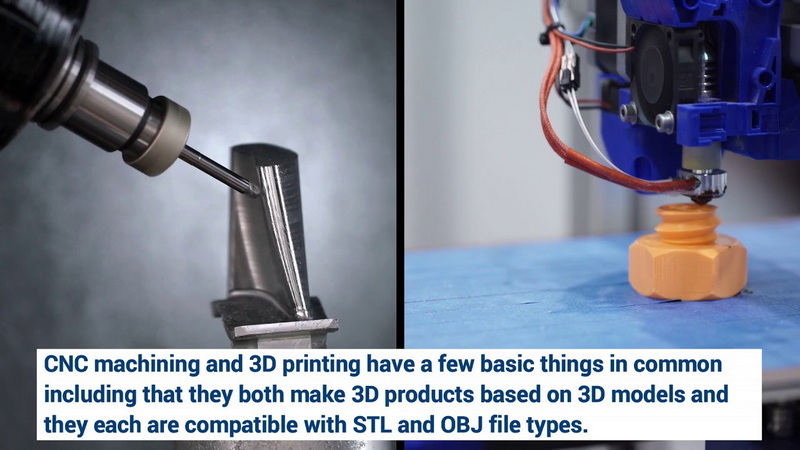
CNC machining is a subtractive manufacturing process that starts with a solid piece of material and removes excess using cutting tools controlled by computer instructions. The CNC machine translates a digital design (CAM or CAD file) into precise tool movements that sculpt the final product. Because the process is highly controlled, it ensures consistency, repeatability, and exceptional accuracy across multiple parts.
CNC machining includes various operations such as milling, turning, drilling, and grinding. Depending on the design, these processes can be combined within a single setup for high efficiency. This versatility makes CNC machining a cornerstone of industries that demand tight tolerances and superior surface finishes—such as aerospace, medical device manufacturing, and automotive engineering.
Another key advantage of CNC machining lies in its compatibility with a wide spectrum of engineering-grade materials. These include metals like aluminum, stainless steel, titanium, and brass, as well as plastics like PEEK, nylon, and ABS. Thus, CNC machining is often used when strength, rigidity, and reliability are paramount.
3D printing, or additive manufacturing, fabricates objects by depositing material layer upon layer following a digital 3D model. Instead of cutting from a solid block like CNC does, 3D printing adds material selectively—making it both resource-efficient and design-flexible.
There are several methods of 3D printing, including FDM (Fused Deposition Modeling), SLA (Stereolithography), SLS (Selective Laser Sintering), and SLM (Selective Laser Melting). Each uses different materials and energy sources to fuse or solidify material layers. These variations give engineers broad design capabilities across applications ranging from disposable prototypes to end-use functional parts.
3D printing is particularly valued for rapid prototyping. Designers can iterate new product concepts, test ergonomics, and validate functionality within hours instead of weeks. It also enables mass customization, such as patient-specific medical implants or lightweight structural parts with unique internal patterns.
The differences between CNC machining and 3D printing go beyond their methods of material formation. They diverge in precision, efficiency, scalability, cost, and post-processing requirements. Here's a deeper look at these key aspects.
CNC machining is subtractive, which inherently generates material waste. Each part requires cutting away significant portions from a solid workpiece. However, these offcuts can sometimes be recycled, depending on the material. The advantage lies in the strength and consistency of the final component—machined materials maintain their structural density because they are derived from uniform stock.
3D printing, being additive, minimizes waste as it only uses material where needed. This makes it an eco-friendlier solution for low-volume production or experimental designs. Nevertheless, some 3D printing processes generate support structures that must be removed, slightly offsetting the waste advantage.
CNC machining remains unmatched in dimensional accuracy. It can achieve tolerances as tight as ±0.005 mm, critical for intricate components like aerospace engine housings or precision surgical tools. The resulting surface finish from CNC machining is also superior, often requiring little or no polishing.
3D printing, while improving quickly, still faces challenges in achieving the same level of tolerance. The layer-by-layer method can leave visible ridges or texture variations that require additional post-processing such as sanding, vapor smoothing, or polishing. For aesthetic prototypes, these treatments are acceptable, but for load-bearing mechanical parts, CNC machining maintains the edge.
Production speed depends greatly on the volume and design complexity. For short-run, high-complexity parts, 3D printing is faster because there are no setup or tooling stages. A digital model can be printed directly after slicing and preparation.
CNC machining has a longer setup time due to toolpath programming, calibration, and fixture design. However, once the setup is complete, CNC machines produce parts at a much faster rate with consistent accuracy—making them ideal for medium to large-scale production runs. In contrast, scaling 3D printing may require multiple printers or longer continuous operation, which slows down throughput.
CNC machining involves higher initial costs due to machine setup, tooling, and material waste. Yet as production volume increases, the cost per piece decreases significantly. This is why CNC machining dominates in high-volume manufacturing, such as automotive component production.
3D printing offers a more predictable cost structure. The absence of tooling and minimal labor involvement make it cost-effective for low-volume orders, unique parts, and prototypes. The per-unit cost remains relatively consistent across quantities, which can be a limitation for mass manufacturing.
3D printing thrives on complexity. Since it builds layer by layer, design constraints tied to tooling access do not exist. Engineers can create organic shapes, lattice structures, and hollow geometries impossible to machine with traditional tools. This design freedom fosters innovation in lightweight design, cooling channels, and ergonomic product development.
CNC machining, on the other hand, is limited by tool accessibility. Deep internal cavities and undercuts are challenging to reach, often requiring special fixtures or multi-axis machines. However, with 5-axis CNC machining, designers can achieve advanced contours once considered impractical, narrowing the gap between the two processes.

The practical applications of CNC machining and 3D printing vary significantly depending on the industry and product lifecycle stage.
- Aerospace: Precision turbine blades, housings, and structural brackets.
- Automotive: Engine heads, suspension components, molds, and fixtures.
- Medical: Surgical tools, orthopedic implants, and prosthetics.
- Industrial manufacturing: Jigs, molds, and custom tooling components that demand durability.
- Product design: Concept models, ergonomic samples, and rapid prototypes.
- Healthcare: Custom prosthetics, dental aligners, and biocompatible implants.
- Aerospace and defense: Lightweight structural parts, ducts, and topology-optimized assemblies.
- Consumer goods: Customized eyewear frames, phone cases, and wearable accessories.
Increasingly, companies use hybrid workflows—printing a prototype to check form and function, then using CNC machining for the final part requiring mechanical integrity.
CNC machining supports nearly all machinable metals and plastics. Common choices include:
- Metals: Aluminum 6061, stainless steel 304/316, brass, copper, titanium, and steel alloys.
- Plastics: ABS, POM (Delrin), nylon, polycarbonate, PEEK, and acrylic.
3D printing materials vary depending on the process:
- FDM: PLA, PETG, ABS, and carbon-fiber-reinforced filaments.
- SLA: Photopolymer resins for high-detail parts.
- SLS: Nylon powders and TPU for flexible components.
- Metal printing (SLM/DMLS): Aluminum, titanium, Inconel, and stainless steel powders fused by laser energy.
However, machined parts often surpass 3D-printed ones in mechanical strength and thermal resistance due to their isotropic structure. In contrast, 3D-printed parts can show anisotropic behavior, meaning strength differs depending on the orientation of printed layers.
CNC machining traditionally creates more waste. The chips generated from milling or turning must be collected and recycled. Some modern facilities reduce environmental impact by using closed-loop coolant systems and scrap recovery programs.
3D printing minimizes waste by adding material only where necessary. Moreover, eco-friendly initiatives are advancing the use of biopolymers and recyclable filaments. However, 3D printing has its own environmental challenges, such as high energy consumption in metal sintering and emission of volatile organic compounds during polymer printing.
In sustainability-focused contexts, combining the two technologies can yield strong results—for example, printing a near-net-shape preform and finishing it with CNC machining to achieve perfect tolerances while reducing raw material consumption.
Both CNC machining and 3D printing are evolving rapidly due to automation, AI-based optimization, and smart manufacturing systems.
CNC machines are becoming more intelligent, integrating real-time monitoring and predictive maintenance to reduce downtime. Multi-axis capabilities and robotic tool changers are also expanding what machinists can achieve.
3D printing is progressing toward industrial-scale production with innovations in material science and faster multi-laser printing systems. Composite 3D printing now combines plastics with reinforcing fibers, bridging the gap toward CNC-level mechanical performance.
In future manufacturing ecosystems, hybrid machines blending subtractive and additive functions are likely to become mainstream. These systems can print rough parts and immediately machine them to finish tolerances in one automated cycle—combining the best of both worlds.
Selecting between CNC machining and 3D printing depends on a project's requirements. Below are key decision-making factors:
| Factor | CNC Machining | 3D Printing |
|---|---|---|
| Manufacturing Type | Subtractive | Additive |
| Material Range | Broad (metals & plastics) | Moderate (plastics, resins, powders) |
| Tolerance & Accuracy | Very high | Moderate to high |
| Setup Cost | High (tooling, fixturing) | Low |
| Ideal Production Volume | Medium to large | Low to medium |
| Surface Finish | Smooth and precise | Requires post-processing |
| Design Flexibility | Limited | Very high |
| Environmental Impact | Generates waste | Less waste, more energy use |
Understanding this table helps businesses align manufacturing methods to goals—whether rapid prototyping, cost reduction, sustainability, or large-scale output.
Both CNC machining and 3D printing offer unique advantages that make them indispensable in modern manufacturing. CNC machining sets the benchmark for precision, durability, and scalability, ideal for industries where every micron matters. In contrast, 3D printing revolutionizes design freedom and rapid iteration, empowering innovation through customization and sustainability.
Rather than viewing them as competitors, manufacturers increasingly see CNC and 3D printing as complementary technologies—each addressing different stages of production. As materials and machines continue to advance, integrating both methods will redefine how products move from concept to reality, balancing creativity with precision and speed.
Contact us to get more information!
CNC machining removes material from a block (subtractive), while 3D printing builds material layer by layer (additive). This affects accuracy, waste, and production style.
CNC machining offers smoother finishes with tighter tolerances. 3D printed parts often need post-processing to achieve similar surface quality.
Generally yes, since 3D printing produces less material waste. However, some printing methods consume more energy, which can offset ecological benefits.
Not yet. While 3D printing is excellent for prototypes and small batches, CNC machining remains superior for high-strength, high-volume, and precision parts.
Companies can print prototypes for testing and later use CNC machining for final production, optimizing both time and quality throughout the product lifecycle.
1. https://www.autodesk.com/solutions/cnc-machining
2. https://www.autodesk.com/solutions/3d-printing
3. https://www.makepartsfast.com/cnc-machining-vs-3d-printing
4. https://www.engineering.com/story/how-cnc-and-3d-printing-complement-each-other
5. https://formlabs.com/blog/cnc-machining-vs-3d-printing
6. https://www.protolabs.com/resources/blog/additive-vs-subtractive-manufacturing


