From idea to market-ready product, our NPI solutions make every stage easier, faster. Discover How We Help

Views: 222 Author: Tomorrow Publish Time: 2025-12-05 Origin: Site


Content Menu
● Does Walmart Offer 3D Printing Services in Stores?
● Walmart's Use of 3D Printing in Supply Chain and Construction
>> Store Expansions with 3D Concrete Printing
>> Prototyping, Maintenance, and Logistics
● Alternatives to Walmart for 3D Printing Services
>> Home and Industrial Solutions
● How Walmart Could Expand 3D Printing for Customers
>> Personalized Retail Products
>> In-Store Hubs and Micro-Factories
>> Sustainability and Speed Advantages
● Benefits and Limitations of 3D Printing
>> Key Benefits
● FAQ
>> 1. Does Walmart sell 3D printers?
>> 2. Can I get 3D prints made at Walmart?
>> 3. What 3D printing projects has Walmart completed?
>> 4. Are there plans for Walmart 3D printing kiosks?
>> 5. Why does Walmart use 3D printing in construction?
3D printing has revolutionized manufacturing, product design, and personal creativity over the past decade. Retailers increasingly explore additive manufacturing to deliver custom products faster and at lower costs. Walmart, as one of the world's largest retail chains, prompts many customers to ask if it offers 3D printing services. This article examines Walmart's current involvement with 3D printing, its internal applications, customer alternatives, and future possibilities.[1][2]

3D printing, or additive manufacturing, creates three-dimensional objects layer by layer from digital designs. It employs materials like plastic, resin, metal, and food-grade substances based on the application. Unlike subtractive traditional methods that cut or mold materials, 3D printing builds additively, excelling in prototyping and small-batch production.[1]
Aerospace, healthcare, automotive, and fashion industries depend on 3D printing for design flexibility, rapid prototyping, and cost savings. Consumers now use affordable home printers for toys, tools, or replacement parts. Recent advancements include large-scale concrete 3D printing for construction, expanding its scope beyond small objects.[5][6]
Walmart does not provide direct 3D printing or custom design services to customers in its retail stores. The company has tested 3D printing internally for logistics and manufacturing but lacks public-facing kiosks or onsite printing options.[2][1]
Past explorations included in-store 3D scanning and custom product partnerships, yet these did not scale nationwide. Walmart prioritizes mass production, online sales, and e-commerce fulfillment over customization suited to 3D printing. Customers seeking prints must look elsewhere, though Walmart sells 3D printers and filaments online and in stores.[3]
Walmart integrates 3D printing extensively behind the scenes, particularly in construction and operations, marking a shift toward large-scale adoption.[4][1]
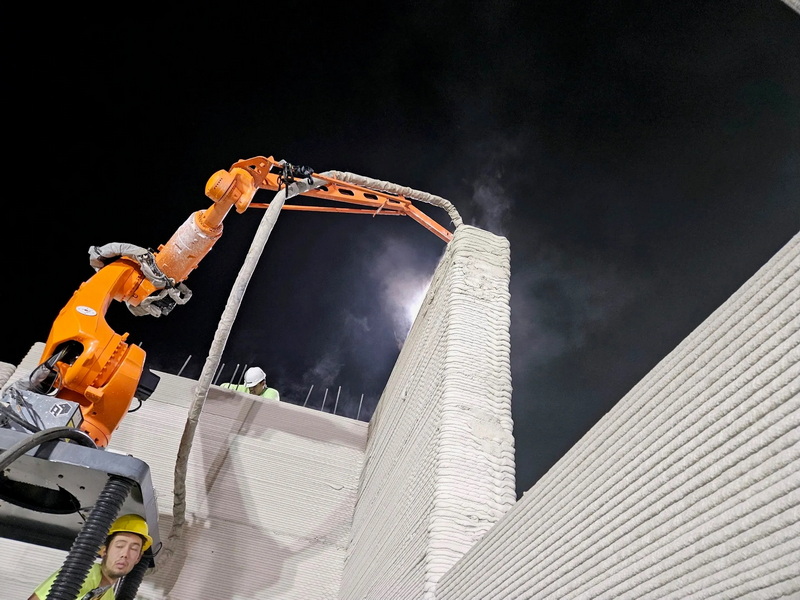
Walmart partnered with Alquist 3D to complete major store expansions using concrete 3D printing. In 2024, Alquist printed an 8,000-square-foot expansion at the Athens, Tennessee store in ten days, creating one of the largest free-standing commercial concrete structures. This space supports Walmart's Online Pickup & Delivery program.[5]
In 2025, a 5,000-square-foot expansion at the Owens Cross Roads, Alabama Supercenter followed. A five-person team with two Alquist systems printed 16-foot-high walls in 75 hours over seven days, cutting construction time by 50%, reducing costs by 15%, and minimizing waste by 55% compared to traditional methods. Walls proved three times stronger than standard concrete masonry units.[6][2]
Most recently, Walmart announced over a dozen more 3D-printed projects nationwide with Alquist, Hugg & Hall, and FMGI. The first under this model starts December 2025 at the Lamar, Missouri store, applying robotic A1X printers for structural walls and infrastructure. This represents the largest commercial deployment of 3D construction printing in U.S. history.[7][3][4][1]
Beyond construction, Walmart uses 3D printing for rapid product prototyping, avoiding delays from traditional molds. It produces replacement parts for shelving, machinery, and logistics robots across thousands of facilities, cutting downtime.[1]
Custom packaging prototypes and tool fixtures further enhance efficiency. These applications align with Walmart's sustainability goals by reducing material waste and enabling on-demand production.[2][4]
Numerous options exist for customer-facing 3D printing needs.
Shapeways, Sculpteo, and Treatstock let users upload designs, select materials, and receive mailed prints. These suit hobbyists and professionals requiring precision without equipment ownership.[1]
Makerspaces and Fab Labs offer community access to printers, workshops, and design help. Staples and UPS stores provide services at select locations, accepting STL files for onsite printing.[3]
Affordable desktop printers from Creality, Anycubic, and Prusa serve frequent users, paired with free software like Blender or Tinkercad. Industrial bureaus handle metal, resin, and high-volume jobs with CNC finishing.[5]
Walmart's construction successes position it for broader retail integration.
Future in-app or website tools could enable custom phone cases, toys, or home goods printed onsite or shipped. This taps growing demand for personalization.[6]
Photo kiosk-style 3D stations might allow uploads and same-day pickup. With over 4,000 U.S. stores, localized printing reduces shipping and boosts responsiveness.[7]
3D printing's low waste supports Walmart's eco-initiatives. Construction pilots demonstrate 50% faster builds and greener processes, scalable to consumer products.[4][2]
- Enables full customization and complex geometries.
- Accelerates prototyping and low-volume runs.
- Cuts material waste significantly.
- Supports on-demand production.
- Facilitates quick repairs.[2][1]
- Slower for high-volume than injection molding.
- Material choices lag for mass retail.
- Demands design expertise and post-processing.
- Per-unit costs remain higher at scale.[4]
Walmart's cautious approach reflects these factors, focusing first on internal efficiencies.
Walmart does not offer 3D printing services to customers in stores or online. However, it leads in industrial applications, completing major 3D-printed store expansions in Tennessee and Alabama, with over a dozen more projects planned through 2025 partnerships with Alquist. These efforts highlight faster, cheaper, and greener construction. Customers can turn to online platforms, makerspaces, or buy printers from Walmart itself. As technology matures, Walmart may extend 3D printing to personalized retail, enhancing its model.[3][7][2][4][5][1]
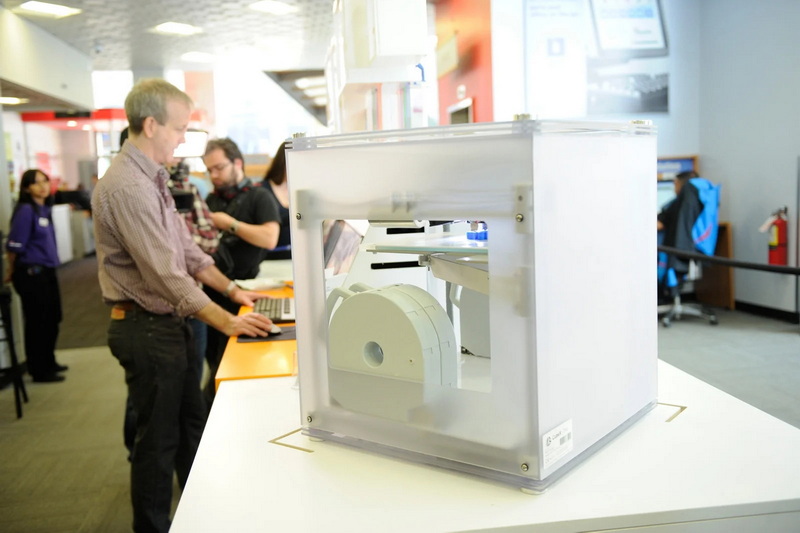
Yes, Walmart stocks 3D printers from Creality and Anycubic online and in stores for personal use, though not as part of a printing service.[3]
No, Walmart lacks customer 3D printing services, focusing instead on internal construction and supply chain uses.[1]
Walmart finished 8,000 sq ft expansions in Athens, TN (2024) and Owens Cross Roads, AL (2025), with more starting in Lamar, MO.[7][2][5]
No official plans exist, but construction successes suggest potential for future in-store customization hubs.[4]
It cuts build times by 50%, costs by 15%, waste by 55%, and produces stronger structures via partners like Alquist.[6][2][1]
[1](https://www.constructiondive.com/news/walmart-3d-print-alquist-retailers/806851/)
[2](https://www.businesswire.com/news/home/20250507123352/en/Walmart-and-Alquist-Complete-3D-Concrete-Printed-Expansion-Of-Alabama-Supercenter)
[3](https://hexaconstruction.media/article/31139-walmart-other-retailers-to-3d-print-more-than-12-projects)
[4](https://www.prnewswire.com/news-releases/alquist-to-scale-3d-print-construction-technology-via-walmart-and-other-commercial-retail-projects-in-2026-302623710.html)
[5](https://www.voxelmatters.com/walmart-3d-prints-8000-square-foot-building-addition-in-tennessee/)
[6](https://www.thecooldown.com/green-tech/walmart-3d-printing-expansion-construction/)
[7](https://industryradar.com/international/walmart-scales-up-3d-printed-construction/)
[8](https://3dprintingindustry.com/news/alquist-expands-3d-construction-printing-across-the-u-s-with-walmart-partnership-246733/)
[9](https://3druck.com/en/case-studies/alquist-scales-3d-printing-walmart-focuses-on-printed-retail-space-15151796/)
[10](https://www.youtube.com/watch?v=nia2pqYrXdQ)


