From idea to market-ready product, our NPI solutions make every stage easier, faster. Discover How We Help

This article explains anodising vs electroplating for CNC precision parts in clear buyer-focused language. It compares performance, appearance, material compatibility, and cost, then helps OEM/ODM buyers choose the right finish for durability, branding, and production success.
This article explains the key CNC part design rules that improve manufacturability, reduce cost, and support tighter tolerances for OEM and ODM projects. It expands on standard DFM advice with practical guidance on wall thickness, radii, tolerances, setup reduction, and buyer-focused production strategy.
This article explains 10 expert CAD design tips for CNC machining, with practical DFM guidance, ISO tolerance strategy, GD&T usage, and finishing considerations. It is written for OEM/ODM buyers and engineers who want better manufacturability, lower cost, and more reliable CNC parts.
Spotface and counterbore holes are small machining features with a major impact on assembly quality, fastener seating, and product reliability. This guide explains the differences, symbols, applications, tolerances, and CNC best practices for OEM and ODM manufacturing.
CNC Milling vs. EDM is a practical buyer’s guide for precision parts sourcing. It compares speed, cost, tolerances, surface finish, material limits, and 2026 trends, then shows when OEM and ODM buyers should choose CNC, EDM, or a hybrid process for better quality and lower total cost.
This article compares climb milling and conventional milling from a practical CNC manufacturing perspective, focusing on tool life, surface finish, and production efficiency. It explains when each method is best, how OEM suppliers can improve consistency, and why modern factories usually prefer climb milling for precision parts.
CNC Milling vs. Manual Milling is a critical comparison for precision manufacturing buyers. This article explains why automation improves repeatability, tight tolerances, and production scalability, with OEM and ODM insights from a Shenzhen CNC parts manufacturer.
This article compares 3-axis and 5-axis CNC milling from a cost-versus-complexity perspective for OEM/ODM buyers and engineers. It explains machine capability, hidden costs, tolerance control, and practical selection logic, helping readers choose the most economical process without sacrificing quality or precision.
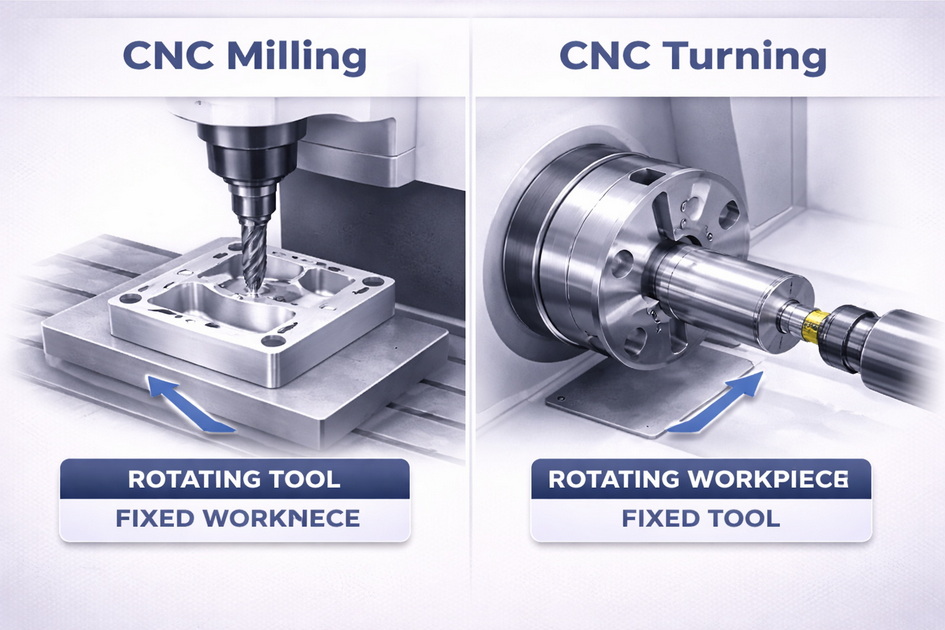
CNC milling and CNC turning are two core precision machining processes, but they solve different manufacturing problems. This article explains when to choose each method, with OEM/ODM insights, current industry trends, and practical decision rules for better quality, cost, and lead time.