From idea to market-ready product, our NPI solutions make every stage easier, faster. Discover How We Help

Tempering Services

Welcome to FLYcncpart's tempering service! Through precise temperature control, we improve part toughness and fracture resistance. Our Shenzhen team ensures a stable process to meet your needs.
Processing Overview
Description: Tempering is performed by heating the quenched steel to 150-650°C, holding for 1-2 hours, and then air cooling to reduce the hardness (HV 200-600) and optimize toughness. The process involves preheating, holding at a constant temperature, and slow cooling, taking 1-3 hours.

Applicable Materials: Carbon and alloy steels after quenching.

Visual Appearance: The surface may have a light blue or golden hue (oxide layer) with no noticeable grain.
Advantage
  • Improved toughness: Reduces brittleness and enhances impact resistance.
  • Stress relief: Eliminates quenching residual stresses and prevents cracking.
  • Hardness adjustment: Controls the temperature between 150-650°C to achieve the desired hardness range.
  • Dimensional stability: Minimal variation maintains tolerances.
  • Improved durability: Balances hardness and ductility for extended life.
  • Economical: Simple process, suitable for mass production.


Precautions
  • Temperature Control: 150-650°C (higher temperatures reduce hardness); test material response.
  • Cooling Rate: Air cool to avoid quenching effects; test for uniformity.
  • Surface Protection: Use a protective atmosphere to prevent oxidation; check color.
  • Design Considerations: Ensure uniform wall thickness and avoid heat-sensitive areas.
  • Quality Standards: Comply with ASTM E10; check hardness and toughness.
  • Safety Measures: Protect against high-temperature operation and control exhaust gases.
CNC Turning Resources
  • Precision Vs Accuracy in CNC Machining: A Practical Guide for OEM And ODM Buyers

    2026-04-19

    Learn the real difference between precision and accuracy in CNC machining, how they affect tolerances, cost, and reliability, and what OEM/ODM buyers should demand from machining partners to protect quality and supply chain performance. Read More
  • CNC Milling Vs. Manual Milling: Why Automation Matters for Precision

    2026-04-22

    CNC Milling vs. Manual Milling is a critical comparison for precision manufacturing buyers. This article explains why automation improves repeatability, tight tolerances, and production scalability, with OEM and ODM insights from a Shenzhen CNC parts manufacturer. Read More
  • Anodizing Vs Powder Coating for CNC Aluminum Parts: How I Help Overseas Customers Choose The Right Finish

    2026-04-10

    Learn how to choose between anodizing and powder coating for CNC aluminum and metal parts. This expert guide explains processes, performance, costs, and real OEM use cases to help engineers and buyers make reliable, long‑term finishing decisions with their manufacturing partners. Read More
  • Alloy Steel Vs Stainless Steel: How I Help CNC Buyers Choose The Right Material

    2026-04-09

    Discover how to choose between alloy steel and stainless steel for precision CNC machining. Learn key differences in strength, corrosion resistance, machinability, cost, and real‑world applications, plus an expert decision framework from a China‑based OEM supplier. Read More
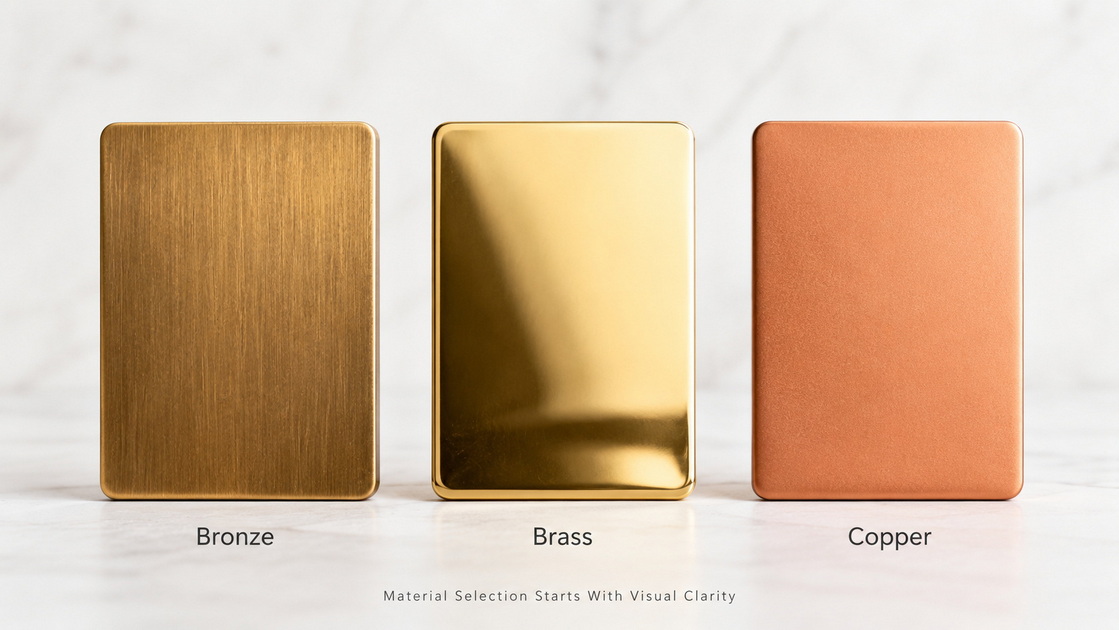
  • Bronze Vs Brass Vs Copper for CNC Machining: How I Actually Choose for Real Projects

    2026-04-12

    Compare bronze vs brass vs copper for CNC machining with a practical, engineer‑level guide. Learn properties, machinability, applications, and OEM/ODM sourcing tips so you can choose the right metal for your next precision parts project. Read More

FAQ

Feel free to consult us 
at any time
  +86-13554857217
  +86-13554857217
  No.7 Lougang Avenue, Lougang Community, Songgang Street, Bao'an District, Shenzhen City

CAPABILITIES

RESOURCES

CONTACT US
Copyright © Shenzhen Feifan Hardware & Electronics Co., Ltd. All rights reserved
We use cookies to enable all functionalities for best performance during your visit and to improve our services by giving us some insight into how the website is being used. Continued use of our website without having changed your browser settings confirms your acceptance of these cookies. For details please see our privacy policy.
×