From idea to market-ready product, our NPI solutions make every stage easier, faster. Discover How We Help

Gold Plating Services

Welcome to FLYcncpart's gold plating service! Gold plating is a high-end electroplating process that offers superior conductivity and oxidation resistance, widely used in electronic and medical devices. Our Shenzhen team ensures precise processes, helping you achieve highly reliable parts.
Processing Overview
Description: Gold plating is an electroplating process that deposits a layer of pure gold or gold alloy onto a substrate surface through electrolysis. The thickness is typically 0.5-5μm. Gold plating can be categorized as soft gold (pure gold) or hard gold (gold-cobalt alloy). The process includes pre-plating with a base layer (e.g., nickel), electroplating, and post-processing (cleaning and drying) to ensure layer purity and adhesion.

Applicable Materials: Copper, silver, stainless steel, titanium, and their alloys, as well as electronic substrates (e.g., circuit boards).

Visual Appearance: Golden or rose gold tones, with a high-gloss mirror or matte finish, enhance the premium feel.
Advantage
  • Excellent conductivity and contact performance: The gold layer has a low resistance (<0.05Ω), making it suitable for high-frequency electronic connectors and reducing signal loss. Strong Oxidation and Corrosion Resistance: Stable in humid and chemical environments, resists discoloration, and lasts for decades.
  • High Biocompatibility: Non-toxic and hypoallergenic, it's ideal for medical devices such as implants and probes.
  • Aesthetics and Decorative Features: Provides a luxurious gold appearance for use in jewelry or high-end consumer goods, enhancing product value.
  • Excellent Weldability: Easy to solder or braze, suitable for precision assembly.
  • Thickness Flexibility: Precise thickness control allows for a balance between cost and performance; environmentally friendly processes reduce the difficulty of gold scrap recycling.
Precautions
  • Cost Control: Gold plating is expensive, so optimize thickness to avoid waste; test a base layer (such as nickel) to prevent diffusion.
  • Substrate Preparation: Surfaces must be highly clean, and a pre-plated base layer should be applied to prevent gold flaking; avoid materials susceptible to hydrogen embrittlement.
  • Environmental Adaptability: Suitable for indoor or mild environments, tested for stability at high temperatures (>200°C).
  • Design Considerations: Parts should be designed for easy plating, avoiding deep grooves; shielding should be planned to protect non-plated areas. Quality Standards: Complies with MIL-G-45204 or ASTM B488 standards, testing for thickness, purity, and adhesion.
  • Safety Measures: Protective equipment is used during processing, and waste fluids are recycled to comply with environmental regulations.
 
CNC Turning Resources
  • Precision Vs Accuracy in CNC Machining: A Practical Guide for OEM And ODM Buyers

    2026-04-19

    Learn the real difference between precision and accuracy in CNC machining, how they affect tolerances, cost, and reliability, and what OEM/ODM buyers should demand from machining partners to protect quality and supply chain performance. Read More
  • CNC Milling Vs. Manual Milling: Why Automation Matters for Precision

    2026-04-22

    CNC Milling vs. Manual Milling is a critical comparison for precision manufacturing buyers. This article explains why automation improves repeatability, tight tolerances, and production scalability, with OEM and ODM insights from a Shenzhen CNC parts manufacturer. Read More
  • Anodizing Vs Powder Coating for CNC Aluminum Parts: How I Help Overseas Customers Choose The Right Finish

    2026-04-10

    Learn how to choose between anodizing and powder coating for CNC aluminum and metal parts. This expert guide explains processes, performance, costs, and real OEM use cases to help engineers and buyers make reliable, long‑term finishing decisions with their manufacturing partners. Read More
  • Alloy Steel Vs Stainless Steel: How I Help CNC Buyers Choose The Right Material

    2026-04-09

    Discover how to choose between alloy steel and stainless steel for precision CNC machining. Learn key differences in strength, corrosion resistance, machinability, cost, and real‑world applications, plus an expert decision framework from a China‑based OEM supplier. Read More
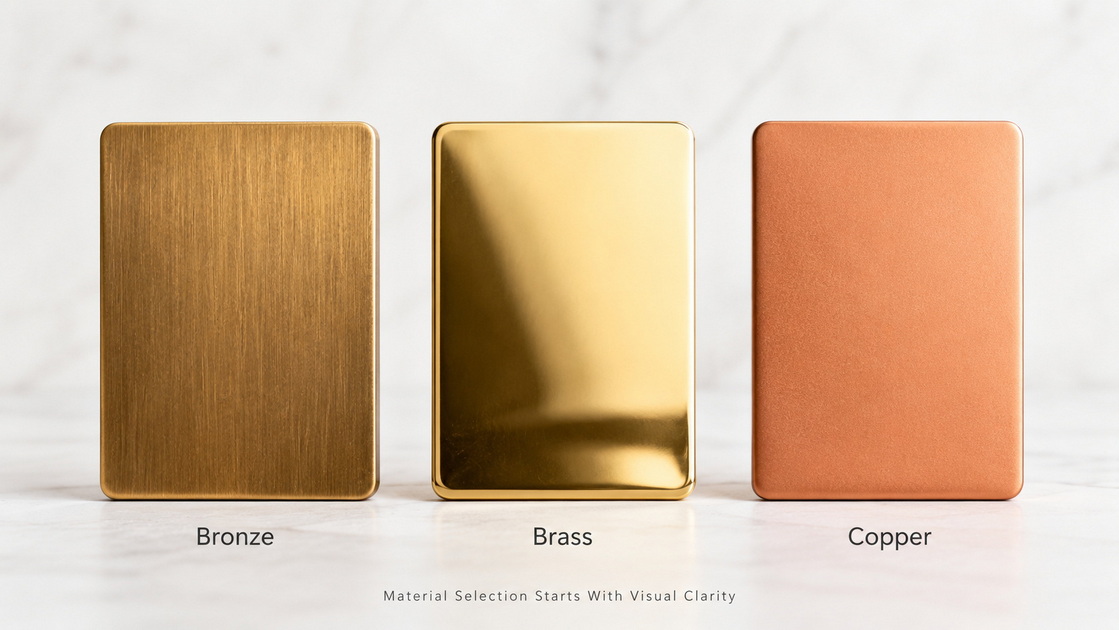
  • Bronze Vs Brass Vs Copper for CNC Machining: How I Actually Choose for Real Projects

    2026-04-12

    Compare bronze vs brass vs copper for CNC machining with a practical, engineer‑level guide. Learn properties, machinability, applications, and OEM/ODM sourcing tips so you can choose the right metal for your next precision parts project. Read More

FAQ

Feel free to consult us 
at any time
  +86-13554857217
  +86-13554857217
  No.7 Lougang Avenue, Lougang Community, Songgang Street, Bao'an District, Shenzhen City

CAPABILITIES

RESOURCES

CONTACT US
Copyright © Shenzhen Feifan Hardware & Electronics Co., Ltd. All rights reserved
We use cookies to enable all functionalities for best performance during your visit and to improve our services by giving us some insight into how the website is being used. Continued use of our website without having changed your browser settings confirms your acceptance of these cookies. For details please see our privacy policy.
×